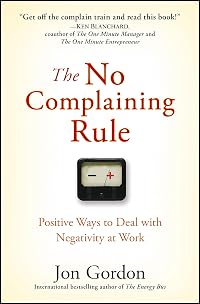
The No Complaining Rule: Positive Ways to Deal with Negativity at Work
by Jon Gordon
On This Page
Description
Negativity in the workplace costs businesses billions of dollars and impacts the morale, productivity and health of individuals and teams. "In The No Complaining Rule: Positive Ways to Deal with Negativity at Work, Jon Gordon, a bestselling author, consultant and speaker, shares an enlightening story that demonstrates how you can conquer negativity and inspire others to adopt a positive attitude." Based on one company's successful No Complaining Rule, the powerful principles and actionable show more plan are practical and easy-to-follow, making this book an ideal read for managers, team leaders and anyone interested in generating positive energy. show lessTags
Recommendations

Member Reviews
The No Complaining Rule could be considered a self-help book. Though the way the information is presented brings it into an entirely new category.
The No Complaining Rule is told as a story. The story of Hope, Vice President of Human Resources at a computer company. The story starts out with Hope going through some person problems, she comes into work to find out the company is also experiencing some problems. Her boss, Dan leaves it up to Hope to help them find their way out of this mess, specifically with employee moral and negativity. Through some encounters with others Hope bases her plan for long term improvement on the No Complaining Rule. She uses this rule for her company but also herself and her family.
Throughout the book we get show more to learn about the No Complaining Rule ourselves and how it works. When I originally heard about this book I was expecting lots of lists, bullet points, and charts. There are hardly any in this book! I really liked the way this information was presented. It was presented in an entertaining way which in the end helps you retain the information much better than a bunch of lists and charts.
This book has made me think a lot about my negativity and complaining. I'll take a short detour and talk about my experiences with complaining. I, personally don't like to complain to people that aren't my family or close to it. I complain to them a lot they already know me, what can i do about it (ask my mother). I think that too much complaining can be seen as a weakness. But on the other hand if someone asks me how I am I'm not going to lie and say "Oh fantastic".
Here are the things I mainly complain about (ask my mother again):
1. I'm tired
2. I'm tired
3. My blank hurts (insert a rotating variety of body parts)
In the book they explain how there are two kinds of complaining, random mindless complaining that has no reason or point, it is done out of boredom and just stresses everyone out. Then there is complaining for an actual reason. It is explained that it is alright to complain but you better come prepared with a way to take action to fix this complaint. It's also pointed out that you should complain to someone that can actually do something about your complaint not just a random bystander.
It is suggested that you take a week to try out the No Complaining Rule, it sort of showcases to you all the negativity you feel and let out of your mouth. It puts a spotlight on it so you can start to control it. It is also explained that once you complain you should add a but to the sentence and add something you are thankful for. For example: I hate getting up at 6am every morning to go to work (I do), but I am thankful that I am able to have a job (I am).
There is definitely a lot of great information presented in this book and it is done in such a way that it's rather exciting! It is great for upper management, managers, regular people, just about anyone!
The No Complaining Rule was released earlier this summer in June. show less
The No Complaining Rule is told as a story. The story of Hope, Vice President of Human Resources at a computer company. The story starts out with Hope going through some person problems, she comes into work to find out the company is also experiencing some problems. Her boss, Dan leaves it up to Hope to help them find their way out of this mess, specifically with employee moral and negativity. Through some encounters with others Hope bases her plan for long term improvement on the No Complaining Rule. She uses this rule for her company but also herself and her family.
Throughout the book we get show more to learn about the No Complaining Rule ourselves and how it works. When I originally heard about this book I was expecting lots of lists, bullet points, and charts. There are hardly any in this book! I really liked the way this information was presented. It was presented in an entertaining way which in the end helps you retain the information much better than a bunch of lists and charts.
This book has made me think a lot about my negativity and complaining. I'll take a short detour and talk about my experiences with complaining. I, personally don't like to complain to people that aren't my family or close to it. I complain to them a lot they already know me, what can i do about it (ask my mother). I think that too much complaining can be seen as a weakness. But on the other hand if someone asks me how I am I'm not going to lie and say "Oh fantastic".
Here are the things I mainly complain about (ask my mother again):
1. I'm tired
2. I'm tired
3. My blank hurts (insert a rotating variety of body parts)
In the book they explain how there are two kinds of complaining, random mindless complaining that has no reason or point, it is done out of boredom and just stresses everyone out. Then there is complaining for an actual reason. It is explained that it is alright to complain but you better come prepared with a way to take action to fix this complaint. It's also pointed out that you should complain to someone that can actually do something about your complaint not just a random bystander.
It is suggested that you take a week to try out the No Complaining Rule, it sort of showcases to you all the negativity you feel and let out of your mouth. It puts a spotlight on it so you can start to control it. It is also explained that once you complain you should add a but to the sentence and add something you are thankful for. For example: I hate getting up at 6am every morning to go to work (I do), but I am thankful that I am able to have a job (I am).
There is definitely a lot of great information presented in this book and it is done in such a way that it's rather exciting! It is great for upper management, managers, regular people, just about anyone!
The No Complaining Rule was released earlier this summer in June. show less
This is a quick and easy read that doesn’t require more than maybe 2 hours of time. Great content, and a lot of takeaways for me; I know I complain a lot, and this really convicted me on that front as well as gave me some action items to take instead.
I do wish the editing was a bit tighter, and that seemingly basic (to me) stylistic considerations were used (like italicizing a character’s internal thoughts). Having those thoughts as plain text was jarring and easily avoidable. Tenses occasionally changed mid-paragraph as well. A descriptor used for a real-life person (“tall, thin, mild-mannered”) was used verbatim just a few pages later for a character in the book. Can we get some variety?
But, certainly worthwhile for the show more content! I also appreciated all the resources at the end of the book. show less
I do wish the editing was a bit tighter, and that seemingly basic (to me) stylistic considerations were used (like italicizing a character’s internal thoughts). Having those thoughts as plain text was jarring and easily avoidable. Tenses occasionally changed mid-paragraph as well. A descriptor used for a real-life person (“tall, thin, mild-mannered”) was used verbatim just a few pages later for a character in the book. Can we get some variety?
But, certainly worthwhile for the show more content! I also appreciated all the resources at the end of the book. show less
This was a short audiobook and the positive impact of a change in attitude. The story revolves around an employee in a computer business that is having a recall problem. The employeeis also facing a number of personal issues after her divorce. A "no complaint" policy has a beneficial impact on her and on the company. I liked the book for the simple message. The book is merely a story but I think that attitude makes a huge difference. (

Are you a chronic complainer? Take a look at your life and think...how do you spend most of your time talking to people? And when you complain do you offer suggestions for ways to improve it? This is the premise behind this book and a plan to reduce complaints, not only at work, but in the rest of show more your life as well. And before you get in a tizzy, no complaining isn't necessarily wrong. But, when it starts consuming your life perhaps its a chance to step back. And if at work that's all you hear, perhaps its a chance to introduce this book to your colleagues.
What this book does is present in a story format of one company that takes on the program of the no complaining rule. They introduced guidelines for if you did complain what you had to do, such as offer suggestions. The "rule" was introduced as a way to help improve morale, efficiency, and make a more productive workplace. And it worked. The book introduces the topic in a simple format with guidelines of how you can introduce it first in your own life and then in the workplace.
Its a quick and easy read and comes with a supplemental website with additional information and handouts. If you're a manager or an aspiring manager, then this book should be on your bookshelf. show less

Are you a chronic complainer? Take a look at your life and think...how do you spend most of your time talking to people? And when you complain do you offer suggestions for ways to improve it? This is the premise behind this book and a plan to reduce complaints, not only at work, but in the rest of show more your life as well. And before you get in a tizzy, no complaining isn't necessarily wrong. But, when it starts consuming your life perhaps its a chance to step back. And if at work that's all you hear, perhaps its a chance to introduce this book to your colleagues.
What this book does is present in a story format of one company that takes on the program of the no complaining rule. They introduced guidelines for if you did complain what you had to do, such as offer suggestions. The "rule" was introduced as a way to help improve morale, efficiency, and make a more productive workplace. And it worked. The book introduces the topic in a simple format with guidelines of how you can introduce it first in your own life and then in the workplace.
Its a quick and easy read and comes with a supplemental website with additional information and handouts. If you're a manager or an aspiring manager, then this book should be on your bookshelf. show less
3 stars for the book, 4 for the concept. Not that it's a bad book, but all of his books seem more like "envelopes" for the concept than anything else. I've been thinking about the no-complaining rule since reading it, and trying to implement it for myself - so definitely something worth reading!
Are you a chronic complainer? Take a look at your life and think...how do you spend most of your time talking to people? And when you complain do you offer suggestions for ways to improve it? This is the premise behind this book and a plan to reduce complaints, not only at work, but in the rest of your life as well. And before you get in a tizzy, no complaining isn't necessarily wrong. But, when it starts consuming your life perhaps its a chance to step back. And if at work that's all you hear, perhaps its a chance to introduce this book to your colleagues.
What this book does is present in a story format of one company that takes on the program of the no complaining rule. They introduced guidelines for if you did complain what you had show more to do, such as offer suggestions. The "rule" was introduced as a way to help improve morale, efficiency, and make a more productive workplace. And it worked. The book introduces the topic in a simple format with guidelines of how you can introduce it first in your own life and then in the workplace.
Its a quick and easy read and comes with a supplemental website with additional information and handouts. If you're a manager or an aspiring manager, then this book should be on your bookshelf. show less
What this book does is present in a story format of one company that takes on the program of the no complaining rule. They introduced guidelines for if you did complain what you had show more to do, such as offer suggestions. The "rule" was introduced as a way to help improve morale, efficiency, and make a more productive workplace. And it worked. The book introduces the topic in a simple format with guidelines of how you can introduce it first in your own life and then in the workplace.
Its a quick and easy read and comes with a supplemental website with additional information and handouts. If you're a manager or an aspiring manager, then this book should be on your bookshelf. show less
This was a short audiobook and the positive impact of a change in attitude. The story revolves around an employee in a computer business that is having a recall problem. The employeeis also facing a number of personal issues after her divorce. A "no complaint" policy has a beneficial impact on her and on the company. I liked the book for the simple message. The book is merely a story but I think that attitude makes a huge difference.
"The No Complaining Rule", by Jon Gordon, is about positive ways to deal with negativity. Jon writes, "In fact I use to be a professional complainer. I blamed everyone else for all my problems…My complaining and negativity got so bad that my wife gave me an ultimatum. Change or I was off the bus. I was dejected, rejected, and about to be ejected!" He further tells us he came from a long line of complainers, he is Jewish-Italian.
The book is about ending mindless, chronic complaining and to turn justified complaints into positive solutions. Jon illustrates with a story of a V. P. of Human Resources at EZ Tech. Hope had a bad divorce a year ago and was struggling with 2 children and possible breast cancer. She was in bad mental shape. show more Then EZ Tech had a huge problem with their computer batteries catching on fire and the company's stock just plummeted to its lowest.
The story in this fast paced book has plenty of action and little statistics. What I really enjoyed about the No Complaining Rule is how it was applied in a business, family, school, and hospital setting. While the techniques are not new, his approach is simple, easy to understand, and easy to communicate. I'm going to start a No Complaining Rule in my cubicle at work. show less
The book is about ending mindless, chronic complaining and to turn justified complaints into positive solutions. Jon illustrates with a story of a V. P. of Human Resources at EZ Tech. Hope had a bad divorce a year ago and was struggling with 2 children and possible breast cancer. She was in bad mental shape. show more Then EZ Tech had a huge problem with their computer batteries catching on fire and the company's stock just plummeted to its lowest.
The story in this fast paced book has plenty of action and little statistics. What I really enjoyed about the No Complaining Rule is how it was applied in a business, family, school, and hospital setting. While the techniques are not new, his approach is simple, easy to understand, and easy to communicate. I'm going to start a No Complaining Rule in my cubicle at work. show less
Members
- Recently Added By
Author Information

26 Works 3,152 Members
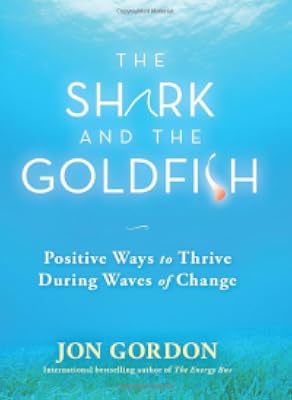
Jon Gordon is an American business consultant and author on the topics of leadership, culture, sales, and teamwork. His books have been used by the Universuty of Georgia's Bulldogs and the Atlanta Falcons. His work has been featured in The Washington Post and U.S. News and World Report. He has earned degrees from Cornell University and Emory show more University. Gordon is the author of several books including: The No Complaining Rule, The Positive Dog, The Shark and The Goldfish: Positive Ways to Thrive During Waves of Change, One Word that Will Change Your Life, and The Power of Positive Team : Proven Principles and Practices That Make Great Teams Great. His title The Carpenter: A story about the Greatest Success Strategies of All made The New York Times Best Seller List in 2014. (Bowker Author Biography) show less
Classifications
Statistics
- Members
- 275
- Popularity
- 117,241
- Reviews
- 10
- Rating
- (3.59)
- Languages
- English
- Media
- Paper, Audiobook, Ebook
- ISBNs
- 11
- ASINs
- 2