
About the Author
Susan Fowler is a senior consulting partner with The Ken Blanchard Companies and a professor in the Master of Science in Executive Leadership program at the University of San Diego. Her clients include Microsoft, Bayer Healthcare, NASA, the Catholic Leadership Institute, Merrill Lynch, Mattel, and show more dozens more. show less
Works by Susan Fowler
Self Leadership and the One Minute Manager: Increasing Effectiveness Through Situational Self Leadership (2005) 259 copies, 1 review
Whistleblower: My Journey to Silicon Valley and Fight for Justice at Uber (2020) 88 copies, 4 reviews
Why Motivating People Doesn't Work . . . and What Does: The New Science of Leading, Energizing, and Engaging (2014) 84 copies, 1 review
Sensory Stimulation: Sensory-Focused Activities for People with Physical and Multiple Disabilities (JKP Resource Materials) (2006) 13 copies, 1 review
Multisensory Rooms and Environments: Controlled Sensory Experiences for People with Profound and Multiple Disabilities (2008) 13 copies, 1 review
Whistleblower: My Unlikely Journey to Silicon Valley and Speaking Out Against Injustice (2021) 8 copies, 1 review
Why Motivating People Doesn't Work...and What Does, Second Edition: More Breakthroughs for Leading, Energizing, and Engaging (2023) 8 copies
Pourquoi motiver est-il si compliqué... et comment y arriver ! : La science de la motivation : une démarche inédite pour diriger, stimuler et impliquer vos… (2017) 5 copies, 1 review
Managing Priorities 2 copies
Whistlebrower 2 copies
Noua ştiinţă a motivării: cum să conduci, să energizezi şi să implici prin metoda motivaţiei optime (2016) 2 copies
Associated Works
Leading at a Higher Level, Revised and Expanded Edition: Blanchard on Leadership and Creating High Performing Organizations (2010) — Author — 210 copies, 1 review
Tagged
Common Knowledge
- Gender
- female
Members
Reviews

It got to the point where I wasn’t able to hold back my tears until after meetings anymore. I found myself wiping tears from my face right there in the meetings, hoping that nobody would notice; then I’d go home after work and cry myself to sleep. On days like that, I thought seriously about leaving Uber. I even applied for several other jobs. But, ultimately, I decided to stay. I was twenty-five years old. Uber was the third company I’d worked at since I graduated from Penn only ashow more
year and a half earlier. How could I convince the companies I applied to that the problem was with Uber, and not with me? Even worse, what if Kevin and Duncan were right, I’d wonder, and I was really an awful engineer? What if I was so awful that I would never get another job in engineering?
This book is the result of Susan Fowler's efforts after she posted a famous blog post about working at Uber for a year. She was the victim of structural sexual discrimination that flourished in the company, where a culture of sweeping all 'problems'—i.e. sexual-abuse complaints to HR and management—under the rug was the norm.
Fowler is a deft writer who takes the reader on a journey through her younger years, finding her way into both logics and philosophy and later into programming. She was hit with discrimination during her education at the University of Pennsylvania; in the end of that bout, she let it be:
I took the lawyers’ advice and decided to move on with my life. But before I did, I carefully documented everything, saving every email, every call log, every text message. There was part of me that wondered if perhaps I’d change my mind about suing them in the future. And there was another part of me that thought I’d want to write about it someday. My heart broke when I realized that moving on meant giving up on my dream. The professors I’d been counting on for letters of recommendation now refused to talk to me because of the situation with Tim, and without the recommendation letters I needed, I knew I would never be accepted into a physics PhD program. So I trashed my graduate school applications and, with them, my hopes of becoming a physicist.
She made her way to Silicon Valley and spread her wings, first, at a company named Plaid:
Everyone went out for drinks that night to celebrate the two new employees: me and the new office manager, Heidi. We were the only women in the office; as I later learned, they had us start on the same day so that we wouldn’t feel “alone.”
Ooh, the misogyny doesn't seep through: it pours.
Fowler writes well about sexism and other types of work-related abuse becoming normalised. She writes about leaving Plaid for another company, PubNub:
Within a few days, I found out that my boss—who managed me and one other employee—was openly, unabashedly sexist. He commented on my clothing, making fun of me if I ever dressed nicely and telling me I was dumpy if I wore jeans and a T-shirt. He told me that he bet any man I was dating was off secretly having sex with prostitutes. He was also anti-Semitic, frequently commenting about how “stingy” and “Jewish” he thought the founders were (I didn’t dare tell him that I was Jewish, too). The only way I could deal with it was to keep my head down, do my work, and try not to pay attention to anything he said. To keep myself sane, I read the philosophers Epictetus, Seneca, and Marcus Aurelius every morning on my way to work and during my lunch breaks.
Fowler loves—or, at least, loved—stoic philosophers. This paragraph jumped out at me as seeming very strange:
The words of the Stoics reinforced what I already knew: I couldn’t control what others did to me, but I could control how I reacted.
I disagree with not being able to control what others do; this book is proof that one's actions lead to how others treat you. Also, it's not always possible to control one's own reactions, e.g. if raped. These are important distinctions.
Before signing on with Uber, Fowler searched the web to see whether she could find any wrongdoings at the company; she found nothing:
What I didn’t know at the time was that the mere fact that there was no public record of wrongdoing wasn’t because Uber had a spotless record, but because all Uber employees were bound by forced arbitration. Forced arbitration clauses are often included in employment agreements that workers must sign as a condition of employment, usually on their very first day of work—not only at tech companies like Uber, but at many companies in the United States.
Nefarious, to say the least.
One early warning sign at Uber was this:
Uber encouraged employees to spend time working with their coworkers over the holidays rather than with their families and offered employees free all-inclusive trips almost anywhere in the world if they chose work over family.
Her manager swiftly started writing about his open relationship with his girlfriend and went into sex immediately and often. When Fowler turned to HR to rectify the situation, they reacted:
Then she gave me a “choice”: I could stay on the cloud team, with Jake as my manager—though I would likely receive a bad performance review from him because I had turned down his advances and reported him to HR—or I could transfer to a different SRE team.
This book should be read by men, especially men in manager or executive roles, to not only make them understand how non-men are being treated by men, but also make them aware of their fallacies: if something is brought to HR, it must be treated with the urgency it deserves. Everybody deserves to be treated equally and nicely at work.
Fowler bravely fought Uber, their HR people, went to executives, spoke with friends and family, and went further than a lot of people would dare or have the strength to do, while battling an earthquake of issues that were designed to make her quit working at Uber.
Still, she persisted, and the rest is history: one person can make a difference (even though more persons than herself were involved in toppling Uber's sexist structure, which may still be in place for all I know).
There are lovely segues throughout the book that point to a promising future for non-male tech workers (including men):
Rigetti Quantum Computing and Uber Technologies were at opposite ends of the spectrum: Chad wanted Rigetti Quantum Computing to be a company filled with joy, where people came into work excited and passionate about the technical challenges of building quantum computers and working as a team to solve hard problems; Uber, on the other hand, was a company driven by aggression, hell-bent on destroying the competition no matter the cost, where it felt like people came into work to tear down, not to build up.
To quote Beastie Boys: 'be true to yourself and you will never fall'.
Susan Fowler was brave enough to stand up against a tech giant and they fell.
This book is both a lovely example of how critique and whistleblowing must be included in a worker's guide and how great workplaces can be built. show less
Hell hath no fury....and, from what I read, Uber had no conscience, no compassion, and no humility either. This book is worth reading, if for no other reason than to make you think twice about standing up for your right to be treated fairly, equally, and with respect. That might sound odd, but if you are going to take on the giant you better have a really thick skin, a strong constitution, and a solid base of supporters because the retaliation can be swift, cruel, and relentless.
Whistleblower: My Unlikely Journey to Silicon Valley and Speaking Out Against Injustice by Susan Fowler
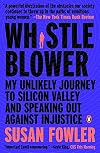
Short review: read her blog post, skip the book.
Slightly longer review: Fowler talks about her life, facing some pretty staggering injustices at the University of Pennsylvania, then working at a couple of tech startups before getting to Uber. Exactly how terrible it is to be a woman at a tech-bro startup is now fairly well-known - thanks in part to Fowler's earlier blog post detailing conditions at Uber - but the precise details range from predictably depressing (her first startup job) to show more astonishingly bad (some of her experiences at Uber, and her earlier time at Penn).
The book falls a bit flat at the end, though. She discusses how Uber brought in Eric Holder to do a report (he concluded that the situation was terrible), how Travis Kalanick left the company, and then the reader is implicitly led to believe that things are better now. However, over the course of the book, many people told Fowler that they were taking her complaints seriously and things would improve, only for nothing to change, so this soft conclusion rings a little hollow - how do we know that things actually did get better? If she'd talked to women still working at Uber, or tried to talk to them and been denied access, or even mentioned that the percentage of female engineers at Uber was growing again, the book would have been much better.
Also, Fowler never mentions talking to a lawyer at any point in the book. This is initially a just little weird (She could afford a consultation, she was around enough people that someone would have recommended it) but it eventually becomes enough of an oversight that I started to wonder if she'd in fact reached some kind of settlement with Uber that she was bound to not discuss. Regardless of whether that's what happened, she might talk a bit more about how seeking legal counsel would benefit others in similar situations. Uber certainly didn't seem to listen to all the other avenues she tried before the eventual blog post. show less
Slightly longer review: Fowler talks about her life, facing some pretty staggering injustices at the University of Pennsylvania, then working at a couple of tech startups before getting to Uber. Exactly how terrible it is to be a woman at a tech-bro startup is now fairly well-known - thanks in part to Fowler's earlier blog post detailing conditions at Uber - but the precise details range from predictably depressing (her first startup job) to show more astonishingly bad (some of her experiences at Uber, and her earlier time at Penn).
The book falls a bit flat at the end, though. She discusses how Uber brought in Eric Holder to do a report (he concluded that the situation was terrible), how Travis Kalanick left the company, and then the reader is implicitly led to believe that things are better now. However, over the course of the book, many people told Fowler that they were taking her complaints seriously and things would improve, only for nothing to change, so this soft conclusion rings a little hollow - how do we know that things actually did get better? If she'd talked to women still working at Uber, or tried to talk to them and been denied access, or even mentioned that the percentage of female engineers at Uber was growing again, the book would have been much better.
Also, Fowler never mentions talking to a lawyer at any point in the book. This is initially a just little weird (She could afford a consultation, she was around enough people that someone would have recommended it) but it eventually becomes enough of an oversight that I started to wonder if she'd in fact reached some kind of settlement with Uber that she was bound to not discuss. Regardless of whether that's what happened, she might talk a bit more about how seeking legal counsel would benefit others in similar situations. Uber certainly didn't seem to listen to all the other avenues she tried before the eventual blog post. show less
Susan Fowler's account of her time in Silicon Valley (notably Uber) is predictably infuriating--the details are already known from her 2017 blog post.
Luckily there's more to her story--how she got to be a software engineer in the first place, and how her original plans to become a physicist were derailed. If anyone doubts that so much could happen to one woman before she turned 30, it just shows how good a job we do of covering up sexual harassment and discrimination, and how we've got show more institutional policies in place from universities to corporations to ensure it stays hidden. Fowler has a decent writing style and the book is a quick read. show less
Luckily there's more to her story--how she got to be a software engineer in the first place, and how her original plans to become a physicist were derailed. If anyone doubts that so much could happen to one woman before she turned 30, it just shows how good a job we do of covering up sexual harassment and discrimination, and how we've got show more institutional policies in place from universities to corporations to ensure it stays hidden. Fowler has a decent writing style and the book is a quick read. show less
Lists
Awards


You May Also Like


Associated Authors
Statistics
- Works
- 23
- Also by
- 1
- Members
- 575
- Popularity
- #43,588
- Rating
- 3.7
- Reviews
- 11
- ISBNs
- 60
- Languages
- 7