

Mark Goulston
Author of Just Listen: Discover the Secret to Getting Through to Absolutely Anyone
About the Author
Mark Goulston, MD, (Los Angeles, CA) is a top psychiatrist, business adviser, mentor, and international speaker. Author of the bestselling Just Listen and Get Out of Your Own Way as well as other popular books, he blogs for Harvard Business Review, Fast Company, Business Insider, Huffington Post, show more and Psychology Today; hosts the "Prison Letters" podcast; and is featured frequently in major media, including The Wall Street Journal, Fortune, Newsweek, Time, CNN, Fox News, and the TODAY Show. show less
Works by Mark Goulston
Just Listen: Discover the Secret to Getting Through to Absolutely Anyone (2009) 539 copies, 11 reviews
Talking to Crazy: How to Deal with the Irrational and Impossible People in Your Life (2015) 142 copies, 4 reviews
Get Out of Your Own Way at Work and Help Others Do the Same: Conquering Self-Defeating Behavior on the Job (2005) 49 copies
Why Cope When You Can Heal?: How Healthcare Heroes of COVID-19 Can Recover from PTSD (2020) 9 copies
Trauma to Triumph 1 copy
Tagged
Common Knowledge
- Gender
- male
- Short biography
- Over his career as an organizational consultant, relationship counselor, and hostage-negotiation trainer, Mark Goulston has found what works, consistently, to reach all kinds of people in any type of situation. What it comes down to is “Daring to Care” which is the mission of the global community Heartfelt Leadership that he co-founded.
In his latest book, REAL INFLUENCE, Dr. Goulston along with co-author Dr. John Ullmen have interviewed more than 100 influential people and distilled a 4 step model that they have in common. As he explains, “We are in a ‘post-selling/post-pushing’ world where most people can’t stand to either of these done to them and don’t enjoy when they have to do it to others.” He says, “There is a way to persuade without pushing and that is by positively influencing people, because influence can last a lifetime, whereas persuasion sometimes doesn’t even last until the end of a conversation.”
In REAL INFLUENCE you’ll discover the first step in Dr. Goulston’s and Dr. Ullmen’s model which is to “go for great outcomes.” That is far beyond where people want to go and be, to where and who they could be. It’s about helping people see past a goal to possibility that is often game and life changer.
Mark Goulston is a psychiatrist, business consultant, executive coach, and a hostage-negotiation trainer for the FBI. A bestselling author whose books include “Get Out of Your Own Way” and “Get Out of Your Own Way at Work” and his last #1 international and #1 kindle best selling book, “Just Listen” Discover the Secret to Getting Through to Absolutely Anyone. He blogs or contributes to Harvard Business, Fast Company, Business Insider and writes the “Closing Bell” for C-Suite Quarterly Magazing and the Tribune syndicated column, “Solve Anything with Dr. Mark.” Frequently called upon to share his expertise with the media, he has been quoted in the Wall Street Journal, Harvard Business Review, Fortune, Newsweek, Time, and Reuters; has offered commentary on NPR, CNN, and Fox News; and has appeared on the Oprah and Today shows. He lives in Los Angeles, California.
http://www.actionablebooks.com/author...
Members
Reviews
Talking to Crazy How to Deal with the Irrational and Impossible People in Your Life by Mark Goulston
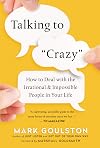
Everyone has a crazy person in his or her workplace or family. (If you don’t think you do, it’s probably you. The old saw is pretty true.) Whether it’s Uncle Silas, who can’t stop spouting the latest nonsense from Fox News or Donald Trump; a hypercritical or manipulative parent or sibling, a backstabbing or shiftless coworker, or an insufferable mom who’s the president of your child’s PTA, they’re out there. Author Mark Goulston, himself a psychiatrist, gives wonderful advice show more for “leaning into the crazy” — not necessarily capitulating to the crazies in your life, but playing along enough to at least get them to listen to you or change their behavior. (I’ve learned that you can’t change anyone’s behavior — you can only change your own, thereby changing the dynamic.)
I’ve read other books about dealing with difficult people, but none of them can compare with this gem. And, for those listening to this book in the audio format, narrator L. J. Ganser, is superb. Highly recommended. show less
I’ve read other books about dealing with difficult people, but none of them can compare with this gem. And, for those listening to this book in the audio format, narrator L. J. Ganser, is superb. Highly recommended. show less
Just Listen: Discover the Secret to Getting Through to Absolutely Anyone by Goulston (April 1, 2015) Paperback by Mark Goulston
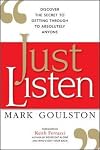
I read this only as a Blinkist summary and this review is based on that short summary so is not really a reflection of the whole book. Listening is a key to overcoming resistance and initiating progress.....Have you ever stopped to consider the rhythm of your everyday conversations? If so, you might have found that you approach them as if they were all rational arguments, and this can often be counterproductive....In fact, using arguments or pressure to influence or convince others often show more creates resistance.
If you want people to be open to your arguments, you have to listen first. “When you really get where people are coming from ... they’re more likely to let you take them where you want them to go.”
We feel positive emotions when our emotions are mirrored back to us.......mirroring is actually programmed into our brains: brain cells called mirror neurons allow us to experience what we perceive that others are feeling. Some scientists believe these neurons could even be the basis for human empathy. In fact, researcher V.S. Ramachandran has called mirror neurons “empathy neurons” because of the way they bring people closer together.
Studies have shown that if we mirror others but aren’t mirrored in return, we develop a deficit in our mirror neuron receptors. When these mirror neuron receptor deficits occur, we feel alone and disconnected.
Listening relies on the rational–not the emotional or instinctual–part of our brains.
Our reptilian layer is very primitive, and is all about reacting to the immediate situation.
The next layer, the mammalian layer, is a bit more evolved than the reptilian layer: it’s in charge of our emotions and is the home of your inner drama queen. The mammalian layer is where powerful feelings arise, including emotions like anger, jealousy, love, grief, pleasure, joy and sadness....Lastly, there’s the rational, reasoning layer. This layer of the brain is responsible for collecting and analyzing the data from the reptilian and mammalian layers of the brain, and developing logical next steps. [My understanding is that this triune brain theory has been thoroughly debunked...so it’s a little disturbing to find it being put forward here].
Make sure that you and your conversation partner are using your rational brains.
If you want to be able to listen to and reach others, you have to get your own emotions under control first......In threatening situations, the brain’s Mr. Spock shuts down and passes control over to the emotional side of the brain, controlled by the amygdala. Feeling threatened can also trigger the fight-or-flight mechanisms that cause logical reasoning to freeze and allow your immediate emotions and instincts to take over.
However, by expressing your feelings of fear or panic aloud, you give yourself the opportunity to calm down and look for solutions. Knowing this, you should also give others the space they need to address their fears when things start getting out of control. This way, they can listen to your arguments again with a clear and rational mind.
Showing vulnerability is empowering and gives others the chance to listen to us. If you hide your emotions, you won’t be truly understood.
Your colleague makes an insensitive remark to you and you respond with anger......not great!.....However, if you had instead shown your genuine emotions, i.e., your nervousness, your colleague probably would have been able to empathize with you and boost your confidence before the meeting.....Furthermore, giving others the opportunity to show their vulnerability enables you both to explore what’s behind the emotions.
“If you want to open the lines of communication, open your own mind first.”
When you level with others, they’ll be more relaxed and open for dialogue.
Using questions to establish an atmosphere of equality with your conversation partner will create a stronger connection. One way to do this is with the Side-by-Side approach, in which you ask questions during a shared moment and then follow up with more questions to deepen the connection....By asking questions that demonstrate interest (which of your friends do you think might get into trouble later?) rather than boring his son with questions about grades, the father got his son to open up to him about deeper issues, like friendship and loyalty.
In summary, since the majority of our interactions follow familiar patterns, it’s precisely by breaking these patterns that we can open up and deepen our connections.
The best way to make others feel understood and valued is through empathy.
Here’s a script you can follow that will guide you towards empathy: First, attach an emotion to what your conversation partner is feeling. Let’s use anger as an example.
Next, ask him or her if your perceptions are accurate by saying something like: “I’m trying to get a sense of what you’re feeling and I think it’s anger. Is that correct? If not, what are you feeling?”
Then, once you’ve established which emotion they’re feeling, ask: “How angry are you?”
Next, find out why they’re angry by saying something like: “And the reason you’re so angry is because........?
After they’ve answered, say: “Tell me–what needs to happen for that feeling to feel better?”
Finally, find out how the two of you can work together to move forward; ask: “What can I do to make that happen? What can you do to make that happen?”
The key message in this book: Although it might feel counterintuitive, the best way to get people to listen and become receptive to your ideas is to listen to them first. Listening allows you to create a shared connection between you and your conversation partner that opens them up to your ideas.
Actionable advice: Don’t be afraid to be vulnerable.
If you ever feel afraid, nervous or distressed about something, don’t pretend you’re not and try to hide it. By being honest with your emotions, you can create stronger bonds with your conversation partners and open up lines of communication,
My take on the book: Yes...all reasonable advice (except the bit about the trinune brain). Did I learn anything? Well yes, I think I did. Their script for defusing an emotional situation seems quite good though maybe it might work with Americans. Not so sure that it would work in other cultural settings...such as Asian. Most of this material was covered off by Dale Carnegie over 60 years ago. And, I suppose, that the title of the book summarises a lot of the real content....just listen (which my wife tells me I don’t do very well). Three stars from me. show less
If you want people to be open to your arguments, you have to listen first. “When you really get where people are coming from ... they’re more likely to let you take them where you want them to go.”
We feel positive emotions when our emotions are mirrored back to us.......mirroring is actually programmed into our brains: brain cells called mirror neurons allow us to experience what we perceive that others are feeling. Some scientists believe these neurons could even be the basis for human empathy. In fact, researcher V.S. Ramachandran has called mirror neurons “empathy neurons” because of the way they bring people closer together.
Studies have shown that if we mirror others but aren’t mirrored in return, we develop a deficit in our mirror neuron receptors. When these mirror neuron receptor deficits occur, we feel alone and disconnected.
Listening relies on the rational–not the emotional or instinctual–part of our brains.
Our reptilian layer is very primitive, and is all about reacting to the immediate situation.
The next layer, the mammalian layer, is a bit more evolved than the reptilian layer: it’s in charge of our emotions and is the home of your inner drama queen. The mammalian layer is where powerful feelings arise, including emotions like anger, jealousy, love, grief, pleasure, joy and sadness....Lastly, there’s the rational, reasoning layer. This layer of the brain is responsible for collecting and analyzing the data from the reptilian and mammalian layers of the brain, and developing logical next steps. [My understanding is that this triune brain theory has been thoroughly debunked...so it’s a little disturbing to find it being put forward here].
Make sure that you and your conversation partner are using your rational brains.
If you want to be able to listen to and reach others, you have to get your own emotions under control first......In threatening situations, the brain’s Mr. Spock shuts down and passes control over to the emotional side of the brain, controlled by the amygdala. Feeling threatened can also trigger the fight-or-flight mechanisms that cause logical reasoning to freeze and allow your immediate emotions and instincts to take over.
However, by expressing your feelings of fear or panic aloud, you give yourself the opportunity to calm down and look for solutions. Knowing this, you should also give others the space they need to address their fears when things start getting out of control. This way, they can listen to your arguments again with a clear and rational mind.
Showing vulnerability is empowering and gives others the chance to listen to us. If you hide your emotions, you won’t be truly understood.
Your colleague makes an insensitive remark to you and you respond with anger......not great!.....However, if you had instead shown your genuine emotions, i.e., your nervousness, your colleague probably would have been able to empathize with you and boost your confidence before the meeting.....Furthermore, giving others the opportunity to show their vulnerability enables you both to explore what’s behind the emotions.
“If you want to open the lines of communication, open your own mind first.”
When you level with others, they’ll be more relaxed and open for dialogue.
Using questions to establish an atmosphere of equality with your conversation partner will create a stronger connection. One way to do this is with the Side-by-Side approach, in which you ask questions during a shared moment and then follow up with more questions to deepen the connection....By asking questions that demonstrate interest (which of your friends do you think might get into trouble later?) rather than boring his son with questions about grades, the father got his son to open up to him about deeper issues, like friendship and loyalty.
In summary, since the majority of our interactions follow familiar patterns, it’s precisely by breaking these patterns that we can open up and deepen our connections.
The best way to make others feel understood and valued is through empathy.
Here’s a script you can follow that will guide you towards empathy: First, attach an emotion to what your conversation partner is feeling. Let’s use anger as an example.
Next, ask him or her if your perceptions are accurate by saying something like: “I’m trying to get a sense of what you’re feeling and I think it’s anger. Is that correct? If not, what are you feeling?”
Then, once you’ve established which emotion they’re feeling, ask: “How angry are you?”
Next, find out why they’re angry by saying something like: “And the reason you’re so angry is because........?
After they’ve answered, say: “Tell me–what needs to happen for that feeling to feel better?”
Finally, find out how the two of you can work together to move forward; ask: “What can I do to make that happen? What can you do to make that happen?”
The key message in this book: Although it might feel counterintuitive, the best way to get people to listen and become receptive to your ideas is to listen to them first. Listening allows you to create a shared connection between you and your conversation partner that opens them up to your ideas.
Actionable advice: Don’t be afraid to be vulnerable.
If you ever feel afraid, nervous or distressed about something, don’t pretend you’re not and try to hide it. By being honest with your emotions, you can create stronger bonds with your conversation partners and open up lines of communication,
My take on the book: Yes...all reasonable advice (except the bit about the trinune brain). Did I learn anything? Well yes, I think I did. Their script for defusing an emotional situation seems quite good though maybe it might work with Americans. Not so sure that it would work in other cultural settings...such as Asian. Most of this material was covered off by Dale Carnegie over 60 years ago. And, I suppose, that the title of the book summarises a lot of the real content....just listen (which my wife tells me I don’t do very well). Three stars from me. show less
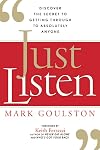
Thumbed through this book again before shelving it this evening and realized that I must raise the rating from 4 to 5 stars: Already this week, I have used, almost subconsciously, two of the techniques outlined and modeled in this book, and both with good effect.
One simple, open-ended, fill-in-the-blank question, well-timed, elicited a clear expression of vision from a new client and corrected at least one presumption I had for their interest in engaging a financial / strategic advisor for show more their business expansion. This technique was common sense, but not something I have used consistently in the past. Another technique helped me change the course of a hyperbole-driven gripe session towards a more constructive end.
This is simple, yet heady, life-changing advise. Highly recommend for anyone seeking to improve their communication skills, respond more effectively and consistently to surprises and set-backs, and connect more deeply with family, clients and colleagues. show less
One simple, open-ended, fill-in-the-blank question, well-timed, elicited a clear expression of vision from a new client and corrected at least one presumption I had for their interest in engaging a financial / strategic advisor for show more their business expansion. This technique was common sense, but not something I have used consistently in the past. Another technique helped me change the course of a hyperbole-driven gripe session towards a more constructive end.
This is simple, yet heady, life-changing advise. Highly recommend for anyone seeking to improve their communication skills, respond more effectively and consistently to surprises and set-backs, and connect more deeply with family, clients and colleagues. show less
Talking to Crazy: How to Deal with the Irrational and Impossible People in Your Life by Mark Goulston
This was an interesting read, covering a variety of topics--from business (coworkers, clients, etc.) to personal life (including divorce, aging parents, etc.). I appreciated all of the examples, finding them relatable and thought provoking (especially as I tried to imagine how I'd respond in each!).
I didn't get quite as much out of it as I was expecting going in. I started to realize that the "crazy" I went in learning how to deal with was less "crazy" on their side and more a very different show more life approach/way of thinking (one I'm still trying to figure out) than my own (very logical and ordered). show less
I didn't get quite as much out of it as I was expecting going in. I started to realize that the "crazy" I went in learning how to deal with was less "crazy" on their side and more a very different show more life approach/way of thinking (one I'm still trying to figure out) than my own (very logical and ordered). show less
Awards

You May Also Like


Associated Authors
Statistics
- Works
- 12
- Members
- 1,120
- Popularity
- #22,934
- Rating
- 3.9
- Reviews
- 17
- ISBNs
- 54
- Languages
- 7
- Favorited
- 1

