
Anna Wiener
Author of Uncanny Valley: A Memoir
Works by Anna Wiener
Associated Works
Close to the Machine: Technophilia and Its Discontents (1997) — Introduction, some editions — 506 copies, 8 reviews
Tagged
Common Knowledge
- Birthdate
- 1987
- Gender
- female
- Education
- Wesleyan University
- Nationality
- USA
- Places of residence
- Brooklyn, New York, USA
San Francisco, California, USA - Associated Place (for map)
- USA
Members
Reviews

A bizarre and surreal memoir about a frustrated woman in her mid twenties who makes the unlikely decision to leave her lack luster career in publishing to join a string of tech startups in Silicon Valley. Told in clever, almost lyrical prose, this is a tale of the strange alternate universe that tech companies operate in. The author has the bizarre experience of being the oldest person in her office at the geriatric age of 25. She's also among the only women in the office and must deal with show more the inherent misogyny of her coworkers.
She recounts, in a way that strikes a bit too close to home for me, the way her twenties just sort of melt away. As she moves through startup culture, she finds herself mildly brainwashed until she's waking up as she nears 30 wondering what she's doing with her life. She struggles with the meaninglessness of her work, her out of control internet addiction, and the dreary sense of history repeating itself.
This memoir is fascinating and a rare look into the dysfunctional world of technology start ups. show less
She recounts, in a way that strikes a bit too close to home for me, the way her twenties just sort of melt away. As she moves through startup culture, she finds herself mildly brainwashed until she's waking up as she nears 30 wondering what she's doing with her life. She struggles with the meaninglessness of her work, her out of control internet addiction, and the dreary sense of history repeating itself.
This memoir is fascinating and a rare look into the dysfunctional world of technology start ups. show less

Uncanny Valley: A Memoir by Anna Wiener is a personal glimpse at the world of big tech when start ups were happening at what should have clearly been seen as an unsustainable rate.
First, for all the "bros" who are slamming this for being limited to what she experienced and for addressing how she felt about what was happening around her, this is a freakin' memoir. Look that word up. This isn't a research based expose, this is a memoir. Are you that stupid or that insecure? Okay, back to your show more regularly scheduled programming.
Wiener was definitely not the typical start-up employee, whether in gender or in training. As she made her way she had what I think any rational person would have, conflicting thoughts and feelings. Wow, these benefits are great, wow, these people are truly vile and juvenile. Wow, they could really do harm to a lot of people with their lack of either ethics or basic human compassion. But, again, wow, these perks are great. It is real easy to stand outside and pretend we would have either turned our back and walked away or, conversely, gone all in on the vile culture that has, indeed, helped to dismantle our democracy. Wiener lets us inside her head as she navigates her life.
Yes, this is written rather episodically, but I think for a memoir that is focusing on her experiences in a toxic environment it works. There is, to be sure, plenty of humor. But underneath everything is the foundational bro-culture that gave emotionally stunted boys far too much money and power and now we are all paying the price.
Reviewed from a copy made available by the publisher via Edelweiss. show less
First, for all the "bros" who are slamming this for being limited to what she experienced and for addressing how she felt about what was happening around her, this is a freakin' memoir. Look that word up. This isn't a research based expose, this is a memoir. Are you that stupid or that insecure? Okay, back to your show more regularly scheduled programming.
Wiener was definitely not the typical start-up employee, whether in gender or in training. As she made her way she had what I think any rational person would have, conflicting thoughts and feelings. Wow, these benefits are great, wow, these people are truly vile and juvenile. Wow, they could really do harm to a lot of people with their lack of either ethics or basic human compassion. But, again, wow, these perks are great. It is real easy to stand outside and pretend we would have either turned our back and walked away or, conversely, gone all in on the vile culture that has, indeed, helped to dismantle our democracy. Wiener lets us inside her head as she navigates her life.
Yes, this is written rather episodically, but I think for a memoir that is focusing on her experiences in a toxic environment it works. There is, to be sure, plenty of humor. But underneath everything is the foundational bro-culture that gave emotionally stunted boys far too much money and power and now we are all paying the price.
Reviewed from a copy made available by the publisher via Edelweiss. show less
The author's sojourn in Silicon Valley is simultaneously disturbing and banal, like an episode of "Black Mirror." Wiener works in customer service for two different tech firms, after starting her working life in publishing in New York City, then washing out of an e-book startup. When she tries to bring her book-loving personality and natural talents to the e-book world, she intercepts a chat in which she is pilloried for "learning, not doing." This is actually viewed as a drawback.
When this show more creative soul is transplanted to Silicon Valley to work for young, hyper, tech dudes presiding over startup companies, rolling in millions in venture capital and crippled with Messiah complexes, Wiener must do customer service 7/365 on her own phone. She is obliged to go on weird corporate retreats. She feels devotedly loyal to the CEOs and tries to ignore the growing warning signs that all is not well, in San Francisco, in modern tech, and in her own soul. Her life evolves pretty much as expected and she experiences discrimination in this men's world. After all, women are "good at" customer service by nature, aren't they? It's not like she's writing code or anything. I feared that these egotistic males who wanted to "move fast and break things" would break Wiener as well, but, as one would guess from the fact that she has written a memoir, they didn't.
Some readers may observe that this memoir enumerates strictly first-world problems: poor baby, earning six figures.
I, however, was inspired to wonder, along with the author, why we let these young men take over our entire lives and invade our privacy to such a massive extent. Are they worth either the power or the billions that we have given them? Are their cool tools worth it? How much power do they really have? The new Twenties should mark the end of our dreamy infatuation with these companies, their products, and the men who get preposterously rich creating them. This insightful memoir could not be more timely.
I received an advanced readers copy of this book from the publisher and was encouraged to submit a review. show less
When this show more creative soul is transplanted to Silicon Valley to work for young, hyper, tech dudes presiding over startup companies, rolling in millions in venture capital and crippled with Messiah complexes, Wiener must do customer service 7/365 on her own phone. She is obliged to go on weird corporate retreats. She feels devotedly loyal to the CEOs and tries to ignore the growing warning signs that all is not well, in San Francisco, in modern tech, and in her own soul. Her life evolves pretty much as expected and she experiences discrimination in this men's world. After all, women are "good at" customer service by nature, aren't they? It's not like she's writing code or anything. I feared that these egotistic males who wanted to "move fast and break things" would break Wiener as well, but, as one would guess from the fact that she has written a memoir, they didn't.
Some readers may observe that this memoir enumerates strictly first-world problems: poor baby, earning six figures.
I, however, was inspired to wonder, along with the author, why we let these young men take over our entire lives and invade our privacy to such a massive extent. Are they worth either the power or the billions that we have given them? Are their cool tools worth it? How much power do they really have? The new Twenties should mark the end of our dreamy infatuation with these companies, their products, and the men who get preposterously rich creating them. This insightful memoir could not be more timely.
I received an advanced readers copy of this book from the publisher and was encouraged to submit a review. show less
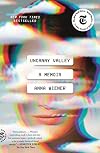
Somewhere in the last third of Uncanny Valley: “Contemporary literature offered no respite: I would find prose cluttered with data points, tenuous historical connections, detail so finely tuned it could only have been extracted from a feverish night of search-engine queries.” Is it a defense to say that Wiener’s book participates in this trend with some degree of self-awareness, if we happen to find it irritating or less insightful than it supposes it is? So do most of the works of show more contemporary literature.
The decision to anonymize every company named in the book and to render the history of tech-era San Francisco in vague detail might be another defense. I thought that this move, when combined with the short, pithy sentences and the willful naivete of a younger Wiener, also made UV feel like plenty of contemporary fiction, Rachel Cusk or Sally Rooney. Or like an NPR podcaster, with a curiosity about the world that’s a little too bright-eyed to feel real. (Wiener writes at one point that she likes “huge novels with minimal plot, or minimal novels with minimal plot.”) I don’t mind this adoption of a persona, other than the times it begins to feel too overtly like a slash-up of her past self designed to smooth the arc of a memoir or hammer in the abstract menace of a surveillance society. It’s as if one of the requirements of Wiener’s immaculate prose — the craft of the New Yorker writer who hits her targets with precision — is a featureless simplicity in its narrator-creator, allowing ideas, arguments, and parties in conversation to pit themselves neatly against one another.
I liked Wiener best when she was telling stories about her start-ups, or speculating irresponsibly about the humanity of the most powerful people in her world and, by extension, ours. She disavows this impulse at the end: “I was always looking for the emotional narrative, the psychological explanation, the personal history,” comes in a tone of cafard. “I was looking for stories; I should have seen a system.” show less
The decision to anonymize every company named in the book and to render the history of tech-era San Francisco in vague detail might be another defense. I thought that this move, when combined with the short, pithy sentences and the willful naivete of a younger Wiener, also made UV feel like plenty of contemporary fiction, Rachel Cusk or Sally Rooney. Or like an NPR podcaster, with a curiosity about the world that’s a little too bright-eyed to feel real. (Wiener writes at one point that she likes “huge novels with minimal plot, or minimal novels with minimal plot.”) I don’t mind this adoption of a persona, other than the times it begins to feel too overtly like a slash-up of her past self designed to smooth the arc of a memoir or hammer in the abstract menace of a surveillance society. It’s as if one of the requirements of Wiener’s immaculate prose — the craft of the New Yorker writer who hits her targets with precision — is a featureless simplicity in its narrator-creator, allowing ideas, arguments, and parties in conversation to pit themselves neatly against one another.
I liked Wiener best when she was telling stories about her start-ups, or speculating irresponsibly about the humanity of the most powerful people in her world and, by extension, ours. She disavows this impulse at the end: “I was always looking for the emotional narrative, the psychological explanation, the personal history,” comes in a tone of cafard. “I was looking for stories; I should have seen a system.” show less
Lists
Awards


You May Also Like


Associated Authors
Statistics
- Works
- 1
- Also by
- 2
- Members
- 1,066
- Popularity
- #24,147
- Rating
- 3.7
- Reviews
- 43
- ISBNs
- 19
- Languages
- 4