

Ellen Ullman
Author of Close to the Machine: Technophilia and Its Discontents
About the Author
Image credit: Marion Ettlinger
Works by Ellen Ullman
Associated Works
Tagged
Common Knowledge
- Birthdate
- 1949
- Gender
- female
- Education
- Cornell University
- Occupations
- programmer
writer - Nationality
- USA
- Places of residence
- San Francisco, California, USA
- Associated Place (for map)
- California, USA
Members
Reviews
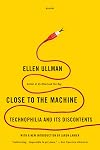
A friend of mine linked me to Robin Sloan's fantastic interactive review of Close to the Machine and after reading it, I immediately placed a request for the book through the library where I work. And once it came, I couldn't wait to start reading it. And, well, it was fantastic, in every way.
I am not, nor will I ever be, any sort of computer programmer/engineer/etc. And you don't need to be in order to enjoy Close to the Machine. Ullman's writing is, among many wonderful things, completely show more accessible. If there's something that you don't understand, she usually explains it. And everything else is pretty easy to infer from the context. Ullman's book is both her biography as well as the story of what it was like to be a woman in the male-dominated computer programming/engineering world. Ullman's story is fascinating, from her relationship with lovers to that of her late father to those with her coworkers.
The world she describes, in many ways, seems unchanged today, which is why the book, written in 1997, is still completely relevant today. We get a rare glimpse (as someone said, perhaps in the intro to the book) into the closed off world of programming and a perspective of someone who is both deep inside that world (she's a programmer) and outside it (she's a woman) at the same time.
I love this book and I highly, highly recommend it to everyone, regardless of your interest in computers and/or computer programming. show less
I am not, nor will I ever be, any sort of computer programmer/engineer/etc. And you don't need to be in order to enjoy Close to the Machine. Ullman's writing is, among many wonderful things, completely show more accessible. If there's something that you don't understand, she usually explains it. And everything else is pretty easy to infer from the context. Ullman's book is both her biography as well as the story of what it was like to be a woman in the male-dominated computer programming/engineering world. Ullman's story is fascinating, from her relationship with lovers to that of her late father to those with her coworkers.
The world she describes, in many ways, seems unchanged today, which is why the book, written in 1997, is still completely relevant today. We get a rare glimpse (as someone said, perhaps in the intro to the book) into the closed off world of programming and a perspective of someone who is both deep inside that world (she's a programmer) and outside it (she's a woman) at the same time.
I love this book and I highly, highly recommend it to everyone, regardless of your interest in computers and/or computer programming. show less
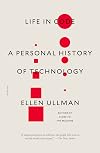
This is a fascinating collection of essays, all related to various topics around computer programming, predictions about the future of computing, artificial intelligence, and the culture of the technology world. These essays were written over the past 3 decades, so it is interesting to see how some of these topics have and have not changed over time.
I read this right as artificial intelligence has exploded into our daily lives through ChatGPT and other AI models. A lot of the predictions and show more fears that Ullman writes about in the 90s are coming to fruition now, and it's interesting to see how much the conversation has and has not changed since then.
Ullman's perspective as a woman in IT is interesting, particularly as she talks about artificial intelligence. The men who talk about AI envision it as a brain in a box, but Ullman writes about intelligence as requiring a body. As AI brings up concerns about what makes us human, Ullman emphasizes the fact that being human requires having a body, and all of the stresses, insecurities, and joys that a mortal body entails. I think it's a lot easier for men in a male-dominated industry to ignore their bodies than women.
Ullman's chapter on Y2K does a wonderful job of capturing the uncertainties and fears around Y2K, and how the public was stuck between predictions of apocalypse and reassurances that everything would be fine, with no real way of knowing how it was going to turn out until it happened. This will be a perfect primary source for future historians.
As a memoir, this book is often about Ullman's love/hate relationship with technology. She loves coding and has a deep drive to solve problems in code, but at the same time, finds male-dominated IT culture to be off-putting and often downright hostile. show less
I read this right as artificial intelligence has exploded into our daily lives through ChatGPT and other AI models. A lot of the predictions and show more fears that Ullman writes about in the 90s are coming to fruition now, and it's interesting to see how much the conversation has and has not changed since then.
Ullman's perspective as a woman in IT is interesting, particularly as she talks about artificial intelligence. The men who talk about AI envision it as a brain in a box, but Ullman writes about intelligence as requiring a body. As AI brings up concerns about what makes us human, Ullman emphasizes the fact that being human requires having a body, and all of the stresses, insecurities, and joys that a mortal body entails. I think it's a lot easier for men in a male-dominated industry to ignore their bodies than women.
Ullman's chapter on Y2K does a wonderful job of capturing the uncertainties and fears around Y2K, and how the public was stuck between predictions of apocalypse and reassurances that everything would be fine, with no real way of knowing how it was going to turn out until it happened. This will be a perfect primary source for future historians.
As a memoir, this book is often about Ullman's love/hate relationship with technology. She loves coding and has a deep drive to solve problems in code, but at the same time, finds male-dominated IT culture to be off-putting and often downright hostile. show less

I LOVED this book. I've now read all the reviews on Amazon, as well as the interview with the author. Several people commented that it was slow; that they only got into it after the first 100 pages; but I was hooked from the first page.
The device of the mysterious narrator was fascinating. It removed us from the protagonist, the patient whose therapy he overheard, in the same way she was removed from her mother. The sense of place, San Francisco in the 70s; the descriptions of the building; show more grounded us, providing a counterpoint to the almost dreamlike recounting of the patient's (and the narrator's own) story.
Until the end, it was a 5 star book for me - but I didn't like the ending, which I won't give away. I also became so intrigued with the narrator's own mysterious difficulties that I wanted the book to go on and on.
But perhaps Ullman wil give us a sequel! show less
The device of the mysterious narrator was fascinating. It removed us from the protagonist, the patient whose therapy he overheard, in the same way she was removed from her mother. The sense of place, San Francisco in the 70s; the descriptions of the building; show more grounded us, providing a counterpoint to the almost dreamlike recounting of the patient's (and the narrator's own) story.
Until the end, it was a 5 star book for me - but I didn't like the ending, which I won't give away. I also became so intrigued with the narrator's own mysterious difficulties that I wanted the book to go on and on.
But perhaps Ullman wil give us a sequel! show less
I like reading non-fiction on my phone's Kindle app. Non-fiction books are easy to read in snatches while I'm on the subway or waiting for an appointment. But with the COVID19 pandemic, I haven't gotten out much, so sadly, didn't read this for nearly a year, until I decided to just sit down and finish it. That's when I discovered I enjoyed it more in snatches. I got bogged down in some of the tech and found my attention wandering for some of Ullman's personal life anecdotes. Overall, I show more enjoyed it, but the book is episodic, the chapters focused on themes such as Y2K, artificial intelligence, and so on. The chapter on Y2K and how coders worked to keep computers running when the millennial date turned from 1999 to 2000 was fascinating. Other chapters, not so much. Still, I'm glad I read it for the inside look at technology from someone who's been there. show less
Lists
Awards


You May Also Like


Associated Authors
Statistics
- Works
- 5
- Also by
- 3
- Members
- 1,479
- Popularity
- #17,373
- Rating
- 3.8
- Reviews
- 47
- ISBNs
- 35
- Languages
- 3
- Favorited
- 1