
Walter Isaacson
Author of Steve Jobs
About the Author
Walter Isaacson was born on May 20, 1952 in New Orleans, Louisiana. He received a B. A. in history and literature from Harvard College. He then attended the University of Oxford, where he was a Rhodes Scholar at Pembroke College and read philosophy, politics, and economics. He began his career in show more journalism at The Sunday Times of London and then the New Orleans Times-Picayune/States-Item. He joined TIME in 1978 and served as a political correspondent, national editor and editor of new media before becoming the magazine's editor in 1996. He became Chairman and CEO of CNN in 2001, and then president and CEO of the Aspen Institute in 2003. He has written numerous books including American Sketches, Einstein: His Life and Universe, Benjamin Franklin: An American Life, Kissinger: A Biography, Steve Jobs, and The Innovators: How a Group of Hackers, Geniuses, and Geeks Created the Digital Revolution. He is the co-author, with Evan Thomas, of The Wise Men: Six Friends and the World They Made. (Bowker Author Biography) show less
Series
Works by Walter Isaacson
The Innovators: How a Group of Inventors, Hackers, Geniuses and Geeks Created the Digital Revolution (2014) 2,369 copies, 44 reviews
The Code Breaker: Jennifer Doudna, Gene Editing, and the Future of the Human Race (2021) 1,824 copies, 67 reviews
American Sketches: Great Leaders, Creative Thinkers, and Heroes of a Hurricane (2010) 246 copies, 6 reviews
People of the Century: One Hundred Men And Women Who Shaped The Last One Hundred Years (1985) 212 copies
The Code Breaker, Young Readers Edition: Jennifer Doudna and the Race to Understand Our Genetic Code (2022) 20 copies, 1 review
Walter Isaacson: The Genius Biographies: Benjamin Franklin, Einstein, Steve Jobs, and Leonardo da Vinci (2019) 15 copies
Tiểu sử Elon Musk 1 copy
Inovatori 1 copy
Associated Works
The Evolution of Physics: The Growth of Ideas from Early Concepts to Relativity and Quanta, (1938) — Foreword, some editions — 1,025 copies, 14 reviews
Invent and Wander: The Collected Writings of Jeff Bezos, With an Introduction by Walter Isaacson (2020) — Introduction — 180 copies, 6 reviews
Reader's Digest Today's Best Nonfiction 22 1993: A Bus of My Own / Kissinger / The Happy Isles of Oceania / Marrying the Hangman (1993) — Author — 9 copies, 1 review
Summary of Jeff Bezos and Walter Isaacson's Book: Invent and Wander: The Collected Writings of Jeff Bezos (2021) — Associated Name — 1 copy
Tagged
Common Knowledge
- Canonical name
- Isaacson, Walter
- Legal name
- Isaacson, Walter Seff
- Birthdate
- 1952-05-20
- Gender
- male
- Education
- Deep Springs College
Harvard University (BA|1974)
Pembroke College, Oxford University (MA|1976) - Occupations
- journalist
biographer
editor
administrator
professor
CEO - Organizations
- Time (1978-2001, Editor 1996-2001)
CNN (CEO, 2001-2003)
Aspen Institute (president and CEO, 2003-)
Teach for America (chair emeritus)
Tulane University - Awards and honors
- Rhodes Scholar
Jefferson Lecture (2014)
Gerald Loeb Award (2012)
American Philosophical Society (2005)
American Academy of Arts & Sciences (2016)
Royal Society of Arts (Fellow) (show all 9)
Benjamin Franklin Medal (2013)
National Humanities Medal (2021)
Carl Sandburg Literary Award (2012) - Short biography
- Walter Isaacson, University Professor of History at Tulane, has been CEO of the Aspen Institute, chairman of CNN, and editor of Time magazine. He is the author of Leonardo da Vinci; Steve Jobs; Einstein: His Life and Universe; Benjamin Franklin: An American Life; and Kissinger: A Biography. He is also the coauthor of The Wise Men: Six Friends and the World They Made.
- Nationality
- USA
- Birthplace
- New Orleans, Louisiana, USA
- Places of residence
- New Orleans, Louisiana, USA
Washington, D.C., USA - Map Location
- Louisiana, USA
Members
Discussions
other walter isaacson books in Book talk (May 2012)
Reviews
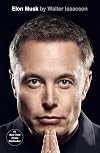
On a day when Elon Musk, richest man in the world, donates a 'sizeable sum' to Donald Trump's campaign after a bungled assassination attempt, this blockbuster biography may be a 'must-read' to help understand the possible future relationship of capital to politics at the heart of the imperium.
Musk is 'sui generis'. A man with Aspergers who cannot be understood except in the light of his brain structure. He is not normal and he does not mind who knows it. Loathed and admired in equal show more proportions, few can look on him with equanimity or complete objectivity.
To be fair, Professor Isaacson, despite being alongside Musk for a couple of years and so potentially subject to influence, manages to present a 'warts and all' biography which will ensure that admiration will be tempered by an understanding of his risky and often unintentionally cruel behaviour.
Musk is complex. His achievements are undoubted and are based on a peculiar mind-set that places technocratic ambitions for the safety of future humanity at the root of major projects that take phenomenal risks based on a single-minded ruthless ambition.
We have here the man who, inter alia, triggered the EV revolution with Tesla and the space economy with SpaceX, originally led the world in attempting to control AI including the man/machine interface through Neuralink and dictated the terms of the Ukraine war through Starlink.
He contributed to the mass take-up of household solar energy (though this was commercially less successful than most of his enterprises) and his interesting super-liberal view of free speech and interest in a total financial services platform led to his troubled acquisition of Twitter, now X.
This commitment to free speech (which it turned out he imperfectly understood despite his 'genius' much as he had to learn international relations on the hoof in the case of Ukraine) is worth understanding. It is not some abstract ideological interest but pragmatic.
He, I think rightly, understands that problems are only solvable under conditions of vigorous open debate (even if his personality often squashes dissent in his own operations) and that the more complex the problem, the more debate is required.
His caveat is the 'law of physics'. He is a true technocrat. Any problem that can be solved according to the law of physics should be solved and immense risks taken to solve it at that. Politics and human problems are, however, beyond physics and their complexity requires constant struggle.
To get the best outcome in society and politically, he seems to see free speech as an essential tool. Controlled speech results in skewed models of reality run by those who do the controlling. A skewed model of social reality is as bad as ignoring the laws of physics in engineering and materials science.
Musk is also a mass of contradictions evidenced by his own behaviours including a complete disregard of the family lives of the human raw material used in his great projects yes a highly ethical (by his own lights) if sometimes clumsy approach to his complicated private relations.
His private behaviours are his and his family's business but Musk becomes our business when he creates a new economy with social effects and engages in a political world that he massively influences but evidently still imperfectly understands (although no learner could be faster).
His 'genius' lay originally largely in rethinking the commercial base for heavyweight manufacturing for the 'new economy'. He is rightly seen as a 'tech billionaire' given his awareness of the value of the data generated by his inventiveness and how it can be cross-pollinated for profit.
However, what is also clear is that his approach to manufacturing was also ground-breaking both in understanding material science and cost control (taking risks that permitted expensive mistakes in order to learn) and in bringing production back into the shortest possible supply chain process.
The book gives us almost a standard behaviour pattern linked to his personality. First, the idea and using his reputational credit to ensure funding. Then the moment of realisation that to make it work, he has to live and sleep the product - there is a pattern of sleeping on factory and office floors.
If he has to live and sleep the product so does everyone else until the problems are solved and the product is rolling off the line as the best thing the customer can get at the right price and then he moves on to the next project, adopting the same method and burning out everyone around him.
His attitude to people is ruthless but not from malice. He simply does not take into account their 'being' outside their role as agents of his vision of progress. The secret to this probably lies in the influence of the high libertarian and militaristic science fiction that formed him as a boy.
There is story after story in this book (reported fairly by Isaacson) of people part of his 'fun' inner circle at the centre of his project and then literally forgotten once he has moved on. This man forgets even his rages and bullying once he has triggered the action he wants.
So many 'victims' still (an engineers' version of 'Stockholm Syndrome' perhaps) still look on him with awe and respect despite his callous behaviours because working with him was evidently the most intense period of their lives and they know that he and they achieved something significant.
This is why judging the man is difficult. He is not entirely the self-centred robber baron of the gilded age. He does not screw the workers simply to buy Italian statues and high class British aristocratic wives. He really does think his mission is not to make money but to save humanity.
This gives any of us who care about how people are treated in life and the rights of working people some pause for thought because Musk reminds us of a more constrained and more decent Stalin, driving humanity for some greater cause, far from the usual capitalist baron.
The problem is that, forgetting socialist alternatives for the moment, Musk seems to suggest that great things will be achieved through libertarian struggle and risk that will benefit humanity whereas traditional fat cat corporatism tends benefit most the management class and their social lackeys.
Of course, there is a question here whether (in total) auto-electrification taking place years ahead of schedule, the entry of capitalism into space (let alone his passion for humanity reaching Mars) or man/machine interfaces are in fact beneficial to humanity. On that, the jury is out.
A lot of it depends on whether he has judged the world in ways that are credible because Aspergers may mean either that his view of human reality is flawed or perhaps far-seeing. We simply cannot know until what he thinks will happen actually happens or not.
For example, a great deal of his energy is directed into the production of massive new rocketry. This has been triggerede ultimately by his belief that humanity may be doomed because of its own irrational flaws and can only be saved if it is recolonised by human Martians one day.
Similarly, he (and he is not alone in this) sees AI as an existential threat to humanity, a genie let out of the bottle. Neuralink (man/machine interface) is a very deliberate attempt to create a means by which humans can control machines perhaps by becoming hybrid with them.
There is lots of meat to ponder in this book about how science fiction and fantasy shape men's minds, about the mind of the engineer, about risk (Musk is addicted to risk) and about childhood misery and trauma (which have played an undoubted role in shaping the man).
Indeed, Elon Musk is almost a character out of a 1950s science fiction story, one with the standard trope of a driven scientist prepared to sacrifice anything (including people) for the sake of progress and the future. A hero in the literature of the time and a puzzlement to ours.
His 'vision' extends to his private life. Unlike those pressimistic anti-natalists whining about global resources and wanting population reduced, Musk is almost Papal (or national socialist) in his belief in producing children. Children are, to him, an absolute good and he seems caring to his.
And he has a lot of them by traditional means, surrogacy and artificial insemination. Although he clearly cannot give them the attention they probably deserve, they are important to him. Family is pulled into his business dealings as much as any Murdoch ... if they can deliver.
Issacson has produced an exemplary contemporary biography although, of course, it ends in April 2023 and the story continues. It is also divided into two parts with very different characters - the first up to roughly January 2022 is conventional and based on many witness statements.
The second shifts from traditional biography to something closer to journalistic reportage since it based on Isaacson living alongside Musk and his events as they took place. We are taken through the acquisition of Twitter in considerable detail.
The character of the two parts is thus very different. Close observation of Musk gives us a less forgiving picture of the man. Close contact seemed to bring out an awareness in Isaacson of his brutality under pressure as he attempted to deal with people who were not always engineers.
This brings us on to the politics of Elon Musk which are not rigidly ideological as they are with, say, the libertarian Peter Thiel or simply concerned with corporate profit and so a disinterest in society and politics except as consumers, workers and suppliers as with Steve Jobs, say.
His ideology which we have outlined above as a set of technocratic and apocalyptic concerns about humanity is only contingently relate to any current political formation. He could be a Green except that its tendency to anti-natalism and its anti-growth stance are inimical to hm.
He starts out as a fairly standard issue liberal Democrat with low interest in politics. He meets and is unimpressed with Donald Trump. Yet here, in mid-2024, we find that he is committed, it would seem, to the Republican populist cause. The trajectory is partially explained in the book.
Some of it is unclear but we might identify the self interest involved in corporate taxation measures (although he arranged affairs to deliver $11bn of taxes he did not need to, perhaps to show that such grants should be his decision). Probably he perceives them as anti-growth.
Then there is his free speech concern under conditions where it is the liberal-left and centrists, whether in the US or, more recently, the EU, who are trying to control what people say as a precursor to controlling what people do and perhaps what they think.
Then there is his experience of the military-industrial complex which is ambivalent to say the least. He profits immensely from it through SpaceX and Starlink but is also aware of the vested interests he out-manouevred in order to cut space costs by a huge margin.
Ukraine seems to have shaken him to the core. He stepped in to halt the use of Starlink to attack Crimea while being one of the first (with his usual initial political naivete) to support Kiev by supplying Starlink for Ukraine's defence. He genuinely feared escalation to nuclear conflict.
Humanity destroying itself is one of his background concerns and his investments seem designed to create the conditions to avert apocalypse (whether climate change, nuclear apocalypse or out-of control AI) and to ensure human survival (rockets to Mars) in the event it happens.
Whatever he does there is an acute intertwining of self interest and forward-looking ideology. There is no change (he is right on this) without re-invested profits from growth but his commercial interests are still often looked at through the prism of ultimate ideological ends.
There is a fundamental psychology of fear here, almost certainly of the out of control behaviours of the humans he knows he does not understand fully. However, as a high functioning aspie with exceptionally high intelligence he can understand enough to stop it from the abyss.
This may be presumptuous of him. He may not fully understand how humanity is not an engineering problem but a biological one involving the half-hive mind of a species prepared to sacrifice huge numbers of its own kind to save the whole. The obscene cleansing of war need not be terminal.
In other words, humanity will probably survive despite the rational fears of engineers and aspies because it is self-correcting which is what evolution does but with the added advantage of humans being aware of the environment it needs to manipulate in order to survive.
From this perspective, Musk may be over-egging his pudding but, in doing so, he has added to the tools available to the species to improve its condition. He is not killing people doing it, unlike other visionaries and certainly unlike the monsters at the top of our competing States.
Nor would he, it is clear, if he could. He is life-affirmative. His a peacenik as Trump is more inclined to peace than war. It is good for business but also, in Musk's case, for humanity, albeit that he deals with the military-industrial economy out of necessity in order to build his space economy.
What will be interesting will be whether his advances in robotics (Optimus) will end up being used by the imperial military. Frankly, we would expect them to be so because Musk's ethics only seem to go so far and there is no sign that he is not committed to full spectrum American military dominance.
Musk's Tesla Gigafactories (massive factory operations) are to be found in California (which state he increasingly despises), Texas (which he increasingly treats as home), Berlin and China (where the Chinese broke their rule over joint ownership). He is looking at India.
He is a globalist but not of the sinister managerialist and manipulative WEF type. He would probably be in Russia if it was not a political bridge too far and perhaps in Africa, Brazil or Indonesia one day. As a former South African, he appears to think out of the American box.
So, all told, Isaacson is to be congratulated for producing an insightful and seemingly very honest account of this peculiar 'sacre monstre' who is part of the technocratic neo-feudal billionaire revolution and yet distinctive within it. He has presented us with a mass of contradictions.
If Varoufakis is right about capitalism being displaced by a new serfdom in which our existence is subject to data and 'licences' then Musk is the Duke of Norfolk. His autopilot data and the data from Twitter combined with the work at Neuralink and Optimus may yet change our lives radically.
He does not frighten me. The Democrat Party, the American Deep State and the European Union frighten me far more. However, this book tells us that we need to watch this man carefully because what he does is important and not easily understood in Manichean terms. show less
Musk is 'sui generis'. A man with Aspergers who cannot be understood except in the light of his brain structure. He is not normal and he does not mind who knows it. Loathed and admired in equal show more proportions, few can look on him with equanimity or complete objectivity.
To be fair, Professor Isaacson, despite being alongside Musk for a couple of years and so potentially subject to influence, manages to present a 'warts and all' biography which will ensure that admiration will be tempered by an understanding of his risky and often unintentionally cruel behaviour.
Musk is complex. His achievements are undoubted and are based on a peculiar mind-set that places technocratic ambitions for the safety of future humanity at the root of major projects that take phenomenal risks based on a single-minded ruthless ambition.
We have here the man who, inter alia, triggered the EV revolution with Tesla and the space economy with SpaceX, originally led the world in attempting to control AI including the man/machine interface through Neuralink and dictated the terms of the Ukraine war through Starlink.
He contributed to the mass take-up of household solar energy (though this was commercially less successful than most of his enterprises) and his interesting super-liberal view of free speech and interest in a total financial services platform led to his troubled acquisition of Twitter, now X.
This commitment to free speech (which it turned out he imperfectly understood despite his 'genius' much as he had to learn international relations on the hoof in the case of Ukraine) is worth understanding. It is not some abstract ideological interest but pragmatic.
He, I think rightly, understands that problems are only solvable under conditions of vigorous open debate (even if his personality often squashes dissent in his own operations) and that the more complex the problem, the more debate is required.
His caveat is the 'law of physics'. He is a true technocrat. Any problem that can be solved according to the law of physics should be solved and immense risks taken to solve it at that. Politics and human problems are, however, beyond physics and their complexity requires constant struggle.
To get the best outcome in society and politically, he seems to see free speech as an essential tool. Controlled speech results in skewed models of reality run by those who do the controlling. A skewed model of social reality is as bad as ignoring the laws of physics in engineering and materials science.
Musk is also a mass of contradictions evidenced by his own behaviours including a complete disregard of the family lives of the human raw material used in his great projects yes a highly ethical (by his own lights) if sometimes clumsy approach to his complicated private relations.
His private behaviours are his and his family's business but Musk becomes our business when he creates a new economy with social effects and engages in a political world that he massively influences but evidently still imperfectly understands (although no learner could be faster).
His 'genius' lay originally largely in rethinking the commercial base for heavyweight manufacturing for the 'new economy'. He is rightly seen as a 'tech billionaire' given his awareness of the value of the data generated by his inventiveness and how it can be cross-pollinated for profit.
However, what is also clear is that his approach to manufacturing was also ground-breaking both in understanding material science and cost control (taking risks that permitted expensive mistakes in order to learn) and in bringing production back into the shortest possible supply chain process.
The book gives us almost a standard behaviour pattern linked to his personality. First, the idea and using his reputational credit to ensure funding. Then the moment of realisation that to make it work, he has to live and sleep the product - there is a pattern of sleeping on factory and office floors.
If he has to live and sleep the product so does everyone else until the problems are solved and the product is rolling off the line as the best thing the customer can get at the right price and then he moves on to the next project, adopting the same method and burning out everyone around him.
His attitude to people is ruthless but not from malice. He simply does not take into account their 'being' outside their role as agents of his vision of progress. The secret to this probably lies in the influence of the high libertarian and militaristic science fiction that formed him as a boy.
There is story after story in this book (reported fairly by Isaacson) of people part of his 'fun' inner circle at the centre of his project and then literally forgotten once he has moved on. This man forgets even his rages and bullying once he has triggered the action he wants.
So many 'victims' still (an engineers' version of 'Stockholm Syndrome' perhaps) still look on him with awe and respect despite his callous behaviours because working with him was evidently the most intense period of their lives and they know that he and they achieved something significant.
This is why judging the man is difficult. He is not entirely the self-centred robber baron of the gilded age. He does not screw the workers simply to buy Italian statues and high class British aristocratic wives. He really does think his mission is not to make money but to save humanity.
This gives any of us who care about how people are treated in life and the rights of working people some pause for thought because Musk reminds us of a more constrained and more decent Stalin, driving humanity for some greater cause, far from the usual capitalist baron.
The problem is that, forgetting socialist alternatives for the moment, Musk seems to suggest that great things will be achieved through libertarian struggle and risk that will benefit humanity whereas traditional fat cat corporatism tends benefit most the management class and their social lackeys.
Of course, there is a question here whether (in total) auto-electrification taking place years ahead of schedule, the entry of capitalism into space (let alone his passion for humanity reaching Mars) or man/machine interfaces are in fact beneficial to humanity. On that, the jury is out.
A lot of it depends on whether he has judged the world in ways that are credible because Aspergers may mean either that his view of human reality is flawed or perhaps far-seeing. We simply cannot know until what he thinks will happen actually happens or not.
For example, a great deal of his energy is directed into the production of massive new rocketry. This has been triggerede ultimately by his belief that humanity may be doomed because of its own irrational flaws and can only be saved if it is recolonised by human Martians one day.
Similarly, he (and he is not alone in this) sees AI as an existential threat to humanity, a genie let out of the bottle. Neuralink (man/machine interface) is a very deliberate attempt to create a means by which humans can control machines perhaps by becoming hybrid with them.
There is lots of meat to ponder in this book about how science fiction and fantasy shape men's minds, about the mind of the engineer, about risk (Musk is addicted to risk) and about childhood misery and trauma (which have played an undoubted role in shaping the man).
Indeed, Elon Musk is almost a character out of a 1950s science fiction story, one with the standard trope of a driven scientist prepared to sacrifice anything (including people) for the sake of progress and the future. A hero in the literature of the time and a puzzlement to ours.
His 'vision' extends to his private life. Unlike those pressimistic anti-natalists whining about global resources and wanting population reduced, Musk is almost Papal (or national socialist) in his belief in producing children. Children are, to him, an absolute good and he seems caring to his.
And he has a lot of them by traditional means, surrogacy and artificial insemination. Although he clearly cannot give them the attention they probably deserve, they are important to him. Family is pulled into his business dealings as much as any Murdoch ... if they can deliver.
Issacson has produced an exemplary contemporary biography although, of course, it ends in April 2023 and the story continues. It is also divided into two parts with very different characters - the first up to roughly January 2022 is conventional and based on many witness statements.
The second shifts from traditional biography to something closer to journalistic reportage since it based on Isaacson living alongside Musk and his events as they took place. We are taken through the acquisition of Twitter in considerable detail.
The character of the two parts is thus very different. Close observation of Musk gives us a less forgiving picture of the man. Close contact seemed to bring out an awareness in Isaacson of his brutality under pressure as he attempted to deal with people who were not always engineers.
This brings us on to the politics of Elon Musk which are not rigidly ideological as they are with, say, the libertarian Peter Thiel or simply concerned with corporate profit and so a disinterest in society and politics except as consumers, workers and suppliers as with Steve Jobs, say.
His ideology which we have outlined above as a set of technocratic and apocalyptic concerns about humanity is only contingently relate to any current political formation. He could be a Green except that its tendency to anti-natalism and its anti-growth stance are inimical to hm.
He starts out as a fairly standard issue liberal Democrat with low interest in politics. He meets and is unimpressed with Donald Trump. Yet here, in mid-2024, we find that he is committed, it would seem, to the Republican populist cause. The trajectory is partially explained in the book.
Some of it is unclear but we might identify the self interest involved in corporate taxation measures (although he arranged affairs to deliver $11bn of taxes he did not need to, perhaps to show that such grants should be his decision). Probably he perceives them as anti-growth.
Then there is his free speech concern under conditions where it is the liberal-left and centrists, whether in the US or, more recently, the EU, who are trying to control what people say as a precursor to controlling what people do and perhaps what they think.
Then there is his experience of the military-industrial complex which is ambivalent to say the least. He profits immensely from it through SpaceX and Starlink but is also aware of the vested interests he out-manouevred in order to cut space costs by a huge margin.
Ukraine seems to have shaken him to the core. He stepped in to halt the use of Starlink to attack Crimea while being one of the first (with his usual initial political naivete) to support Kiev by supplying Starlink for Ukraine's defence. He genuinely feared escalation to nuclear conflict.
Humanity destroying itself is one of his background concerns and his investments seem designed to create the conditions to avert apocalypse (whether climate change, nuclear apocalypse or out-of control AI) and to ensure human survival (rockets to Mars) in the event it happens.
Whatever he does there is an acute intertwining of self interest and forward-looking ideology. There is no change (he is right on this) without re-invested profits from growth but his commercial interests are still often looked at through the prism of ultimate ideological ends.
There is a fundamental psychology of fear here, almost certainly of the out of control behaviours of the humans he knows he does not understand fully. However, as a high functioning aspie with exceptionally high intelligence he can understand enough to stop it from the abyss.
This may be presumptuous of him. He may not fully understand how humanity is not an engineering problem but a biological one involving the half-hive mind of a species prepared to sacrifice huge numbers of its own kind to save the whole. The obscene cleansing of war need not be terminal.
In other words, humanity will probably survive despite the rational fears of engineers and aspies because it is self-correcting which is what evolution does but with the added advantage of humans being aware of the environment it needs to manipulate in order to survive.
From this perspective, Musk may be over-egging his pudding but, in doing so, he has added to the tools available to the species to improve its condition. He is not killing people doing it, unlike other visionaries and certainly unlike the monsters at the top of our competing States.
Nor would he, it is clear, if he could. He is life-affirmative. His a peacenik as Trump is more inclined to peace than war. It is good for business but also, in Musk's case, for humanity, albeit that he deals with the military-industrial economy out of necessity in order to build his space economy.
What will be interesting will be whether his advances in robotics (Optimus) will end up being used by the imperial military. Frankly, we would expect them to be so because Musk's ethics only seem to go so far and there is no sign that he is not committed to full spectrum American military dominance.
Musk's Tesla Gigafactories (massive factory operations) are to be found in California (which state he increasingly despises), Texas (which he increasingly treats as home), Berlin and China (where the Chinese broke their rule over joint ownership). He is looking at India.
He is a globalist but not of the sinister managerialist and manipulative WEF type. He would probably be in Russia if it was not a political bridge too far and perhaps in Africa, Brazil or Indonesia one day. As a former South African, he appears to think out of the American box.
So, all told, Isaacson is to be congratulated for producing an insightful and seemingly very honest account of this peculiar 'sacre monstre' who is part of the technocratic neo-feudal billionaire revolution and yet distinctive within it. He has presented us with a mass of contradictions.
If Varoufakis is right about capitalism being displaced by a new serfdom in which our existence is subject to data and 'licences' then Musk is the Duke of Norfolk. His autopilot data and the data from Twitter combined with the work at Neuralink and Optimus may yet change our lives radically.
He does not frighten me. The Democrat Party, the American Deep State and the European Union frighten me far more. However, this book tells us that we need to watch this man carefully because what he does is important and not easily understood in Manichean terms. show less
The Code Breaker: Jennifer Doudna, Gene Editing, and the Future of the Human Race by Walter Isaacson
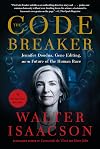
In our generation, codes comprise some of the most interesting subjects of study. We code computers to do work for us; we also are beginning to decode the genetic code to propel life forward. The discovery of CRISPR promises to allow us to edit the human genome, and Professor Doudna sits among this innovation’s prime discoverers. Along with another female scientist Professor Charpentier, she won the Nobel Prize for Chemistry in 2020. This biography, written by eminent historian Walter show more Isaacson, tells her story in a way that clarifies the historical record, explains the core science, and demonstrates that women do really excellent science.
Doudna was inspired as a teenager to become a scientist by reading Watson’s The Double Helix. Like any scientist, she had to persevere along her path, but she eventually earned a PhD from Harvard University en route to a professorship at UC-Berkeley. She found a professional niche in learning everything about RNA. As explained here, through conversations with Charpentier and work by post-doctoral fellows, she eventually developed a way to edit genes.
However, this discovery only invited controversy. The two labs had co-discovered how to do this in bacteria, but could they do this in humans? Other labs began to pursue this question, too, and two groups claim legal priority in this discovery. The courts may decide who will get the money, but the Nobel committee clearly decided that this all-female duo deserved preeminence. Isaacson, a careful writer with a long history of describing innovation, maintains an unbiased tone when dissecting this dilemma.
Ultimately, this book might prove to be the equivalent of The Double Helix for a new generation of scientists, both male and female. It presents Doudna as a noble figure who studies interesting and impactful things. It also presents a host of postdoctoral workers and collaborators who deservedly find their own place in the scientific folklore. Isaacson, though a historian and biographer – not a scientist – never scrimps on the science. He lucidly and accurately describes the biochemical happenings without over-complexifying or over-simplifying.
This book should receive a broad audience among the reading public. As this book repeatedly trumpets, the life sciences are carrying the banner of innovation in the early twenty-first century. Thus, it behooves everyone to learn how to import its insights into our personal lives. Isaacson writes with clarity and vibrancy enough for the general reader, who may not have an advanced scientific education. He also gives readers a taste of how the structure of American science works by providing glimpses into the labs and administrations. Thus, future scientists can learn how science actually works. Many can, have, and will benefit from Isaacson’s explanation of Doudna and company’s labors, and as with CRISPR, benefits will roll in during coming years. show less
Doudna was inspired as a teenager to become a scientist by reading Watson’s The Double Helix. Like any scientist, she had to persevere along her path, but she eventually earned a PhD from Harvard University en route to a professorship at UC-Berkeley. She found a professional niche in learning everything about RNA. As explained here, through conversations with Charpentier and work by post-doctoral fellows, she eventually developed a way to edit genes.
However, this discovery only invited controversy. The two labs had co-discovered how to do this in bacteria, but could they do this in humans? Other labs began to pursue this question, too, and two groups claim legal priority in this discovery. The courts may decide who will get the money, but the Nobel committee clearly decided that this all-female duo deserved preeminence. Isaacson, a careful writer with a long history of describing innovation, maintains an unbiased tone when dissecting this dilemma.
Ultimately, this book might prove to be the equivalent of The Double Helix for a new generation of scientists, both male and female. It presents Doudna as a noble figure who studies interesting and impactful things. It also presents a host of postdoctoral workers and collaborators who deservedly find their own place in the scientific folklore. Isaacson, though a historian and biographer – not a scientist – never scrimps on the science. He lucidly and accurately describes the biochemical happenings without over-complexifying or over-simplifying.
This book should receive a broad audience among the reading public. As this book repeatedly trumpets, the life sciences are carrying the banner of innovation in the early twenty-first century. Thus, it behooves everyone to learn how to import its insights into our personal lives. Isaacson writes with clarity and vibrancy enough for the general reader, who may not have an advanced scientific education. He also gives readers a taste of how the structure of American science works by providing glimpses into the labs and administrations. Thus, future scientists can learn how science actually works. Many can, have, and will benefit from Isaacson’s explanation of Doudna and company’s labors, and as with CRISPR, benefits will roll in during coming years. show less

Oh, to have come of age in the 60's and 70's in what is now widely known as Silicon Valley. For Steve Jobs, born at the right time in the right place with a good mix of skills and luck, it was like having a front row seat to the future. Still, I love this biography for other reasons. It's not simply an account of his life, but an accurate account. One that shows all the fanfare and failings. In the introduction the author relates how Jobs' wife implored him to tell the whole truth about her show more husband. Jobs had many flaws, some of them unforgivable, but it's these moments that create the full picture of a man who would shape the tech world.
Walter Isaacson's book takes the reader through nearly all of Jobs' life, starting from his idyllic childhood being raised by adoptive parents through his experimental drug years, the founding of Apple with Steve Wozniak, early 80's Apple, his exile, NeXT, Pixar, the return to Apple and the tech revolution, and fighting cancer. You'll also meet all the people—friends, loved ones, co-workers, industry contemporaries—that were a part of his story, and all have insight to share.
It doesn't seem right that it's the semi-crazy assholes who pioneer our future. And still people followed Steve Jobs because he could inspire like few ever could. For that I admire him, even while part of me shakes my head at the personal chaos he left in his wake. show less
Walter Isaacson's book takes the reader through nearly all of Jobs' life, starting from his idyllic childhood being raised by adoptive parents through his experimental drug years, the founding of Apple with Steve Wozniak, early 80's Apple, his exile, NeXT, Pixar, the return to Apple and the tech revolution, and fighting cancer. You'll also meet all the people—friends, loved ones, co-workers, industry contemporaries—that were a part of his story, and all have insight to share.
It doesn't seem right that it's the semi-crazy assholes who pioneer our future. And still people followed Steve Jobs because he could inspire like few ever could. For that I admire him, even while part of me shakes my head at the personal chaos he left in his wake. show less
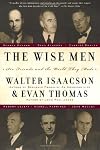
The Wise Men, while an enlightening history of US foreign policy is a frustrating read.
It is the history of the creation of the US foreign policy establishment, its heyday, and its dissolution in the Reagan years. It is told through the biographies of six friends who formed the core of the establishment.
Each were remarkable men. Perhaps the most famous of them were Secretary of State Dean Acheson and the roving millionaire diplomat and once Governor of New York, Averell Harriman, son of the show more the 19th century railroad robber baron, E.H. Harriman.
Its biggest flaw is the absence of context for major events.
We enter the innermost conversations of US presidents, their military and diplomatic advisors.
The book’s high point is really the debate amongst war planners on what to do about the advancing Soviet armies in WWII. Despite wartime agreements Franklin Roosevelt never really pinned Stalin down on what he planned to do once Germany was defeated.
It’s one of the great turning points in history and was fun to read. What Stalin is doing, what Stalin might do, but there is no supporting research here about what the other side was actually thinking.
This book was first published in 1986 and we know so much more about the nascent Soviet Union than we did back then. This book really could stand some updating. For one thing we certainly know that Stalin was about self-preservation first.
American policy makers were scratching their heads over the intentions of the Communists, or were they Russians first and Communists second. Wait a minute, Stalin was Georgian, not Russian. Or perhaps more troubling, was the Soviet Union being being run by a criminal conspiracy that neither well-meaning Communists nor ordinary Russians approved of.
Any or all of these conclusions could have influenced American behaviour.
American policy makers certainly had some reason to believe the Soviet Union wouldn’t stop at Berlin. They had brutally butchered 22,000 Polish officers and intelligentsia in the Katyn Forest in April and May of 1940.
They were avowedly opponents of capitalism.
The extent of Stalin’s paranoia wasn’t fully known at the time, but the Western Allies gave him good reason to be paranoid if he wasn’t before:
1. They secretly developed first the A-Bomb then the Hydrogen bomb behind his back. (They didn’t realize a spy had given the Russians a heads up.)
2. No sooner had they defeated Germany than they were talking about re-arming Germany in the war’s aftermath.
3. They invented NATO to unite Western European nations against the Soviet Union and its satellites.
4. In the Truman years the Americans anointed themselves defenders of freedom around the world...even though knew they didn’t have the resources nor the commitment of Congress to make it happen.
5. The Marshall Plan helped rebuild Western Europe but left Eastern Europe a smoldering dump.
6. They were leaving thousands of troops in Western Europe even though the war was over.
7. They were actively recruiting German rocket experts, most notably Werner von Braun.
8. They were also recruiting German spies, incl. senior spies who had worked for the Nazis.
That was the Truman Doctrine. Self-appointed defenders of freedom.
Then they drew a line somewhere in the Pacific as their security perimeter. Unfortunately, that perimeter didn’t include South Korea and that blunder gave the Soviets and their North Korean clients reason to believe America would not come to South Korea’s defence. Thus the Korean War.
But the authors say nothing about what the Russians were thinking about Korea. Or about Laos. Or what Ho Chi Minh thought about the Chinese Communists north of the border.
And there was only fleeting discussion of CIA-hatched plots to keep countries out of the hands of the Soviets. Italy. Guatemala. Iran. Chile. Bay of Pigs. Funny how the decision to invade Cuba was left out of the book. It was on the Republican’s watch so what the hey. So much for the defenders of freedom.
The authors of this book would probably agree that the western allies time and time again overestimated the Soviet leadership. Stalin ruled his empire with fear. He emerged from the 1930’s having decimated the population of Ukraine with starvation and having slaughtered known and imagined political opponents.
In fact, Stalin’s team were lousy at feeding the population, at preparing for Nazi aggression, and building their foreign reserves. In their march westward they tore up Eastern European railways and industrial plants and left the Warsaw resistors to their fate as the German regiments tore them to pieces with Stalin’s divisions waiting for the dust to settle.
It was a terrible system and the disaster at Chernobyl sealed its fate.
The authors were happy to bury Lyndon Johnson under the debacle of Vietnam. Yes, it was self-inflicted. But the foreign-policy establishment really let him down. We’ll have to wait for Robert Caro’s next volume of The Years of Lyndon Johnson to get a better telling.
There is yet one more part of the story which seems little editorialized by the authors, and that is the distain for which the establishment bureaucrats hold the elected members of Congress.
Now given the hours some of them spent testifying in Congress in front of the red-baiting Sen. Joe McCarthy in the 1950’s, the distain and outright hatred for some of them is completely understandable. But on another level, it is reprehensible if you believe in the idea of self-government by the people.
It is nothing for the authors to praise or blame the Executive Branch for action on foreign policy. They assume it is perfectly ok for the President to make policies which have monumental impact on the budget of the Federal Government and the commitment of its soldiers.
In their minds it is no usurpation of authority for the Executive Branch to take these steps, and go cap in hand to Congress afterward for the spending authority. But as we see in this book, there is never any open discussion of ends and means on these issues.
The authors obscure the background of the Cuban Missile Crisis, an important part of which was the placing of Jupiter missiles in Turkey and they ignore much of the backchannel negotiations possibly because it wasn’t done by the heroes of the book.
The American electorate, somewhat intoxicated by the victory of WWII, followed somewhat blindly into the wars that followed. The authors blithely blame the isolationists for keeping America from taking its rightly place at the head of the community of nations.
Donald Trump is unilaterally ending that place of leadership to the horror of the modern day establishment. But his motivations for doing so are probably more destructive than anything tried before.
Books like this also make you wonder about the limits of sovereignty. Foreign policy is if nothing else, a means with which to project one sovereignty abroad. How helpful was that exercise if today we see the true limits of sovereignty? No obvious way to contain a pandemic. No obvious way to contain international crime. No obvious way to attack climate warming in a concerted global effort.
The allies fighting Nazism gave up a sterling chance to create global cooperation. Instead of competing to build nuclear arsenals NATO and the Soviet Union could have used that cooperation to build lasting institutions far more effective than the United Nations.
They tried it with nuclear test bans and non-proliferation treaties. They should have taken it much further.
All it required was giving up a modicum of sovereignty for the collective good. These “wise men” really could have done more. And they could have used a few wise women.
A new era began with the fall of the Soviet Union in 1989 and, once again, a brief period when Americans were intoxicated with the smell of success. They won the Cold War.
And maybe the seeds the Wise Men had planted flowered after all.
But Putin? Really? show less
It is the history of the creation of the US foreign policy establishment, its heyday, and its dissolution in the Reagan years. It is told through the biographies of six friends who formed the core of the establishment.
Each were remarkable men. Perhaps the most famous of them were Secretary of State Dean Acheson and the roving millionaire diplomat and once Governor of New York, Averell Harriman, son of the show more the 19th century railroad robber baron, E.H. Harriman.
Its biggest flaw is the absence of context for major events.
We enter the innermost conversations of US presidents, their military and diplomatic advisors.
The book’s high point is really the debate amongst war planners on what to do about the advancing Soviet armies in WWII. Despite wartime agreements Franklin Roosevelt never really pinned Stalin down on what he planned to do once Germany was defeated.
It’s one of the great turning points in history and was fun to read. What Stalin is doing, what Stalin might do, but there is no supporting research here about what the other side was actually thinking.
This book was first published in 1986 and we know so much more about the nascent Soviet Union than we did back then. This book really could stand some updating. For one thing we certainly know that Stalin was about self-preservation first.
American policy makers were scratching their heads over the intentions of the Communists, or were they Russians first and Communists second. Wait a minute, Stalin was Georgian, not Russian. Or perhaps more troubling, was the Soviet Union being being run by a criminal conspiracy that neither well-meaning Communists nor ordinary Russians approved of.
Any or all of these conclusions could have influenced American behaviour.
American policy makers certainly had some reason to believe the Soviet Union wouldn’t stop at Berlin. They had brutally butchered 22,000 Polish officers and intelligentsia in the Katyn Forest in April and May of 1940.
They were avowedly opponents of capitalism.
The extent of Stalin’s paranoia wasn’t fully known at the time, but the Western Allies gave him good reason to be paranoid if he wasn’t before:
1. They secretly developed first the A-Bomb then the Hydrogen bomb behind his back. (They didn’t realize a spy had given the Russians a heads up.)
2. No sooner had they defeated Germany than they were talking about re-arming Germany in the war’s aftermath.
3. They invented NATO to unite Western European nations against the Soviet Union and its satellites.
4. In the Truman years the Americans anointed themselves defenders of freedom around the world...even though knew they didn’t have the resources nor the commitment of Congress to make it happen.
5. The Marshall Plan helped rebuild Western Europe but left Eastern Europe a smoldering dump.
6. They were leaving thousands of troops in Western Europe even though the war was over.
7. They were actively recruiting German rocket experts, most notably Werner von Braun.
8. They were also recruiting German spies, incl. senior spies who had worked for the Nazis.
That was the Truman Doctrine. Self-appointed defenders of freedom.
Then they drew a line somewhere in the Pacific as their security perimeter. Unfortunately, that perimeter didn’t include South Korea and that blunder gave the Soviets and their North Korean clients reason to believe America would not come to South Korea’s defence. Thus the Korean War.
But the authors say nothing about what the Russians were thinking about Korea. Or about Laos. Or what Ho Chi Minh thought about the Chinese Communists north of the border.
And there was only fleeting discussion of CIA-hatched plots to keep countries out of the hands of the Soviets. Italy. Guatemala. Iran. Chile. Bay of Pigs. Funny how the decision to invade Cuba was left out of the book. It was on the Republican’s watch so what the hey. So much for the defenders of freedom.
The authors of this book would probably agree that the western allies time and time again overestimated the Soviet leadership. Stalin ruled his empire with fear. He emerged from the 1930’s having decimated the population of Ukraine with starvation and having slaughtered known and imagined political opponents.
In fact, Stalin’s team were lousy at feeding the population, at preparing for Nazi aggression, and building their foreign reserves. In their march westward they tore up Eastern European railways and industrial plants and left the Warsaw resistors to their fate as the German regiments tore them to pieces with Stalin’s divisions waiting for the dust to settle.
It was a terrible system and the disaster at Chernobyl sealed its fate.
The authors were happy to bury Lyndon Johnson under the debacle of Vietnam. Yes, it was self-inflicted. But the foreign-policy establishment really let him down. We’ll have to wait for Robert Caro’s next volume of The Years of Lyndon Johnson to get a better telling.
There is yet one more part of the story which seems little editorialized by the authors, and that is the distain for which the establishment bureaucrats hold the elected members of Congress.
Now given the hours some of them spent testifying in Congress in front of the red-baiting Sen. Joe McCarthy in the 1950’s, the distain and outright hatred for some of them is completely understandable. But on another level, it is reprehensible if you believe in the idea of self-government by the people.
It is nothing for the authors to praise or blame the Executive Branch for action on foreign policy. They assume it is perfectly ok for the President to make policies which have monumental impact on the budget of the Federal Government and the commitment of its soldiers.
In their minds it is no usurpation of authority for the Executive Branch to take these steps, and go cap in hand to Congress afterward for the spending authority. But as we see in this book, there is never any open discussion of ends and means on these issues.
The authors obscure the background of the Cuban Missile Crisis, an important part of which was the placing of Jupiter missiles in Turkey and they ignore much of the backchannel negotiations possibly because it wasn’t done by the heroes of the book.
The American electorate, somewhat intoxicated by the victory of WWII, followed somewhat blindly into the wars that followed. The authors blithely blame the isolationists for keeping America from taking its rightly place at the head of the community of nations.
Donald Trump is unilaterally ending that place of leadership to the horror of the modern day establishment. But his motivations for doing so are probably more destructive than anything tried before.
Books like this also make you wonder about the limits of sovereignty. Foreign policy is if nothing else, a means with which to project one sovereignty abroad. How helpful was that exercise if today we see the true limits of sovereignty? No obvious way to contain a pandemic. No obvious way to contain international crime. No obvious way to attack climate warming in a concerted global effort.
The allies fighting Nazism gave up a sterling chance to create global cooperation. Instead of competing to build nuclear arsenals NATO and the Soviet Union could have used that cooperation to build lasting institutions far more effective than the United Nations.
They tried it with nuclear test bans and non-proliferation treaties. They should have taken it much further.
All it required was giving up a modicum of sovereignty for the collective good. These “wise men” really could have done more. And they could have used a few wise women.
A new era began with the fall of the Soviet Union in 1989 and, once again, a brief period when Americans were intoxicated with the smell of success. They won the Cold War.
And maybe the seeds the Wise Men had planted flowered after all.
But Putin? Really? show less
Lists
Awards


You May Also Like


Associated Authors
Statistics
- Works
- 41
- Also by
- 8
- Members
- 36,083
- Popularity
- #517
- Rating
- 4.1
- Reviews
- 772
- ISBNs
- 523
- Languages
- 31
- Favorited
- 31

