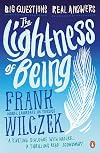
The Lightness of Being: Mass, Ether, and the Unification of Forces
by Frank Wilczek
On This Page
Description
Our understanding of nature's deepest reality has changed radically, but almost without our noticing, over the past twenty-five years. Transcending the clash of older ideas about matter and space, acclaimed physicist Frank Wilczek explains a remarkable new discovery: matter is built from almost weightless units, and pure energy is the ultimate source of mass. He calls it ?The Lightness of Being." Space is no mere container, empty and passive. It is a dynamic Grid?a modern ether? and its show more spontaneous activity creates and destroys particles. This new understanding of mass explains the puzzli show lessTags
Recommendations







Member Reviews
If I devoted the rest of my natural (and unnatural) life to study of quantum physics, I might be within an order of magnitude (one-tenth) of what Frank Wilczek has forgotten about it. A pioneer of quantum chromodynamics in the 1970s and winner of the 2004 Nobel Prize in Physics, Wilczek, in The Lightness of Being, tries to take intensely complicated ideas such as gluon fields and supersymmetry and make them understandable to the lay person. For the most part, he succeeds (the mere fact that I could remember what those were called without opening the book is a feat in and of itself). Wilczek walks the reader through the history (and even some pre-history) of quantum physics, stopping along the way to talk about the current theoreticians show more and their (inevitably) quirky personalities.
All in all, I liked this book. I didn’t immediately glaze over when he wrote about mu leptons at length, and I could even wrap my head around the fact that color charge doesn’t mean the object has color, and I even stuck with it when he started in on the Grid and Mass without Mass. There were quite a few illustrations, but I wished there were more. The problem is that most of the visual aids of quantum physics are math and equations, and those would serve to further complicate the book. If you’ve got a free day and are done with vapid fiction, then try this book out. If not, then just watch an episode of NOVA and call it a day. show less
All in all, I liked this book. I didn’t immediately glaze over when he wrote about mu leptons at length, and I could even wrap my head around the fact that color charge doesn’t mean the object has color, and I even stuck with it when he started in on the Grid and Mass without Mass. There were quite a few illustrations, but I wished there were more. The problem is that most of the visual aids of quantum physics are math and equations, and those would serve to further complicate the book. If you’ve got a free day and are done with vapid fiction, then try this book out. If not, then just watch an episode of NOVA and call it a day. show less
Funny and accessible particle physics but i’m still not sure i understand everything. AND i was hoping to find out where mass comes from but i did not despite Wilczek’s assurances that he would reveal that nugget.
Nonetheless, the range of topics covered in this conversational heavy physics book quenched some of my thirsts for more knowledge on the subject. I now feel i better understand quarks and some of the underlying principles of subatomic particles and gravity. Wilczek also provides anecdotes of him conversing and jockeying with other physics including the great Feynman himself. It was very interesting to see that SUSY (supersymmetry theory) comes very, very close to unifying gravity with the other fundamental forces and to show more learn about the metric field which Wilczek dubs “the Grid” because calling it “the Matrix” would demean it just like the last two movies did the first.
He’s a funny man and, like i said, makes this heady stuff as easily accessible as might be possible. He even refrains from using mathematical formulae to flesh out his tale unlike many others thus he did not lose me. I don’t think…
The appendices and glossary were wonderful and eminently useful additions.
The book covers the constituent particles of matter and how they fit together to form our universe. It explains or describes where it cannot explain what the subatomic and subnuclear world looks like and how it operates. One of the most interesting pieces of information to come out of this book for me was the existence of and functioning of ultrastroboscopic nanomicroscopes - of which, the LHC is one. Because we can’t use our eyes to see in the miniscule wavelengths needed to peer inside nuclear particles, we have to use interference patterns between electrons and photons bouncing off and through those particles. He provides a still photo of a fluctuating cube if gluon fields within a proton that he calls “deep reality.” empty space isn't really empty and here's a snapshot of it not being empty.
Odd, fascinating, and profound but readable and understandable to anyone with a grasp of basic science, i think. show less
Nonetheless, the range of topics covered in this conversational heavy physics book quenched some of my thirsts for more knowledge on the subject. I now feel i better understand quarks and some of the underlying principles of subatomic particles and gravity. Wilczek also provides anecdotes of him conversing and jockeying with other physics including the great Feynman himself. It was very interesting to see that SUSY (supersymmetry theory) comes very, very close to unifying gravity with the other fundamental forces and to show more learn about the metric field which Wilczek dubs “the Grid” because calling it “the Matrix” would demean it just like the last two movies did the first.
He’s a funny man and, like i said, makes this heady stuff as easily accessible as might be possible. He even refrains from using mathematical formulae to flesh out his tale unlike many others thus he did not lose me. I don’t think…
The appendices and glossary were wonderful and eminently useful additions.
The book covers the constituent particles of matter and how they fit together to form our universe. It explains or describes where it cannot explain what the subatomic and subnuclear world looks like and how it operates. One of the most interesting pieces of information to come out of this book for me was the existence of and functioning of ultrastroboscopic nanomicroscopes - of which, the LHC is one. Because we can’t use our eyes to see in the miniscule wavelengths needed to peer inside nuclear particles, we have to use interference patterns between electrons and photons bouncing off and through those particles. He provides a still photo of a fluctuating cube if gluon fields within a proton that he calls “deep reality.” empty space isn't really empty and here's a snapshot of it not being empty.
Odd, fascinating, and profound but readable and understandable to anyone with a grasp of basic science, i think. show less
In 21st century physics, there is no such thing as truly empty space. What we envision as “empty” is a multiplicity of space-filling ethers or fields, where virtual particles pop in and out of existence. The theory of all that activity is called quantum chromodynamics, or QCD. Frank Wilczek, a Nobel Prize winning professor of physics at MIT and one of the developers of QCD, attempts to describe that arcane subject in The Lightness of Being.
Wilczek tackles the profound issues of what is matter and from whence does mass arise. In the process, he introduces us to the details of the most current theories of particle physics. He tells us that the existence of many types of exotic particles was first predicted from the governing show more equations before those particles were ever observed in a laboratory. The actual equations from which the predictions followed are a bit too advanced for a book of this type. He tries to impart the importance to scientists of a unified field theory that could unite the four known forces found in nature into a single overarching set of equations. Alas, although significant progress along those lines has been made, we still lack a way of combining the force of gravity with the other three forces.
Wilczek is a lucid writer with a deft sense of humor, and he avoids all but the simplest equations. His explanation of Einstein’s special theory of relativity is as terse and clear as I have read. Moreover, he provides the reader with a comprehensive glossary that itself would constitute a challenging and fairly thorough introduction to the subject. Nevertheless, the subject matter is TOUGH. I found the first eight chapters (out of 21) pretty easy to understand, but I started to get lost when the book delved into the combinetrics of quarks and gluons.
(JAB) show less
Wilczek tackles the profound issues of what is matter and from whence does mass arise. In the process, he introduces us to the details of the most current theories of particle physics. He tells us that the existence of many types of exotic particles was first predicted from the governing show more equations before those particles were ever observed in a laboratory. The actual equations from which the predictions followed are a bit too advanced for a book of this type. He tries to impart the importance to scientists of a unified field theory that could unite the four known forces found in nature into a single overarching set of equations. Alas, although significant progress along those lines has been made, we still lack a way of combining the force of gravity with the other three forces.
Wilczek is a lucid writer with a deft sense of humor, and he avoids all but the simplest equations. His explanation of Einstein’s special theory of relativity is as terse and clear as I have read. Moreover, he provides the reader with a comprehensive glossary that itself would constitute a challenging and fairly thorough introduction to the subject. Nevertheless, the subject matter is TOUGH. I found the first eight chapters (out of 21) pretty easy to understand, but I started to get lost when the book delved into the combinetrics of quarks and gluons.
(JAB) show less
This is likely the best book I have read on these subjects, and I would recommend it. But I still find myself wondering whom it's written for as the explanations still require a lot of complicated math and a lot of "trust me, we've proven this." I am beginning to doubt that there will ever be a popular physics book that actually brings the understanding that, say, a popular biology or history book does.
Frank Wilczek is a professor of Physics at MIT and has been awarded a Nobel Prize in the field of Quantum Chromo Dynamics (QCD), This places him at the cutting edge of modern theoretical physics. Nevertheless this book can be read and appreciated by anyone with a background in the physical sciences. The style is completely casual and conversational. It is as if Professor Wilczek invited the reader into his home and then said something like 'now you can sit over there on the sofa and I'll sit here in this easy chair and I'll tell you how it really is'. Then the book follows.
The author invites the reader to share with him a new view of matter and a new view of reality. An anchor point in these novel views is the successful completion of show more a calculation which shows that at least 95% of what was previously thought of as matter (material substance) is really energy in the form of excitations (oscillations, vibrations) of the fields which make up the basic fabric of the universe. This dynamic concept is reminiscent of the ideas presented by Alfred North Whitehead in his book "Process and Reality".
The typical reader will be most interested in those parts of the book which deal with the Large Hadron Collider (LHC) which is now being tuned up at CERN in Europe. Wilczek lays his reputation on the line by invoking a novel concept of cosmic superconductivity, supersymmetry and QCD to predict some of the properties of here-to-fore unseen particles which may be produced by the LHC. It will certainly be very interesting to see how this thread plays out.
An aspect of this book may have "unintended consequences". For each type of fundamental particle there is a unique field extending throughout the entire universe, the excitations of which give rise to copies of that particle. For example all electrons are excitations of the one unique 'electron field'. The collection of all of these fields, one for each type of fundamental particle and a few more, is called The Grid. Thus all matter, including the matter in our own bodies, has a common origin in excitations of The Grid. This common origin suggests 'the democratic theory of reality' as a name for this concept.
An alternate theory states that reality consists of little 'micro-billard' balls that have no common origin and hence no method of interaction except by collision. This theory has been called 'reductionism', for example, by Stuart Kauffmann in his book "Reinventing the Sacred". I think a better name would be 'the aristocratic theory of reality' since it provides a philosophical basis for claims that some people are inherently superior to others through their superior origin and hence are not necessarily subject to the same moral code as their inferior counter parts of a distinctly different inferior origin. The social implications of this view have been discussed by David Bohm in the first chapter his book "Wholeness and the Implicate Order".
The science presented in Wilczek's book has been confirmed by many experiments and reviewed by many nationally respected authorities. It is an impeccable and irrefutable scientific presentation. However the possible religious, social and political implications of the result mentioned above, may cause some persons to evaluate this book irrationally and illogically, either excessively laudatory or excessively critical. I have not seen any reactions of this type, but if the reader does encounter some, I hope the reader well recognize their source and origin and proceed to evaluate the book rationally and intelligently according to their own criteria.
The only problem I have with this book is that there are no mathematical equations or formulae to specifically spell out the exact meaning of the verbal descriptions of the new ideas. Wilczek says the publisher 'advised' him to leave them all out. show less
The author invites the reader to share with him a new view of matter and a new view of reality. An anchor point in these novel views is the successful completion of show more a calculation which shows that at least 95% of what was previously thought of as matter (material substance) is really energy in the form of excitations (oscillations, vibrations) of the fields which make up the basic fabric of the universe. This dynamic concept is reminiscent of the ideas presented by Alfred North Whitehead in his book "Process and Reality".
The typical reader will be most interested in those parts of the book which deal with the Large Hadron Collider (LHC) which is now being tuned up at CERN in Europe. Wilczek lays his reputation on the line by invoking a novel concept of cosmic superconductivity, supersymmetry and QCD to predict some of the properties of here-to-fore unseen particles which may be produced by the LHC. It will certainly be very interesting to see how this thread plays out.
An aspect of this book may have "unintended consequences". For each type of fundamental particle there is a unique field extending throughout the entire universe, the excitations of which give rise to copies of that particle. For example all electrons are excitations of the one unique 'electron field'. The collection of all of these fields, one for each type of fundamental particle and a few more, is called The Grid. Thus all matter, including the matter in our own bodies, has a common origin in excitations of The Grid. This common origin suggests 'the democratic theory of reality' as a name for this concept.
An alternate theory states that reality consists of little 'micro-billard' balls that have no common origin and hence no method of interaction except by collision. This theory has been called 'reductionism', for example, by Stuart Kauffmann in his book "Reinventing the Sacred". I think a better name would be 'the aristocratic theory of reality' since it provides a philosophical basis for claims that some people are inherently superior to others through their superior origin and hence are not necessarily subject to the same moral code as their inferior counter parts of a distinctly different inferior origin. The social implications of this view have been discussed by David Bohm in the first chapter his book "Wholeness and the Implicate Order".
The science presented in Wilczek's book has been confirmed by many experiments and reviewed by many nationally respected authorities. It is an impeccable and irrefutable scientific presentation. However the possible religious, social and political implications of the result mentioned above, may cause some persons to evaluate this book irrationally and illogically, either excessively laudatory or excessively critical. I have not seen any reactions of this type, but if the reader does encounter some, I hope the reader well recognize their source and origin and proceed to evaluate the book rationally and intelligently according to their own criteria.
The only problem I have with this book is that there are no mathematical equations or formulae to specifically spell out the exact meaning of the verbal descriptions of the new ideas. Wilczek says the publisher 'advised' him to leave them all out. show less
I'm sure the information is good but I couldn't get past the smarmy condescending tone.
The Lightness of Being is a book on Physics by Nobel Laureate Frank Wilczek. In the book, Dr. Wilczek hopes to impart the ideas of the Grand Unified Theory, basically the Holy Grail of Physics. The Grand Unified Theory (GUT) for those not in the know is an attempt by scientists to rectify the predictions and equations of Quantum Theory and General Relativity. It is an attempt to combine the unimaginably large with the vanishingly small. If you attempt to do so with equations as we have them now, to my understanding, all you get is garbage.
So Dr. Wilczek talks about the standard ideas of Quantum Chromodynamics (QCD), the idea that quarks possess a property known as a ‘color’ to distinguish them from each other. Wilczek introduces the show more idea of what he calls ‘The Grid.’ This is his advanced version of the field that permeates reality. He goes in depth on a lot of subjects but never seems to meander pointlessly. There are color plates in the middle of the book that further illustrates what he is talking about. The end of the book contains three appendices that further elaborate on some of the subjects in the book. For instance, it goes into depth on the ubiquitous Einstein equation E=mc^2.
So all in all, this book was excellent. show less
So Dr. Wilczek talks about the standard ideas of Quantum Chromodynamics (QCD), the idea that quarks possess a property known as a ‘color’ to distinguish them from each other. Wilczek introduces the show more idea of what he calls ‘The Grid.’ This is his advanced version of the field that permeates reality. He goes in depth on a lot of subjects but never seems to meander pointlessly. There are color plates in the middle of the book that further illustrates what he is talking about. The end of the book contains three appendices that further elaborate on some of the subjects in the book. For instance, it goes into depth on the ubiquitous Einstein equation E=mc^2.
So all in all, this book was excellent. show less
Members
- Recently Added By
Author Information

9+ Works 1,428 Members
Currently the Herman Feshbach Professor of Physics at MIT, Frank Wilczek won the Nobel Prize in Physics in 2004 for work that he did as a twenty-one-year-old graduate student. His book, Longing for the Harmonies, was a New York Times Notable Book of the Year. One of the few physicists to join the American Philosophical Society while still show more productive, Wilczek's work has been anthologized in Best American Science Writing and The Norton Anthology of Light Verse. He lives in Cambridge, Massachusetts. show less
Awards and Honors
Notable Lists
Series
Belongs to Publisher Series
BUR: Saggi [Rizzoli] (908)
Saggi [Einaudi] (908)
Common Knowledge
- Original publication date
- 2008
Classifications
Statistics
- Members
- 397
- Popularity
- 78,266
- Reviews
- 11
- Rating
- (3.76)
- Languages
- 5 — Czech, English, Italian, Polish, Spanish
- Media
- Paper, Audiobook, Ebook
- ISBNs
- 12
- ASINs
- 6