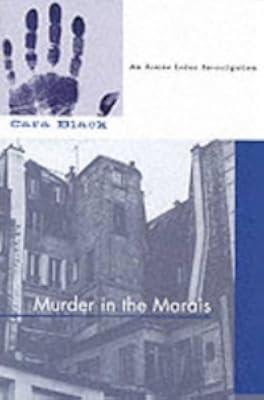
On This Page
Description
Meet Aimée Leduc, the smart, stylish Parisian private investigator, in her bestselling first investigationAimée Leduc has always sworn she would stick to tech investigation—no criminal cases for her. Especially since her father, the late police detective, was killed in the line of duty. But when an elderly Jewish man approaches Aimée with a top-secret decoding job on behalf of a woman in his synagogue, Aimée unwittingly takes on more than she is expecting. She drops off her findings show more at her client’s house in the Marais, Paris’s historic Jewish quarter, and finds the woman strangled, a swastika carved on her forehead. With the help of her partner, René, Aimée sets out to solve this horrendous murder, but finds herself in an increasingly dangerous web of ancient secrets and buried war crimes. show less
Tags
Recommendations






























Member Reviews
Fast-paced thriller that links to past dark days in Parisian history.
A confirmed Aimee Leduc fan, this stunning mystery casts its net around the life of Aimee Leduc and draws her (and me) ever more tightly into the centre of a dark web.
It starts when an elderly gentleman, with the look of a survivor searching for lost ones, presents himself at Aimee's office. He utters these words, 'I knew your father, an honourable man. He told me to come to you if I needed help.'
Aimee doesn't take investigative detective work anymore, she deals in corporate security. This seems like a simply delivery, and she needs the money.
Nothing is ever as it seems with Aimee. She finds herself drawn into the hunt for a killer with Nazi ties through circumstances show more that open her own wounds, haunted as she is by nightmares of her father's death.
This time the past crawls out to confront the future as Aimee finds herself investigating the death of an old Jewish woman who'd been barely a teenager when her parents had been taken by the Gestapo, turned in by a collaborator. Lili Stein had escaped deportation to the camps when Marais had been raided during the Nazi occupation. Now that woman has been brutally murdered and bodies start to pile up, as investigations are mysteriously halted or referred to other branches of the French police and security.
When the final puzzle is brought together it is chilling. The past overshadows the present, lives are turned upside down and old wounds opened and closed. Shocking events mirror each other. Why had Lili boarded up a window? Who fears exposure? Aimee is drawn into the heart of a neo-Nazi organization, dangerous and deluded, in her search for answers.
Aimee finds herself in a fight for her very life, as always impeccably dressed in her designer wear. And this time it saves her life when scrabbling over rooftops pursued by an unknown assassin, 'she had to say one thing for designer wear, it held up under tough conditions.'
(priceless!).
This was a second read for me. It grabbed me just as much now as the first read did.
A NetGalley ARC show less
A confirmed Aimee Leduc fan, this stunning mystery casts its net around the life of Aimee Leduc and draws her (and me) ever more tightly into the centre of a dark web.
It starts when an elderly gentleman, with the look of a survivor searching for lost ones, presents himself at Aimee's office. He utters these words, 'I knew your father, an honourable man. He told me to come to you if I needed help.'
Aimee doesn't take investigative detective work anymore, she deals in corporate security. This seems like a simply delivery, and she needs the money.
Nothing is ever as it seems with Aimee. She finds herself drawn into the hunt for a killer with Nazi ties through circumstances show more that open her own wounds, haunted as she is by nightmares of her father's death.
This time the past crawls out to confront the future as Aimee finds herself investigating the death of an old Jewish woman who'd been barely a teenager when her parents had been taken by the Gestapo, turned in by a collaborator. Lili Stein had escaped deportation to the camps when Marais had been raided during the Nazi occupation. Now that woman has been brutally murdered and bodies start to pile up, as investigations are mysteriously halted or referred to other branches of the French police and security.
When the final puzzle is brought together it is chilling. The past overshadows the present, lives are turned upside down and old wounds opened and closed. Shocking events mirror each other. Why had Lili boarded up a window? Who fears exposure? Aimee is drawn into the heart of a neo-Nazi organization, dangerous and deluded, in her search for answers.
Aimee finds herself in a fight for her very life, as always impeccably dressed in her designer wear. And this time it saves her life when scrabbling over rooftops pursued by an unknown assassin, 'she had to say one thing for designer wear, it held up under tough conditions.'
(priceless!).
This was a second read for me. It grabbed me just as much now as the first read did.
A NetGalley ARC show less
Murder in the Marais is the first Aimee Leduc mystery by Cara Black. It’s filled with the scares of modern day terrorism, the horrors of history, and the sights, smells and sounds of a Paris suburb, specifically of the Marais. There, Jewish families were once betrayed, children starved, and Nazis strode. But now, new white supremacists carry a half-blind torch for the past, and an old woman dies a gruesome death with her secrets undisclosed.
Aimee Leduc is a fascinating character in her own right, with her mother’s disappearance and her father’s death offering equal depth to her skills. A wealth of disguises, smooth physical prowess, a talent for asking the right, or seriously wrong questions, and enviable computer skills, all help show more her with the case. Meanwhile her partner Rene surely hides many mysteries of his own.
Together, the intrepid duo navigate taxes owed, dangerous allies, awkward politics, and unexpected deaths. Bullets pepper the Paris streets. The European Union advances its cause. And history tries to repeat itself. It’s heady stuff, convincingly told, with detailed facts nicely hidden in evocative description, and disparate viewpoints that gradually gel into complex threads of revelation. And it’s great fun. I’m eager to read more.
Disclosure: It was a Christmas present and I offer my honest review. show less
Aimee Leduc is a fascinating character in her own right, with her mother’s disappearance and her father’s death offering equal depth to her skills. A wealth of disguises, smooth physical prowess, a talent for asking the right, or seriously wrong questions, and enviable computer skills, all help show more her with the case. Meanwhile her partner Rene surely hides many mysteries of his own.
Together, the intrepid duo navigate taxes owed, dangerous allies, awkward politics, and unexpected deaths. Bullets pepper the Paris streets. The European Union advances its cause. And history tries to repeat itself. It’s heady stuff, convincingly told, with detailed facts nicely hidden in evocative description, and disparate viewpoints that gradually gel into complex threads of revelation. And it’s great fun. I’m eager to read more.
Disclosure: It was a Christmas present and I offer my honest review. show less
Aimée Leduc is spike-haired, with jeans, leather jacket and boots. She is the daughter of a flic, a Parisian policeman, and his American wife who bolted when Aimée was eight years old—we don’t know why, but I suspect someone corrected her French pronunciation one time too many. Aimée has a sidekick named René who is a computer wizard, and together they run a quiet little agency in the Rue de Louvre, specializing in computer security. Aimée does a small computer-hacking job for a client in the Marais quarter of Paris, but when she finds her client shot dead with a swastika carved in her forehead, Aimée suddenly becomes a murder investigator.
The Marais is historically the Jewish quarter of Paris, between the Place de la show more Bastille and what is now the Centre Georges Pompidou. This quarter and the Rue de Louvre where she has her office and the Ile St. Louis where Aimée has inherited an apartment from her grandfather all form the backdrop for this mystery, which has its beginnings in Nazi-occupied Paris, but is very much about the city and its people in the nineties. This book shows us Paris from the rooftops to the catacombs and the sewers. Aimée Leduc’s creator, Cara Black, is not French but American, but this sort of cultural appropriation is common in detective fiction, where you will find a French detective created by a Belgian, a Belgian detective created by an Englishwoman, and English, Irish, and Italian detectives all created by Americans. And of course, the original fictional detective was also a Parisian created by the American Edgar Allan Poe.
What we have in Aimée Leduc is a detective very much in the hard-boiled school, with a French twist. She is resourceful with costumes, wigs, and the quick lie. She’s tough and resilient. She survives jumping out of a moving car to escape the Neo-Nazi hate group she’d infiltrated, and she’s also knocked off her moped and nearly murdered by hit men. She’s as handy with a gun as with a computer. If you like Sara Paretsky’s V. I. Warshawski and have a soft spot for the City of Lights, Aimée Leduc is probably your demitasse.
Murder in the Marais is the first of five mysteries Cara Black has written about this character. The first three have been optioned by a Dublin production company, but so far I’ve heard of no TV or movie feature that has resulted. All of the books deal with particular quarters that Black calls “funky . . . gritty, off-the-beaten-tourist track Paris”—Belleville, the Sentier, the Bastille, and Clichy, as well as the Marais—and all feature Aimée Leduc. show less
The Marais is historically the Jewish quarter of Paris, between the Place de la show more Bastille and what is now the Centre Georges Pompidou. This quarter and the Rue de Louvre where she has her office and the Ile St. Louis where Aimée has inherited an apartment from her grandfather all form the backdrop for this mystery, which has its beginnings in Nazi-occupied Paris, but is very much about the city and its people in the nineties. This book shows us Paris from the rooftops to the catacombs and the sewers. Aimée Leduc’s creator, Cara Black, is not French but American, but this sort of cultural appropriation is common in detective fiction, where you will find a French detective created by a Belgian, a Belgian detective created by an Englishwoman, and English, Irish, and Italian detectives all created by Americans. And of course, the original fictional detective was also a Parisian created by the American Edgar Allan Poe.
What we have in Aimée Leduc is a detective very much in the hard-boiled school, with a French twist. She is resourceful with costumes, wigs, and the quick lie. She’s tough and resilient. She survives jumping out of a moving car to escape the Neo-Nazi hate group she’d infiltrated, and she’s also knocked off her moped and nearly murdered by hit men. She’s as handy with a gun as with a computer. If you like Sara Paretsky’s V. I. Warshawski and have a soft spot for the City of Lights, Aimée Leduc is probably your demitasse.
Murder in the Marais is the first of five mysteries Cara Black has written about this character. The first three have been optioned by a Dublin production company, but so far I’ve heard of no TV or movie feature that has resulted. All of the books deal with particular quarters that Black calls “funky . . . gritty, off-the-beaten-tourist track Paris”—Belleville, the Sentier, the Bastille, and Clichy, as well as the Marais—and all feature Aimée Leduc. show less
Rubbish. This book had an unbelievable, far-fetched plot and was clumsily put together. What surprised me the most about it was that I liked it when I first read it, over twelve years ago. I can't imagine how that could be except that maybe I was taken with all the cobblestones and chocolate croissants, the story being set in Paris. So I expected to like it again, but I didn't. At one point towards the end, I thought maybe this is all tongue-in-cheek, and that's why the plot is so improbable. But if that was the case, it would be unforgivably offensive that the author used the holocaust and Nazi occupation as a tasteless fill in for her storytelling.
What's fun with Aimée Leduc is that not only is she spunky and clever, she's also fallible. Contrarily to so many sleuths, she makes mistakes and sometimes leaves bodies in her wake. This makes her human, without making her a bumbling idiot or a super detective.
This backdrop of WWII showing the horrific side of the Nazis and the après-guerre makes the modern murders even more potent and gripping.
Aimée is a true Parisian despite her half-American heritage, which makes her interesting and adds to her dimension.
Too bad Black's publisher doesn't believe in splurging for a bilingual editor - the French sure could use some cleaning up.
This backdrop of WWII showing the horrific side of the Nazis and the après-guerre makes the modern murders even more potent and gripping.
Aimée is a true Parisian despite her half-American heritage, which makes her interesting and adds to her dimension.
Too bad Black's publisher doesn't believe in splurging for a bilingual editor - the French sure could use some cleaning up.
Somehow Aimée Leduc is an archetypal French woman: breezy, stylish, skillful, thrifty, sexy, and she has a curly haired lapdog that never needs a walk. She also has a dwarf and an apartment in an ancient unheated Parisian building. If this sounds unbelievable, it is, but as we give the French as a whole a pass on this kind of stuff, we should certainly should allow Aimée to entertain us.
Aimée is a trained detective who specializes in industrial espionage. She and her colleague, the dwarf René, are computer hackers who never ever do field work after some earlier exploits that are never fully explained but which left Aimée wounded. One day, though, an elderly Jewish gentleman arrives at Aimée's office and asks her to deliver an show more envelope to an elderly Jewish woman who lives in the Marais. (I never quite figured out why he could not do it himself.) Aimée thinks that while this job is outside her new operating parameters, the bank account is empty, the rent is due, and the taxman is calling, so she agrees to run this simple errand. When she arrives, the old woman is dead and then the old man is murdered. Aimée uses her prodigious skill set and an assortment of disguises (including posing as a neo-Nazi) to solve the murder. The murderer's identity is implausible and, like the hyper-successful continuation of the underground Nazi political cell "Werwolf" ("Werewolf" in English"), completely unneeded. Simplicity would have been better.
"Murder in the Marais" was published in 1998 but it is set in 1993. This date is somewhat arbitrary as Ms Black needed to find a time modern enough so Aimée could be a computer hacker but early enough that the characters in the story who were thrown together by WW2, were still young enough to be professionally active. This did not work very well, I thought, but I tend to forget how young soldiers were in WW2. Here we are told that one of the soldiers was only 18. Maybe, but it did not feel right.
All in all "Murder in the Marias" is a first book and is a little rough. But it is amusing and I enjoyed it even though I rolled my eyes a bit.
I received a review copy of "Murder in the Marais" by Cara Black (SoHo Press) through NetGalley.com. show less
Aimée is a trained detective who specializes in industrial espionage. She and her colleague, the dwarf René, are computer hackers who never ever do field work after some earlier exploits that are never fully explained but which left Aimée wounded. One day, though, an elderly Jewish gentleman arrives at Aimée's office and asks her to deliver an show more envelope to an elderly Jewish woman who lives in the Marais. (I never quite figured out why he could not do it himself.) Aimée thinks that while this job is outside her new operating parameters, the bank account is empty, the rent is due, and the taxman is calling, so she agrees to run this simple errand. When she arrives, the old woman is dead and then the old man is murdered. Aimée uses her prodigious skill set and an assortment of disguises (including posing as a neo-Nazi) to solve the murder. The murderer's identity is implausible and, like the hyper-successful continuation of the underground Nazi political cell "Werwolf" ("Werewolf" in English"), completely unneeded. Simplicity would have been better.
"Murder in the Marais" was published in 1998 but it is set in 1993. This date is somewhat arbitrary as Ms Black needed to find a time modern enough so Aimée could be a computer hacker but early enough that the characters in the story who were thrown together by WW2, were still young enough to be professionally active. This did not work very well, I thought, but I tend to forget how young soldiers were in WW2. Here we are told that one of the soldiers was only 18. Maybe, but it did not feel right.
All in all "Murder in the Marias" is a first book and is a little rough. But it is amusing and I enjoyed it even though I rolled my eyes a bit.
I received a review copy of "Murder in the Marais" by Cara Black (SoHo Press) through NetGalley.com. show less
Sadly disappointing. I had heard that this was an atmospheric detective novel set in one of my (everyone’s?) favourite cities, and had hopes for it. But it’s an action genre novel with characters of little depth who exist primarily to push the plot from one improbable point to another. It’s set in the Marais, and refers to many sites and buildings that are fond recollections, but they are used as little more than flat background. They don’t add atmosphere, just setting. The neo-Nazi plot could have been intriguing, but again it’s just a plot device in which some bad guys play, and is no more illuminating than the crime scenes in a gangster novel. There’s no emotional involvement in the characters because they are too show more limited, and even the attempts to give them a back-story don’t go anywhere. The final confrontation is so absurd, with literally a Deus ex machina resolution, that I had to wonder if the author was having a sly chuckle with us about the conventions of the made-for-tv novel. But I think not – it’s more like the hopeful scenario for a series that the author wants to sell to a movie or television production company. Perhaps I was expecting too much – this isn’t Victor Hugo, although it is set in his city (and home) – but I’m not drawn to try her other novels. show less
Members
- Recently Added By
Lists

Majkia's Mystery/ Thriller TBR
86 works; 3 members

Chronological 2017
30 works; 1 member

Books Read in 2014
2,344 works; 89 members

Allie's Wishlist
217 works; 2 members

Paris, City of Lights
103 works; 17 members
Author Information

Cara Black was born in Chicago, Illinois on November 14, 1951. She was educated at Cañada College in California, Sophia University in Yotsuya, Tokyo in Japan, and finished her degree at San Francisco State University with a BA and an MA in education. She has worked as a preschool teacher and as director of a preschool. Black is a bestselling show more American mystery writer. She is best known for her Aimée Léduc mystery novels featuring a female Paris-based private investigator. (Bowker Author Biography) show less
Some Editions
Awards and Honors
Awards
Notable Lists
Series

Work Relationships
Common Knowledge
- Canonical title
- Murder in the Marais
- Original publication date
- 1999
- People/Characters
- Aimée Leduc; Soli Hecht; Lili Stein; Abraham Stein; Commissaire Morbier; René Friant (show all 12); Hartmuth Griffe; Ilse Häckl; Rachel Blum; Sarah Strauss; Thierry Rambuteau; Claude Rambuteau
- Important places
- Paris, France
- Important events
- World War II
- Epigraph
- Fate knows no distance -- a French saying
- Dedication
- Dedicated to the 'real' Sarah and all the ghosts, past and present
- First words
- Aimée Leduc felt his presence before she saw him.
- Last words
- (Click to show. Warning: May contain spoilers.)"If he asks. Otherwise, I'll let the ghosts alone. All of them," she said.
- Blurbers
- Grant, Linda; Smith, Sarah; King, Laurie
- Canonical DDC/MDS
- 813.6
- Canonical LCC
- PS3552.L297
Classifications
Statistics
- Members
- 1,207
- Popularity
- 20,622
- Reviews
- 62
- Rating
- (3.20)
- Languages
- English, German, Spanish
- Media
- Paper, Audiobook, Ebook
- ISBNs
- 18
- ASINs
- 13