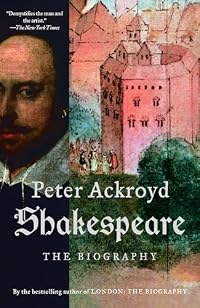
Shakespeare: The Biography
by Peter Ackroyd
On This Page
Description
Biographer and novelist Ackroyd brings William Shakespeare to life in the manner of a contemporary rather than a biographer. His method is to position the playwright in the context of his world, exploring everything from Stratford's humble town to its fields of wildflowers; discerning influences on the plays from unexpected quarters; and entering London with the playwright as modern theatre, as we know it, is just beginning to emerge. Writing as though we are observing Shakespeare and his show more circle of friends, patrons, managers, and fellow actors and writers, Ackroyd is able to see Shakespeare's genius from within, so we feel that Ackroyd the writer merges with Shakespeare the writer, the poet, the man; and thus with great sympathy and clarity we experience the way in which Shakespeare worked.--From publisher description. show lessTags
Recommendations






Member Reviews
My heart always sings when I pick up a Peter Ackroyd biography. I expect that I shall read an interesting account of the person, but one that does not push any particular bias. I have yet to be disappointed and, certainly, this biography of William Shakespeare never looked likely to buck the trend. Mr Ackroyd respects Shakespeare's position at the pinnacle of British writers without glossing over the deficiencies that any human must possess.
The information concerning the life of Shakespeare is not sufficient to produce a definite story from the cradle to the grave so, Peter Ackroyd gives us what definite knowledge exists and adds the gossip and rumour that surrounds the man. What I particularly like, is that the fact and surmise are show more clearly separated. He sets out the basis for any unsubstantiated details, gives any supporting evidence and leaves the reader to decide how much credence to give to it.
When one is writing about someone who lived in a very different age to our own, it is important that the historical background is set. This book does this in an admirable fashion; the reader is not lectured, but the detail is all there. One other point which is vital when discussing an earlier age, is to see it through the eyes of the moral standards of the time. Ackroyd, by standing aloft from his subject, reports, without any judgement.
The greatest compliment that one can give to any biography is that it sends the reader scurrying to re-read the poems and re-watch the plays of William Shakespeare. I recently read a fictional biography of the Bard and, at the end, felt dis-satisfied and not drawn to re-engage with Mr Shakespeare's work: with this book, I was re-watching the plays before completing the book. Not only does this work bring the man to life, it adds a new facet to the plays and sonnets.
I would imagine that this biography has enough detail to be worth the time for a Shakespeare expert to read,: without question,it is written in such a way that someone, such as myself, with only the most basic schoolboy awareness of the man and his works can read, enjoy and learn. Thank you, Mr. Ackroyd, for bringing William Shakespeare to life for one ignorant reader. show less
The information concerning the life of Shakespeare is not sufficient to produce a definite story from the cradle to the grave so, Peter Ackroyd gives us what definite knowledge exists and adds the gossip and rumour that surrounds the man. What I particularly like, is that the fact and surmise are show more clearly separated. He sets out the basis for any unsubstantiated details, gives any supporting evidence and leaves the reader to decide how much credence to give to it.
When one is writing about someone who lived in a very different age to our own, it is important that the historical background is set. This book does this in an admirable fashion; the reader is not lectured, but the detail is all there. One other point which is vital when discussing an earlier age, is to see it through the eyes of the moral standards of the time. Ackroyd, by standing aloft from his subject, reports, without any judgement.
The greatest compliment that one can give to any biography is that it sends the reader scurrying to re-read the poems and re-watch the plays of William Shakespeare. I recently read a fictional biography of the Bard and, at the end, felt dis-satisfied and not drawn to re-engage with Mr Shakespeare's work: with this book, I was re-watching the plays before completing the book. Not only does this work bring the man to life, it adds a new facet to the plays and sonnets.
I would imagine that this biography has enough detail to be worth the time for a Shakespeare expert to read,: without question,it is written in such a way that someone, such as myself, with only the most basic schoolboy awareness of the man and his works can read, enjoy and learn. Thank you, Mr. Ackroyd, for bringing William Shakespeare to life for one ignorant reader. show less
This is a fascinating account of William Shakespeare, with much more theatrical detail than I've ever read or heard before. There is more information than can be remembered, but I really appreciated that conjecture was all well backed up with data, mostly financial and theatrical records. It was a different view from past books I've read. I also really liked that he discussed in detail the many suppositions that have been made about Shakespeare and why they may or may not be accurate, if they were probable, possible but unknown, improbable, or nearly impossible. Ackroyd is quite careful not to state anything is absolutely true without lots of evidence and explanation. Granted, that means there's a lot of data and a lot of threads to show more follow, but it's intriguing and well written.
Ackroyd's writing style is perfect for this; at times he puts phrases together like a modern Shakespeare.
This is not the book for a very casual Shakespeare enthusiast; the more you are familiar with him and his plays and theater in general, the more interesting this is. If you are just beginning your study of Shakespeare, I would read a more generalized book first. Also, if you are mostly interested in an analysis of Shakespeare's plays in order to reveal Shakespeare's life and persona, this is not that biography. The plays are analyzed, but with more emphasis on what was happening in England and the theatrical world at the time. How they related to Shakespeare's life at the time was discussed, but because how he felt about things is more conjecture, Ackroyd does not focus on that. show less
Ackroyd's writing style is perfect for this; at times he puts phrases together like a modern Shakespeare.
This is not the book for a very casual Shakespeare enthusiast; the more you are familiar with him and his plays and theater in general, the more interesting this is. If you are just beginning your study of Shakespeare, I would read a more generalized book first. Also, if you are mostly interested in an analysis of Shakespeare's plays in order to reveal Shakespeare's life and persona, this is not that biography. The plays are analyzed, but with more emphasis on what was happening in England and the theatrical world at the time. How they related to Shakespeare's life at the time was discussed, but because how he felt about things is more conjecture, Ackroyd does not focus on that. show less
A first rate look at the life of England's most famous dramatist. The details are amazing, even the trivial details are interesting. The author makes no claims to know things that are not known, and often will discuss all the differing views on what a piece of evidence means, and discuss the likelihood of each idea. He examines the youth of Shakespeare in some detail, and discusses the ideas about his relationship with his wife. He does not jump feet first into the fray of who wrote Shakespeare's plays, but instead moves ahead with the assumption that Shakespeare himself wrote Shakespeare's plays, while at times discussing the reasons why the other candidates don't work. Upon reading this book, it is difficult to see where those other show more candidates came from, or even the idea that there was someone other than Shakespeare who wrote Shakespeare's plays. Far from being unmentioned in his own time as is often posited, Ackroyd assembles an impressive array of mentions of Shakespeare by his contemporaries, both praise and dismissal. Though he is by no means as often mentioned as many of the other playwrights, Ackryod details the particulars of Shakespeare's life as they are known to demonstrate that the man lived a relatively private and less flamboyant existence than the other playwrights, and also that he is mentioned as the author of his plays repeatedly throughout his life. He also discusses the education and likely apprenticeship of the playwright, and finds the idea that he was illiterate or nearly so to be lacking any evidence or support. A must read for all fans of the bard, because it helps understand his plays better by putting them in the context not only of the time, but the place in which they were written. The main downside is the length, which is daunting, and some of the details are not necessary. But with such well-written prose and such extensive research, that can be forgiven. Just plan on devoting some real time to it. show less
Ackroyd is almost lawyer-like in his reasoning that supports his assumptions about the plays and the life. It will inform my understanding of the Bard from now on. A key point for the author is the Bard's Catholicism, which had an effect on all his writing. Also, Ackroyd skillfully debunks the Oxfordians and others. I like how he explains to readers that it's OK to recognize and appreciate Shakespeare's Genius with a capital G. He was a freak - everything in his life contributed to who he became, but it was that mysterious spark we all wish we had that led to his body of work. He was who he was and who he was was better than anybody else ever. Get over it, Justice John Paul Stevens.
Describing himself as a Shakespeare enthusiast instead of an expert, Ackroyd focuses on the bard as an extraordinarily talented theatre professional rather than rhapsodising about the intricacies of the man's genius. He interweaves Shakespeare's life story with England's dramatic history and the fascinating world of the emerging Elizabethan theatre. Apocryphal stories are identified and plausible explanations for what occurred during the missing years are offered. The great strength of Ackroyd's book is the depth of his immersion in the culture of Shakespeare's age and the sense he gives of Shakespeare as a product of that extraordinary moment in time. His feeling for the role of the theater in Elizabethan London, "a city where dramatic show more spectacles became the primary means of understanding reality," seems to come from an impressively wide reading of Shakespeare's dramatic and poetic contemporaries. Shakespeare emerges as a thoroughly engaging, almost modern man, brimming with humour, eager for social advancement, and carefully tracking the popular trends in entertainment. Students who want to discover whether Shakespeare really was the author of the famous plays will find compelling evidence that only the man from Stratford could have hidden so many ingenious clues in his work. show less
Ackroyd uses his considerable skills to evoke time and place in this biography to present as close to a living, breathing Shakespeare as is possible when so much is unknown. That he does this without presenting speculation as fact is no mean feat. Compare this excellent biography with "Will in the World" or worse, "In Search of Shakespeare," both of which make unwarranted assumptions about Shakespeare through an examination of his work, which is like arguing after reading "The Metamorphosis" that Kafka must have believed he was a bug. In contrast Ackroyd, the quintessential Londoner, takes what is actually known about Shakespeare, places it in context of what is known about Elizabethan and Jacobean London, and brings his subject to life show more without making him a fictional character. While drawing appropriate inferences where possible, Ackroyd stays respectfully clear of speculation about Shakespeare's religious beliefs, his sexuality, and his family life, choosing instead to focus on the more solid ground of his life as a professional dramatist and poet. By doing so, he blows away much of the Shakespearen myth. "He was a man, take him for all in all, we shall not look upon his like again." show less
A standard biography of Shakespeare, with the lucid, engaging prose of Peter Ackroyd. There are few endnotes, but mostly the sources Ackroyd uses are mentioned in the text. There is a serviceable bibliography. Nice images. Ackroyd is a Stratfordian, and offers reliable, solid evidence that Shakspere the man from Stratford-upon-Avon was the actor AND playwright Shakespeare of London. (No evidence that will convince the average, paranoiac, anti-Stratfordian conspiracy theorist, however, but convincing to me.) Shakespeare the man and Shakespeare the playwright are brought to life in almost novelist-like detail here (as much as is possible with the oftentimes scanty documentation of Shakespeare's life). The story is interesting and show more essential. To me, this is the essential one-volume life of Shakespeare for the general reader for this generation (much like Rowse's was a generation or two ago). show less
Members
- Recently Added By
Published Reviews
ThingScore 25
Most biographies, John Updike has observed, “are really just novels with indexes.” That seems especially true with lives of Shakespeare. Peter Ackroyd’s rather arrogantly subtitled Shakespeare: The Biography, although its flights of fancy are far less extreme than Asquith’s, also trespasses upon the terrain of fiction. So, “we may imagine [Shakespeare] to have been a singularly show more competitive small boy” and “no doubt easily bored.” As a man, he was apparently “given to lustfulness but fastidious in other particulars,” something which, we are told, “by a curious chance consorts well with the imagery of the plays where there are plentiful references to bawdiness, but where there is also evidence of a general sensitivity to unpleasant sights or smells.” And so on, ad infinitum. show less
added by private library
Lists

1001 Books You Must Read Before You Die
1,448 works; 1,132 members

Top Five Books of 2013
1,564 works; 722 members

Books Read in 2013
1,629 works; 51 members
Author Information

90+ Works 31,852 Members
Peter Ackroyd was born in London in 1949. He graduated from Cambridge University and was a Fellow at Yale (1971-1973). A critically acclaimed and versatile writer, Ackroyd began his career while at Yale, publishing two volumes of poetry. He continued writing poetry until he began delving into historical fiction with The Great Fire of London show more (1982). A constant theme in Ackroyd's work is the blending of past, present, and future, often paralleling the two in his biographies and novels. Much of Ackroyd's work explores the lives of celebrated authors such as Dickens, Milton, Eliot, Blake, and More. Ackroyd's approach is unusual, injecting imagined material into traditional biographies. In The Last Testament of Oscar Wilde (1983), his work takes on an autobiographical form in his account of Wilde's final years. He was widely praised for his believable imitation of Wilde's style. He was awarded the British Whitbread Award for biography in 1984 of T.S. Eliot, and the Whitbread Award for fiction in 1985 for his novel Hawksmoor. Ackroyd currently lives in London and publishes one or two books a year. He still considers poetry to be his first love, seeing his novels as an extension of earlier poetic work. (Bowker Author Biography) Peter Ackroyd is the award-winning author of four biographies, most recently the national bestseller "The Life of Thomas More", as well as ten novels, including "Chatterton" & "Hawksmoor". He lives in London, where he is at work on his next book, "London: The Biography. (Publisher Provided) Peter Ackroyd is a bestselling writer of both fiction and nonfiction. He lives in London. (Publisher Provided) show less
Common Knowledge
- Original title
- Shakespeare: The Biography
- Original publication date
- 2005
- People/Characters
- William Shakespeare
- Important places
- Stratford-upon-Avon, Warwickshire, England, UK
- First words
- William Shakespeare is popularly supposed to have been born on 23 April 1564, or St George's Day.
- Last words
- (Click to show. Warning: May contain spoilers.)The volume is adorned by the Droeshout engraving of the dramatist, which is indeed the only generally accepted likeness of William Shakespeare.
- Original language
- English
Classifications
- Genres
- Poetry, Biography & Memoir, Literature Studies and Criticism
- DDC/MDS
- 822.33 — Literature & rhetoric English & Old English literatures English drama Elizabethan 1558-1625 Shakespeare, William 1564–1616
- LCC
- PR2894 .A26 — Language and Literature English English Literature English renaissance (1500-1640)
- BISAC
Statistics
- Members
- 1,369
- Popularity
- 17,273
- Reviews
- 19
- Rating
- (4.00)
- Languages
- 9 — Dutch, English, French, German, Hungarian, Italian, Portuguese, Russian, Spanish
- Media
- Paper, Audiobook, Ebook
- ISBNs
- 28
- ASINs
- 7