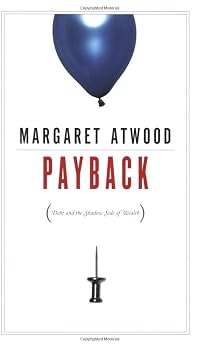
Payback: Debt and the Shadow Side of Wealth
by Margaret Atwood
On This Page
Description
Collected here, the Massey Lectures from legendary novelist Margaret Atwood investigate the highly topical subject of debt, exploring debt as an ancient and central motif in religion, literature, and the structure of human societies.Tags
Recommendations






Member Reviews
I really enjoyed this series of essays where Atwood explores debt and credit from a philosophical, sociological, historical and literary perspective. Our built in sense of justice and equity, our inherited morals and culture, our collective history, all impact the way we view money and debt. She ends with the impact of our capitalist society and its toll on our planet and proposes a reframing: not a popular outlook but certainly a needed one. An interested and wild ride through the world of money.
The 2008 Massey Lectures are about debt and are delivered by Margaret Atwood. This review is an attempt at a more eloquent way of saying "Worst. Massey Lectures. Ever."
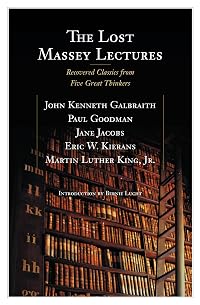
With the Masseys, you have a tradition of experts being invited to deliver a series of lectures about the stuff they really know about. Examples from my own bookshelf include Martin Luther King Jr. about the civil rights movement (1967), Noam Chomsky about controlling dissent in democratic societies (1988), and Stephen Lewis about AIDS in Africa (2005).
And now Margaret Atwood on...debt? I gave it a chance but it just doesn't work.
To top things off, I got excited when I saw that the second lecture mentioned Systems of Survival by Jane Jacobs. My hopes were quickly dashed show more as Atwood completely misinterpreted what Jacobs wrote, and then went off on this incorrect bearing for half of the lecture. It's downright embarrassing. It's like she read Jacobs' book years ago and didn't bother to go back to make sure her memories of it were correct.
She makes attempts at joking, which seem very out of place in such lectures. Even then, they might have worked had they actually been funny. The jokes feel like padding; they're that unnecessary. An example (p. 57), in which she mentions Emile Zola's novel, Germinal:
"You'll be pleased to learn that there's a famous riot scene in which the wives and daughters get their full revenge, and the genital organs of the store owner are skewered on a stick that's carried in triumphant procession through the streets - a crude form of entertainment, granted, but there was no TV then."
Was it really necessary to add that last bit? It's lazy, it's not funny, and it adds nothing to the lecture at all.
The jokes, while irritating, aren't as insulting as some of the other bits. In the third lecture, "Debt as Plot", she suggests that we are tempted to go into debt because it keeps the excitement in our lives:
"Could it be that some people get into debt because, like speeding on a motorbike, it adds an adrenaline hit to their otherwise humdrum lives? When the bailiffs are knocking at the door and the lights go off because you didn't pay the hydro and the bank's threatening to foreclose, at least you can't complain of ennui."
That makes for great storytelling but it adds nothing to the understanding of causes and effects of debt. Margaret Atwood may be able to laugh off debt by saying that her father had to pawn his fountain pen back in the late 1930s; the rest of us wouldn't mind a bit more insight from someone with an understanding of the causes and effects of the current financial meltdown, as well as those past (and many of us have more harrowing family stories of the great depression than having a family member *gasp* pawning a fountain pen).
In the past, the Massey Lectures have been given by experts sharing their knowledge about a topic. This year, Margaret Atwood is learning about debt on the spot. Her intro says it all:
"The motive for this book is curiosity - mine - and my hope is that the writing of it will allow me to explore a subject I know little about, but which for this reason intrigues me. That subject is debt."
Given the current economic situation, I can't think of a better topic to address in this year's Masseys. I also can't think of a worse person to broach that subject than Margaret Atwood. show less
With the Masseys, you have a tradition of experts being invited to deliver a series of lectures about the stuff they really know about. Examples from my own bookshelf include Martin Luther King Jr. about the civil rights movement (1967), Noam Chomsky about controlling dissent in democratic societies (1988), and Stephen Lewis about AIDS in Africa (2005).
And now Margaret Atwood on...debt? I gave it a chance but it just doesn't work.
To top things off, I got excited when I saw that the second lecture mentioned Systems of Survival by Jane Jacobs. My hopes were quickly dashed show more as Atwood completely misinterpreted what Jacobs wrote, and then went off on this incorrect bearing for half of the lecture. It's downright embarrassing. It's like she read Jacobs' book years ago and didn't bother to go back to make sure her memories of it were correct.
She makes attempts at joking, which seem very out of place in such lectures. Even then, they might have worked had they actually been funny. The jokes feel like padding; they're that unnecessary. An example (p. 57), in which she mentions Emile Zola's novel, Germinal:
"You'll be pleased to learn that there's a famous riot scene in which the wives and daughters get their full revenge, and the genital organs of the store owner are skewered on a stick that's carried in triumphant procession through the streets - a crude form of entertainment, granted, but there was no TV then."
Was it really necessary to add that last bit? It's lazy, it's not funny, and it adds nothing to the lecture at all.
The jokes, while irritating, aren't as insulting as some of the other bits. In the third lecture, "Debt as Plot", she suggests that we are tempted to go into debt because it keeps the excitement in our lives:
"Could it be that some people get into debt because, like speeding on a motorbike, it adds an adrenaline hit to their otherwise humdrum lives? When the bailiffs are knocking at the door and the lights go off because you didn't pay the hydro and the bank's threatening to foreclose, at least you can't complain of ennui."
That makes for great storytelling but it adds nothing to the understanding of causes and effects of debt. Margaret Atwood may be able to laugh off debt by saying that her father had to pawn his fountain pen back in the late 1930s; the rest of us wouldn't mind a bit more insight from someone with an understanding of the causes and effects of the current financial meltdown, as well as those past (and many of us have more harrowing family stories of the great depression than having a family member *gasp* pawning a fountain pen).
In the past, the Massey Lectures have been given by experts sharing their knowledge about a topic. This year, Margaret Atwood is learning about debt on the spot. Her intro says it all:
"The motive for this book is curiosity - mine - and my hope is that the writing of it will allow me to explore a subject I know little about, but which for this reason intrigues me. That subject is debt."
Given the current economic situation, I can't think of a better topic to address in this year's Masseys. I also can't think of a worse person to broach that subject than Margaret Atwood. show less
I found this a very interesting view on Debt (financial and other) and man's attitude to it through the ages. Atwood explores it in the context of ancient civilizations and justice and then moves more into the modern era and considers the good and bad sides of debt. I was intrigued by the view that the requirement for money and capital flow that arose with the industrial revolution and capitalism changed our attitudes to debt radically. She also comes to the conclusion that money (rather than love) is often the driving force for change and narrative development in the great novels (Little Dorrit and Vanity Fair are the examples that spring to mind).
The last chapter with her updating Scrooge to see a global view of man's debt to the show more world felt a bit preachy but was though provoking.
Maybe because it's based on lectures, I did find that the whole book rambled slightly but as I've indicated contains many interesting pieces of information and different views on debt. show less
The last chapter with her updating Scrooge to see a global view of man's debt to the show more world felt a bit preachy but was though provoking.
Maybe because it's based on lectures, I did find that the whole book rambled slightly but as I've indicated contains many interesting pieces of information and different views on debt. show less
This is a fascinating book for a number of reasons:
1. Atwood is a gifted fiction writer and poet who brings her writing skill to bear on this non-fiction topic.
2. The topic itself is quite apropos in our current economic climate.
3. Atwood’s knowledge of literature provides the her with scads of illustrative material to draw from.
4. Atwood manages to make such a serious topic entertaining, readable, and thought-provoking.
This is not a self-help book on personal finance. It’s an exploration of the role that debt has played in our society throughout history. While the whole book is interesting, the ending is chilling. Using the Scrooge narrative as a framework, the author of Oryx and Crake revisits her apocalyptic vision when show more considering the debt we owe to our environment. show less
1. Atwood is a gifted fiction writer and poet who brings her writing skill to bear on this non-fiction topic.
2. The topic itself is quite apropos in our current economic climate.
3. Atwood’s knowledge of literature provides the her with scads of illustrative material to draw from.
4. Atwood manages to make such a serious topic entertaining, readable, and thought-provoking.
This is not a self-help book on personal finance. It’s an exploration of the role that debt has played in our society throughout history. While the whole book is interesting, the ending is chilling. Using the Scrooge narrative as a framework, the author of Oryx and Crake revisits her apocalyptic vision when show more considering the debt we owe to our environment. show less
Look! I read a non-fiction book!
Yes, I usually read fiction books, and non-fiction in magazine or journal articles. Ironically, this non-fiction book (which I liked very much) reminded me why. Most non-fiction is just not written in a style that encourages long-form reading. Atwood is an exception – probably correlated with her being a consummate fiction writer.
The writing here is engaging and consistently interesting. It’s almost like sitting down to dinner with a chatty Atwood, as she digresses on subjects near and dear to her heart.
Atwood is considering the human concept of debt – how and why we have the feeling of “owing” someone – the whole idea of obligation. Her thoughts draw on her not-inconsiderable personal show more knowledge and research, as she discusses her theme as it appears in history, religion, literature and anthropology.
The first four chapters are 5-star. Unfortunately, the final chapter, largely taken up with a didactic allegory, gets very, very preachy. (And I mean Sheri-S.-Tepper levels of preachy.) It wasn’t necessary – the content of the first four chapters got the point across very clearly, already. I’m already converted; so the finale felt a bit patronizing. show less
Yes, I usually read fiction books, and non-fiction in magazine or journal articles. Ironically, this non-fiction book (which I liked very much) reminded me why. Most non-fiction is just not written in a style that encourages long-form reading. Atwood is an exception – probably correlated with her being a consummate fiction writer.
The writing here is engaging and consistently interesting. It’s almost like sitting down to dinner with a chatty Atwood, as she digresses on subjects near and dear to her heart.
Atwood is considering the human concept of debt – how and why we have the feeling of “owing” someone – the whole idea of obligation. Her thoughts draw on her not-inconsiderable personal show more knowledge and research, as she discusses her theme as it appears in history, religion, literature and anthropology.
The first four chapters are 5-star. Unfortunately, the final chapter, largely taken up with a didactic allegory, gets very, very preachy. (And I mean Sheri-S.-Tepper levels of preachy.) It wasn’t necessary – the content of the first four chapters got the point across very clearly, already. I’m already converted; so the finale felt a bit patronizing. show less
What happens when you take a skilled writer, teacher and editor with a bent toward social activism and give her a topic like debt to present as the Massey Lectures on CBC in November 2008? You get this book: an essay in 5 chapters that explores the topic of fairness, morality, and social attitudes about debt and wealth over the ages.
This is not a look at debt from the perspective of an economist, banker, or anyone in the finance world. Nor is it a 'how to' book, as in how to stay out debt, or recover from overwhelming debt.
Instead it is a book that deals with the narrative of debt and wealth through the ages....from ancient times to current times, as well as from the perspective of a child to death bed thinking.
In this time of financial show more crises, as we all stand around wringing our hands wondering when will we hit bottom, this book provides a means to step back and look at debt and paybacks from a different perspective. It's not terribly refreshing. In fact it's scary in some ways I had not thought about.
The book is drawn with literary references and analogie along with the author's memories and experiences in learning about debt and paybacks. And it is peppered with Margaret's signature dark humor and basic common sense. show less
This is not a look at debt from the perspective of an economist, banker, or anyone in the finance world. Nor is it a 'how to' book, as in how to stay out debt, or recover from overwhelming debt.
Instead it is a book that deals with the narrative of debt and wealth through the ages....from ancient times to current times, as well as from the perspective of a child to death bed thinking.
In this time of financial show more crises, as we all stand around wringing our hands wondering when will we hit bottom, this book provides a means to step back and look at debt and paybacks from a different perspective. It's not terribly refreshing. In fact it's scary in some ways I had not thought about.
The book is drawn with literary references and analogie along with the author's memories and experiences in learning about debt and paybacks. And it is peppered with Margaret's signature dark humor and basic common sense. show less
Payback. Debt and the shadow side of wealth is the result, in book form, of the five lectures Margaret Atwood delivered for the CBC Massey Lectures Series in 2008. Each lecture explores the way debt is part of literary works.
In as far as debt and finance are interesting topics, the talks put the spotlight on the financial aspect of literary works, most of which readers are all familiar. Well-known works featuring examples of avarice, greed and envy are paraded along with many other works, which are shown to contain elements related to the world of finance.
The result is a very eclectic compilation of ideas, which often feels stretched or far-fetched. There is no clear development or progression, merely a piling of often unconnected show more ideas. As in many literary works, finance and debts are possibly minor motives, forefronting the issue seemingly deflects the theme of many novels. For instance, Atwood writes "When I was young and simple, I thought the nineteenth century novel was driven by love; but now, in my more complicated riper years, I see that it's also driven by money, which indeed hold a more central place in it than love does." She goes on to show that in Wuthering Heights Heathcliffe's victory in love is won through the financial ruin of Linton. Regardless of how interesting that might be, it is doubtful that many people will want to reread Wuthering Heights from that point of view.
Besides exploring debt and finance as themes in literature, Atwood also extensively looks at the way language deals with money matters. She illustrates the origin and way nineteenth century authors used the word "ruin", and uses The Pilgrim's Progress to show how "death washes away all debt". There are many literary works in which contracts bind characters to a deathly bond, and Atwood uses both well-known and lesser literary works or fairytales to demonstrate this. Payback is also rich in detail. For example, how many readers would realize that Ebenezer Scrooge's given name, "Ebenezer" means "rock that helps" showing that Scrooge has the good in him all the while (p.99).
It is obvious that Atwood had no shortage of material to choose from. In fact, the wealth of material presented is the weakness of the book. There are far too many examples, to make Payback and pleasant read. Each page contains multiple examples from very different genre and periods. This dazzling of snippets of information keeps the author from more in-depth reflection. The author has also branched out too much, by including virtually all aspects of finance, and taking on all of world literature. Thus, the theme has become too broad, and instead of a well-paced contemplation, the book reads as a light, too light, entertainment. It should be remembered that these are not essays, but lectures, probably for an audience not used to too much depth. show less
In as far as debt and finance are interesting topics, the talks put the spotlight on the financial aspect of literary works, most of which readers are all familiar. Well-known works featuring examples of avarice, greed and envy are paraded along with many other works, which are shown to contain elements related to the world of finance.
The result is a very eclectic compilation of ideas, which often feels stretched or far-fetched. There is no clear development or progression, merely a piling of often unconnected show more ideas. As in many literary works, finance and debts are possibly minor motives, forefronting the issue seemingly deflects the theme of many novels. For instance, Atwood writes "When I was young and simple, I thought the nineteenth century novel was driven by love; but now, in my more complicated riper years, I see that it's also driven by money, which indeed hold a more central place in it than love does." She goes on to show that in Wuthering Heights Heathcliffe's victory in love is won through the financial ruin of Linton. Regardless of how interesting that might be, it is doubtful that many people will want to reread Wuthering Heights from that point of view.
Besides exploring debt and finance as themes in literature, Atwood also extensively looks at the way language deals with money matters. She illustrates the origin and way nineteenth century authors used the word "ruin", and uses The Pilgrim's Progress to show how "death washes away all debt". There are many literary works in which contracts bind characters to a deathly bond, and Atwood uses both well-known and lesser literary works or fairytales to demonstrate this. Payback is also rich in detail. For example, how many readers would realize that Ebenezer Scrooge's given name, "Ebenezer" means "rock that helps" showing that Scrooge has the good in him all the while (p.99).
It is obvious that Atwood had no shortage of material to choose from. In fact, the wealth of material presented is the weakness of the book. There are far too many examples, to make Payback and pleasant read. Each page contains multiple examples from very different genre and periods. This dazzling of snippets of information keeps the author from more in-depth reflection. The author has also branched out too much, by including virtually all aspects of finance, and taking on all of world literature. Thus, the theme has become too broad, and instead of a well-paced contemplation, the book reads as a light, too light, entertainment. It should be remembered that these are not essays, but lectures, probably for an audience not used to too much depth. show less
Members
- Recently Added By
Published Reviews
ThingScore 78
Atwood's project is to show how human thought has been deeply shaped by notions of debt. It will be objected that she is merely spinning out an extended metaphor suggesting analogies between debt and noneconomic phenomena that are only vaguely analogous. In fact she is advancing the contrary and more interesting claim that economic activities involving borrowing and lending are metaphorical show more extensions of an underlying human sense of indebtedness. show less
added by stephmo
Payback broaches an urgent topic in a way that won't make your eyes glaze over.
added by stephmo
In short, Margaret Atwood’s deeply enjoyable contemplation of debt comes from the same stable as the classic Presbyterian sermon about the sinners burning in hell who call out, ‘Lord, lord, we didnae ken.’ To which God replies, ‘Ah weel, ye ken noo!’
added by stephmo
Lists

Massey Lectures
6 works; 1 member

Important books I've read
5 works; 1 member

Evergreen Award™ Winners and Nominees 2005–2024
200 works; 3 members
Author Information

284+ Works 199,251 Members
Margaret Atwood was born on November 18, 1939 in Ottawa, Canada. She received a B.A. from Victoria College, University of Toronto in 1961 and an M.A. from Radcliff College in 1962. Her first book of verse, Double Persephone, was published in 1961 and was awarded the E. J. Pratt Medal. She has published numerous books of poetry, novels, story show more collections, critical work, juvenile work, and radio and teleplays. Her works include The Journals of Susanna Moodie, Power Politics, Cat's Eye, The Robber Bride, Morning in the Buried House, the MaddAdam trilogy, and The Heart Goes Last. She has won numerous awards including the Prince of Asturias Award for Literature, the Booker Prize in 2000 for The Blind Assassin, the Giller Prize and the Premio Mondello for Alias Grace, and the Governor General's Award in 1966 for The Circle Game and in 1986 for The Handmaid's Tale, which also won the very first Arthur C. Clarke Award in 1987. She won the PEN Pinter prize in 2016 for her political activism. She was awarded the 2016 PEN Pinter Prize for the outstanding literary merit of her body of work. (Bowker Author Biography) show less
Awards and Honors
Series
Belongs to Publisher Series
CBC Massey Lectures (2008)
Common Knowledge
- Canonical title
- Payback: Debt and the Shadow Side of Wealth
- Original title
- Payback : Debt and the Shadow Side of Wealth
- Original publication date
- 2007
- People/Characters
- Scrooge; Scrooge McDuck; Ma'at; Doctor Faust; Faust
- Dedication
- For Graeme and Jess,
and Matthew and Graeme the younger
Lecture One: Ancient Balances--This chapter is dedicated to the Royal Ontario Museum in Toronto, where my interests in Egyptian coffins was awakened when I was nine; to my father, Dr. C. E. Atwood, through whom I read The ... (show all)Water Babies; and to all the children I babysat and watched over at summer camps and in the home -- stern teachers in the ways of tit-for-tat.
Lecture Two: Debt and Sin--This chapter is dedicated to Aileen Christianson of Scotland, to Valerie Martin of the United States, and to Alice Miunro of Canada -- experts on sin and debt, all. Also to my mother, Margaret K. At... (show all)wood, and to my aunt, Joyce Barkhouse, for the insights they have provided on living within your means.
Lecture Three: Debt as Plot--This chapter is dedicated to Miss Bessie B. Billings and Miss Florence Smedley, my English teachers at Leaside HIgh School in Toronto, where I first read The Mill and the Floss; - First words
- Although my Massey Lectures, collectively titled Payback: Debt and the Shadow Side of Wealth, were greeted as prophetic when they first appeared in the fall of 2008, I did not foresee the writing of them. So much for m... (show all)y prophetic powers. But here is how I came by that undeserved reputation, in this instance. -Introduction to the 2019 Edition
Canadian nature writer Ernest Thompson Seton had an odd bill presented to him on his twenty-first birthday. It was a record kept by his father of all the expenses connected with young Ernest's childhood and youth, including t... (show all)he fee charged by the doctor for delivering him. Even more oddly, Ernest is said to have paid it. I used to think that Mr. Seton Senior was a jerk, but now I'm wondering. What if he was - in principle - right? Are we in debt to anyone or anything for the bare fact of our existence? If so, what do we owe, and to whom or to whaat? And how should we pay? - (One), Ancient Balances - Last words
- (Click to show. Warning: May contain spoilers.)Where should I start?
- Original language
- English
- Canonical DDC/MDS
- 306.3
- Canonical LCC
- PR9199.A8 P39
Classifications
- Genres
- Nonfiction, Business, General Nonfiction, History
- DDC/MDS
- 306.3 — Society, government, & culture Social sciences, sociology & anthropology Social Behavior - Dating, Marriage, Divorce Economic institutions
- LCC
- PR9199 .A8 .P39 — Language and Literature English English Literature English literature: Provincial, local, etc.
- BISAC
Statistics
- Members
- 950
- Popularity
- 27,951
- Reviews
- 29
- Rating
- (3.83)
- Languages
- 7 — English, Finnish, French, German, Italian, Portuguese, Spanish
- Media
- Paper, Audiobook, Ebook
- ISBNs
- 23
- ASINs
- 5