Efficient Society: Why Canada is as Close to Utopia as It Gets
by Joseph Heath
On This Page
Description
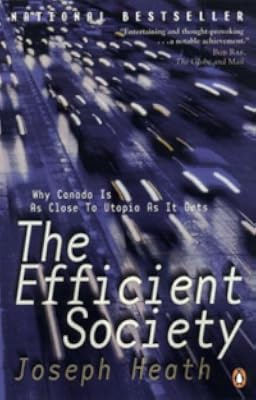
In this fascinating account of what makes Canada such a successful society, Joseph Heath celebrates the much-maligned value of efficiency and asks some searching questions about the forces that threaten to undermine our quality of life. Canada is an efficient society, much more efficient than our neighbour to the south, where personal liberty takes precedence over collective well-being. This is one of the reasons, Heath argues, that the United Nations Annual Human Development Report show more consistently ranks Canada as the best place in the world to live. But this efficiency is under siege. Can we resist the allure of short-sighted tax cuts? Can we maintain our quality of life in the face of relentless pressure to increase our productivity - both at work and at home? This is a profound and important look at how government and business conspire to improve our lives - and at the dramatic changes that will decide our social and economic future. show lessTags
Recommendations




















Member Reviews
I read quite a few philosophy books that are thought-provoking, but “enjoy” is not typically a word I would use to describe the process. Joseph Heath, however, is one philosopher whose works I thoroughly enjoy. He is a very engaging writer who makes economic theories (or, rather, the philosophies guiding them) interesting and understandable without ever dumbing them down. Heath was the co-author of The Rebel Sell: Why the Culture Can’t Be Jammed and it was on the strength of that book that I took a chance on this one---otherwise I wouldn’t have looked twice at a book saddled with such an unfortunate title. Even the subtitle, as Heath himself admits, is just a bit of hyperbole: the book itself is not really about Canada nor is it show more simple boosterism for welfare state capitalism. The fact that Canada has consistently ranked as one of the world’s best countries in which to live is just a handy way for Heath to segue to his central thesis: that we owe this good fortune in large part to the value our nation places on efficiency in public policy development. Efficiency, argues Heath, is not readily apparent but nevertheless has a profound effect on how societies are formed and shaped.
This is not nearly as dry and dreary as it sounds. As in his other books, Heath’s approach is fresh, his writing jargon-free, and his tone witty but never condescending. And his knowledge base is rock-solid. As a former student of Jürgen Habermas, Heath carries on the Frankfurt School tradition of critical social theory in all of his books. Here, it is intermingled with a healthy dose of game theory (prisoner’s dilemmas and collective action problems abound), Hobbesian social contract theory and rational action theory. This is not a book about capitalism per se. (For that, I urge you to read his later work, Filthy Lucre: Economics for People Who Hate Capitalism.) Although he does address the development, functioning and externalities of market economies in The Efficient Society, he continually draws our attention back to the underlying ethics (the more efficient the market, the greater the inequalities), and reframes questions in a way that challenges our assumptions about the costs and benefits of free market systems, the relative merits of public services and private enterprise, the true function of taxation, and the necessity of state regulation to overcome the tendency of capitalism to drive the race to the bottom. Highly recommended. show less
This is not nearly as dry and dreary as it sounds. As in his other books, Heath’s approach is fresh, his writing jargon-free, and his tone witty but never condescending. And his knowledge base is rock-solid. As a former student of Jürgen Habermas, Heath carries on the Frankfurt School tradition of critical social theory in all of his books. Here, it is intermingled with a healthy dose of game theory (prisoner’s dilemmas and collective action problems abound), Hobbesian social contract theory and rational action theory. This is not a book about capitalism per se. (For that, I urge you to read his later work, Filthy Lucre: Economics for People Who Hate Capitalism.) Although he does address the development, functioning and externalities of market economies in The Efficient Society, he continually draws our attention back to the underlying ethics (the more efficient the market, the greater the inequalities), and reframes questions in a way that challenges our assumptions about the costs and benefits of free market systems, the relative merits of public services and private enterprise, the true function of taxation, and the necessity of state regulation to overcome the tendency of capitalism to drive the race to the bottom. Highly recommended. show less
Joseph Heath is a philosopher but "The Efficient Society" is really a landmark text in modern Political Economics.
He takes an admirably unbiased look at the economics and politics of modern western societies using a benchmark of "Efficiency" - being forms of organization that increase the wellbeing of citizens in a country rather than the more usual measure of per capita GDP.
As he quite rightly points out, Canada has a lower per capita GDP than the United States but a higher level of wellbeing as shown by surveys, health and other social statistics. The GDP measure itself is shown to be faulty with the classic example being US healthcare that costs twice the amount of equivalent European systems while producing a less health population. show more At least half of US healthcare spending (component of GDP) is a complete waste of money.
An "Efficiency" view of politics/economics has to conclude that markets are best suited to efficiently provide some goods, and governments best suited to provide others. The standard example of government intervention is pollution that isn't an easy fit in a tradeable market. It is simply more efficient to pass laws against pollution, in a similar way to laws against crime, given the general acceptance in efficient societies that crime is not a tradable activity (although in corrupt inefficient societies this is not nearly so clear).
Following the same line, Heath sees well run government and private bureaucracies as essential to an efficient society. When things reach a certain level of complexity, a centrally controlled division of labour is essential to avoid chaos. How would Boeing build aircraft if every production unit had to trade with the others to obtain parts and information?
This is not to say that the efficiency generated by free markets is popular or comfortable. On the contrary, free market competition is generally disliked and feared. Socialists see it as breaking the "togetherness" of society by generating the inequality of winners and losers, and from a different angle, the traditional administrative Guardians of society never liked "trade" in the first place, since they see it as diminishing virtue. Heath actually quotes Nietzsche, (in the marketplace) "They punish you for all your virtues. They forgive you entirely - your mistakes."
He equally shows that free markets are in no way natural, and that in the advanced form in which they are found in Western societies, they rest on the careful legal construction of individual property rights and the civil law of contract. These laws have to be framed and protected by government and "Efficiency" requires this unnatural state of affairs be shielded against the natural desire of special interests to subvert the political/economic rules for their own advantage (best book on this is Olson's, "Power and Prosperity. Outgrowing Communist and Capitalistic Dictatorships).
He touches on some secular market trends such as increased automation where increased automation = fewer employees = increased private profit , while unemployment costs are dumped on society ( good book here is Ford's, "The Lights in the Tunnel"), and the inevitability of market competition leading a "race to the bottom" in production costs which means offshore - once again a sellout of society from a traditional/nationalist or socialist viewpoint.
Heath finally sees a careful welfare state capitalism as the best organization for an "Efficient" society.
A minor point is a tangential attack on Ayn Rand as an exponent of savage capitalism, although on my reading (of "Atlas Shrugged") she is really taking aim at extreme state socialism/communism rather than glorifying entrepreneurs. There is a Nietzschean over man aspect to her heroes ( as Heath points out) but the real target seems to be Nietzsche's "ressentiment" exemplified by the dead hand of state socialism. show less
He takes an admirably unbiased look at the economics and politics of modern western societies using a benchmark of "Efficiency" - being forms of organization that increase the wellbeing of citizens in a country rather than the more usual measure of per capita GDP.
As he quite rightly points out, Canada has a lower per capita GDP than the United States but a higher level of wellbeing as shown by surveys, health and other social statistics. The GDP measure itself is shown to be faulty with the classic example being US healthcare that costs twice the amount of equivalent European systems while producing a less health population. show more At least half of US healthcare spending (component of GDP) is a complete waste of money.
An "Efficiency" view of politics/economics has to conclude that markets are best suited to efficiently provide some goods, and governments best suited to provide others. The standard example of government intervention is pollution that isn't an easy fit in a tradeable market. It is simply more efficient to pass laws against pollution, in a similar way to laws against crime, given the general acceptance in efficient societies that crime is not a tradable activity (although in corrupt inefficient societies this is not nearly so clear).
Following the same line, Heath sees well run government and private bureaucracies as essential to an efficient society. When things reach a certain level of complexity, a centrally controlled division of labour is essential to avoid chaos. How would Boeing build aircraft if every production unit had to trade with the others to obtain parts and information?
This is not to say that the efficiency generated by free markets is popular or comfortable. On the contrary, free market competition is generally disliked and feared. Socialists see it as breaking the "togetherness" of society by generating the inequality of winners and losers, and from a different angle, the traditional administrative Guardians of society never liked "trade" in the first place, since they see it as diminishing virtue. Heath actually quotes Nietzsche, (in the marketplace) "They punish you for all your virtues. They forgive you entirely - your mistakes."
He equally shows that free markets are in no way natural, and that in the advanced form in which they are found in Western societies, they rest on the careful legal construction of individual property rights and the civil law of contract. These laws have to be framed and protected by government and "Efficiency" requires this unnatural state of affairs be shielded against the natural desire of special interests to subvert the political/economic rules for their own advantage (best book on this is Olson's, "Power and Prosperity. Outgrowing Communist and Capitalistic Dictatorships).
He touches on some secular market trends such as increased automation where increased automation = fewer employees = increased private profit , while unemployment costs are dumped on society ( good book here is Ford's, "The Lights in the Tunnel"), and the inevitability of market competition leading a "race to the bottom" in production costs which means offshore - once again a sellout of society from a traditional/nationalist or socialist viewpoint.
Heath finally sees a careful welfare state capitalism as the best organization for an "Efficient" society.
A minor point is a tangential attack on Ayn Rand as an exponent of savage capitalism, although on my reading (of "Atlas Shrugged") she is really taking aim at extreme state socialism/communism rather than glorifying entrepreneurs. There is a Nietzschean over man aspect to her heroes ( as Heath points out) but the real target seems to be Nietzsche's "ressentiment" exemplified by the dead hand of state socialism. show less
A really entertaining read about values in a society and how these drive capitalism, socialism/nationalism, communism. Canada I learn is efficiency driven, while America is driven by liberty. A must read for anyone who is not an economist or philospher and is interested in the logic of economics.
Ratings
Members
- Recently Added By
Author Information

14+ Works 1,165 Members
Joseph Heath is a Professor in the Department of Philosophy as well as the Munk School of Global Affairs and Public Policy at the University of Toronto. He is the author of numerous scholarly works, including Communicative Action and Rational Choice (2001) and Following the Rules (2008). He is a Fellow of the Royal Society of Canada, as well as show more the Trudeau Foundation. show less
Classifications
- Genres
- Economics, Sociology, Nonfiction, General Nonfiction, Anthropology, Politics and Government
- DDC/MDS
- 301 — Society, government, & culture Social sciences, sociology & anthropology Sociology and anthropology
- LCC
- HN103.5 .H43 — Social sciences Social history and conditions. Social problems. Social reform Social history and conditions. Social problems. By region or country
- BISAC
Statistics
- Members
- 77
- Popularity
- 413,112
- Reviews
- 3
- Rating
- (3.97)
- Languages
- English, French
- Media
- Paper, Ebook
- ISBNs
- 5
- ASINs
- 2