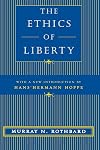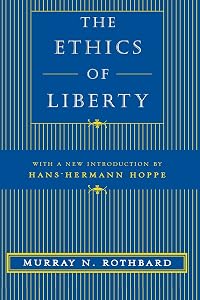
The Ethics of Liberty
by Murray Rothbard
On This Page
Description
The authoritative text on the libertarian political position In recent years, libertarian impulses have increasingly influenced national and economic debates, from welfare reform to efforts to curtail affirmative action. Murray N. Rothbard's classic The Ethics of Liberty stands as one of the most rigorous and philosophically sophisticated expositions of the libertarian political position. Rothbard's unique argument roots the case for freedom in the concept of natural rights and applies it to show more a host of practical problems. And while his conclusions are radical--that a social order that strictly adheres to the rights of private property must exclude the institutionalized violence inherent in the state--Rothbard's applications of libertarian principles prove surprisingly practical for a host of social dilemmas, solutions to which have eluded alternative traditions. The Ethics of Liberty authoritatively established the anarcho-capitalist economic system as the most viable and the only principled option for a social order based on freedom. This classic book's radical insights are sure to inspire a new generation of readers. show lessTags
Recommendations














Member Reviews
If this had been the only book on libertarianism I had ever read, I would probably have become an authoritarian. I'm aware that academics often use words differently than us normies do, but the idea that there is a school of "ethics" that includes allowing one's own baby to starve to death is unfathomable.
Clearly by the 1980s Rothbard was already well on his journey right-ward from the leftist activists had the pleasure of working with in the 1960s Peace & Liberty Party and the author of radical works like "Man economy & State." He spends the whole book looking at his basis for an economic and "legal" system in a libertarian society and expanding upon those for various parts of life and society. However, he just accepts his own basis show more as fact and doesn't even seem to attempt to argue why that should be a basis of any thought, let alone libertarianism. This is particularly true in the first section of property ownership. There is no explanation why mixing one's labor with unowned property automatically makes it the private property of the laborer. There is no question as to the idea that an individual can be private property, even to himself, while also claiming that slavery, even so-called voluntary slavery, is unethical. There is absolutely no explanation why inheritance is considered an ethical transfer of private property rights, but a promise to do so is not. (There are plenty of reasons he says why a promise is not, but I see that as little difference than inheritance). There was a whole chapter on the transfer of land titles and the problem of tracking such back to its rightful owner, yet there was 0 reference to the obvious cases of this such as European colonialization into Australia, Africa, & the Americas. An incredible western European centric viewpoint, particularly when you consider Rothbard was an American Jew.
One thing he did do right was right in the introduction he made it clear that nothing contained within would be able to challenge Marxists ideals, including the labor-theory-of-value, as the ideas are so far apart, they can't even be compared properly.
I've been a Libertarian for over 20 years, and no argument against liberty written by a statist has come nearly close to making me question my belief in libertarianism as this one of the American libertarian right. show less
Clearly by the 1980s Rothbard was already well on his journey right-ward from the leftist activists had the pleasure of working with in the 1960s Peace & Liberty Party and the author of radical works like "Man economy & State." He spends the whole book looking at his basis for an economic and "legal" system in a libertarian society and expanding upon those for various parts of life and society. However, he just accepts his own basis show more as fact and doesn't even seem to attempt to argue why that should be a basis of any thought, let alone libertarianism. This is particularly true in the first section of property ownership. There is no explanation why mixing one's labor with unowned property automatically makes it the private property of the laborer. There is no question as to the idea that an individual can be private property, even to himself, while also claiming that slavery, even so-called voluntary slavery, is unethical. There is absolutely no explanation why inheritance is considered an ethical transfer of private property rights, but a promise to do so is not. (There are plenty of reasons he says why a promise is not, but I see that as little difference than inheritance). There was a whole chapter on the transfer of land titles and the problem of tracking such back to its rightful owner, yet there was 0 reference to the obvious cases of this such as European colonialization into Australia, Africa, & the Americas. An incredible western European centric viewpoint, particularly when you consider Rothbard was an American Jew.
One thing he did do right was right in the introduction he made it clear that nothing contained within would be able to challenge Marxists ideals, including the labor-theory-of-value, as the ideas are so far apart, they can't even be compared properly.
I've been a Libertarian for over 20 years, and no argument against liberty written by a statist has come nearly close to making me question my belief in libertarianism as this one of the American libertarian right. show less
The book is a collection of topical essays, organized or presented in five parts. The first three parts deliver Rothbard's views on natural law, on various topics or ethical issues related to society, and on a review of what he sees as governmental errors. The forth part is a review of certain practitioners and literature in which he reports what he calls the shortcomings of Hayek, Isaiah Berlin, von Mises and Nozick. The last part presents some (now dated) views of current events (60s and 70s) that could encourage a libertarian to work toward the expansion of liberty.
Much of the material and examples are reprises of things he has also presented in other volumes, but they are well written, and if considered alone support his well-earned show more reputation as an outstanding intellectual supporter of a general ‘libertarian’ position. The surprise to me was that considering his positions as a whole does not seem to lead to libertarianism, but to anarchy or anarcho-caopiatlism as a desired state. If you are into any study of governments and their role in supporting individual liberty, the subjects and reasoning presented are well worth your time. show less
Much of the material and examples are reprises of things he has also presented in other volumes, but they are well written, and if considered alone support his well-earned show more reputation as an outstanding intellectual supporter of a general ‘libertarian’ position. The surprise to me was that considering his positions as a whole does not seem to lead to libertarianism, but to anarchy or anarcho-caopiatlism as a desired state. If you are into any study of governments and their role in supporting individual liberty, the subjects and reasoning presented are well worth your time. show less
This was my favorite of the books I read for my capitolo-anarchist symposium. Rothbard is considered very weak, almost a dandy of the field, but for a bleeding heart libertarian, he's the closest they get to me.
An ethics/morals based case for a society without rulers. Rothbard outlines the legal framework for a free society. Very convincing.
natural rights theory of libertarianism, weak logic in defining "man"
Ratings
Members
- Recently Added By
Lists

Ancap Part 2 - Beginner
12 works; 1 member

Economics
60 works; 5 members
Author Information

126+ Works 4,784 Members
Common Knowledge
- Original publication date
- 1982
- Important places
- United States of America
- Related movies
- Atlas Shrugged: Part I (2011 | IMDb); Atlas Shrugged II: The Strike (2012 | IMDb); Atlas Shrugged: Part III (2015 | IMDb)
- Epigraph
- "As reason tells us, all are born thus naturally equal, i.e. with an equal right to their persons, so also with an equal right to their preservation...and every man having a property in his own person, the labour of his body ... (show all)and the work of his hands are properly his own, to which no one has right but himself; it will therefore follow that when he removes anything out of the state that nature has provided and left it in, he has mixed his labour with it, and joined something to it that is his own, and thereby makes it his property...Thus every man having a natural right to (or being proprietor of) his own person and his own actions and labour, which we call property, it certainly follows, that no man can have a right to the person or property of another: And if every man has a right to his person and property; he has also a right to defend them...and so has a right of punishing all insults upon his perosn and property." --Rev. Elisha Williams (1744)
- Dedication
- TO
THE MEMORY OF
FRANK CHODORV
F.A. "BALDY HARPER
and my father
DAVID ROTHBARD - First words
- Among intellectuals who consider themselves "scientific," the phrase "the nature of man" is apt to have the effect of a red flag on a bull.
- Quotations
- Applying our theory to parents and children, this means that a parent does not have the right to aggress against his children, "but also" that the parent should not have a "legal obligation" to feed, clothe or educate his chi... (show all)ldren, since such obligations would entail positive acts of coerced upon the parent and depriving the parent of his rights.
- Last words
- (Click to show. Warning: May contain spoilers.)But certainly, both theory and analysis of current historical conditions lead to the conclusion that the current prospects of liberty, even in the short-run, are highly encouraging.
- Original language
- English
- Canonical DDC/MDS
- 323.4401
- Canonical LCC
- JC585.R69
Classifications
- Genres
- Economics, Nonfiction, Philosophy, Politics and Government, General Nonfiction
- DDC/MDS
- 323.4401 — Society, government, & culture Political science Civil Rights & Liberties/ Human Rights The state and the individual Liberty
- LCC
- JC585 .R69 — Political Science Political theory Political theory. The state. Theories of the state Purpose, functions, and relations of the state
- BISAC
Statistics
- Members
- 332
- Popularity
- 95,897
- Reviews
- 5
- Rating
- (3.90)
- Languages
- 8 — Czech, English, French, German, Italian, Portuguese, Spanish, Turkish
- Media
- Paper, Ebook
- ISBNs
- 17
- ASINs
- 5