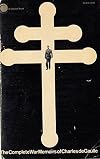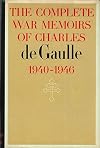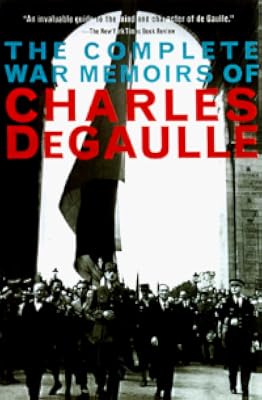
The Complete War Memoirs of Charles de Gaulle
by Charles de Gaulle
de Gaulle War Memoirs (Collections and Selections — 1-3), The Memoirs of Charles de Gaulle (Collections and Selections — 1-3)
On This Page
Description
Originally published in three separate volumes covering three distinct periods, this single edition encompasses all the personal writings by one of this century's most prominent generals and statesmen from the fall of France in 1940 to the aftermath of World War II in 1946. The first section, "The Call to Honor," recounts the confusion and despair triggered by Hitler's blitzkrieg invasion of France. The second section, "Unity," describes de Gaulle's struggles to rally the Free French in show more Africa and in underground movements throughout Europe, his bitter conflict with the Vichy puppet regime ruling occupied France, and his cooperation with the Allied powers. "Salvation," the final installment, chronicles the turning of the tide of war against Nazi Germany, de Gaulle's triumphant return to France, and the reincarnation of the French Republic as a major international presence. - Back cover. show lessTags
Recommendations





























Member Reviews
(This review is of volume 3, "Le Salut.")
In Britain and America, Charles de Gaulle tends to be thought of as a bit of a prima donna, whose peevishness and notoriously thin skin would exasperate Churchill and Roosevelt. There is plenty of this on display in this memoir, which covers the end of the war and the first months of peace. He sulks at perceived slights from the allies, most of which are clearly imagined and seems obsessed with protocol in a way which must have mystified his counterparts. The saving grace is that he is obsessed not with his own personal standing but with the honor and world position of his beloved France, humiliated by the German victory in 1940 and subsequent occupation. Thus he refuses to accept Roosevelt’s show more invitation to meet him on his ship in Algiers because Roosevelt has no business inviting him to a part of his own country, and instead invites Roosevelt to Paris. The result, of course, is that no meeting takes place. He is deeply offended when Churchill, Roosevelt and Stalin meet without inviting him as a representative of France.
Accompanying this love of France is an exaggerated view of how the country is loved and admired by the rest of the world. He constantly stresses that the world is anxious to see France take its place as a great power, and that no decision could command respect unless France is seen to have taken part. This rose-tinted view leads him to believe that the French will be welcomed back to Indochina and Syria, and in the case of the latter country to see the hand of perfidious Albion in any adverse events there, prompting one to wonder if this paranoia might have played a role in his later anti-British actions. It also shows that in some ways de Gaulle was stuck in the past, in a world where a benign colonial power is welcomed by the local populations who aspire to close ties to the mother country, although he does envisage their eventual independence within a confederation.
In his attitude towards the defeated Germany, de Gaulle also seems to be stuck in the nineteenth century. He proposes French occupation of the Saarland and an international administration of the Ruhr to exact reparations.
De Gaulle’s fussiness and obsession with protocol is annoying and occasionally comical, making you smile, “Here he goes again!” But it does have a practical side. He succeeds in winning a seat for France at the major conferences at the end of the war and in the Security Council of the United Nations, and he was probably the only man who could restore respect to his country, which has much to thank him for.
This book will probably only be enjoyed by those with an interest in the man and the period, and perhaps by those who appreciate precise and lucid use of the French language in a slightly precious style, which accurately reflects its author. show less
In Britain and America, Charles de Gaulle tends to be thought of as a bit of a prima donna, whose peevishness and notoriously thin skin would exasperate Churchill and Roosevelt. There is plenty of this on display in this memoir, which covers the end of the war and the first months of peace. He sulks at perceived slights from the allies, most of which are clearly imagined and seems obsessed with protocol in a way which must have mystified his counterparts. The saving grace is that he is obsessed not with his own personal standing but with the honor and world position of his beloved France, humiliated by the German victory in 1940 and subsequent occupation. Thus he refuses to accept Roosevelt’s show more invitation to meet him on his ship in Algiers because Roosevelt has no business inviting him to a part of his own country, and instead invites Roosevelt to Paris. The result, of course, is that no meeting takes place. He is deeply offended when Churchill, Roosevelt and Stalin meet without inviting him as a representative of France.
Accompanying this love of France is an exaggerated view of how the country is loved and admired by the rest of the world. He constantly stresses that the world is anxious to see France take its place as a great power, and that no decision could command respect unless France is seen to have taken part. This rose-tinted view leads him to believe that the French will be welcomed back to Indochina and Syria, and in the case of the latter country to see the hand of perfidious Albion in any adverse events there, prompting one to wonder if this paranoia might have played a role in his later anti-British actions. It also shows that in some ways de Gaulle was stuck in the past, in a world where a benign colonial power is welcomed by the local populations who aspire to close ties to the mother country, although he does envisage their eventual independence within a confederation.
In his attitude towards the defeated Germany, de Gaulle also seems to be stuck in the nineteenth century. He proposes French occupation of the Saarland and an international administration of the Ruhr to exact reparations.
De Gaulle’s fussiness and obsession with protocol is annoying and occasionally comical, making you smile, “Here he goes again!” But it does have a practical side. He succeeds in winning a seat for France at the major conferences at the end of the war and in the Security Council of the United Nations, and he was probably the only man who could restore respect to his country, which has much to thank him for.
This book will probably only be enjoyed by those with an interest in the man and the period, and perhaps by those who appreciate precise and lucid use of the French language in a slightly precious style, which accurately reflects its author. show less
If you have read the Churchill WWII Memoirs, well, this is the work of his prickliest ally. De Gaulle was the Free French and the book is necessary for the student. It is useful to read the sections on the assassination of Admiral Darlan, and the portraits of FDR and WSC. the continuing debate in french circles to the degree of collaboration with the Germans also takes a good deal of space.
Ratings
Members
- Recently Added By
Lists

Best Biographies, Autobiographies and Memoirs
465 works; 160 members

All Things France
100 works; 8 members

Mustich's 1000 Books to Read Before You Die: A Life Changing List
1,001 works; 20 members
Author Information

91+ Works 970 Members
Charles De Gaulle 1890 - 1970 Charles Andre Joseph Marie de Gaulle was born in 1890 in Lille, France. He attended Saint-Cyr Military Academy before serving in World War I at the Battle of Verdun in 1916, where he was wounded three times and finally taken prisoner by the Germans. After the war he became the Aide-de-Camp to Marshal Henri Petain. In show more this position he won prominence with his advocacy of a highly mechanized French Army. He eventually attained the rank of Brigadier General during World War II. De Gaulle escaped to London when France fell and formed a French national committee in exile there. The committee was officially recognized by the Allies in 1942, and de Gaulle became President of the Free French. The forces under his command joined with British forces in an attack on Syria in 1941 and took control of Madagascar in 1942. In 1943, de Gaulle joined the French Committee of National Liberation in Algiers, as co-president with General Henri Giroud. A few months later, he became sole president of the committee and moved the headquarters to Paris after the Allies liberated France in 1944. It was recognized as the de facto government of France. In 1945, de Gaulle became the provisional president of France, but resigned two months later. He then organized a new political movement in 1947 called "The Rally of the People of France" or the RPF. In the 1951 elections, the RPF won the most seats in the assembly. But even with this victory, de Gaulle chose to retire from politics in 1953. In 1958, civil war breaks out in France over whether to allow Algiers their independence. De Gaulle was called in to act as Premier and the National Assembly granted him power to rule by decree for six months and to create a new constitution. De GAulle was elected President of the Fifth Republic on January 8, 1959. During his first term, he instituted economic, industrial and governmental reforms, negotiated Algerian independence and lead France into the European Economic Community. He also strengthened french ties with the USSR while scorning the Americans who had helped to liberate France. De GAulle was elected to a second term in 1965, when he urged the autonomy of France and Canada. He requested the withdrawal of troops from the North Atlantic Treaty organization from France in 1967, disregarding any threats along his border. De Gaulle resigned from the Presidency in 1969 after a defeat in a national referendum. He returned home to work on his memoirs, "War Memoirs - 54-59" and Memoirs of Hope:Renewal and Endeavor." De Gaulle wrote three books on military tactics as well, entitled, "Edge of the Sword" published in 1932, "The Army of the Future" published in 1934, and "France and Its Army" published in 1938. Charles de Gaulle died in 1970. (Bowker Author Biography) show less
Awards and Honors
Notable Lists
Series


Work Relationships
Contains
Common Knowledge
- Canonical title
- The Complete War Memoirs of Charles de Gaulle
- Original publication date
- 1964 (collection, USA) (collection, USA); 1954 – 1959 (individual volumes, France) (individual volumes, France)
- People/Characters
- Charles de Gaulle
- Important places
- France
- Important events
- World War II (1939 | 1945); World War II, German Occupation of France (1940 | 1944)
Classifications
Statistics
- Members
- 157
- Popularity
- 209,108
- Reviews
- 2
- Rating
- (3.72)
- Languages
- 6 — Danish, English, French, German, Hungarian, Spanish
- Media
- Paper
- ISBNs
- 10
- ASINs
- 16