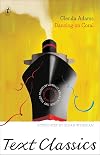
Dancing on Coral
by Glenda Adams
On This Page
Description
Lark Watter, the student daughter of Henry and Mrs Watter, embarks on a journey of self-discovery with a mixture of courage, innocent hopefulness. This work features her ensuing adventures full of profound comedy and peopled by awful characters, and all is related with Adams' trademark zany wit, sophistication and narrative exuberance.Tags
Recommendations
















Member Reviews
Adams certainly has fun satirising group rhetoric in Dancing on Coral. Dated by allusions to the late 1950s by her protagonist Lark Watters' visit to the cinema to see Cat on a Hot Tin Roof (1958) and her father's ambition to be on the Jack Davey 1950s radio show, Dancing on Coral pokes fun at the university set exemplified by the 'Sydney Push'. What I know of the them is derived from my reading of Richard Appleton's Appo, Recollections of a Member of the Sydney Push, but the poseurs, inane babble and heavy drinking of Dancing on Coral seem authentic.
Lark stumbles into this bunch of pseudo-intellectuals when she meets her first American. Sprung at the cash register for hiding an extra pat of butter under her roll to save the extra penny, she is defended by Tom Brown:
Tom is studying urban anthropology. He's a social theorist and, in his spare time, a critic of society. And when Lark timidly suggests that the 'anthropological' activities of Tom's mentor Manfred Bird in the Pacific makes him a plunderer, stealing art from societies that couldn't protect themselves', she is promptly patronised by Bird's daughter Donna (who turns out to be Lark's nemesis):
Tom suggests that they take Lark on as a 'project.'
Well, they do, and it mostly consists of getting involved in dubious pranks, infantile protests, a lot of long-winded pompous rhetoric from Tom while Lark fends off drunken advances from young men who lecture her about not perpetuating outdated morality.
Lark doesn't really know what she wants to do but the one thing that she craves, is to leave Australia. Her parents are eccentrics but life, as far as she can tell, is lived elsewhere, and so she applies uselessly for jobs which offer free travel. Her interview at Qantas is cringeworthy: she is told that "in addition to a deep desire to serve others, our hostesses have to be good-looking girls. The best of the crop."
To read the rest of my review please visit https://anzlitlovers.com/2021/01/21/dancing-on-coral-by-glenda-adams/ms/ show less
Lark had watched Donna Bird for several years as she floated around the quadrangle, looking like some sort of court jester, always arguing and waving her arms about, always surrounded byshow more
groups of the important students—the libertarian who wore no shoes and tied his khaki trousers with a piece of rope and wrote lewd columns for the newspaper; the architecture student who was caught by a security guard on the floor of the library stacks with the psychology fresher; the leader of the student conservative club who was known only by his initials. (p.22)
Lark stumbles into this bunch of pseudo-intellectuals when she meets her first American. Sprung at the cash register for hiding an extra pat of butter under her roll to save the extra penny, she is defended by Tom Brown:
"Good for you," he said, "fighting the system like that. Butter belongs to the people. Butter and guns and art. They should be free, and if they're not, the people should take them." (p.24)
Tom is studying urban anthropology. He's a social theorist and, in his spare time, a critic of society. And when Lark timidly suggests that the 'anthropological' activities of Tom's mentor Manfred Bird in the Pacific makes him a plunderer, stealing art from societies that couldn't protect themselves', she is promptly patronised by Bird's daughter Donna (who turns out to be Lark's nemesis):
"It's called preservation," said Donna quickly. "Sometimes the natives just threw away the stuff, their funerary carvings and so on. The Rockefellers and my father just wanted to preserve art. Art is what matters." (p.27-8)
Tom suggests that they take Lark on as a 'project.'
"She's young and inexperienced," said Tom to Donna, at the same time patting Lark's hand in a fatherly way. He turned back to Lark. "Donna should know," he said gently, like a doctor at an invalid's bedside. "After all, she's the one who knows them all. Say," and he turned back to Donna Bird, "what say we take her in hand." (p.28)
Well, they do, and it mostly consists of getting involved in dubious pranks, infantile protests, a lot of long-winded pompous rhetoric from Tom while Lark fends off drunken advances from young men who lecture her about not perpetuating outdated morality.
Lark doesn't really know what she wants to do but the one thing that she craves, is to leave Australia. Her parents are eccentrics but life, as far as she can tell, is lived elsewhere, and so she applies uselessly for jobs which offer free travel. Her interview at Qantas is cringeworthy: she is told that "in addition to a deep desire to serve others, our hostesses have to be good-looking girls. The best of the crop."
To read the rest of my review please visit https://anzlitlovers.com/2021/01/21/dancing-on-coral-by-glenda-adams/ms/ show less
Glenda Adams's novel was winner of the NSW Premier's Award in 1987, and the Miles Franklin in 1988.
The reviews depicted this as a subtle and very funny novel, parodying the psychobabble and political tenor of the 1960s.
There is no doubt it made for an interesting and, at times amusing read. However, for me, it certainly did not live up to the promise implicit in the major awards and the high praise of the critics.
The reviews depicted this as a subtle and very funny novel, parodying the psychobabble and political tenor of the 1960s.
There is no doubt it made for an interesting and, at times amusing read. However, for me, it certainly did not live up to the promise implicit in the major awards and the high praise of the critics.
I thought it was a stupid story. I don't know how I finished it. Maybe I kept hoping that the characters would become a bit more understandable but they just got more annoying. I chose this book because it won the Miles Franklin but all I can say is ' there could not have been much choice that year.
Ratings
Members
- Recently Added By
Author Information

7+ Works 195 Members
Awards and Honors
Series
Belongs to Publisher Series
Common Knowledge
- Dedication
- In memory of my father
- First words
- The rooster was crowing, at two in the afternoon, and the cicadas had started up again after their lunchtime quiet.
- Blurbers
- Jolley, Elizabeth; Grenville, Kate; Halligan, Marion; Anderson, Don; Jefferis, Barbara
Classifications
Statistics
- Members
- 75
- Popularity
- 421,795
- Reviews
- 3
- Rating
- (3.32)
- Languages
- English
- Media
- Paper, Ebook
- ISBNs
- 8
- ASINs
- 1