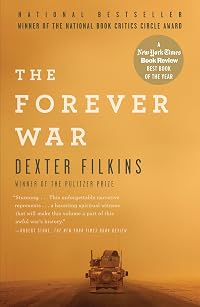
The Forever War
by Dexter Filkins
On This Page
Description
A prizewinning "New York Times" correspondent chronicles a remarkable chain of events that begins with the rise of the Taliban in the 1990s, continues with the attacks of 9/11, and moves on to the wars in Afghanistan and Iraq.Tags
Recommendations

Member Reviews
The Forever War is war as recorded in a journal. The best comparison I have to it are Thomas Goltz's books, but this is much less gory or political and more observational. Just stories, not always chronological.
Filkins spent years in Afghanistan and Iraq. He saw the ins and outs of both wars from the front lines and lived to tell the story. What he saw wasn't exactly the same thing that Americans wanted to see. For example, when 5,000 Marines assault a city where there is no running water, how do you use the bathroom? You kick down the doors random peoples' houses, or mosques and fill theirs to an overflowing mess.
"There were always two conversations in Iraq-- the one the Iraqis were having with the Americans, and the one the Iraqis show more were having among themselves."
Filkins saw throughout the Iraq war that U.S. troops and actions were overwhelmingly hated, even where they were glad to be rid of Saddam. Where there was cooperation with Americans to work, rebuild, police, etc., Iraqis took the money, did some work, and resented it. "Nobody likes being told what to do. The Americans are the occupiers." There was always an understanding that one day-- one way or another-- the Americans would leave, the sooner the better. The price they'd imposed outweighed the benefit, at least in the Iraqi's shortened lifetimes.
"I long ago quit believing that the Defense Department knew any better than I did."
It was never just Sunni vs. Shiite vs. Kurd (Kurds are hardly mentioned in the book), you have so many Arab tribes maintaining power and status in certain neighborhoods of certain cities. Mix in foreigners streaming in, criminals on the loose, people just looking for a quick buck through kidnapping, extortion, blood feuds demanding reprisals, etc. and you have a real mess.
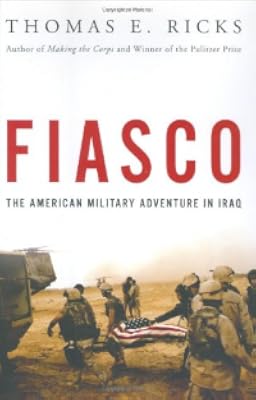
This book makes me look at Bush's Decision Points (my review) differently, and more angrily-- even though I've already read Fiasco (my review) and other books on Iraq. I think President Bush's administration made the mistake of thinking democracy would heal all wounds--and quickly. Democracy (not to mention a free market) however, requires a level of trust that does not exist in many Arab countries at any level. An elected Shiite majority quickly settled scores with Sunnis, leading to outright civil war-- as Filkins documents the evidence of showing up slowly but surely.
How dumb were we to think this would all be over quickly or even be above 50% likely to turn out "well?" Filkins, by and large, isn't critical of the war-- he just observes events and conversations as they happen. He tells one poignant story of how he had to have a dealing with the CIA and reached a conclusion they were incompetent, when it turns out he was being duped by Iraqis he had long trusted and thought he was helping. He admits to his own ignorance.
For the first several chapters, I'd assumed Filkins spoke Arabic. He sometimes has quick conversations with a hostile crowd before diving back into his truck for safety. Later, he says he never learned Arabic and talks about the role of his translators. That takes some of the shine off the book, but not a lot. But I'm struck by how little anyone knows anything in these situations. After reading President Bush's Decision Points, it seems years later the attitude of Iraqis on the ground never really filtered up to him, or he doesn't fully believe the accounts of people like Filkins.
I did admire Filkins' courage in his forays into Afghanistan before the fall of the Taliban and the perspective it gave him when he was in New York for 9/11, and traveling along with the Northern Alliance immediately after 9/11 (for which he won a Pulitzer Prize). What's it like to be in a Syrian household, where your gracious host is ranting against American and pops in a videotape of an American being beheaded in Iraq, eagerly enjoying and praising it?
Filkins shows a very sensitive side. He records random encounters with children, while he's jogging, in stores, etc. He includes descriptions of the women and children he sees, as well as dogs and others, bringing the brutal human aspects of war home. He records the random conversations he has with the soldiers, and the difficult conditions. Filkins feels particularly responsible for one particular soldiers' death and meets with his parents when the battalion returns to the U.S. I hope his insurance pays for whatever counseling he most likely needs. show less
Filkins spent years in Afghanistan and Iraq. He saw the ins and outs of both wars from the front lines and lived to tell the story. What he saw wasn't exactly the same thing that Americans wanted to see. For example, when 5,000 Marines assault a city where there is no running water, how do you use the bathroom? You kick down the doors random peoples' houses, or mosques and fill theirs to an overflowing mess.
"There were always two conversations in Iraq-- the one the Iraqis were having with the Americans, and the one the Iraqis show more were having among themselves."
Filkins saw throughout the Iraq war that U.S. troops and actions were overwhelmingly hated, even where they were glad to be rid of Saddam. Where there was cooperation with Americans to work, rebuild, police, etc., Iraqis took the money, did some work, and resented it. "Nobody likes being told what to do. The Americans are the occupiers." There was always an understanding that one day-- one way or another-- the Americans would leave, the sooner the better. The price they'd imposed outweighed the benefit, at least in the Iraqi's shortened lifetimes.
"I long ago quit believing that the Defense Department knew any better than I did."
It was never just Sunni vs. Shiite vs. Kurd (Kurds are hardly mentioned in the book), you have so many Arab tribes maintaining power and status in certain neighborhoods of certain cities. Mix in foreigners streaming in, criminals on the loose, people just looking for a quick buck through kidnapping, extortion, blood feuds demanding reprisals, etc. and you have a real mess.
This book makes me look at Bush's Decision Points (my review) differently, and more angrily-- even though I've already read Fiasco (my review) and other books on Iraq. I think President Bush's administration made the mistake of thinking democracy would heal all wounds--and quickly. Democracy (not to mention a free market) however, requires a level of trust that does not exist in many Arab countries at any level. An elected Shiite majority quickly settled scores with Sunnis, leading to outright civil war-- as Filkins documents the evidence of showing up slowly but surely.
How dumb were we to think this would all be over quickly or even be above 50% likely to turn out "well?" Filkins, by and large, isn't critical of the war-- he just observes events and conversations as they happen. He tells one poignant story of how he had to have a dealing with the CIA and reached a conclusion they were incompetent, when it turns out he was being duped by Iraqis he had long trusted and thought he was helping. He admits to his own ignorance.
For the first several chapters, I'd assumed Filkins spoke Arabic. He sometimes has quick conversations with a hostile crowd before diving back into his truck for safety. Later, he says he never learned Arabic and talks about the role of his translators. That takes some of the shine off the book, but not a lot. But I'm struck by how little anyone knows anything in these situations. After reading President Bush's Decision Points, it seems years later the attitude of Iraqis on the ground never really filtered up to him, or he doesn't fully believe the accounts of people like Filkins.
I did admire Filkins' courage in his forays into Afghanistan before the fall of the Taliban and the perspective it gave him when he was in New York for 9/11, and traveling along with the Northern Alliance immediately after 9/11 (for which he won a Pulitzer Prize). What's it like to be in a Syrian household, where your gracious host is ranting against American and pops in a videotape of an American being beheaded in Iraq, eagerly enjoying and praising it?
Filkins shows a very sensitive side. He records random encounters with children, while he's jogging, in stores, etc. He includes descriptions of the women and children he sees, as well as dogs and others, bringing the brutal human aspects of war home. He records the random conversations he has with the soldiers, and the difficult conditions. Filkins feels particularly responsible for one particular soldiers' death and meets with his parents when the battalion returns to the U.S. I hope his insurance pays for whatever counseling he most likely needs. show less
The Immorality of War
If you read one book this year, Dexter Filkin's "Forever War" should be the one. Filkins has spent the past decade at the center of the two major conflict zones of this generation in Afghanistan and Iraq. To date, nobody has been able to capture the day to day events on the ground for the entire length of time as realistically as Filkins has done in "Forever War." It is truly a gem of a book.
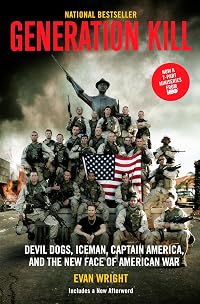
As a journalist for the New York Times, Filkins is uniquely positioned to witness the barbarity of war first hand and put that experience onto paper like no one else can. When compared to Evan Wright's "Generation Kill," I think Filkins is more polished, more accomplished and therefore there is a profound sense of show more professionalism throughout that is sometimes laking in "Generation Kill."
The book is structured very much like a diary. Written in the first person, the stories are personal stories. Filkins writes about things that are happening to him and he mixes in some of the major news stories of both Afghanistan and Iraq such as John Walker Lindh, Jessica Lynch, the 4 contractors in Falluja, Nicholas Berg, or Jill Carroll.
We get more than just canned reports from being inside the Green Zone. Filkins tells us what's happening in the streets. For example, in Afghanistan he writes: "In my many trips to Afghanistan, I grew to adore the place, for its beauty and its perversions... I sat in a mud-brick hut near Bamiyan, the site of a gnawing famine, and a man and his family pressed upon me, their overfed American guest, their final disk of bread." (p. 24).
His selection of words, style of writing, its clear that Filkins is an accomplished writer in his own right. He writes: "So the war could go on forever. Men fought, men switched sides, men lined up and fought again. War in Afghanistan often seemed like a game of pickup basketball, a contest among frineds, a tournament where you never knew which team you'd be on when the next game got under way. Shirts today, skins tomorrow." (p 51). The writing is just so fluid, vivid, and ingenuousness. You can't help but stop, reread, and admire passages like that.
Another major coup for Filkins is his impartiality. That is no easy feat for an American, reporting on Americans in foreign lands, there is a built-in bias which is hard to get away from. Filkins shows everything, he gives you the raw data, and he lets you the reader decide what to think. Obviously he has his opinions, but he keeps them mostly close to the vest. I think the following passage captures his sentiments perfectly: "There were ugly moments and there were hopeful ones, and they made me wonder not only what the Americans were doing to Iraq, but what Iraq was doing to the Americans. The struggle for the country was mirrored in the hearts of the men." (p. 152).
The Battle of Falluja is one of the parts of the book (Chp Pearland) that will literally make you cringe. At times, the writing is so raw, unedited, and macabre you literally feel yourself inside the humvee, or on the street, or hunkered down behind a barricade. If there ever was a hell on earth, it certainly was Falluja in 2004.
Last but not least, the story of Jill Carroll's kidnapping, and specifically Filkins role in attempting to find her and secure her release is just the perfect story that symbolizes the complex underground labyrinth of Iraq at war. I can tell that Filkins still thinks about those days quite a bit.
I wouldn't be surprised if "Forever War" or portions of were made into a movie, or if it won the Pulitzer Prize, it really is that good. Filkins deserves every praise, every award for this incredible memoir. show less
If you read one book this year, Dexter Filkin's "Forever War" should be the one. Filkins has spent the past decade at the center of the two major conflict zones of this generation in Afghanistan and Iraq. To date, nobody has been able to capture the day to day events on the ground for the entire length of time as realistically as Filkins has done in "Forever War." It is truly a gem of a book.
As a journalist for the New York Times, Filkins is uniquely positioned to witness the barbarity of war first hand and put that experience onto paper like no one else can. When compared to Evan Wright's "Generation Kill," I think Filkins is more polished, more accomplished and therefore there is a profound sense of show more professionalism throughout that is sometimes laking in "Generation Kill."
The book is structured very much like a diary. Written in the first person, the stories are personal stories. Filkins writes about things that are happening to him and he mixes in some of the major news stories of both Afghanistan and Iraq such as John Walker Lindh, Jessica Lynch, the 4 contractors in Falluja, Nicholas Berg, or Jill Carroll.
We get more than just canned reports from being inside the Green Zone. Filkins tells us what's happening in the streets. For example, in Afghanistan he writes: "In my many trips to Afghanistan, I grew to adore the place, for its beauty and its perversions... I sat in a mud-brick hut near Bamiyan, the site of a gnawing famine, and a man and his family pressed upon me, their overfed American guest, their final disk of bread." (p. 24).
His selection of words, style of writing, its clear that Filkins is an accomplished writer in his own right. He writes: "So the war could go on forever. Men fought, men switched sides, men lined up and fought again. War in Afghanistan often seemed like a game of pickup basketball, a contest among frineds, a tournament where you never knew which team you'd be on when the next game got under way. Shirts today, skins tomorrow." (p 51). The writing is just so fluid, vivid, and ingenuousness. You can't help but stop, reread, and admire passages like that.
Another major coup for Filkins is his impartiality. That is no easy feat for an American, reporting on Americans in foreign lands, there is a built-in bias which is hard to get away from. Filkins shows everything, he gives you the raw data, and he lets you the reader decide what to think. Obviously he has his opinions, but he keeps them mostly close to the vest. I think the following passage captures his sentiments perfectly: "There were ugly moments and there were hopeful ones, and they made me wonder not only what the Americans were doing to Iraq, but what Iraq was doing to the Americans. The struggle for the country was mirrored in the hearts of the men." (p. 152).
The Battle of Falluja is one of the parts of the book (Chp Pearland) that will literally make you cringe. At times, the writing is so raw, unedited, and macabre you literally feel yourself inside the humvee, or on the street, or hunkered down behind a barricade. If there ever was a hell on earth, it certainly was Falluja in 2004.
Last but not least, the story of Jill Carroll's kidnapping, and specifically Filkins role in attempting to find her and secure her release is just the perfect story that symbolizes the complex underground labyrinth of Iraq at war. I can tell that Filkins still thinks about those days quite a bit.
I wouldn't be surprised if "Forever War" or portions of were made into a movie, or if it won the Pulitzer Prize, it really is that good. Filkins deserves every praise, every award for this incredible memoir. show less
You know what you're in for when you step into a book about the Iraq war after 9/11 written by a New York Times writer. It's going to be bleak, maybe a bit odd, and it's going to be fair. Filkins's book is all of that but what stands out to me is his deft pacing and striking language. While this could easily have devolved into a series of anecdotes, there are thematic guy wires helping the reader stay on course. There is darkness here. A lot of it. But there's just enough light and humor that the humanity doesn't disappear. There's also an adept sense that neither Filkins himself nor the Iraqis understand the disaster that befell that country in the wake of the US invasion. This book doesn't seek to explain or dissect but tells the show more story of the people involved and how they coped. A wonderful book full of honesty, humanity, and horror. show less
Already, the Iraq War is fading from our memory. 2003 already seems in the distant past, and the withdrawal in 2011 is getting there. Still wrought with civil war, our attention has already shifted to other wars, both present and potential: Iran, Libya, Syria.
This amnesia should be surprising. the Vietnam War—a similar quagmire—traumatized the nation, and led to a suspicion of the military that only started to thaw by the time of Desert Storm. Yet there's one important difference: the draft is gone, and an all-volunteer army increasingly draws from rural and poor youth, all categories nearly invisible in the media. Rather than a shared sacrifice, war is increasingly waged using the unprivileged few.
This forgetting and ignorance, show more which had already started during the occupation itself, means the public isn't so easily soured by war—making books like The Forever War all the more crucial as reminders of just how crazy the times were. Crazy is almost a cruel way to describe the events, as that doesn't capture the very real suffering inflicted on all parties involved, but especially Iraqi civilians. For them there was no withdrawal coming, no salve to the daily reality of trying to balance the hope of collaboration with the sobering knowledge that it would make them a target for violence.
It's apt that the writing style reflects this craziness, a pointillist vision through dozens of discrete events, all adding together to chronicle the deeply dysfunctional occupation. At first, the institutional corruption and the violence are two separate problems. Before long, though, they merge: sectarian militias made official instruments of the state, carrying out civil war under police uniforms.
Filkins' book works because it captures the street-level degeneration, shows how the civilians are pulled between the will of the state and the much more dangerous will of the insurgency—or really, how that dichotomy is false, concealing a much more complex tug-of-war between powers, some clothed in official authority and others not. It's hard to go into much more detail, because in some sense this book is all detail; it resists summary, and therein is its power. Sorry if this sounds like a mess as a result. show less
This amnesia should be surprising. the Vietnam War—a similar quagmire—traumatized the nation, and led to a suspicion of the military that only started to thaw by the time of Desert Storm. Yet there's one important difference: the draft is gone, and an all-volunteer army increasingly draws from rural and poor youth, all categories nearly invisible in the media. Rather than a shared sacrifice, war is increasingly waged using the unprivileged few.
This forgetting and ignorance, show more which had already started during the occupation itself, means the public isn't so easily soured by war—making books like The Forever War all the more crucial as reminders of just how crazy the times were. Crazy is almost a cruel way to describe the events, as that doesn't capture the very real suffering inflicted on all parties involved, but especially Iraqi civilians. For them there was no withdrawal coming, no salve to the daily reality of trying to balance the hope of collaboration with the sobering knowledge that it would make them a target for violence.
It's apt that the writing style reflects this craziness, a pointillist vision through dozens of discrete events, all adding together to chronicle the deeply dysfunctional occupation. At first, the institutional corruption and the violence are two separate problems. Before long, though, they merge: sectarian militias made official instruments of the state, carrying out civil war under police uniforms.
Filkins' book works because it captures the street-level degeneration, shows how the civilians are pulled between the will of the state and the much more dangerous will of the insurgency—or really, how that dichotomy is false, concealing a much more complex tug-of-war between powers, some clothed in official authority and others not. It's hard to go into much more detail, because in some sense this book is all detail; it resists summary, and therein is its power. Sorry if this sounds like a mess as a result. show less
3 of 3 people found the following review helpful:
Great writing about horrific stuff. First off, let me say Dexter Filkins is one helluva good writer. Secondly, I have to tell you that I could only read this book in small portions, a chapter or two at a time, and then put it aside for a time to digest the horror and near hopelessness of what he was describing about his several years - yes,YEARS - spent reporting the wars in Afghanistan and Iraq. During those months and years, Filkins made it a point to get to know the men and officers he worked with and wrote about them, unsentimentally, but still in ways that will break your heart. Here's a brief sample.
"Corporal Nathan Anderson was dead. He was a lanky kid from a small town in Ohio show more who was always taking his buddies' spare change to raise money for his sister's college tuition. Af few days before, after we'd run through machine-gun fire to cross 40th Street, Anderson had braved gunfire to go back and rescue his friends. Anderson's buddies did the same here, charging into the gunfire to get him. He'd died in their arms."
There are so many small stories of lives cut short here, they will make you weep. Cpl Romulo Jiminez, a hot rod fanatic from West Virginia, shot through the spine, dead. Sgt Lonny Wells, who loved to play poker and "knew all the probabilities," killed by gunfire crossing that same 40th Street. Cpl Gentian Marku, an Albanian immigrant who came to the US at 14, shot and killed on Thanksgiving day. I almost had to turn away as I read these short personal histories, but Filkins did his job; he told their stories.
"There wasn't any point in sentimentalizing the kids; they were trained killers, after all. They could hit a guy at five hundred yards or cut his throat from ear-to-ear. And they didn't ask a lot of questions. They had faith and they did what they were told and they killed people ... Out there in Falluja, in the streets, I was happy they were in front of me."
During his time in the wars, Filkins crossed paths with people you've read about in the newspapers - Paul Bremer, the various commanding generals who have come and gone in the two theaters of the "forever war" on terror. He even crossed the border into Iran and sat in on a meeting between Chalabi and Ahmadinejad. He takes you into the maze-like intricacies of intrigue and vengeance that are common in the tribal systems that have held sway in this region for centuries - things that western minds can simply not comprehend. He makes you feel the grime, the sweat, the unrelenting 100-plus degree heat that permeates everything - in Baghdad, Kabul, Kandahar and Ramadi. You will jog with Filkins along the Tigris river where he is pursued by packs of wild dogs and intimidated by Iraqi checkpoint guards - an insanely dangerous routine he can't seem to stop. Filkins put himself in harm's way repeatedly and always managed to narrowly avert capture and death, and not a few times because some young soldier saved him - at great sacrifice. He is still haunted by those times, and wonders if it was worth it, particularly when he is confronted by a woman who has just voted in the first democratic elections in Iraq -
"'I voted in order to prevent my country from being destroyed by its enemies,; she said ... What enemies, I asked ... 'You - you destroyed our country,' Saadi said. 'The Americans, the British. I am sorry to be impolite. But you destroyed ou country and you called it democracy. Democracy,' she said. 'It is just talking.' ... "
Filkins realizes with sadness that East does not meet West, that there is perhaps an uncrossable chasm between the two cultures that can never be bridged. THE FOREVER WAR is fine journalism, a book that should stand beside the works of Ernie Pyle and Bill Mauldin; a work to be shelved between Herr's Dispatches and O'Brien's The Things They Carried. show less
Great writing about horrific stuff. First off, let me say Dexter Filkins is one helluva good writer. Secondly, I have to tell you that I could only read this book in small portions, a chapter or two at a time, and then put it aside for a time to digest the horror and near hopelessness of what he was describing about his several years - yes,YEARS - spent reporting the wars in Afghanistan and Iraq. During those months and years, Filkins made it a point to get to know the men and officers he worked with and wrote about them, unsentimentally, but still in ways that will break your heart. Here's a brief sample.
"Corporal Nathan Anderson was dead. He was a lanky kid from a small town in Ohio show more who was always taking his buddies' spare change to raise money for his sister's college tuition. Af few days before, after we'd run through machine-gun fire to cross 40th Street, Anderson had braved gunfire to go back and rescue his friends. Anderson's buddies did the same here, charging into the gunfire to get him. He'd died in their arms."
There are so many small stories of lives cut short here, they will make you weep. Cpl Romulo Jiminez, a hot rod fanatic from West Virginia, shot through the spine, dead. Sgt Lonny Wells, who loved to play poker and "knew all the probabilities," killed by gunfire crossing that same 40th Street. Cpl Gentian Marku, an Albanian immigrant who came to the US at 14, shot and killed on Thanksgiving day. I almost had to turn away as I read these short personal histories, but Filkins did his job; he told their stories.
"There wasn't any point in sentimentalizing the kids; they were trained killers, after all. They could hit a guy at five hundred yards or cut his throat from ear-to-ear. And they didn't ask a lot of questions. They had faith and they did what they were told and they killed people ... Out there in Falluja, in the streets, I was happy they were in front of me."
During his time in the wars, Filkins crossed paths with people you've read about in the newspapers - Paul Bremer, the various commanding generals who have come and gone in the two theaters of the "forever war" on terror. He even crossed the border into Iran and sat in on a meeting between Chalabi and Ahmadinejad. He takes you into the maze-like intricacies of intrigue and vengeance that are common in the tribal systems that have held sway in this region for centuries - things that western minds can simply not comprehend. He makes you feel the grime, the sweat, the unrelenting 100-plus degree heat that permeates everything - in Baghdad, Kabul, Kandahar and Ramadi. You will jog with Filkins along the Tigris river where he is pursued by packs of wild dogs and intimidated by Iraqi checkpoint guards - an insanely dangerous routine he can't seem to stop. Filkins put himself in harm's way repeatedly and always managed to narrowly avert capture and death, and not a few times because some young soldier saved him - at great sacrifice. He is still haunted by those times, and wonders if it was worth it, particularly when he is confronted by a woman who has just voted in the first democratic elections in Iraq -
"'I voted in order to prevent my country from being destroyed by its enemies,; she said ... What enemies, I asked ... 'You - you destroyed our country,' Saadi said. 'The Americans, the British. I am sorry to be impolite. But you destroyed ou country and you called it democracy. Democracy,' she said. 'It is just talking.' ... "
Filkins realizes with sadness that East does not meet West, that there is perhaps an uncrossable chasm between the two cultures that can never be bridged. THE FOREVER WAR is fine journalism, a book that should stand beside the works of Ernie Pyle and Bill Mauldin; a work to be shelved between Herr's Dispatches and O'Brien's The Things They Carried. show less
This is a well-written book that sheds a huge amount of light on the Iraq occupation. Dexter Filkins was in-country for five years, and seems to have stayed mostly out of the Green Zone, thanks in no small part to the New York Times, which ran its bureau like a military compound, and hired a small private army. Despite this one imagines it took some degree of courage on the author’s part too, although he would probably frame his “risk-assessment” somewhat differently. Chiefly because of this, but also because of Filkins’ previous time in Afghanistan, it’s an invaluable text for anyone seeking an understanding of that time. I can tell you it is an infinitely superior work to anything written by British civil administrators in show more the CPA; Rory Stewart or Hilary Synnott, conceited British snobs who understood very little of what they saw.
It has unfairly but inevitably drawn comparisons with Herr’s Despatches. Despatches is a seminal but an entirely different work. Herr was present in a war that was saturated with media presence; Filkins in Iraq is a more solitary light. Also, Herr’s work is infused with introspection, and a weird kind of lyrical war-poetry. What Herr saw was not intrinsically important in terms of reportage, what Filkins saw is. There are stories and anecdotes in this book which will open your eyes. While he makes several stylistic nods towards Herr, Filkins has something else to bring to the table. He has more to focus on.
For all this it is still in parts an infuriating book. Filkins sees everything through American eyes, but this isn’t so terrible, because he never pretends not to. He wears his subjectivity on his sleeve. A review of The Forever War in the Herald argued it was refreshing to read a book on Iraq that wasn’t an argument, but there is an argument in this book, latently, or at least a tacit acceptance of the war as something without a moral dimension, as something that just happened, and that probably should have. There is too running through this the implication that the Iraq invasion wasn’t a moral disaster, that Islam has something dark and violent and its heart, that the Americans that fought there were making some kind of positive contribution.
Further, there is the old American insularity. There is far more scorn poured on the Iraqi people than on US soldiers. Political motivations back in Washington, George Bush, Bremer, American attitudes towards the Middle East and foreigners in general, these things aren’t mentioned at all. When, concluding, he talks of those Iraqis and Pakistanis lucky enough to come into the New York Times’ orbit, and thereby later get visas for America, his tone is slightly sickening. As if there was nothing really out there, beyond the borders of the States, no countries or cultures worth living in, nothing really to be built or saved. When he was in Iraq he might as well have been in outer space, he adds. I suspect Filkins’ social alienation post-Iraq is not just the trauma of coming back from a war zone, but also the sign of a huge cognitive dissonance. It will remain so until he figures out an argument he can live with.
As informative and competent as this book is, it’s probably best to accompany it with a more thoughtful analysis. I would recommend Jonathan Steele’s Defeat. show less
It has unfairly but inevitably drawn comparisons with Herr’s Despatches. Despatches is a seminal but an entirely different work. Herr was present in a war that was saturated with media presence; Filkins in Iraq is a more solitary light. Also, Herr’s work is infused with introspection, and a weird kind of lyrical war-poetry. What Herr saw was not intrinsically important in terms of reportage, what Filkins saw is. There are stories and anecdotes in this book which will open your eyes. While he makes several stylistic nods towards Herr, Filkins has something else to bring to the table. He has more to focus on.
For all this it is still in parts an infuriating book. Filkins sees everything through American eyes, but this isn’t so terrible, because he never pretends not to. He wears his subjectivity on his sleeve. A review of The Forever War in the Herald argued it was refreshing to read a book on Iraq that wasn’t an argument, but there is an argument in this book, latently, or at least a tacit acceptance of the war as something without a moral dimension, as something that just happened, and that probably should have. There is too running through this the implication that the Iraq invasion wasn’t a moral disaster, that Islam has something dark and violent and its heart, that the Americans that fought there were making some kind of positive contribution.
Further, there is the old American insularity. There is far more scorn poured on the Iraqi people than on US soldiers. Political motivations back in Washington, George Bush, Bremer, American attitudes towards the Middle East and foreigners in general, these things aren’t mentioned at all. When, concluding, he talks of those Iraqis and Pakistanis lucky enough to come into the New York Times’ orbit, and thereby later get visas for America, his tone is slightly sickening. As if there was nothing really out there, beyond the borders of the States, no countries or cultures worth living in, nothing really to be built or saved. When he was in Iraq he might as well have been in outer space, he adds. I suspect Filkins’ social alienation post-Iraq is not just the trauma of coming back from a war zone, but also the sign of a huge cognitive dissonance. It will remain so until he figures out an argument he can live with.
As informative and competent as this book is, it’s probably best to accompany it with a more thoughtful analysis. I would recommend Jonathan Steele’s Defeat. show less
Filkins is a foreign correspondent who travelled widely and lived in Afghanistan and Iraq. This book describes his impressions of Afghanistan under the Taliban (from September 1998) through to their overthrow. But the bulk of the book is centred on his years in Iraq, monitoring, analyzing, reporting on events following the US invasion in 2003. Filkins is an astute observer and someone who tried to stay close the Iraqi people and what they were experiencing, rather than retreating into the Green Zone as the security situation grew more and more perilous.
The theme, the odour of violence pervades in both countries, but Filkin strives to see beyond that, to understand, and to see the goodness that does still exist. His description of show more Afghanistan under the Taliban: “The brutality one could witness in the course of a working day was often astonishing, the casualness of it more so; and the way that brutality had seeped into every corner of human life was a thing to behold. And yet somewhere, deep down, a place in the heart stayed tender.” And in Iraq: “Murder and torture and sadism: it was part of Iraq. It was in people’s brains.”
In Iraq, Filkins charts the mismanagement, the missed opportunities of the successful US invasion, the descent into chaos, political infighting, violence, and ethnic cleansing, and the increasing disconnect between two worlds:
“There were always two conversations in Iraq, the one the Iraqis were having with the Americans and the one they were having among themselves. The one the Iraqis were having with us—that was positive and predictable and boring, and it made the Americans happy because it made them think they were winning. And the Iraqis kept it up because it kept the money flowing, or because it bought them a little peace. The conversation they were having with each other was the one that really mattered of course. That conversation was the chatter of a whole other world, a parallel reality, which sometimes unfolded right next to the Americans, even right in front of them. And we almost never saw it.”
Barriers to understanding were everywhere: cultural, historical, political, social: “…for many Iraqis, the typical nineteen-year-old army corporal from South Dakota was not a youthful innocent carrying America’s goodwill; he was a terrifying combination of firepower and ignorance.” And yet, Filkins, who spent a good deal of time in combat with marines, has an abiding respect and caring for these young soldiers, thrown into impossible situations that they cannot fathom, exposed to very real danger and death, in a world where firepower trumps nuance every time to the detriment of relations with Iraqis, but where they will risk their lives for each other and then return home, dead or battered to grieving families in small towns. show less
The theme, the odour of violence pervades in both countries, but Filkin strives to see beyond that, to understand, and to see the goodness that does still exist. His description of show more Afghanistan under the Taliban: “The brutality one could witness in the course of a working day was often astonishing, the casualness of it more so; and the way that brutality had seeped into every corner of human life was a thing to behold. And yet somewhere, deep down, a place in the heart stayed tender.” And in Iraq: “Murder and torture and sadism: it was part of Iraq. It was in people’s brains.”
In Iraq, Filkins charts the mismanagement, the missed opportunities of the successful US invasion, the descent into chaos, political infighting, violence, and ethnic cleansing, and the increasing disconnect between two worlds:
“There were always two conversations in Iraq, the one the Iraqis were having with the Americans and the one they were having among themselves. The one the Iraqis were having with us—that was positive and predictable and boring, and it made the Americans happy because it made them think they were winning. And the Iraqis kept it up because it kept the money flowing, or because it bought them a little peace. The conversation they were having with each other was the one that really mattered of course. That conversation was the chatter of a whole other world, a parallel reality, which sometimes unfolded right next to the Americans, even right in front of them. And we almost never saw it.”
Barriers to understanding were everywhere: cultural, historical, political, social: “…for many Iraqis, the typical nineteen-year-old army corporal from South Dakota was not a youthful innocent carrying America’s goodwill; he was a terrifying combination of firepower and ignorance.” And yet, Filkins, who spent a good deal of time in combat with marines, has an abiding respect and caring for these young soldiers, thrown into impossible situations that they cannot fathom, exposed to very real danger and death, in a world where firepower trumps nuance every time to the detriment of relations with Iraqis, but where they will risk their lives for each other and then return home, dead or battered to grieving families in small towns. show less
Members
- Recently Added By
Published Reviews
ThingScore 100
New York Times correspondent Dexter Filkins has written a gripping book, rich in vivid vignettes of courage, chaos, service, depravity, and death. . . . Filkins highlights the murderousness of the Taliban, of the Baathists, of the jihadist terrorists who think of themselves as "forever" at war with the infidels.
added by TomVeal
Lists

Best Military History Books
123 works; 21 members

Stories of War and Revolution
143 works; 54 members

Non-Fiction Worth Reading
1,015 works; 261 members

2008-2012 Notable Books for Adults
127 works; 10 members

Best of GWOT
7 works; 1 member
Author Information

1+ Work 1,570 Members
Awards and Honors
Awards
Distinctions
Common Knowledge
- Original publication date
- 2008
- Important places
- Iraq; Pakistan; Afghanistan
- Important events
- War on Terrorism; Iraq War; Afghanistan War, 2001-
- Epigraph
- He thought that in the beauty of the world hid a secret. He thought the world's heart beat at some terrible cost and that the world's pain and its beauty moved in a relationship of diverging equity and that in this headlong d... (show all)eficit the blood of multitudes might ultimately be exacted for the vision of a single flower.
-Cormac McCarthy, All the Pretty Horses
Oh, horrible vultureism of earth! from which not the mightiest whale is free.
-Herman Melville, Moby-Dick - Dedication
- To Khalid Hassan and Fakher Haider, friends and colleague who were killed while looking for the truth, and Lance Corporal William L. Miller, who went first.
- First words
- The marines were pressed flat on a rooftop when the dialogue began to unfold.
- Last words
- (Click to show. Warning: May contain spoilers.)The war didn't get her; it got me.
Classifications
Statistics
- Members
- 1,570
- Popularity
- 14,529
- Reviews
- 42
- Rating
- (4.14)
- Languages
- 8 — Dutch, English, French, German, Italian, Portuguese, Spanish, Swedish
- Media
- Paper, Audiobook, Ebook
- ISBNs
- 21
- ASINs
- 8