When Plague Strikes
by James Cross Giblin
On This Page
Description
Details the stories of the three most serious and damaging diseases in history: the Black Death, smallpox, and AIDS.Tags
Recommendations
















Member Reviews
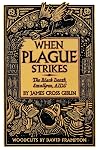
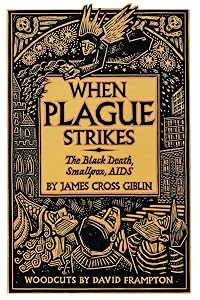
I was immediately captured by the cover of this book: a woodcut print that illustrates the three historic periods discussed within. Then, I was immediately put off by the redundancy of the opening sentence: "...the Plague of Athens struck suddenly and without warning" (page 1). I quickly got over that.
Beginning with this prologue that introduces the reader to plagues with the ancient scourge of Athens, the book is arranged chronologically and well-organized within each specific topic while clearly linking the multiple topics to create one cohesive book. The author's unpretentious and information-packed writing style makes for a captivating read. I couldn't put it down; I read it in one sitting. Much of the information presented helped show more me further understand the broad world around me, especially with his explanations of the etymology of words such as "vaccine." The prologue is mirrored with an afterword that is foreboding, but suiting, and really quite poignant in its call for humanity to unite against our common enemy of disease.
The author was appropriately tender in his address of our modern-day plague, HIV/AIDS. He managed to present this sensitive topic (especially at the time he was writing this book) in a way that felt neutral by making a direct comparison of the various reactions people had to the Black Death and Smallpox to the various reactions people have regarding individuals with HIV/AIDS, providing a perspective that can help students step outside of their modern lives and evaluate emotions held by our ancestors, thus promoting the development of critical thinking skills. Finally, the source notes and bibliography provide much information and solidify this book as an excellent teaching tool and a reminder that such information was still accessible before the golden age of the internet.
The only drawback is that this book was published in 1995 and so much has changed in our medical and social reactions to HIV/AIDS over the last two decades. Importantly, specifically because so much has changed, I feel this early history of the virus includes much information that today largely is forgotten or overshadowed by more recent discoveries. show less
Beginning with this prologue that introduces the reader to plagues with the ancient scourge of Athens, the book is arranged chronologically and well-organized within each specific topic while clearly linking the multiple topics to create one cohesive book. The author's unpretentious and information-packed writing style makes for a captivating read. I couldn't put it down; I read it in one sitting. Much of the information presented helped show more me further understand the broad world around me, especially with his explanations of the etymology of words such as "vaccine." The prologue is mirrored with an afterword that is foreboding, but suiting, and really quite poignant in its call for humanity to unite against our common enemy of disease.
The author was appropriately tender in his address of our modern-day plague, HIV/AIDS. He managed to present this sensitive topic (especially at the time he was writing this book) in a way that felt neutral by making a direct comparison of the various reactions people had to the Black Death and Smallpox to the various reactions people have regarding individuals with HIV/AIDS, providing a perspective that can help students step outside of their modern lives and evaluate emotions held by our ancestors, thus promoting the development of critical thinking skills. Finally, the source notes and bibliography provide much information and solidify this book as an excellent teaching tool and a reminder that such information was still accessible before the golden age of the internet.
The only drawback is that this book was published in 1995 and so much has changed in our medical and social reactions to HIV/AIDS over the last two decades. Importantly, specifically because so much has changed, I feel this early history of the virus includes much information that today largely is forgotten or overshadowed by more recent discoveries. show less
A good look about the influences of the effects of major epidemics on the world. It talks about three: the Black Death, Smallpox, and AIDS. Each one is broken down into different chapters that cover the origins of the disease, its scientific background, effect on the world and outcome, as well as a personal story. At the end of the book, a small chapter covers the topic os these diseases still being a threat because of their adaptation to antibiotics. This is a great book to start students off on this topic. It only gives a brief glance at each epidemic, but enough information to get them interested. My favorite parts were the personal sections in the latter parts of the book. Hearing the personal stories of Rock Hudson and Ryan White show more helps connect us to the past events in a more personal tone. I did wish that such sections were avaliable for first two sections. There are few illustrations, and they are only used to seperate the different sections. This book could be used in a world history class, talking about how these epidemics helped to change the world. show less
When Plague Strikes is a great basic guide to get early teens started in the study of diseases in history. It is not as in-depth as Ziegler's The Black Death but this is not it's intention. This book is very easy to read and comprehend without sacrificing relevant facts and histories. The author covers his subjects in a calm, clear manner and relates facts without passing judgement. An advantage this book holds over Ziegler's The Black Death is the understandable style of the writing (Ziegler constantly refers to statistics and uses large, scholarly language unsuitable for beginners) and the coverage of two other major epidemic diseases, namely smallpox and AIDS. I enjoyed reading this book and did not have to constantly stop and look show more up words the way I did with Ziegler. show less
Review: When Plague Strikes by James Cross Giblin.
The book was interesting and educational as I am reading while the world is at this time in a virus pandemic (2020). It started in February, 2020 and is still spreading all over the world with enormous deaths to this day January 2021. The book was very informative on the history of plagues of Black Death, Smallpox, and AIDS. The author Giblin informs the readers what types of diseases they are, how they spread, and how people reacted when faced with crises or epidemics. It seems like the population back than is what civilization is going through now.
With modern technology and medicine after a year they have now made vaccines with 90+ percent effectible with little symptoms of an allergic show more reaction, so far. I have to say know one knows how effective it will be on the long term but that is how medicine is made. Everyone has not got the same anti-bodies or immune system so it is clear the world is trying to stay positive for good results. show less
The book was interesting and educational as I am reading while the world is at this time in a virus pandemic (2020). It started in February, 2020 and is still spreading all over the world with enormous deaths to this day January 2021. The book was very informative on the history of plagues of Black Death, Smallpox, and AIDS. The author Giblin informs the readers what types of diseases they are, how they spread, and how people reacted when faced with crises or epidemics. It seems like the population back than is what civilization is going through now.
With modern technology and medicine after a year they have now made vaccines with 90+ percent effectible with little symptoms of an allergic show more reaction, so far. I have to say know one knows how effective it will be on the long term but that is how medicine is made. Everyone has not got the same anti-bodies or immune system so it is clear the world is trying to stay positive for good results. show less
This book gives students a good understanding of the historical context of deadly diseases, and how it affects social structure and discrimination against minority groups. While contextualizing the “blame” of the diseases on minorities, it helps students understand the foolishness of discriminating against those who are diagnosed with deadly diseases, and hopefully helps them empathize with those who are sick.
Great non-fiction book fo those interested in major disease throughout history. This book gives an indepth recounting of 3 crippling diseases. For each disease it give specific examples of famous people to have been affected by the plagues. This book is also a great way of looking into medical advances and indentifying possible future medical discoveries and hindrances. This will greatly help pique the interest of the young adult audience. The main downfall is that it is a fair bit out of date to give a full account of the effects of AIDS, but it is a good starting point. It also could have used more images, although that might be a bit morbid.
When Plague Strikes: the Black Death, Smallpox, AIDS by James Cross Giblin; woodcuts by David Frampton
Teen Nonfiction
When Plague Strikes brings together three plagues to provide a continuum and historical perspective leading up to 1995. The juxtaposition of these three plagues shows the evolution not only of the medical establishment but the changing faces and modes of ignorance that will probably always be with us. Informative and well-done, When Plague Strikes also provides a bibliography for further research including Rats, Lice, and History by Hans Zinsser.
Recommended October 2005
Teen Nonfiction
When Plague Strikes brings together three plagues to provide a continuum and historical perspective leading up to 1995. The juxtaposition of these three plagues shows the evolution not only of the medical establishment but the changing faces and modes of ignorance that will probably always be with us. Informative and well-done, When Plague Strikes also provides a bibliography for further research including Rats, Lice, and History by Hans Zinsser.
Recommended October 2005
Members
- Recently Added By
Lists

Best Books About Plagues and Epidemics
99 works; 17 members
Author Information

37+ Works 4,859 Members
James Cross Giblin was born in Cleveland, Ohio on July 8, 1933. He received a B. A. from Western Reserve University in 1954 and an M.F.A. in creative writing from Columbia University in 1955. He pursued playwriting before taking a job at Criterion Books in 1959. He focused on the children's book field. In the early to mid-1960s, he was an show more associate editor at Lothrop, Lee and Shepard. In 1967, he moved to Seabury Press, where he became editor-in-chief, spearheading the development of the children's book line there, later called Clarion Books. When Houghton Mifflin bought Clarion in the late 1970s, he moved to the company as Clarion's publisher. As an editor, he worked with such authors as Eileen Christelow and Mary Downing Hahn. His first children's book, The Scarecrow Book written with Dale Ferguson, was published in 1980. During his lifetime, he wrote more than 20 books for young readers, mainly nonfiction, historical nonfiction, and biographies. He won several awards including the 1983 National Book Award for Chimney Sweeps: Yesterday and Today and the 2003 Sibert Medal for The Life and Death of Adolf Hitler. He died on April 10, 2016 at the age of 82. (Bowker Author Biography) show less
Some Editions
Awards and Honors
Awards
Distinctions
Common Knowledge
- Canonical title
- When Plague Strikes
- Original publication date
- 1995
- People/Characters
- Edward Jenner
- Dedication
- To the memory of Gary W. Bargar, Ron Wegen, and all the other gifted men and women whose lives have been cut short by the plague of AIDS.
- First words
- Early in 1347, a mysterious disease attacked people living near the Black Sea in what is now southern Ukraine.
- Quotations
- "Every major plague that has afflicted the world seems to have brought out the best as well as the worst in people. There have always been doctors, clergy, friends, and neighbors who cared for the victims, often at risk to t... (show all)heir own lives. And there have been others who refused all contact with the sufferers, even going so far as to wall them up in their own homes."
- Last words
- (Click to show. Warning: May contain spoilers.)Finding ways to treat and cure it soon becomes the concern of everyone on the planet.
Classifications
- Genres
- Nonfiction, Kids, Teen
- DDC/MDS
- 614.4 — Applied science & technology Medicine & health Epidemics, Poisons, Alternative Medicine Incidence of and public measures to prevent disease
- LCC
- RA644 .P7 .G53 — Medicine Public aspects of medicine Public aspects of medicine Public health. Hygiene. Preventive medicine Disease (Communicable and noninfectious) and public
- BISAC
Statistics
- Members
- 253
- Popularity
- 127,436
- Reviews
- 8
- Rating
- (3.86)
- Languages
- English
- Media
- Paper
- ISBNs
- 6
- ASINs
- 1