Harlem
by Walter Dean Myers
On This Page
Description
A poem celebrating the people, sights, and sounds of Harlem.Tags
Recommendations


Member Reviews
With the stunning pages illustrated by his son Walter Dean Myers gives readers a very intimate and succinct history of Harlem. Written as a poem, it is part jazz, part blues, and completely amazing.
This poem is a celebration of Harlem and its meaning, literally and figuratively, in African-American culture. Myers’ poem is powerful. “A new sound, raucous and sassy/Cascading over the asphalt village/Breaking against the black sky over/1-2-5 Street./Announcing the hallelujah/Riffing past resolution.” This line is paired with an illustration of a woman with eyes closed and arms outstretched, calling forth the same imagery as the three blackbirds flying out from behind her.
My favorite part of the poem is a few pages later. Across the two-page spread is a preacher, his back to us with his arm held high. His right hand is in the center and becomes a focal point. Parishioners are listening, clapping, participating. “We hoe, we show more pray/Our black skins/Reflecting the face of God/In storefront temples/Jive and Jehovah artists/Lay out the human canvas/The mood indigo.’’ I love that last line!! Its meaning is made more clear a few pages later as Myers chronicles the rise of jazz.
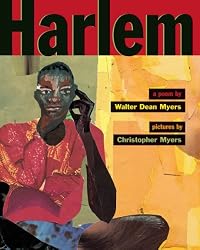
Christopher Myers’ collages are stunning. He has interwoven heavy brush strokes with pages from books, torn paper, and what appear to be pieces of photographs. The effect, particularly from the thick paint and strokes, is to further communicate the strength and pride Harlem evokes and represents.
I would present this book to preservice teachers in a few different ways. One would be to consider the marriage of the poem, the art, and the overall theme that they are both serving. I think an understanding of how these elements work together is important.
Another way is in terms of understanding, at least broadly, African-American culture. If we desire our curriculum and our teaching to be culturally relevant, then we must ourselves possess deeper knowledge of cultures outside of our own. This works helps us understand Harlem’s place in African-American culture—especially in terms of the arts.
Finally, I would bring this to preservice teachers is a larger discussion about poetry. What makes something a poem? What makes it poetic? What are ways to share and read poetry? How do we help our students write poetry? I think we all carry baggage about poetry that makes us hesitant to make it a vital part of our classrooms. I think discussions with preservice teachers are important so that books such as these are not only part of our libraries but also part of our classroom discussions and our lives, writing and otherwise. show less
My favorite part of the poem is a few pages later. Across the two-page spread is a preacher, his back to us with his arm held high. His right hand is in the center and becomes a focal point. Parishioners are listening, clapping, participating. “We hoe, we show more pray/Our black skins/Reflecting the face of God/In storefront temples/Jive and Jehovah artists/Lay out the human canvas/The mood indigo.’’ I love that last line!! Its meaning is made more clear a few pages later as Myers chronicles the rise of jazz.
Christopher Myers’ collages are stunning. He has interwoven heavy brush strokes with pages from books, torn paper, and what appear to be pieces of photographs. The effect, particularly from the thick paint and strokes, is to further communicate the strength and pride Harlem evokes and represents.
I would present this book to preservice teachers in a few different ways. One would be to consider the marriage of the poem, the art, and the overall theme that they are both serving. I think an understanding of how these elements work together is important.
Another way is in terms of understanding, at least broadly, African-American culture. If we desire our curriculum and our teaching to be culturally relevant, then we must ourselves possess deeper knowledge of cultures outside of our own. This works helps us understand Harlem’s place in African-American culture—especially in terms of the arts.
Finally, I would bring this to preservice teachers is a larger discussion about poetry. What makes something a poem? What makes it poetic? What are ways to share and read poetry? How do we help our students write poetry? I think we all carry baggage about poetry that makes us hesitant to make it a vital part of our classrooms. I think discussions with preservice teachers are important so that books such as these are not only part of our libraries but also part of our classroom discussions and our lives, writing and otherwise. show less
I really enjoyed the book “Harlem” for many reasons. One reason was because it was actually a poem in story form which was a refreshing change of pace from the normal format of a children’s story. This would be a great example to use in a poetry unit because it shows children that poems do not have to rhyme or be in a certain format to be powerful. “Hide-and-seek knights and ladies/Waiting to sing their own sweet songs/Living out their own slam-dunk dreams/Listening/For the coming of the blues”. The other thing I really enjoyed about this book were the pictures. They appeared to be a combination of collage art and painting and were extremely interesting and depicted the culture in the story. For instance, the man in the suit show more with a top hat and a cane, the musician playing the saxophone, and the basketball player seen through the chain link fence. The pictures really immerse the reader in the story and make them feel as if they are a part of the community. The main idea of this book is to highlight the deep and rich culture of Harlem from art and music to everyday life. show less
I expected to like this book more than I did. I loved the cover and anticipated a cohesive fusion of layered text and textures images. I still found the illustrations to be powerful and textured, but the text left me wanting. I know it provides reference and location to the pictures but I could not get into a rhythm with them. I didn't find a part I felt until the last few pages, which is too late for me. But the poem is about Harlem, and a history and heritage that is not mine and is not meant for me. It is to showcase and honor a famous neighborhood and its people.
I do think the images in the book can stand on their own, and I would love to see them in a special exhibit.
I do think the images in the book can stand on their own, and I would love to see them in a special exhibit.
This poem by Walter Dean Myers — a revered elder of children's literature — celebrates Harlem, where he grew up, full of "colors loud enough to be heard" and songs first heard in the villages of "Ghana/Mali/Senegal." His son Christopher's bold illustrations, part paint and part collage, don't talk down to kids, instead pulling them into a vibrant city. (For ages 9 and up)
Walter Dean Myers depicts "Harlem" in his poetry, describing a place rich with african american history and diversity, a place that promises life. The macabre illustrations by Christopher Myers add layers of meaning and texture, making the words almost something to reach out and touch. Walter Dean Myers references culture of the past and present, big and small, from the villages of Ghana to Langston Hughes. His words take you in:
"The uptown A
Rattles past 110th Street
Unreal to real
Relaxing the soul
Shango and Jesus
Asante and Mende
One people, a hundred different
People
Huddled masses
And crowded dreams".
This celebration of place and memories is unforgettable. Excellent for school curriculum and story time reading.
Themes: Multicultural, show more Harlem, NY, Black History, American Poetry. show less
"The uptown A
Rattles past 110th Street
Unreal to real
Relaxing the soul
Shango and Jesus
Asante and Mende
One people, a hundred different
People
Huddled masses
And crowded dreams".
This celebration of place and memories is unforgettable. Excellent for school curriculum and story time reading.
Themes: Multicultural, show more Harlem, NY, Black History, American Poetry. show less
Christopher Myers uses several different types of art techniques to uproot his audience and plant them in Harlem. Myers illustrates scenes of children running through a fire hydrant on a hot summer day, preachers preaching, and ladies singing gospels. One of his illustrations shows “perfumed sisters/Hip strutting past fried fish joints” (n.p.). Although his pictures most often follow the text, the facial expressions he has put on his characters tell the story the best. Most of the faces look withdrawn and show an expression of yearning - a yearning to get out.
Members
- Recently Added By
Lists

Caldecott Honor Books
296 works; 23 members

A Child's Book Tour of New York City
57 works; 6 members

SYES Library Wishlist
1,080 works; 4 members

Books Read in 2023
5,547 works; 145 members

NPR Books You Love: 100 Favorite Books For Young Readers
100 works; 1 member
Author Information

149+ Works 38,247 Members
Walter Dean Myers was born on August 12, 1937 in Martinsberg, West Virginia. When he was three years old, his mother died and his father sent him to live with Herbert and Florence Dean in Harlem, New York. He began writing stories while in his teens. He dropped out of high school and enlisted in the Army at the age of 17. After completing his army show more service, he took a construction job and continued to write. He entered and won a 1969 contest sponsored by the Council on Interracial Books for Children, which led to the publication of his first book, Where Does the Day Go? During his lifetime, he wrote more than 100 fiction and nonfiction books for children and young adults. His works include Fallen Angels, Bad Boy, Darius and Twig, Scorpions, Lockdown, Sunrise Over Fallujah, Invasion, Juba!, and On a Clear Day. He also collaborated with his son Christopher, an artist, on a number of picture books for young readers including We Are America: A Tribute from the Heart and Harlem, which received a Caldecott Honor Award, as well as the teen novel Autobiography of My Dead Brother. He was the winner of the first-ever Michael L. Printz Award for Monster, the first recipient of the Coretta Scott King-Virginia Hamilton Award for Lifetime Achievement, and a recipient of the Margaret A. Edwards Award for lifetime achievement in writing for young adults. He also won the Coretta Scott King Award for African American authors five times. He died on July 1, 2014, following a brief illness, at the age of 76. (Bowker Author Biography) show less
All Editions
Awards and Honors
Awards
Distinctions
Common Knowledge
- Canonical title
- Harlem
- Original publication date
- 1997
- Important places
- Harlem, New York, New York, USA
- Dedication
- To the memory of my foster parents, Herbert and Florence Dean --W.D.M.
To Mom and Dad because I like you people --C.M. - First words
- They took to the road in Waycross, Georgia
Skipped over the tracks in East St. Louis
Took the bus from Holly Springs
Hitched a ride from Gee's Bend
Took the long way through Memphis
The third deck down from Tri... (show all)nidad
A wrench of heart from Goree Island
A wrench of heart from Goree Island
To a place called Harlem. - Last words
- (Click to show. Warning: May contain spoilers.)A journey on the A train
That started on the banks of the Niger
And has not ended
Harlem.
Classifications
Statistics
- Members
- 800
- Popularity
- 34,508
- Reviews
- 29
- Rating
- (3.89)
- Languages
- English
- Media
- Paper, Audiobook
- ISBNs
- 8
- ASINs
- 7