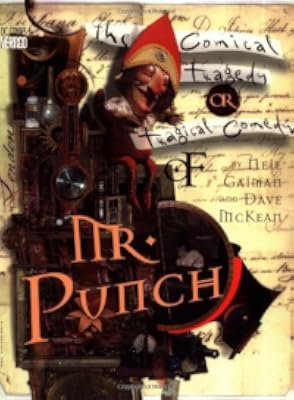
Mr. Punch
by Neil Gaiman (Writer), Dave McKean (Illustrator)
On This Page
Description
"A dark and frightening fully painted novella, MR. PUNCH tells the tale of a young boy's loss of innocence results from a horrific confrontation with his past. Spending a summer at his grandfather's seaside arcade, a troubled adolescent harmlessly becomes involved with a mysterious Punch and Judy Man and a mermaid-portraying woman. But when the violent puppet show triggers buried memories of the boy's family, the lives of all become feverishly intertwined. With disturbing mysteries and show more half-truths uncontrollably unraveling, the young boy is forced to deal with his family's dark secrets of violence, betrayal, and guilt. Written by New York Times best-selling novelist Neil Gaiman, with unwordly illustrations by artist Dave McKean, MR. PUNCH - 20TH ANNIVERSARY EDITION is the new deluxe cut of this landmark original graphic novel. Includes bonus material"-- show lessTags
Recommendations






Member Recommendations

tootstorm Has the strongest, eeriest retelling of the same Punch & Judy performance used in Gaiman & McKean's graphic novel. Punch's sinister personality permeates throughout the novel...which is one of the best I've ever read. Go!
20
Member Reviews
A man recalls his six year-old self, a summer that has stuck in his memory for years with hazy visions of his grandfather's failing amusement arcade. It was that year that the boy met Mr Punch, the puppet who entertains audiences by murdering his baby, wife, a policeman and then the judge. The boy doesn't find Punch's antics funny, in fact he's terrified, but when his grandfather allows a Punch show to open in his arcade as a last ditch effort to stay in business, the boy has no choice but to see more of Mr Punch.
I love Punch and Judy. They're creepy, and the photos used in this GN are collaged with drawings and produce some eerie results. There are some side stories about the various family members, so it's almost a short story.
I love Punch and Judy. They're creepy, and the photos used in this GN are collaged with drawings and produce some eerie results. There are some side stories about the various family members, so it's almost a short story.
The essence of memory is that we rarely get right to the heart of the matter. Something floats up into our thoughts and teases out a recollection. If that recollection has an emotion attached, then we are pulled down deeper towards other memories. As those memories gather about us, the world is recreated for us as it once was. Or at least how we saw it once upon a time. Neil Gaiman & Dave McKean’s MR. PUNCH is all about how we access memory. The story starts with shallow memories, brief bits about his grandparents. Each round of memories adds depth, and soon they begin to connect. There is a wonderful sense of tension built up as the story progresses. The traditional puppet show of Punch & Judy is retold in various forms and show more fragments--working like memory does in bits and pieces. The puppet show acts like a mirror of the memory that we are eventually being drawn toward. The wonderful illustrations are dark like half remembered images and many contain bits of this and that tossed together like disorganized thoughts. The images become more detailed and tangible as we get deeper but seldom is there anything particularly bright to hang hope on. There is no hope in memory, they are what they are. We can glean some understanding, but must be concerned about them taking over our lives—a point the book makes very well. MR. PUNCH does not seem like much at first and it knows this. Sparse at the dialogue keeps you moving until it knows it has you hooked. This is a wonderful creation starting like a light mist until by the end it has become an emotional downpour. show less
Childhood is a dim, misty country. Facts and faces, people and places all flit in and out of the streetlight of memory, all mediated by the prism of emotion. Neil Gaiman's Mr Punch captures that feeling exactly, through the eyes of a small boy -- Neil himself -- and it feels authentic because it is essentially autobiographical, and because it also has a sense of place without being being too specific.
Dave McKean's atmospheric artwork matches young Neil's perspective in the 70s, ferried to and around Southsea in Portsmouth to stay with grandparents and where he encounters other strange relatives and their associates. Self and space, adults and events are presented in a kaleidoscopic fashion that mirrors those confusing years when adults show more have control, violence may be around the corner and nothing truly makes sense, however much you try to fathom it out.
Boyhood memories link back to the inherent violence of the Punch & Judy puppet theatre, featuring as it does domestic abuse, criminal acts and premeditated murder. The acts of the traditional glove puppets are darker than the action in, say, a Tom & Jerry cartoon, and one always wonders at the play's suitability for children, but it was long a mainstay of seaside attractions and may still occasionally feature during family summer beach holidays.
One of Neil's grandfather's runs a rundown seaside arcade, with slot machines, a fortune teller, a maze of mirrors, a mermaid in a tank and a menagerie of parrots. But there are dark secrets in the family history, mysteries that are too insubstantial for the boy to grasp, and whispers of this history are soon bound up with the Punch and Judy man and his macabre comedy-cum-tragedy. Punch, his battered wife Judy, the baby, the law and other puppets become inextricable from people the boy meets, their lives or roles marching in parallel with the personnel in the play.
The sombre colours and noir-ish mixed media illustrations belie one's expectations of days spent at a seaside resort, and the fonts have been carefully created to perhaps suggest journal entries, in keeping with the style of a memoir. While the story can stand perfectly well on its own (or as a radio drama or audio book), being combined with a gallery of outline drawings, paintings and photographs (both sepia-tinged and colour) of models, puppets and seascapes adds immeasurably to its impact.
And the spookiest thing is that the puppets at times seem more real than the people. After a quarter-century this graphic novel has lost none of its power to disturb, and it does it deliciously. As somebody or other is wont to say, That's the way to do it! show less
Dave McKean's atmospheric artwork matches young Neil's perspective in the 70s, ferried to and around Southsea in Portsmouth to stay with grandparents and where he encounters other strange relatives and their associates. Self and space, adults and events are presented in a kaleidoscopic fashion that mirrors those confusing years when adults show more have control, violence may be around the corner and nothing truly makes sense, however much you try to fathom it out.
Boyhood memories link back to the inherent violence of the Punch & Judy puppet theatre, featuring as it does domestic abuse, criminal acts and premeditated murder. The acts of the traditional glove puppets are darker than the action in, say, a Tom & Jerry cartoon, and one always wonders at the play's suitability for children, but it was long a mainstay of seaside attractions and may still occasionally feature during family summer beach holidays.
One of Neil's grandfather's runs a rundown seaside arcade, with slot machines, a fortune teller, a maze of mirrors, a mermaid in a tank and a menagerie of parrots. But there are dark secrets in the family history, mysteries that are too insubstantial for the boy to grasp, and whispers of this history are soon bound up with the Punch and Judy man and his macabre comedy-cum-tragedy. Punch, his battered wife Judy, the baby, the law and other puppets become inextricable from people the boy meets, their lives or roles marching in parallel with the personnel in the play.
The sombre colours and noir-ish mixed media illustrations belie one's expectations of days spent at a seaside resort, and the fonts have been carefully created to perhaps suggest journal entries, in keeping with the style of a memoir. While the story can stand perfectly well on its own (or as a radio drama or audio book), being combined with a gallery of outline drawings, paintings and photographs (both sepia-tinged and colour) of models, puppets and seascapes adds immeasurably to its impact.
And the spookiest thing is that the puppets at times seem more real than the people. After a quarter-century this graphic novel has lost none of its power to disturb, and it does it deliciously. As somebody or other is wont to say, That's the way to do it! show less
Are half of Goodreads on LSD?
Browsing through these reviews, the first one I read describes this book as "Creepy and sinister". Another claims it is "Really morbid". Several mention the words "Disturbing" and "Terrifying", someone calls it "Darker than dark, even by Vertigo standards" and one person was actually so upset by the whole thing that they just wrote "Fuck you mr. Geiman!".
And it all makes me wonder if they have read another book, or if they are on heavy medication? Because the one I read was just a cute little story about a man thinking back at a puppet-show he saw in his youth. That's it! There's no creepiness, nothing is sinister, not one morbid second, and the whole thing is about as disturbing and terrifying as an show more instruction manual on how to cook noodles.
I wouldn't say it's a bad book, but it's not that good either. It's just a nostalgic trip back to the mind of an impressionable boy, and the only thing about it that's remotely scary, is whatever sheltered lives anyone must have lived, if this is what accounts for being "Terrifying". show less
Browsing through these reviews, the first one I read describes this book as "Creepy and sinister". Another claims it is "Really morbid". Several mention the words "Disturbing" and "Terrifying", someone calls it "Darker than dark, even by Vertigo standards" and one person was actually so upset by the whole thing that they just wrote "Fuck you mr. Geiman!".
And it all makes me wonder if they have read another book, or if they are on heavy medication? Because the one I read was just a cute little story about a man thinking back at a puppet-show he saw in his youth. That's it! There's no creepiness, nothing is sinister, not one morbid second, and the whole thing is about as disturbing and terrifying as an show more instruction manual on how to cook noodles.
I wouldn't say it's a bad book, but it's not that good either. It's just a nostalgic trip back to the mind of an impressionable boy, and the only thing about it that's remotely scary, is whatever sheltered lives anyone must have lived, if this is what accounts for being "Terrifying". show less
I heard about this graphic novel in the "On the Ledge" column in the back of an issue of [a:Grant Morrison|12732|Grant Morrison|http://photo.goodreads.com/authors/1311378308p2/12732.jpg]'s [b:The Invisibles|22357|The Invisibles, Vol. 2 Apocalipstick|Grant Morrison|http://photo.goodreads.com/books/1309399851s/22357.jpg|1040171] though the precise issue I don't recall. The pairing of [a:Neil Gaiman|1221698|Neil Gaiman|http://photo.goodreads.com/authors/1234150163p2/1221698.jpg] and [a:Dave McKean|10365|Dave McKean|http://photo.goodreads.com/authors/1249142890p2/10365.jpg] is one that I adore - [b:Mirrormask|760984|MirrorMask|Neil Gaiman|http://photo.goodreads.com/books/1266636866s/760984.jpg|1318615] was particularly good - and I was show more intrigued by the concept more than I would care to admit. I didn't grow up on Punch and Judy, but I knew enough about it from cartoons to get the general idea.
The story is incredibly dark, as "On the Ledge" warned. The story is rife with the confusion present in childhood, the slow realization that life is rife with sex, death, and violence. Family secrets are unveiled before the backdrop of the classic plot of the Punch and Judy show. Everyone dies but Punch in the shows, and the figure of the Punch and Judy Professor likewise seems omnipresent in a strange way.
I really enjoyed this book. I would be hard-pressed to explain exactly what it is about the writing, but it evokes the same sort of feelings in me that the opening pages of [b:Horse's Neck|878267|Horse's Neck|Pete Townshend|http://photo.goodreads.com/books/1179122879s/878267.jpg|945582] do. There is a certain ethereal quality that author's bring, and in this it is present in force.. coupled with the illustrations, it is nearly overwhelming. show less
The story is incredibly dark, as "On the Ledge" warned. The story is rife with the confusion present in childhood, the slow realization that life is rife with sex, death, and violence. Family secrets are unveiled before the backdrop of the classic plot of the Punch and Judy show. Everyone dies but Punch in the shows, and the figure of the Punch and Judy Professor likewise seems omnipresent in a strange way.
I really enjoyed this book. I would be hard-pressed to explain exactly what it is about the writing, but it evokes the same sort of feelings in me that the opening pages of [b:Horse's Neck|878267|Horse's Neck|Pete Townshend|http://photo.goodreads.com/books/1179122879s/878267.jpg|945582] do. There is a certain ethereal quality that author's bring, and in this it is present in force.. coupled with the illustrations, it is nearly overwhelming. show less
A while back, Rose posted a request on BookLikes for amusement park/theme park book recommendations, and this was one of mine. I hadn't read it in years, so I figured a reread was in order.
The title is long, so, from here on out, I'll just refer to it as Mr. Punch. The narrator of Mr. Punch is an adult recalling his childhood, in particular an extended period of time he spent with his grandfather, his father's father, before the birth of his younger sister. When he was a boy, those were just days he spent at his grandfather's arcade, hearing the mermaid sing and learning about Punch and Judy shows from Professor Swatchell. As an adult, those memories took on greater significance, because of disturbing things they revealed, or almost show more revealed, about the narrator's past and his family.
Although the Narrator-As-Child doesn't understand everything that's going on and isn't concerned with certain details, it's easy enough for readers to decipher the general situation. The narrator's grandfather cheated on his wife with the lady who played the mermaid at his arcade. That lady became pregnant and was convinced she was loved and would be supported. Various Punch stories and details about the show's history act as a sinister backdrop to all of this.
This graphic novel is not going to work for everyone. It's slow and reflective. The mixed media artwork is dark, shadowy, and sometimes confusing. The bulk of the text is done in a faux handwriting font, often white on black, that can be kind of annoying to read, although it fits with the artwork better than I imagine anything else would have.
One of the reasons this book works so well for me is that I can connect with it on a personal level. As far as I know, the past couple generations of my family don't have secrets that are quite as dark as the narrator's family's secrets, but they do have secrets. The messages about the way we experienced our childhoods versus the way we remember those experiences as adults resonates with me.
On a more surface level, I found the details about Punch and Judy stories and the history of the shows to be fascinating. Whether they're all true or not, I don't know, but they at least sound like they could be.
I vaguely remember attending a few shows when I was a kid in Germany, although I don't recall them being nearly as creepy-looking as the ones in this book. I used to own a set of hand-puppets, cheap rubber and cloth things, of all the basic characters. My favorite was the crocodile, so I got a kick out of the bit in the book that was specifically about that character.
(Original review, with read-alikes, posted on A Library Girl's Familiar Diversions.) show less
The title is long, so, from here on out, I'll just refer to it as Mr. Punch. The narrator of Mr. Punch is an adult recalling his childhood, in particular an extended period of time he spent with his grandfather, his father's father, before the birth of his younger sister. When he was a boy, those were just days he spent at his grandfather's arcade, hearing the mermaid sing and learning about Punch and Judy shows from Professor Swatchell. As an adult, those memories took on greater significance, because of disturbing things they revealed, or almost show more revealed, about the narrator's past and his family.
Although the Narrator-As-Child doesn't understand everything that's going on and isn't concerned with certain details, it's easy enough for readers to decipher the general situation. The narrator's grandfather cheated on his wife with the lady who played the mermaid at his arcade. That lady became pregnant and was convinced she was loved and would be supported. Various Punch stories and details about the show's history act as a sinister backdrop to all of this.
This graphic novel is not going to work for everyone. It's slow and reflective. The mixed media artwork is dark, shadowy, and sometimes confusing. The bulk of the text is done in a faux handwriting font, often white on black, that can be kind of annoying to read, although it fits with the artwork better than I imagine anything else would have.
One of the reasons this book works so well for me is that I can connect with it on a personal level. As far as I know, the past couple generations of my family don't have secrets that are quite as dark as the narrator's family's secrets, but they do have secrets. The messages about the way we experienced our childhoods versus the way we remember those experiences as adults resonates with me.
On a more surface level, I found the details about Punch and Judy stories and the history of the shows to be fascinating. Whether they're all true or not, I don't know, but they at least sound like they could be.
I vaguely remember attending a few shows when I was a kid in Germany, although I don't recall them being nearly as creepy-looking as the ones in this book. I used to own a set of hand-puppets, cheap rubber and cloth things, of all the basic characters. My favorite was the crocodile, so I got a kick out of the bit in the book that was specifically about that character.
(Original review, with read-alikes, posted on A Library Girl's Familiar Diversions.) show less
Read this book somewhere well-lit. Shady characters, dark images, and the subconscious’ shadows meld into a story that alternates between reality and nightmare.
The narrator recalls a summer of his youth spent with his grandparents at his grandfather’s failing seaside arcade, where he meets a mysterious Punch and Judy professor. Gaiman expertly weaves the narrator’s evasion with the child’s uncertainty about the strange characters around him. Combined with the sinister nature of the Punch and Judy show, the frightening setting of the dilapidated amusement park, and the rainy environment, this book evokes an uneasy but mesmerizing response.
Dave McKean’s surreal illustrations are reminiscent of Quay Brothers films and lend to show more the story’s distorted atmosphere with eerie warped images of rusty, carved and textured sculptures and darkly colored drawings overlaid with illegible text. show less
The narrator recalls a summer of his youth spent with his grandparents at his grandfather’s failing seaside arcade, where he meets a mysterious Punch and Judy professor. Gaiman expertly weaves the narrator’s evasion with the child’s uncertainty about the strange characters around him. Combined with the sinister nature of the Punch and Judy show, the frightening setting of the dilapidated amusement park, and the rainy environment, this book evokes an uneasy but mesmerizing response.
Dave McKean’s surreal illustrations are reminiscent of Quay Brothers films and lend to show more the story’s distorted atmosphere with eerie warped images of rusty, carved and textured sculptures and darkly colored drawings overlaid with illegible text. show less
Members
- Recently Added By
Lists

Best Science Fiction Comics and Graphic Novels
144 works; 11 members

Books Read in 2014
2,344 works; 89 members
Author Information

Neil Gaiman was born in Portchester, England on November 10, 1960. He worked as a journalist and freelance writer for a time, before deciding to try his hand at comic books. Some of his work has appeared in publications such as Time Out, The Sunday Times, Punch, and The Observer. His first comic endeavor was the graphic novel series The Sandman. show more The series has won every major industry award including nine Will Eisner Comic Industry Awards, three Harvey Awards, and the 1991 World Fantasy Award for best short story, making it the first comic ever to win a literary award. He writes both children and adult books. His adult books include The Ocean at the End of the Lane, which won a British National Book Awards, and the Locus Award for Best Fantasy Novel for 2014; Stardust, which won the Mythopoeic Award as best novel for adults in 1999; American Gods, which won the Hugo, Nebula, Bram Stoker, SFX, and Locus awards; Anansi Boys; Trigger Warning: Short Fictions and Disturbances; and The View from the Cheap Seats: Selected Nonfiction, which is a New York Times Bestseller. His children's books include The Day I Swapped My Dad for Two Goldfish; Coraline, which won the Elizabeth Burr/Worzalla, the BSFA, the Hugo, the Nebula, and the Bram Stoker awards; The Wolves in the Walls; Odd and the Frost Giants; The Graveyard Book, which won the Newbery Award in 2009 and The Sandman: Overture which won the 2016 Hugo Awards Best Graphic Story. (Bowker Author Biography) show less

Dave McKean was born on December 29, 1963 in Maidenhead, England. He is an illustrator, photographer, comic book artist, filmmaker and musician. McKean is best known for his regular collaboration with Neil Gaiman. MirrorMask, McKean's first feature film as director and visual designer, premiered at the Sundance Film Festival in January 2005. The show more screenplay was written by Neil Gaiman. (Bowker Author Biography) show less
Some Editions
Awards and Honors
Awards
Notable Lists
Series
Belongs to Publisher Series
Work Relationships
Inspired
Common Knowledge
- Canonical title
- Mr. Punch
- Original title
- The Tragical Comedy or Comical Tragedy of Mr. Punch
- Original publication date
- 1994
- People/Characters
- Mr. Punch
- Important places
- Portsmouth, Hampshire, England, UK; Hampshire, England, UK; England, UK
- Dedication
- For Holly Gaiman, who is now too old to be thrown out of the window and for Yolanda McKean, who is just the right age. And for all the other new cast members who joined us during the preparation and completion of this book in... (show all)cluding Sky McCloud, Nikolai Muth, Ambre Mattotti, Emily DeFiore, Zachary Bruning...
- First words
- My grandfather Arthur once took me fishing.
- Last words
- (Click to show. Warning: May contain spoilers.)I left the churchyard then, shivering in spite of the May sunshine, and went about my life.
- Publisher's editor*
- Berger, Karen
*Some information comes from Common Knowledge in other languages. Click "Edit" for more information.
Classifications
Statistics
- Members
- 1,744
- Popularity
- 12,716
- Reviews
- 27
- Rating
- (3.79)
- Languages
- 6 — English, French, German, Italian, Spanish, Portuguese (Portugal)
- Media
- Paper
- ISBNs
- 19
- UPCs
- 1
- ASINs
- 4