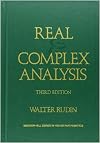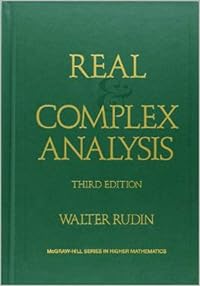
Real and Complex Analysis
by Walter Rudin
On This Page
Description
This is an advanced text for the one- or two-semester course in analysis taught primarily to math, science, computer science, and electrical engineering majors at the junior, senior or graduate level. The basic techniques and theorems of analysis are presented in such a way that the intimate connections between its various branches are strongly emphasized. The traditionally separate subjects of 'real analysis' and 'complex analysis' are thus united in one volume. Some of the basic ideas from show more functional analysis are also included. This is the only book to take this unique approach. The third edition includes a new chapter on differentiation. Proofs of theorems presented in the book are concise and complete and many challenging exercises appear at the end of each chapter. The book is arranged so that each chapter builds upon the other, giving students a gradual understanding of the subject. This text is part of the Walter Rudin Student Series in Advanced Mathematics. show lessTags
Recommendations





Member Reviews
One of a Kind
I normally don't review books that already have this many reviews, especially when I agree so much with the reviews that already exist. But I'm teaching out of green Rudin for the first time this semester, 20 years after getting to know the book well as a student, and I find myself so enthusiastic about it again, that I just had to chime in with an "Amen" to the other positive reviews. When it comes to mathematical writing, it doesn't get any more exquisitely elegant than this.
Probably all our reviews are irrelevant, however, because there are probably very few discretionary purchases of this book: There will be nearly a one-to-one correspondence between buyers of the book and students in classes for which it is required. show more For them, I can only recommend skipping the outrageously expensive hardback (which even at its high price is pretty cheaply constructed nowadays) and opting for the more reasonable international paperback edition. show less
I normally don't review books that already have this many reviews, especially when I agree so much with the reviews that already exist. But I'm teaching out of green Rudin for the first time this semester, 20 years after getting to know the book well as a student, and I find myself so enthusiastic about it again, that I just had to chime in with an "Amen" to the other positive reviews. When it comes to mathematical writing, it doesn't get any more exquisitely elegant than this.
Probably all our reviews are irrelevant, however, because there are probably very few discretionary purchases of this book: There will be nearly a one-to-one correspondence between buyers of the book and students in classes for which it is required. show more For them, I can only recommend skipping the outrageously expensive hardback (which even at its high price is pretty cheaply constructed nowadays) and opting for the more reasonable international paperback edition. show less
Indeholder "Preface", "Prologue: The Exponential Function", "Chapter 1. Abstract Integration", " Set-theoretic notations and terminology", " The concept of measurability", " Simple functions", " Elementary properties of measures", " Arithmetic in [0, infinity]", " Integration of positive functions", " Integration of complex functions", " The role played by sets of measure zero", " Exercises", "Chapter 2. Positive Borel Measures", " Vector spaces", " Topological preliminaries", " The Riesz representation theorem", " Regularity properties of Borel measures", " Lebesgue measure", " Continuity properties of measurable functions", " Exercises", "Chapter 3. L^P-Spaces", " Convex functions and inequalities", " The L^P-spaces", " Approximation show more by continuous functions", " Exercises", "Chapter 4. Elementary Hilbert Space Theory", " Inner products and linear functionals", " Orthonormal sets", " Trigonometric series", " Exercises", "Chapter 5. Examples of Banach Space Techniques", " Banach spaces", " Consequences of Baire's theorem", " Fourier series of continuous functions", " Fourier coefficients of L^1-functions", " The Hahn-Banach theorem", " An abstract approach to the Poisson integral", " Exercises", "Chapter 6. Complex Measures", " Total variation", " Absolute continuity", " Consequences of the Radon-Nikodym theorem", " Bounded linear functionals on L^P", " The Riesz representation theorem", " Exercises", "Chapter 7. Differentiation", " Derivatives of measures", " The fundamental theorem of Calculus", " Differentiable transformations", " Exercises", "Chapter 8. Integration on Product Spaces", " Measurability on cartesian products", " Product measures", " The Fubini theorem", " Completion of product measures", " Convolutions", " Distribution functions", " Exercises", "Chapter 9. Fourier Transforms", " Formal properties", " The inversion theorem", " The Plancherel theorem", " The Banach algebra L^1", " Exercises", "Chapter 10. Elementary Properties of Holomorphic Functions", " Complex differentiation", " Integration over paths", " The local Cauchy theorem", " The power series representation", " The open mapping theorem", " The global Cauchy theorem", " The calculus of residues", " Exercises", "Chapter 11. Harmonic Functions", " The Cauchy-Riemann equations", " The Poisson integral", " The mean value property", " Boundary behavior of Poisson integrals", " Representation theorems", " Exercises", "Chapter 12. The Maximum Modulus Principle", " Introduction", " The Schwarz lemma", " The Phragmen-Lindelöf method", " An interpolation theorem", " A converse of the maximum modulus theorem", " Exercises", "Chapter 13. Approximation by Rational Functions", " Preparation", " Runge's theorem", " The Mittag-Leffler theorem", " Simply connected regions", " Exercises", "Chapter 14. Conformal Mapping", " Preservation of angles", " Linear fractional transformations", " Normal families", " The Riemann mapping theorem", " The class F", " Continuity at the boundary", " Conformal mapping of an annulus", " Exercises", "Chapter 15. Zeros of Holomorphic Functions", " Infinite products", " The Weierstrass factorization theorem", " An interpolation problem", " Jensen's formula", " Blaschke products", " The Müntz-Szasz theorem", " Exercises", "Chapter 16. Analytic Continuation", " Regular points and singular points", " Continuation along curves", " The monodromy theorem", " Construction of a modular function", " The Picard theorem", " Exercises", "Chapter 17. H^P-Spaces", " Subharmonic functions", " The spaces H^P and N", " The theorem of F. and M. Riesz", " Factorization theorems", " The shift operator", " Conjugate functions", " Exercises", "Chapter 18. Elementary Theory of Banach Algebras", " Introduction", " The invertible elements", " Ideals and homomorphisms", " Applications", " Exercises", "Chapter 19. Holomorphic Fourier Transforms", " Introduction", " Two theorems of Paley and Wiener", " Quasi-analytic classes", " The Denjoy-Carleman theorem", " Exercises", "Chapter 20. Uniform Approximation by Polynomials", " Introduction", " Some lemmas", " Mergelyan's theorem", " Exercises", "Appendix: Hausdorff's Maximality Theorem", "Notes and Comments", "Bibliography", "List of Special Symbols", "Index".
Denne går hen over mit hoved, selv om jeg har haft lidt om topologi, metriske rum og målteori. show less
Denne går hen over mit hoved, selv om jeg har haft lidt om topologi, metriske rum og målteori. show less
Nov 12, 2016Danish
Ratings
Members
- Recently Added By
Lists

Most Popular Books Targeted at Mathematicians
26 works; 1 member
Author Information

17 Works 1,528 Members
Walter Rudin is Emeritus Professor of Mathematics at the University of Wisconsin in Madison, Wisconsin, where he has taught since 1959.
Awards and Honors
Awards
Series
Belongs to Publisher Series
Common Knowledge
- Canonical title
- Real and Complex Analysis
Classifications
- Genres
- Nonfiction, General Nonfiction, Science & Nature
- DDC/MDS
- 515 — Natural sciences & mathematics Mathematics Analysis
- LCC
- QA300 .R82 — Science Mathematics Mathematics Analysis
- BISAC
Statistics
- Members
- 400
- Popularity
- 77,503
- Reviews
- 2
- Rating
- (4.44)
- Languages
- 6 — English, French, German, Italian, Polish, Spanish
- Media
- Paper
- ISBNs
- 20
- ASINs
- 4