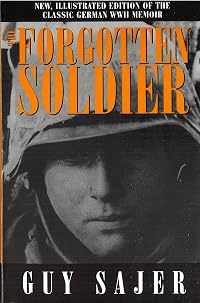
The Forgotten Soldier
by Guy Sajer
On This Page
Description
When Guy Sajer joins the infantry full of ideals in the summer of 1942, the German army is enjoying unparalleled success in Russia. However, he quickly finds that for the foot soldier the glory of military success hides a much harsher reality of hunger, fatigue, and constant deprivation. Posted to the elite Grosse Deutschland division, with its sadistic instructors who shoot down those who fail to make the grade, he enters a violent and remorseless world where all youthful hope is gradually show more ground down, and all that matters is the brute will to survive. As the biting cold of the Russian winter sets in, and the tide begins to turn against the Germans, life becomes an endless round of pounding artillery attacks and vicious combat against a relentless and merciless Red Army. Sajer's perspective as a German foot soldier makes The Forgotten Soldier a unique war memoir, the book that the Christian Science Monitor said "may well be the book about World War II which has been so long awaited." A work of stunning force, this is an unforgettable reminder of the horrors of war. show lessTags
Recommendations














Member Recommendations
VonKar Weliswaar een andere Wereldoorlog, maar eveneens een persoonlijk relaas van de gruwelen van de oorlog. Ernst Jünger ziet er nog een heroïsche kant in; bij Sajer is er enkel harde realiteit.
Member Reviews
Born of a German mother to a French father, Sajer was swept up in National Socialist fervor and enlisted to defend the Reich on the Eastern Front. Truck driver in a convoy arriving in Ukraine as Stalingrad fell, Sajer arrived in time to join in a multi-national retreat akin to Napoleon's withdrawal from Russia. Vacuumed up into the Großdeutschland Division, an elite combat unit of the German Army, Sajer retreated and fought until the Reich, his division, and his identity evaporated leaving him to recover in a France unknown to him. This is a fascinating memoir of Eastern Front privation and a detailed, reflective analysis of events by a front-line soldier grappling with the Red Army and his own reasons for fighting and living. Beside show more battle recaps, material on obtaining and using leave time, encounters with partisans, and fellow fighters not seeing Sajer as truly German make this one of the most revealing and insightful German WW II soldier autobiographies I have read. show less
The Forgotten Soldier is a stunning book, which is to say one leaves feeling traumatized after a long nightmare. Sajer leaves no bones unturned in describing the horrors of the Eastern Front. Of course it's visceral, mutilated corpses. But it runs deeper, Sajer's voice has an innocence and normality in contrast to the insanity of the situation. We tend to think of the Germans as "supermen" but Sajer is a normal person stressed to the utmost degree. No wonder Germany collapsed it's soldiers were abused and when they complained hung up from a tree. This part of the story is not often told.
The writing is dense with incident. It's easy to question if he remembered everything so clearly and with novelistic description but it's not too show more important because it rings true. My favorite part was as he wondered around the steppes of western Ukraine with no front line and troops randomly encountered one another in the dark and snow. The lonely outpost of a single tank buried in the earth surrounded by open plains "like Africa". show less
The writing is dense with incident. It's easy to question if he remembered everything so clearly and with novelistic description but it's not too show more important because it rings true. My favorite part was as he wondered around the steppes of western Ukraine with no front line and troops randomly encountered one another in the dark and snow. The lonely outpost of a single tank buried in the earth surrounded by open plains "like Africa". show less
Where to start? This book has affected me greatly. I did expect to be shocked, and did expect to read an account of some appalling experiences of a soldier fighting in the heart of an horrendously bloody and grisly conflict. But nothing could really prepare the reader for the overwhelming relentlessness of it all. This is a reading experience that should not be at all taken lightly.
Guy Sajer was a very young Alsatian (barely seventeen I think), of mixed Franco-German parentage, who finds himself in training with the German army during the autumn of 1942. The memoir does not make it clear if he is conscripted or volunteers. The zenith of the Nazi Reich has already passed - unbeknownst to its combatants and civilian populations. After his show more training in the Fatherland, Sajer is attached to a transport logistics unit supporting the combat troops at the Eastern Front. All too soon he is witness to the horrors of the fighting that follows the fallout from the Wehrmacht's defeat at Stalingrad and the first retreat from the Don.
Writing several years after the event, Sajer pulls no punches with his descriptions of the deprivations of combat, and the depravity. Early in his account though, he makes it clear how inadequate his words will always be in expressing the "cumulative nightmare...an uncommunicable terror":
"It is a mistake to use intense words without carefully weighing and measuring them, or they will have already been used when one needs them later. It's a mistake, for instance, to use the word 'frightful' to describe a few broken-up companions mixed into the ground: but it's a mistake which might be forgiven.
I should perhaps end my account here, because my powers are inadequate for what I have to tell."
(This on page 90 of a 560 page book.)
As the war progresses, and following a brief respite of sorts during leave in Berlin (where he witnesses a terrifying daytime Allied air raid), Sajer and his comrades are 'volunteered' into the elite Grosse Deutschland division as infantry. Back at the front, he is thrown right into the abyss again, in time for the chaotic blood-soaked retreat from Ukraine. At times in this memoir Sajer comes out with some truly shocking comments - "Throughout the war, one of the biggest mistakes was to treat German soldiers even worse than prisoners, instead of allowing us to rape and steal - crimes which we were condemned for in the end anyway." - for example. And this from a Frenchman not indoctrinated with Nazi bile prior to the conquest of France in 1940. A second period of leave - later in the memoir - is cancelled before he can even reach his destination, the whole train transport being reversed - back depressingly to the front. Anyone who has served as a conscript will recognise the achingly despondent sense that there is when home leave has to end, but to not even get there in the first place? - only to be sent back into the hell you had just escaped from...
There is a constant sense of fear that pervades everywhere.
"I know in my bones what our watchword 'Courage' means - from days and nights of resigned desperation, and from the insurmountable fear which one continues to accept, even though one's brain has ceased to function normally."
There is no mention at all of the ongoing Holocaust against the civilians of Europe, and no mention of Jews, and barely any of the racial Hitlerism at all. (There is though one very sinister glimpse of that horror, and what had thus far been 'dealt with' by the authorities, on the first page, (September '42) when en route to the front from basic training, via Poland, Sajer and co. pass through the Warsaw ghetto:"Our detatchment goes sightseeing in the city, including the famous ghetto - or rather, what's left of it. We return to the station in small groups. We are all smiling. The Poles smile back, especially the girls."
There is a surreal moral code of sorts that exists in his mind - the 'rules' of combat according to the Wehrmacht. When it comes to encounters with the Partisans, he is certain - "Also, partisans were not eligible for the consideration due to a man in uniform. The laws of war condemned them to death automatically, without trial." This coming after a description of how some Red Army POWs were killed mercilessly in a way too graphic to describe here.
The disastrous retreat continues as it becomes clear that all is lost.
"Faced with the Russian hurricane, we ran whenever we could...We no longer fought for Hitler, or for National Socialism, or for the Third Reich - or even for our fiancées or mothers or families trapped in bomb-ravaged towns. We fought from simple fear, which was our motivating power. The idea of death, even when we accepted it, made us howl with powerless rage."
Even when writing many years later Sajer seems to pour most of his anger out still on the Partisans. He doesn't ever seem to accept that Germany had invaded the continent, and that people without an army fighting for them, had the right to fight back - by whichever means available. The moral argument he attempts against the 'underhand' techniques of the guerillas is completely flawed. Nevertheless, his memoir, even if factually inaccurate in places as some have suggested, is an important document of witness. I struggled with the utter nightmare of it all, but am glad that I read The Forgotten Soldier. I'm sure I won't forget it. show less
Guy Sajer was a very young Alsatian (barely seventeen I think), of mixed Franco-German parentage, who finds himself in training with the German army during the autumn of 1942. The memoir does not make it clear if he is conscripted or volunteers. The zenith of the Nazi Reich has already passed - unbeknownst to its combatants and civilian populations. After his show more training in the Fatherland, Sajer is attached to a transport logistics unit supporting the combat troops at the Eastern Front. All too soon he is witness to the horrors of the fighting that follows the fallout from the Wehrmacht's defeat at Stalingrad and the first retreat from the Don.
Writing several years after the event, Sajer pulls no punches with his descriptions of the deprivations of combat, and the depravity. Early in his account though, he makes it clear how inadequate his words will always be in expressing the "cumulative nightmare...an uncommunicable terror":
"It is a mistake to use intense words without carefully weighing and measuring them, or they will have already been used when one needs them later. It's a mistake, for instance, to use the word 'frightful' to describe a few broken-up companions mixed into the ground: but it's a mistake which might be forgiven.
I should perhaps end my account here, because my powers are inadequate for what I have to tell."
(This on page 90 of a 560 page book.)
As the war progresses, and following a brief respite of sorts during leave in Berlin (where he witnesses a terrifying daytime Allied air raid), Sajer and his comrades are 'volunteered' into the elite Grosse Deutschland division as infantry. Back at the front, he is thrown right into the abyss again, in time for the chaotic blood-soaked retreat from Ukraine. At times in this memoir Sajer comes out with some truly shocking comments - "Throughout the war, one of the biggest mistakes was to treat German soldiers even worse than prisoners, instead of allowing us to rape and steal - crimes which we were condemned for in the end anyway." - for example. And this from a Frenchman not indoctrinated with Nazi bile prior to the conquest of France in 1940. A second period of leave - later in the memoir - is cancelled before he can even reach his destination, the whole train transport being reversed - back depressingly to the front. Anyone who has served as a conscript will recognise the achingly despondent sense that there is when home leave has to end, but to not even get there in the first place? - only to be sent back into the hell you had just escaped from...
There is a constant sense of fear that pervades everywhere.
"I know in my bones what our watchword 'Courage' means - from days and nights of resigned desperation, and from the insurmountable fear which one continues to accept, even though one's brain has ceased to function normally."
There is no mention at all of the ongoing Holocaust against the civilians of Europe, and no mention of Jews, and barely any of the racial Hitlerism at all. (There is though one very sinister glimpse of that horror, and what had thus far been 'dealt with' by the authorities, on the first page, (September '42) when en route to the front from basic training, via Poland, Sajer and co. pass through the Warsaw ghetto:"Our detatchment goes sightseeing in the city, including the famous ghetto - or rather, what's left of it. We return to the station in small groups. We are all smiling. The Poles smile back, especially the girls."
There is a surreal moral code of sorts that exists in his mind - the 'rules' of combat according to the Wehrmacht. When it comes to encounters with the Partisans, he is certain - "Also, partisans were not eligible for the consideration due to a man in uniform. The laws of war condemned them to death automatically, without trial." This coming after a description of how some Red Army POWs were killed mercilessly in a way too graphic to describe here.
The disastrous retreat continues as it becomes clear that all is lost.
"Faced with the Russian hurricane, we ran whenever we could...We no longer fought for Hitler, or for National Socialism, or for the Third Reich - or even for our fiancées or mothers or families trapped in bomb-ravaged towns. We fought from simple fear, which was our motivating power. The idea of death, even when we accepted it, made us howl with powerless rage."
Even when writing many years later Sajer seems to pour most of his anger out still on the Partisans. He doesn't ever seem to accept that Germany had invaded the continent, and that people without an army fighting for them, had the right to fight back - by whichever means available. The moral argument he attempts against the 'underhand' techniques of the guerillas is completely flawed. Nevertheless, his memoir, even if factually inaccurate in places as some have suggested, is an important document of witness. I struggled with the utter nightmare of it all, but am glad that I read The Forgotten Soldier. I'm sure I won't forget it. show less
Perhaps the single most depressing war story ever told. Still, a real thing of beauty. There has been some debate as to whether all of this tale is Guy Sajer's (there is some speculation that an anonymous individual provided him the details for the second PanzerGrenadier part of the story), nonetheless, this book is pure gold and a must read.
Long but well-written "memoir" of a French-German boy drafted into the German army during the big war. Very bloody at times. There is a question whether it's actually non-fiction or fiction but it is still a good long read. The author had to have had battle experience, in my opinion.
This book was the first "war story" I read that ruined the glamour and boyish admiration for war, guns, and all things explosive. Until this book, what I read was simply hero worship that did not relay what really goes on...the horror. I was glad to have the veil torn from in front of my eyes by this book as a boy and enjoyed the reminder as an adult. This should be required reading for all recruits as a counterpoint to the "video game-izaton" of war.
This was without a doubt the BEST first person account about war that I have read to this date. As an american living in Germany and married to a german woman I have heard stories of my wife's grandfather who was in the Wehrmacht fighting in Russia. [b:The Forgotten Soldier|102305|The Forgotten Soldier|Guy Sajer|http://photo.goodreads.com/books/1298440972s/102305.jpg|98639] gave me the chills in [a:Guy Sajer|59053|Guy Sajer|http://www.goodreads.com/assets/nophoto/nophoto-U-50x66.jpg]'s account of the events in which he had to survive, and I had to ask myself,"Could I have stayed alive?"
Members
- Recently Added By
Lists

Witness from the front: accounts of war, revolution, and strife
23 works; 5 members

German Literature
518 works; 56 members

THE WAR ROOM
813 works; 24 members
Author Information

37 Works 1,454 Members
Some Editions
Awards and Honors
Awards
Series
Belongs to Publisher Series
Common Knowledge
- Original publication date
- 1965
- Important places
- USSR; Kharkiv, Kharkiv Oblast, Ukraine (as Kharkov); Berlin, Germany; Belgorod, Belgorod Oblast, Russia; Dnieper River; Klaipėda, Lithuania (as Memel, East Prussia, Germany) (show all 7); Russia
- Important events
- World War II (1939 | 1945); World War II, Eastern Front (1941-06-22 | 1945-05-05)
- First words
- July 18, 1942. I arrive at the Chemnitz barracks, a huge oval building, entirely white. I am much impressed, with a mixture of admiration and fear.
- Last words
- (Click to show. Warning: May contain spoilers.)There is another man, whom I must forget. He was called Guy Sajer.
Classifications
Statistics
- Members
- 1,357
- Popularity
- 17,634
- Reviews
- 34
- Rating
- (4.24)
- Languages
- 11 — Dutch, English, Finnish, French, German, Greek, Italian, Norwegian (Bokmål), Polish, Spanish, Swedish
- Media
- Paper, Audiobook, Ebook
- ISBNs
- 48
- UPCs
- 1
- ASINs
- 28