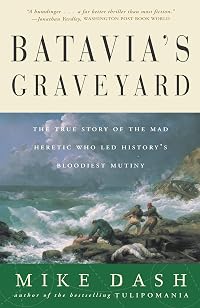
Batavia's Graveyard: The True Story of the Mad Heretic Who Led History's Bloodiest Mutiny
by Mike Dash
On This Page
Description
It was the autumn of 1628, and the Batavia, the Dutch East India Company's flagship, was loaded with a king's ransom in gold, silver, and gems for her maiden voyage to Java. The Batavia was the pride of the Company's fleet, a tangible symbol of the world's richest and most powerful commercial monopoly. She set sail with great fanfare, but the Batavia and her gold would never reach Java, for the Company had also sent along a new employee, Jeronimus Corneliszoon, a bankrupt and disgraced man show more who possessed disarming charisma and dangerously heretical ideas. With the help of a few disgruntled sailors, Jeronimus soon sparked a mutiny that seemed certain to succeed-but for one unplanned event: In the dark morning hours of June 3, the Batavia smashed through a coral reef and ran aground on a small chain of islands near Australia. The commander of the ship and the skipper evaded the mutineers by escaping in a tiny lifeboat and setting a course for Java to summon help. Nearly all of the passengers survived the wreck and found themselves trapped on a bleak coral island without water, food, or shelter. Leaderless, unarmed, and unaware of Jeronimus's treachery, they were at the mercy of the mutineers. show lessTags
Recommendations











Member Recommendations


Member Reviews
A no-holds-barred account of the chillingly brutal aftermath of a 1628 shipwreck on a reef fifty miles off the coast of what is now known as Australia. Dash explores the nastiness in great detail, and aside from a few speculative leaps at various points, this makes for riveting reading.
My one quibble is that the (very) extensive notes are not indicated in the text.
My one quibble is that the (very) extensive notes are not indicated in the text.
Ce livre aurait pu passer pour un roman d'aventures bien mené et bien documenté, un peu glauque, certes, mais entraînant et riche. Sauf que d'emblée l'auteur nous met au parfum: "Ce récit ne contient aucun élément purement imaginaire".
Voilà, c'est une histoire vraie, et une histoire vraiment horrible, et vraiment bien écrite aussi.
Bien plus que le récit d'un naufrage et de ses suites pour les survivants, c'est un témoignage sur la société hollandaise du XVIIème siècle, les atrocités commises, en partie par un groupe d'hommes dits hérétiques, mais en partie aussi des atrocités très comparables commises au nom du commerce, de la religion, même de la justice, et tutti quanti.
Alors bon malgré tout, et très show more franchement, je me serais assez bien passée des scènes de torture et de tuerie: je ne suis pas sûre d'avoir envie de connaître tout ce que sont capables de s'infliger mes congénères les uns aux autres.
Ce n'est donc pas une belle histoire, mais c'est une histoire prenante, qui s'attaque sans fausse manoeuvre aux différents aspects qui rentrent en ligne de compte: la société de l'époque, le contexte historique, la psychologie des personnages, et la documentation est solide! show less
Voilà, c'est une histoire vraie, et une histoire vraiment horrible, et vraiment bien écrite aussi.
Bien plus que le récit d'un naufrage et de ses suites pour les survivants, c'est un témoignage sur la société hollandaise du XVIIème siècle, les atrocités commises, en partie par un groupe d'hommes dits hérétiques, mais en partie aussi des atrocités très comparables commises au nom du commerce, de la religion, même de la justice, et tutti quanti.
Alors bon malgré tout, et très show more franchement, je me serais assez bien passée des scènes de torture et de tuerie: je ne suis pas sûre d'avoir envie de connaître tout ce que sont capables de s'infliger mes congénères les uns aux autres.
Ce n'est donc pas une belle histoire, mais c'est une histoire prenante, qui s'attaque sans fausse manoeuvre aux différents aspects qui rentrent en ligne de compte: la société de l'époque, le contexte historique, la psychologie des personnages, et la documentation est solide! show less
Wow what an amazing story, I couldn't put it down. A true-crime classic from the Age of Sail - if you like mutiny, debauchery and lunacy - sort of like The Raft of the Medusa + Treasure Island. Appropriately for the time, Dash focuses on the grotesque, 1629 was a brutal time in European history, the same period as the Thirty Years War the worst war in European history (prior to the 20th century). The book is useful for imagining the types of ordinary people who lived through it - mercenary, wavering loyalties to God, king, state or company; torn by religion, desperate souls on the margins of life and death with no safety nets. We read about the period with a sense of horror, glad to not to have lived through it, but it was through these show more violent fractures and mistakes that the modern world was born. The story of the Batavia is fascinatingly dark, but also a gateway for understanding a vital time in history. show less
In 1628 the Dutch East India Company loaded the Batavia, the flagship of its fleet, with a king’s ransom in gold, silver, and gems for her maiden voyage to Java; the ship itself was a tangible symbol of the world’s richest and most powerful monopoly.
The company also sent along a new employee to guard its treasure. He was Jeronimus Corneliszoon, a disgraced and bankrupt man with great charisma and dangerously heretical ideas. With the help of a few disgruntled sailors, he hatched a plot to seize the ship and her riches. The mutiny might have succeeded, but in the dark morning hours of June 3, 1629, the Batavia smashed through a coral reef and ran aground on a small chain of islands near Australia. The captain and skipper escaped the show more wreck, and in a tiny lifeboat they set sail for Java—some 1,500 miles north—to summon help. More than 250 frightened survivors waded ashore, thankful to be alive. Unfortunately, Jeronimus and the mutineers had survived too, and the nightmare was only beginning. show less
The company also sent along a new employee to guard its treasure. He was Jeronimus Corneliszoon, a disgraced and bankrupt man with great charisma and dangerously heretical ideas. With the help of a few disgruntled sailors, he hatched a plot to seize the ship and her riches. The mutiny might have succeeded, but in the dark morning hours of June 3, 1629, the Batavia smashed through a coral reef and ran aground on a small chain of islands near Australia. The captain and skipper escaped the show more wreck, and in a tiny lifeboat they set sail for Java—some 1,500 miles north—to summon help. More than 250 frightened survivors waded ashore, thankful to be alive. Unfortunately, Jeronimus and the mutineers had survived too, and the nightmare was only beginning. show less
"We have just come out of such a sorrow that the mind is still a little confused." -- Gijsbert Bastiaensz
*****
Commerce.
Psychopaths.
What do the two have in common?
If I were asked that before I read this book, I’d be glib and respond with something like “trajectory.” But no. I’ve learned it’s something called antinomianism.
If you don’t know what that means, don’t get discouraged. I didn’t either. Not right away, at least. Oh, I’m sure I’d read it before somewhere, probably years ago when I was knee-deep in Karen Armstrong and had a more particular interest in the monotheistic religions that have informed civilizations for thousands of years. But, as the irreligious say, I’ve slept since then.
Before I get to show more antinomianism, though, let me tell you a story. When I was a kid, I knew this other kid. We shall call him Sicko, so as to preserve his anonymity. Sicko was the first person my age I met upon moving to a new town. With adolescence looming, I was overjoyed to find myself just a few houses away from a fellow pre-teen traveler. But it soon dawned on me that age, gender and geography were poor rationales for friendship -- the two of us were completely different. I was an awkward and shy kid, but nevertheless independent, an only child who had just the year before lived in a single-parent home in Los Angeles County; contrariwise, Sicko was athletic and confident, yet oddly deferential, having been home schooled and subjected his entire life to a severely patrician Christian orthodoxy.
When my family moved again, this time within the town, Sicko and I lost touch. It wouldn't be until we were both nineteen that we found ourselves in the same social circles. By this time, Sicko's family had moved to Alaska, leaving him the solitary occupant of their 2400 square foot home. He extended an invitation to me to roommate with him and I quickly accepted. Over the next few months, I saw firsthand how manipulative and slyly sadistic he had become. Especially toward women. Sicko was a handsome guy, much more handsome than me, and there were young women at the house on various occasions. Most, however, never visited more than once. Then one night I had to rescue one of those young women from Sicko when she called out my name in distress. Soon after this incident, I moved out. I wouldn't see Sicko again for several years, whereupon I learned that he worked as a pharmaceutical sales representative, had married into a fairly prominent banking family and had developed a taste for bestiality films.
What's that saying about water seeking its own level?
Anyway, antinomianism. It is defined by wikipedia.org as "belief originating in Christian theology that faith alone, not obedience to religious law, is necessary for salvation." Jernonimus Cornelisz, the fellow at the center of this story of bloody mutiny, took this to mean that he wasn't bound by the same laws as other homo sapiens. He aspired to a life of piracy and manipulated several people into committing all manner of atrocity, the most chilling being the hanging of an infant. Then he was butchered and himself hanged.
I give this book five stars because it is meticulously researched, very well-written, and because I will remember the name Batavia for the rest of my life.
If you'd like to read more about the actual mutiny itself, the information available on Wikipedia is not contradicted by the book. show less
*****
Commerce.
Psychopaths.
What do the two have in common?
If I were asked that before I read this book, I’d be glib and respond with something like “trajectory.” But no. I’ve learned it’s something called antinomianism.
If you don’t know what that means, don’t get discouraged. I didn’t either. Not right away, at least. Oh, I’m sure I’d read it before somewhere, probably years ago when I was knee-deep in Karen Armstrong and had a more particular interest in the monotheistic religions that have informed civilizations for thousands of years. But, as the irreligious say, I’ve slept since then.
Before I get to show more antinomianism, though, let me tell you a story. When I was a kid, I knew this other kid. We shall call him Sicko, so as to preserve his anonymity. Sicko was the first person my age I met upon moving to a new town. With adolescence looming, I was overjoyed to find myself just a few houses away from a fellow pre-teen traveler. But it soon dawned on me that age, gender and geography were poor rationales for friendship -- the two of us were completely different. I was an awkward and shy kid, but nevertheless independent, an only child who had just the year before lived in a single-parent home in Los Angeles County; contrariwise, Sicko was athletic and confident, yet oddly deferential, having been home schooled and subjected his entire life to a severely patrician Christian orthodoxy.
When my family moved again, this time within the town, Sicko and I lost touch. It wouldn't be until we were both nineteen that we found ourselves in the same social circles. By this time, Sicko's family had moved to Alaska, leaving him the solitary occupant of their 2400 square foot home. He extended an invitation to me to roommate with him and I quickly accepted. Over the next few months, I saw firsthand how manipulative and slyly sadistic he had become. Especially toward women. Sicko was a handsome guy, much more handsome than me, and there were young women at the house on various occasions. Most, however, never visited more than once. Then one night I had to rescue one of those young women from Sicko when she called out my name in distress. Soon after this incident, I moved out. I wouldn't see Sicko again for several years, whereupon I learned that he worked as a pharmaceutical sales representative, had married into a fairly prominent banking family and had developed a taste for bestiality films.
What's that saying about water seeking its own level?
Anyway, antinomianism. It is defined by wikipedia.org as "belief originating in Christian theology that faith alone, not obedience to religious law, is necessary for salvation." Jernonimus Cornelisz, the fellow at the center of this story of bloody mutiny, took this to mean that he wasn't bound by the same laws as other homo sapiens. He aspired to a life of piracy and manipulated several people into committing all manner of atrocity, the most chilling being the hanging of an infant. Then he was butchered and himself hanged.
I give this book five stars because it is meticulously researched, very well-written, and because I will remember the name Batavia for the rest of my life.
If you'd like to read more about the actual mutiny itself, the information available on Wikipedia is not contradicted by the book. show less
A real life Lord of the Flies. The shipwrecked passengers and crew of a Dutch East India Company live a real life horror epic as the dark leaders bring barbaric rule to the stranded victims. The parallels to Lord of the Flies are profound, except that these were adults. No excuses about the descent into evil being the result of youthful anarchy here. What a story.
You need to be aware that a great deal of this telling is conjecture. It isn't as if predators or prey left comprehensive as it happened journals. But there is more than enough primary source information to make this too real to be fiction.
You need to be aware that a great deal of this telling is conjecture. It isn't as if predators or prey left comprehensive as it happened journals. But there is more than enough primary source information to make this too real to be fiction.
If I ever wonder what life was like on a seventeenth century ship bound for the Far East, then this is the book to consult. Serious history, but written to be read instead of consulted, Batavia's Graveyard makes a time, a place and a cast of characters come alive off the page. The story, as it unfolds, becomes harrowing and somewhat depressing, as a community of shipwrecked survivors descend into a true life "Lord of the Flies". It's also a gripping narrative, and could as easily slot into a "True Crime" tagging as an "Historical" one. I often feel let down by historical accounts that promise to read like a best-selling thriller, but this book really does, serving both to educate and entertain as you plough through it.
Members
- Recently Added By
Lists

r/AskHistorians' Recommended Books
1,068 works; 19 members

Ten Books About Disasters at Sea
10 works; 2 members

Bibliography of How the Old World Ended by Jonathan Scott
308 works; 1 member
Author Information

9+ Works 2,844 Members
He is the author of the critically acclaimed TULIPOMANIA and two other books. He is the former editorial director of the Fortean Times. A Cambridge educated historian before he became a writer, his articles have been published in the Guardian and the Observer, and he appears frequently on television in the UK. (Bowker Author Biography)
Some Editions
Common Knowledge
- Canonical title
- Batavia's Graveyard: The True Story of the Mad Heretic Who Led History's Bloodiest Mutiny
- Original title
- De ondergang van de Batavia
- Alternate titles
- Batavia's Graveyard: The True Story of the Mad Heretic Who Led History's Bloodiest Mutiny
- Original publication date
- 2002
- People/Characters
- Ariaen Jacobsz; Francisco Pelsaert; Hans Bosschieter; Allert Janssen; Lenert van Os; Cornelis Janssen (show all 43); Ryckert Woutersz; Jan Matthijs; Menno Simmons; Johannes Symonsz. "Torrentius" van der Beeck; Grote Houtstraat; Wybrecht Claasen; David Zevanck; Pieter Jansz.; Claes Harmanszcon of Magdeburg; Claudine Patoys; Gysbert van Welderen; Jan Hendricxsz.; Pauwels Barentsz.; Bessel Jansz.; Nicolas Winckelhaack; Hans Hardens; Hilletgie Hardens; Andries de Vries; Walcheren Banks; Bastiaen Gijsbertszoon; Pieter Gijsbertszoon; Gijsbert Gijsbertszoon; Judick Gijsbertszoon; Willemijntigie Bastiaensz.; Agnete Bastiaensz.; Mayken Cardoes; David Zevanck; Claes Gerritsz.; Jacob Jansz. Hollert; Tryntgien Fredericx.; Anneken Bosschieters; Anneken Hardens; Marretgie Louys; Wiebbe Hayes; Rogier Decker; Jan Pelgrom; Lucretia Jansdochter
- Important places
- Friesland, Netherlands; Houtman Abrolhos, Western Australia, Australia; Haarlem, North Holland, Netherlands; Java, Indonesia; East India House, Kloveniersburgwal, Amsterdam, North Holland, Netherlands; Sierra Leone (show all 7); Cape of Good Hope, South Africa
- Important events
- Wreck of the Batavia (1629); Münster Rebellion (1534-1535); Amboina Massacre (1623); plagues (Dordrecht Plague, 1636)
- Epigraph
- I looked at him with great sorrow: such a scoundrel, cause of so many disasters and of the shedding of human blood. Besmirched in every way not only with abominable misdeeds but also with damnable heresy...and still he had th... (show all)e intention to go on. - From the Interrogation of Jeronimus Cornelisz. by Francisco Pelsaert
- Dedication
- For Penny: my Creesje
- First words
- The moon rose at dusk on the evening of 3 June 1629, sending soft grey shafts of light skittering across the giant swells of the eastern Indian Ocean.
- Quotations
- Every impulse was experienced as a divine command; now they could surround themselves with worldly possessions, now they could live in luxury - and now too they could lie and steal and fornicate without qualms of conscience, ... (show all)for since inwardly the soul was wholly absorbed into God, external acts were of no account..The Free Spirit movement was, therefore, an affirmation of freedom so reckless and unqualified that it amounted to a total denial of every kind of restraint and limitation.
So we all of us together expected to be murdered at any moment, and we besought God continuously for merciful relief...O cruelty! O atrocity of atrocities! They proved themselves to be nothing more than highwaymen. Murderers ... (show all)who are on the roads often take their belongings from People, but they sometimes leave them their lives; but these have taken both, goods and blood. - Gijsbert Bastiaensz.
...such a scoundrel, cause of so many disasters and of the shedding of human blood - and still he had the intention to go on...I examined him in the presence of the [Sardam's] council, and asked him why he allowed the devil t... (show all)o lead him so far astray from all human feeling, to do that which had never been so cruelly perpetrated among Christians, without any real hunger or need of thirst, but solely out of bloodthirstiness. - Francisco Pelsaert
...in order to turn us from the wrath of God and to cleanse the name of Christianity of such an unheard of villian, have sentenced the foresaid Jeronimus Cornelisz. that he shall be taken to a place prepared to execute justic... (show all)e, and there first cut off both his hands, and after that punish him on a gallows with a cord until death follows - with confiscation of all his goods, Moneys, Gold, Silver, monthly wages, and all that he may have to claim here in India against the VOC, our Lord Masters. - Francisco Pelsaert
If ever there has been a Godless Man, in his utmost need, it was he; [for] he had done nothing wrong, according to his statement. Yes, saying even at the end, as he mounted the gallows: 'Revenge! Revenge!' So that to the end ... (show all)of his life he was an evil Man. - Bastiaen Gijsbertszoon - Last words
- (Click to show. Warning: May contain spoilers.)The rope groans and creaks its way across the gallows tree, but the noise it makes cannot be heard. It is drowned out by the ceaseless shrieking of the mutton birds.
Classifications
- Genres
- History, Nonfiction, General Nonfiction, Travel
- DDC/MDS
- 919.413 — History & geography Geography & travel Geography of and travel in Australasia, Pacific Ocean islands, Atlantic Ocean islands, Arctic islands, Antarctica and on extraterrestrial worlds Australia Western Australia
- LCC
- G530 .D27 — Geography, Anthropology and Recreation Geography (General) Adventures, shipwrecks, buried treasure, etc.
- BISAC
Statistics
- Members
- 1,006
- Popularity
- 26,046
- Reviews
- 32
- Rating
- (4.17)
- Languages
- 6 — Dutch, English, French, German, Italian, Spanish
- Media
- Paper, Audiobook, Ebook
- ISBNs
- 21
- ASINs
- 9