On This Page
Description
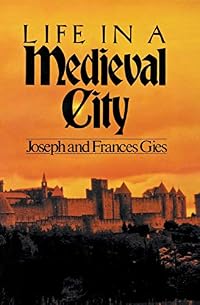
Life in a Medieval City is the classic account of the year 1250 in the city of Troyes, in modern-day France. Acclaimed historians Frances and Joseph Gies focus on a high point of medieval civilization-before war and the Black Death ravaged Europe-providing a fascinating window into the sophistication of a period we too often dismiss as backward. Urban life in the Middle Ages revolved around the home, often a mixed-use dwelling for burghers with a store or workshop on the ground floor and show more living quarters upstairs. A developed economy, focusing on textiles, farming, and financial services, could be found in the town center, where craftsmen competed for business while adhering to the guilds' codes of conduct. There were schools for the children, though only boys could attend and the lessons were taught in Latin by a priest. The church was a hub of both religious and civic life; services were lively and filled with song, and baptisms and other special occasions brought neighbors together to celebrate. The weddings of wealthier townsfolk were lavish affairs full of song and dance and drinking that could sometimes last for weeks. show lessTags
Recommendations




















Member Recommendations
Member Reviews
Life in a Medieval City takes the reader on a systematic exploration of different aspects of life in a town called Troyes in 13th century France.
One was struck by how deeply uncomfortable life was for even the most wealthy of 13th century city dwellers; they lived in drafty cold houses that were infested with fleas and bedbugs.
This was counterbalanced by the book’s discussion of the energetic religious, commercial, and legal activities that were developing at this time. It is possible to imagine a Europe that was gearing up for the Renaissance and the Industrial Revolution.
This book is written in a lively and engaging manner that catches the idiosyncrasies of this time and place, and is possessed of a sly sense of humour.
One was struck by how deeply uncomfortable life was for even the most wealthy of 13th century city dwellers; they lived in drafty cold houses that were infested with fleas and bedbugs.
This was counterbalanced by the book’s discussion of the energetic religious, commercial, and legal activities that were developing at this time. It is possible to imagine a Europe that was gearing up for the Renaissance and the Industrial Revolution.
This book is written in a lively and engaging manner that catches the idiosyncrasies of this time and place, and is possessed of a sly sense of humour.
A classic of social history, Life in Medieval City uses Troyes in 1250 to explore the ordinary life of the small yet prosperous bourgeois. This is an age of relative stability and wealth. The Catholic Church is the undoubted supreme power in Christendom. A system of interlocking guilds regulates the cities, and the sophistication of stone walls against the relatively crude military logistics of the age favors defenders. Troyes is situated to mediate trade between the weavers of Holland and Europe, and the great markets of the Mediterranean, with winter and summer fairs the source of the city's wealth.
It's still the Middle Ages, and if something is to be done (cooking, cleaning, crafts, farming...) it is likely to be done with show more backbreaking effort, but the population is on the rise and things are noticeably better than they were a hundred years ago. The dislocations of the Black Death and the Reformation are far in the future. This is a charming little book, and if scholarship has moved on since 1981, its foundational, accessible, and a steal at $2. show less
It's still the Middle Ages, and if something is to be done (cooking, cleaning, crafts, farming...) it is likely to be done with show more backbreaking effort, but the population is on the rise and things are noticeably better than they were a hundred years ago. The dislocations of the Black Death and the Reformation are far in the future. This is a charming little book, and if scholarship has moved on since 1981, its foundational, accessible, and a steal at $2. show less
The author uses the city of Troyes as it existed in 1250 AD as the exemplar, and tackles the major institutions and occupations in separate (but connected) chapters. Though this would be useful in a history course, it is not written in a dry, academic style; instead, her style is easy to read, interesting, and flows well. The topics are well researched and referenced for those wishing to delve deeper into a subject.
For as long as I can remember, I have been interested in both medieval life and culture – the way in which people of the era lived, survived and managed their day-to-day lives. As a kid I was fascinated with dragons (I still am), and knights..and swords..and castles, and yes magic. Some of these, of course, have little to do with the real life of the middle ages – at least that of battling fiery dragons and sea serpents, but the time in general has always struck something inside of myself – an interest that has grown stronger with time (which is partially due to my love of fantasy novels). For this reason, I have decided to take this fascination to the next level and actually do some real research! That is why I purchased the book show more “Life in a Medieval City” by Joseph and Francis Gies.
Life in a Medieval City by Joseph and Francis Gies covers a huge range of topics and issues – essentially anything you can think of when it comes to a Medieval City – at least the city of Troyes. The book focuses in on the city in the year of 1250 – a year in which, as described by the book, was a relatively safe and prosperous time. A time where society and civilization had truly begun to progress and advance, from medicine to architecture, to schools and to business.
While many history related books tend to bore me – not necessarily because of the content within, but because of the writing itself – I found that “Life in a Medieval City” did more than an adequate job of not only education and enlightening, but doing so without ever becoming dull or robotic. The writing didn’t drag on and on, the author was to the point, and the book in its entirety was written in a more down-to-earth tone. This format, along with the wealthy abundance of interesting content – truly made for a compelling and informative read. I found myself immersed within nearly each page, and came out knowing far more about the subject than I had when going in.
Oh, and did I mention that “Life in a Medieval City” is completely jam packed with information? Just looking at the index had had me salivating. From homes, to churches, to medieval housewives, to childbirth and children, to weddings, funerals, schools, businesses, doctors, natural disasters and more – nearly every aspect of Troyes was covered. Along with this, there were several great illustrations – artwork of the time, as well as actual photos of the city as it stands today. I personally found the chapter on doctors and medicine to be most fascinating – but was was intrigued by the chapters on home life. I’ve always had an interest in the people of that era; of how they spent their daily lives and simply lived. There was a great deal of material on this, and I found enjoyment in every bit. It was also quite interesting to compare and contrast life as it is today, with life as it was then – to note the things that have changed so much, as well as the things that really haven’t.
Overall this was a great and informative work. From the large array of topics, to the excellent writing – I have very few qualms when it comes to this. After finishing “Life in a Medieval City”, I can definitely say that I have learned so much – and would certainly suggest it to those who may be like myself; those who have an interest in medieval studies but have never actually put that interest into action. In other words, this is an excellent starting point when it comes to studies of the Medieval era – especially when it comes to the medieval city. I’ll also say that the two authors have several other published works on the subject, including “Life in a Medieval Village,” “Life in a Medieval Castle,” “Marriage and the Family in the Middle Ages,” “Technology and Invention in the Middle Ages“ and more – all of which have rather favorable reviews.
As you can probably tell, I was quite pleased with this read and will continue to delve further into the studies of medieval life. This book has a lot of re-readability, and is a great overview of what the city of Troyes was like in the year 1250. Not only was it informative – but it was full of life. While reading “Life in a Medieval City,” I felt as though the words brought out the true essence of the time – for it wasn’t simply a compiled list of already established information – but a nicely structured piece of work, with great detail and vivid description. Overall this was a fascinating read, and I again, would recommend it to anyone interested in the Middle Ages.
http://tyrionfrost.wordpress.com/ show less
Life in a Medieval City by Joseph and Francis Gies covers a huge range of topics and issues – essentially anything you can think of when it comes to a Medieval City – at least the city of Troyes. The book focuses in on the city in the year of 1250 – a year in which, as described by the book, was a relatively safe and prosperous time. A time where society and civilization had truly begun to progress and advance, from medicine to architecture, to schools and to business.
While many history related books tend to bore me – not necessarily because of the content within, but because of the writing itself – I found that “Life in a Medieval City” did more than an adequate job of not only education and enlightening, but doing so without ever becoming dull or robotic. The writing didn’t drag on and on, the author was to the point, and the book in its entirety was written in a more down-to-earth tone. This format, along with the wealthy abundance of interesting content – truly made for a compelling and informative read. I found myself immersed within nearly each page, and came out knowing far more about the subject than I had when going in.
Oh, and did I mention that “Life in a Medieval City” is completely jam packed with information? Just looking at the index had had me salivating. From homes, to churches, to medieval housewives, to childbirth and children, to weddings, funerals, schools, businesses, doctors, natural disasters and more – nearly every aspect of Troyes was covered. Along with this, there were several great illustrations – artwork of the time, as well as actual photos of the city as it stands today. I personally found the chapter on doctors and medicine to be most fascinating – but was was intrigued by the chapters on home life. I’ve always had an interest in the people of that era; of how they spent their daily lives and simply lived. There was a great deal of material on this, and I found enjoyment in every bit. It was also quite interesting to compare and contrast life as it is today, with life as it was then – to note the things that have changed so much, as well as the things that really haven’t.
Overall this was a great and informative work. From the large array of topics, to the excellent writing – I have very few qualms when it comes to this. After finishing “Life in a Medieval City”, I can definitely say that I have learned so much – and would certainly suggest it to those who may be like myself; those who have an interest in medieval studies but have never actually put that interest into action. In other words, this is an excellent starting point when it comes to studies of the Medieval era – especially when it comes to the medieval city. I’ll also say that the two authors have several other published works on the subject, including “Life in a Medieval Village,” “Life in a Medieval Castle,” “Marriage and the Family in the Middle Ages,” “Technology and Invention in the Middle Ages“ and more – all of which have rather favorable reviews.
As you can probably tell, I was quite pleased with this read and will continue to delve further into the studies of medieval life. This book has a lot of re-readability, and is a great overview of what the city of Troyes was like in the year 1250. Not only was it informative – but it was full of life. While reading “Life in a Medieval City,” I felt as though the words brought out the true essence of the time – for it wasn’t simply a compiled list of already established information – but a nicely structured piece of work, with great detail and vivid description. Overall this was a fascinating read, and I again, would recommend it to anyone interested in the Middle Ages.
http://tyrionfrost.wordpress.com/ show less
Using Troyes, a 13th century French town boasting two annual fairs, numerous aspects of medieval life across the classes are discussed highlighting the advances that separate "current" Troyes from the Dark Ages: the burgeoning of business and all of the legal and monetary advances this entails, manufacturing and construction processes, the formation/solidification of town governments, and daily life and its major moments (weddings, childbirth, funerals). Not unlucky to be born now.
"Most of the masonry work consists of old, long-practiced technique. The Romans maneuvered bigger blocks into position than any that medieval masons tackle. On the Pont du Gard there are stones eleven feet in length. But medieval masons are steadily improving show more their ability to handle large masses of stone. The Romans habitually built without mortar, dressing their stones accurately enough so that walls and arches stood simply by their own weight." Aaaaand now I need an overview of the Roman Empire. show less
"Most of the masonry work consists of old, long-practiced technique. The Romans maneuvered bigger blocks into position than any that medieval masons tackle. On the Pont du Gard there are stones eleven feet in length. But medieval masons are steadily improving show more their ability to handle large masses of stone. The Romans habitually built without mortar, dressing their stones accurately enough so that walls and arches stood simply by their own weight." Aaaaand now I need an overview of the Roman Empire. show less
Entertaining overview of Medieval town and city life, centering principally in France and England. It does "fill in" a lot of information about middle class life that tends to get glossed over in texts that focus on either court life, or the rural peasant/lord dynamic. If you are in the SCA, it can be a facinating place to "look" for a persona. It is well documented, so the reader who want to explore topics in more detail have recourse to do so.
As with Life In A Medieval Castle, the authors have collected a great deal of information and created an entertaining and informative read.
I found the sections on Small and Big Business, as well as the description of the evolution of modern credit and banking, to be very interesting.
I found the sections on Small and Big Business, as well as the description of the evolution of modern credit and banking, to be very interesting.
Members
- Recently Added By
Author Information

Joseph Gies was born on October 8, 1916 in Ann Arbor, Mich and attended the University of Michigan and Columbia University. He held jobs with several publishers including Encyclopaedia Britannica, and was editor-in-chief for a division of Doubleday. Gies is best known for several books, such as Life in a Medieval Castle, Life in a Medieval City, show more and Life in a Medieval Village. These books, written with his wife Frances Carney, explore existence in Medieval times. The works, and his others, are noted for their highly readable, but thorough quality. Topics such as archaeology, government, dining, entertainment, and daily life are presented in fascinating detail. (Bowker Author Biography) show less

All Editions
Some Editions
Series

Work Relationships
Common Knowledge
- Canonical title
- Life in a Medieval City
- Original title
- Life in a Medieval City
- Original publication date
- 1969-08
- Important places
- Troyes, Aube, Grand-Est, France
- Important events
- Hot Fair; Cold Fair; Champagne Fairs
- Dedication
- To Jane Sturman Gies and Frances Gibson Carney.
Nos ignoremus quid sit matura senectus, scire aevi meritum, non numerare decet. - First words
- The western European city, with all its implications for the future, was born in the Middle Ages.
- Last words
- (Click to show. Warning: May contain spoilers.)Among such ancient professions as that of gem cutter, precious-metal worker, and apothecary, "Troy weight," with its medieval ratio of twenty pennyweight to the ounce and twelve ounces to the pound, is still in use--a last souvenir of the great days of the Champagne Fairs.
- Original language*
- Anglais (Etats-Unis) (Etats-Unis)
*Some information comes from Common Knowledge in other languages. Click "Edit" for more information.
Classifications
Statistics
- Members
- 1,430
- Popularity
- 16,397
- Reviews
- 13
- Rating
- (3.71)
- Languages
- English, French, Polish, Serbian
- Media
- Paper, Audiobook, Ebook
- ISBNs
- 15
- ASINs
- 12