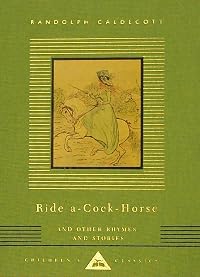
Ride a-Cock-Horse and Other Rhymes and Stories
by Randolph Caldecott
R. Caldecott's Picture Books (Everyman's Library Children's Classics (1995) — )
51 Members (3.67)
On This Page
Description
'The very essence of all illustration for children's books' said The Times on Christmas Eve, 1878, shortly after the publication of Caldecott's first two picture books, or Toy Books as they were called, John Gilpin and The House that Jack Built. They were an immediate success, and in Caldecott's special talent for juxtaposing words and pictures, he created a tradition of children's picture-book making that continues to the present day and has influenced many artists, in particular, Maurice show more Sendak. Between 1878 and 1886 Cldecott produced sixteen picture books, taking as texts traditional rhymes and songs, and illustrating them in sepia colour with great humour and feeling for the English countryside which so often provides the background. The collection reproduces eight of his books, including The Babes in the Wood, Oliver Goldsmith's Elegy on the Death of a Mad Dog, The Great Panjandrum Himself, The Queen of Hearts, Ride a Cock-Horse to Banbury Cross, and Sing a Song Of Sixpence. show lessTags
Recommendations











Member Reviews
Members
- Recently Added By
Author Information

73+ Works 818 Members
Heralded as the greatest artist of the triumvirate of modern illustrators that included Greenaway and Crane, Randolph Caldecott is highly praised for introducing techniques of animation into picture book art and for his humorous, satiric extensions of the text in his illustrations. Caldecott's fame centers on 16 books, often referred to as the show more "Toy Books," reprinted by Edmund Evans in his innovative printing techniques, featuring mainly traditional nursery rhymes and songs, and published in pairs. They include: The House That Jack Built (1865), The Diverting History of John Gilpin (written by William Cowper) (1878), Elegy on the Death of a Mad Dog (written by Oliver Goldsmith) (1979), Babes in the Wood (1879), Sing a Song of Sixpence (1880), The Three Jovial Huntsmen (1880), The Farmer's Boy (1881), The Queen of Hearts (1881), The Milkmaid (1882), Hey Diddle Diddle with Baby Bunting (1882), A Frog He Would a-Wooing Go (1883), and The Fox Jumps over the Parson's Gate (1884). Caldecott generally drew his illustrations in sepia applied with a brush rather than a pen; he included an average of three uncolored illustrations for each colored one. He has received praise for his fluid style, which created a sense of movement across a page and from one page to another; he is also lauded for his insight into human nature and instinctive grasp of what appeals to children. Each year the American Library Association awards a highly coveted medal in his name to the best illustrated book by an American author. (Bowker Author Biography) show less
Some Editions
Series

Belongs to Publisher Series
Work Relationships
Contains
Common Knowledge
- Canonical title
- Ride a-Cock-Horse and Other Rhymes and Stories
- Original publication date
- 1995-11-21
- First words
- Ride a-Cock-Horse
to Banbury Cross,
To see a fine Lady
Get on a white Horse,
With rings on her fingers
and bells on her toes,
Whe shall have music wherever she goes. - Last words
- (Click to show. Warning: May contain spoilers.)But soon a wonder came to light,
That show'd the rogues they lied --
The man recover'd of the bite;
The dog it was that died.
Classifications
- Genres
- Children's Books, Poetry, Picture Books, Fiction and Literature
- DDC/MDS
- 398.8 — Society, government, & culture Customs, etiquette & folklore Folklore & Folktales Rhymes and rhyming games
- LCC
- PZ8.3 .R4385 — Language and Literature Fiction and juvenile belles lettres Fiction and juvenile belles lettres Juvenile belles lettres
- BISAC
Statistics
- Members
- 51
- Popularity
- 595,782
- Rating
- (3.67)
- Languages
- English
- Media
- Paper
- ISBNs
- 2