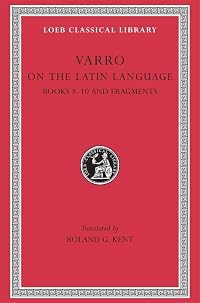
Varro: On the Latin Language, Volume II, Books 8-10. Fragments. (Loeb Classical Library No. 334)
by Varro
81 Members (5.00)
On This Page
Description
Varro (M. Terentius), 116A?-27 BCE, of Reate, renowned for his vast learning, was an antiquarian, historian, philologist, student of science, agriculturist, and poet. He was a republican who was reconciled to Julius Caesar and was marked out by him to supervise an intended national library. Of Varro's more than seventy works involving hundreds of volumes we have only his treatise On Agriculture (in Loeb number 283) and part of his monumental achievement De Lingua Latina, On the Latin show more Language, a work typical of its author's interest not only in antiquarian matters but also in the collection of scientific facts. Originally it consisted of twenty-five books in three parts: etymology of Latin words (books 1A?-7); their inflexions and other changes (books 8A?-13); and syntax (books 14A?-25). Of the whole work survive (somewhat imperfectly) books 5 to 10. These are from the section (books 4A?-6) which applied etymology to words of time and place and to poetic expressions; the section (books 7A?-9) on analogy as it occurs in word formation; and the section (books 10A?-12) which applied analogy to word derivation. Varro's work contains much that is of very great value to the study of the Latin language. The Loeb Classical Library edition of On the Latin Language is in two volumes. show lessTags
Recommendations



Member Reviews
Members
- Recently Added By
Author Information

53+ Works 443 Members
Series
Belongs to Publisher Series
Loeb Classical Library (334)
Common Knowledge
- Original title
- Dé Linguá Latíná
- Original publication date
- 43 BCE (ca.) (ca.)
- Dedication
- Ad Ciceronem
- First words
- I. 1. QUOM oratio natura tripertita esset, ut superioribus libris ostendi, cuius prima pars, quemadmodum vocabula rebus essent imposita, secunda, quo pacto de his declinata in discrimina ierint, tertia, ut ea inter se ratione... (show all) coniuncta sententiam efferant, prima parte exposita de decunda incipiam hinc. Ut propago omnis natura secunda, quod prius illud rectum, unde ea, sic declinata: itaque declinatur in verbis: rectum homo, obliquum hominis, quod declinatum a recto.
I. 1. SPEECH is natually divided into three parts, as I have shown in the previous books: its first part is how names were imposed upon things; its second, in what way the derivatives of these names have arrived at their diff... (show all)erences; its third, how the words when united with one another reasoningly, express an idea. Having set forth the first part, I shall from here begin upon the second. As every offshoot is secondary by nature, because that vertical trunk from which it comes is primary, and it is therefore declined: so there is declension in words: "homo" 'man' is the vertical, "hominis" 'man's' is the oblique, because it is declined from the vertical. - Last words
- (Click to show. Warning: May contain spoilers.)Fr. 38. Leontion et Chrysion et Phanion ex neutris Craecis feminina nostri fecere, et Plautus quod dixit haec Phronesium et Caecilius Leontium. Varroni autem placet talia nomina dativo tantum casu et ablativo declinari, in ceteris vero sic efferri ut nominativo.
(Click to show. Warning: May contain spoilers.)Fr. 38. Leontion and Chrysion and Phanion are neuters in Greek, but when we took them into Latin we made feminines of them; Plautus used Phronesium as a feminine, and Caecilius used Leontium in the same way. But Varro thinks that such nouns are inflected only for the dative and the ablative, and that in the other cases the same form as the nominative is used. - Original language
- Latin
Classifications
Statistics
- Members
- 81
- Popularity
- 394,001
- Rating
- (5.00)
- Languages
- English, Latin
- Media
- Paper
- ISBNs
- 1