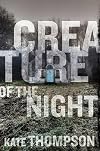
Creature of the Night
by Kate Thompson
On This Page
Description
Bobby lives a reckless life smoking, drinking, and stealing cars in Dublin. So his mother moves the family to the country. But Bobby suspects their cottage might not be as quaint as it seems. And spooky details of the history of their little cottage gradually turn Bobby into a detective of night creatures real and imagined.Tags
Recommendations







Member Reviews
This wasn't what I expected - this story is much more complicated than the spooky-isolated-house-in-the-countryside story I thought it would be. Instead, it's the story of a kid with a messed up life, who is clinging to the mess for all he's worth. While he wavers between choosing the better life he's being offered or running away and stealing cars to crash, his little brother is up in the middle of the night having conversations with a creepy, secret visitor. It's a murder mystery and a family drama combined in a very strange way.
Nominated for a Carnegie Medal, shortlisted for the Booktrust Teenage Prize and marketed as a novel ‘written by the winner of the Whitbread Children’s Book Award and the Guardian Children’s Fiction Prize’, I was in danger of writing this off as a very ‘worthy’ book. However, as soon as I began reading I was drawn in to a compelling story that had me rooting for a most unlikely hero and I read the whole slim volume (less than three hundred pages) in a mere three hours.
The opening chapter immediately sets up an intriguing situation. Bobby’s mother is moving her small family out of Dublin and into the country, possibly to rescue her son from the friends she feels are leading him deeper into trouble, possibly to escape from show more some unknown people. She claims they’re going on a summer break, but her bolshy son can see right through that: ‘we’d given up the flat for one thing, and if we wanted to get one again we’d be right back at the bottom of the housing list’. Of course, the new house has a more interesting history than their old one, if the stories are true…
It quickly becomes evident that this family could be the nightmare family to live next door to: fourteen year old Bobby has a penchant for stealing cars and torching then, then spending all his (stolen) cash on getting stoned or drunk; his ma is on the dole and puts everything on credit, with little intention of repaying any of it; and as for his brother, Dennis, well, Dennis just wets the bed and cries, but he’s young yet. It’s alright, though, because Bobby isn’t staying, and he’s told his ma that. He told her ‘when she came up with the idea and [he] told her again when she tried to bribe [him] with the new xbox’. Bobby’s confident that he’s in charge of their relationship and is only waiting for her back to be turned long enough for him to make a good getaway because she’d be an irritation to him otherwise.
Initially I found Bobby’s coldness towards his family shocking, but as the story develops and the swearing and bickering becomes less surprising it appears that Bobby might be little more than a chip off the old block – so can he really turn over a new leaf? Of course, he's not really as bad as he seems and maybe a fresh start will be the answer.
Cliches aside, it seems clear from early on (almost as soon as the writer sets up the familiar premise of new home, new town, new start) that this must be a story of how a bad boy comes good in the end. However, Bobby is determined not to enjoy his new life and it’s not long before he’s heading back to Dublin and trying to summon up his old mates Fluke, Beetle and Psycho Mike, leaving the reader with a mind full of questions. Why did Bobby’s ma move them to Dublin? Who is Bobby’s father? Can Bobby adapt to his new life? Will he be given a chance to?
As the questions pile up, we meet a cast of likeable and, perhaps more importantly, believable characters. PJ Dooley and his son Coley want to help Bobby, if he’ll let them, but Coley’s grandmother is more interested in warning Bobby’s ma to leave some milk and biscuits out for the fairies. Yes, the fairies. Don’t worry, though: this doesn’t degenerate into some mystical tale of small folk. There is a mystery and there are some who seem to believe in the fairy folk, but before long there are also rumours of an old murder and a recent unsolved disappearance. The story remains firmly rooted in reality, and although it is often a slightly sad reality, it makes for an intriguing read.
This reality is partly created by the narrator. Written in the first person, Bobby reveals what he’s seen and done in a believable voice. Snippets of his past life are integrated into the flow of the story and never slow down the pace or feel like obvious lumps of background. Indeed, the story continues past the end of the book. After a particularly surprising incident, Thompson leaves us with an epilogue that seems to show Bobby living his life several years on from the events of the main story. This life isn’t fleshed out in any real detail and leaves you pondering exactly what happened to him. Like real life, the novel’s central mysteries are never fully resolved. Often, this type of ending leaves me feeling irritated and cheated, but the ending here fits perfectly with the matter of fact style of the rest of the novel.
Finally, it is worth noting that the book is billed as ‘Not suitable for younger readers’ and I would certainly agree with this. In fact, I feel slightly uncomfortable as I anticipate discussing this with my book group – a bunch of clean cut young girls, some of whom are already reading the classics, who might not be particularly impressed by Bobby's out of his head experiences. That said, the book’s success seems to lie in its ‘slice of real life’ approach: it never patronises its audience, but it should enthral them as they follow Bobby’s rebellion and attempt to uncover exactly what did happen in that house. show less
The opening chapter immediately sets up an intriguing situation. Bobby’s mother is moving her small family out of Dublin and into the country, possibly to rescue her son from the friends she feels are leading him deeper into trouble, possibly to escape from show more some unknown people. She claims they’re going on a summer break, but her bolshy son can see right through that: ‘we’d given up the flat for one thing, and if we wanted to get one again we’d be right back at the bottom of the housing list’. Of course, the new house has a more interesting history than their old one, if the stories are true…
It quickly becomes evident that this family could be the nightmare family to live next door to: fourteen year old Bobby has a penchant for stealing cars and torching then, then spending all his (stolen) cash on getting stoned or drunk; his ma is on the dole and puts everything on credit, with little intention of repaying any of it; and as for his brother, Dennis, well, Dennis just wets the bed and cries, but he’s young yet. It’s alright, though, because Bobby isn’t staying, and he’s told his ma that. He told her ‘when she came up with the idea and [he] told her again when she tried to bribe [him] with the new xbox’. Bobby’s confident that he’s in charge of their relationship and is only waiting for her back to be turned long enough for him to make a good getaway because she’d be an irritation to him otherwise.
Initially I found Bobby’s coldness towards his family shocking, but as the story develops and the swearing and bickering becomes less surprising it appears that Bobby might be little more than a chip off the old block – so can he really turn over a new leaf? Of course, he's not really as bad as he seems and maybe a fresh start will be the answer.
Cliches aside, it seems clear from early on (almost as soon as the writer sets up the familiar premise of new home, new town, new start) that this must be a story of how a bad boy comes good in the end. However, Bobby is determined not to enjoy his new life and it’s not long before he’s heading back to Dublin and trying to summon up his old mates Fluke, Beetle and Psycho Mike, leaving the reader with a mind full of questions. Why did Bobby’s ma move them to Dublin? Who is Bobby’s father? Can Bobby adapt to his new life? Will he be given a chance to?
As the questions pile up, we meet a cast of likeable and, perhaps more importantly, believable characters. PJ Dooley and his son Coley want to help Bobby, if he’ll let them, but Coley’s grandmother is more interested in warning Bobby’s ma to leave some milk and biscuits out for the fairies. Yes, the fairies. Don’t worry, though: this doesn’t degenerate into some mystical tale of small folk. There is a mystery and there are some who seem to believe in the fairy folk, but before long there are also rumours of an old murder and a recent unsolved disappearance. The story remains firmly rooted in reality, and although it is often a slightly sad reality, it makes for an intriguing read.
This reality is partly created by the narrator. Written in the first person, Bobby reveals what he’s seen and done in a believable voice. Snippets of his past life are integrated into the flow of the story and never slow down the pace or feel like obvious lumps of background. Indeed, the story continues past the end of the book. After a particularly surprising incident, Thompson leaves us with an epilogue that seems to show Bobby living his life several years on from the events of the main story. This life isn’t fleshed out in any real detail and leaves you pondering exactly what happened to him. Like real life, the novel’s central mysteries are never fully resolved. Often, this type of ending leaves me feeling irritated and cheated, but the ending here fits perfectly with the matter of fact style of the rest of the novel.
Finally, it is worth noting that the book is billed as ‘Not suitable for younger readers’ and I would certainly agree with this. In fact, I feel slightly uncomfortable as I anticipate discussing this with my book group – a bunch of clean cut young girls, some of whom are already reading the classics, who might not be particularly impressed by Bobby's out of his head experiences. That said, the book’s success seems to lie in its ‘slice of real life’ approach: it never patronises its audience, but it should enthral them as they follow Bobby’s rebellion and attempt to uncover exactly what did happen in that house. show less
This story of leaving a home which may not be so much of a home after all is told from the point of view of a young boy who has lived way beyond his years. Bobby is fourteen and a veteran of a street gang in Dublin when his mother carts him and his four year old brother off to rural Clare in an effort to leave behind the realities of a life on the edge of survival. Determined to return, Bobby is careless of money, mother and the new neighbours who trust and befriend him. Back in the big smoke he is unwanted by his former gang mates, who have found a younger accomplice to replace him. He reaches a despairing point but has an inner strength which may save him if he can hold on to the right people.
Bobby has fallen in with a bad crowd. His young, feckless mother moves the family from Dublin to a small town in Clare to remove him from the situation, and to get away from the loan sharks. Their new landlady warns them that the house is haunted and tells them to leave milk out at night for the fairy folk. But they ignore her. Bobby is desperate to get back to Dublin and his mates, but finds that he almost enjoys the challenges of helping their landlord with tasks around the farm. Meanwhile, little brother Dennis sees a tiny woman around the house at night.
Slightly creepy, but ambiguous as to fantasy. Mostly a character-piece focusing on Bobby, who is sympathetic despite himself.
Slightly creepy, but ambiguous as to fantasy. Mostly a character-piece focusing on Bobby, who is sympathetic despite himself.
Posted at:
http://web.mac.com/ann163125/Table_Talk/Table_Talk_Blog/Entries/2008/7/23_Creatu...
I first remember reading Kate Thompson’s work when her trilogy The Switchers was complete. I’m not sure whether or not it pre-date Pullman’s His Dark Materials but with its theme of an interwoven human and animal existence linked to puberty there are similarities. Whatever the relationship may be, it was very clear right from the start that Thompson was a considerable talent and one whose works looked likely to get better as she went on. And that’s certainly been the case. As well as a number of stand alone novels, there has been another trilogy, The Missing Link and two recent books related through setting and association, The New show more Policeman and The Last of the High Kings. In these the world of reality and that of Irish myth are intricately interwoven until it is impossible to be certain which holds the greater truth and relevance to the life we lead, or ought to lead, if we want to survive in the rat race driven world that we have created. The Creature of the Night belongs with these last two novels but here the balance between reality and fantasy is differently distributed and this is a much more gritty book than the previous two.
Fourteen year old Bobby is disgusted when his mother tells him of her intention to move from Dublin to a small village in County Clare. She wants to make a new start - for which read she wants to give the money-lenders the slip - and moves Bobby and his little brother, Dennis, into a small, tumbled down cottage on the farm owned by PJ Dooley, a character from the earlier books. Bobby has been running wild on the night streets of Dublin, acting as the goffer for a group of older lads. It’s clear from what we learn of the way that he’s been living that it’s only a matter of time before he becomes so deeply involved in a life of drugs and crime that he ends up either in goal or dead with a needle in his arm. Nevertheless, this is the life he knows and the life he wants. Life in rural County Clare is not for him.
The relationship between Bobby and his mother is explosive and as we learn more about the way in which the boy has been brought up it is easy to blame his mother for the life that he now leads. Readers of twelve or so will readily identify with the conflict in the family and some, unfortunately, will recognise why Bobby behaves as he does. However, as the story unfolds it becomes clear that Bobby’s mother has had no chance in life either and her behaviour becomes more and more understandable as well. I’m not sure if the teenage reader will pity her, but as an adult it’s hard not to. What is missing in every level of every relationship is trust and it’s only when PJ shows himself the better man by taking the risk and offering Bobby something more than he has had before that there is any light in this book. There is a way forward but someone has to be prepared to go out on a limb.
The fantasy element is very slight in this book and I’m not sure to what extent it adds to what is already an extremely powerful story, but, neither does it detract and it does serve to tie this novel in with its predecessors. This is a very fine book and one that shows another step forward in Kate Thompson’s writing for teenagers. I hope this makes its way onto next year’s Carnegie short-list. It certainly deserves to. show less
http://web.mac.com/ann163125/Table_Talk/Table_Talk_Blog/Entries/2008/7/23_Creatu...
I first remember reading Kate Thompson’s work when her trilogy The Switchers was complete. I’m not sure whether or not it pre-date Pullman’s His Dark Materials but with its theme of an interwoven human and animal existence linked to puberty there are similarities. Whatever the relationship may be, it was very clear right from the start that Thompson was a considerable talent and one whose works looked likely to get better as she went on. And that’s certainly been the case. As well as a number of stand alone novels, there has been another trilogy, The Missing Link and two recent books related through setting and association, The New show more Policeman and The Last of the High Kings. In these the world of reality and that of Irish myth are intricately interwoven until it is impossible to be certain which holds the greater truth and relevance to the life we lead, or ought to lead, if we want to survive in the rat race driven world that we have created. The Creature of the Night belongs with these last two novels but here the balance between reality and fantasy is differently distributed and this is a much more gritty book than the previous two.
Fourteen year old Bobby is disgusted when his mother tells him of her intention to move from Dublin to a small village in County Clare. She wants to make a new start - for which read she wants to give the money-lenders the slip - and moves Bobby and his little brother, Dennis, into a small, tumbled down cottage on the farm owned by PJ Dooley, a character from the earlier books. Bobby has been running wild on the night streets of Dublin, acting as the goffer for a group of older lads. It’s clear from what we learn of the way that he’s been living that it’s only a matter of time before he becomes so deeply involved in a life of drugs and crime that he ends up either in goal or dead with a needle in his arm. Nevertheless, this is the life he knows and the life he wants. Life in rural County Clare is not for him.
The relationship between Bobby and his mother is explosive and as we learn more about the way in which the boy has been brought up it is easy to blame his mother for the life that he now leads. Readers of twelve or so will readily identify with the conflict in the family and some, unfortunately, will recognise why Bobby behaves as he does. However, as the story unfolds it becomes clear that Bobby’s mother has had no chance in life either and her behaviour becomes more and more understandable as well. I’m not sure if the teenage reader will pity her, but as an adult it’s hard not to. What is missing in every level of every relationship is trust and it’s only when PJ shows himself the better man by taking the risk and offering Bobby something more than he has had before that there is any light in this book. There is a way forward but someone has to be prepared to go out on a limb.
The fantasy element is very slight in this book and I’m not sure to what extent it adds to what is already an extremely powerful story, but, neither does it detract and it does serve to tie this novel in with its predecessors. This is a very fine book and one that shows another step forward in Kate Thompson’s writing for teenagers. I hope this makes its way onto next year’s Carnegie short-list. It certainly deserves to. show less
I was disappointed by this offering from Kate Thompson. It began with promise--including a sufficiently spooky atmosphere--but rather fizzled out. For those who purchase books for school or public libraries, you may be interested in knowing that there is a great deal of profanity in the book (which, really, in the long run doesn't add much.) I wouldn't recommend the book--not enough bang for the buck. If you must read it, borrow it from the library. I am unloading the copy I purchased.
This book is specifically aimed at teenage boys and is a fairly good read. It isn't the mysterious crime story I was expecting, and the magical element is totally unnecessary, but I did enjoy the Irish setting and I liked how Bobby, the troubled teenage protagonist manages to gradually turn his life around with the help of the neighbouring family.
Members
- Recently Added By
Lists

Pleasant Surprises: Books That Exceeded Our Expectations
418 works; 143 members
Author Information

24+ Works 2,633 Members
Awards and Honors
Awards
Distinctions
Notable Lists
Common Knowledge
- Original publication date
- 2008-06-05
Classifications
- Genres
- Fiction and Literature, Teen, Young Adult
- DDC/MDS
- 823.914 — Literature & rhetoric English & Old English literatures English fiction 1900- 1901-1999 1945-1999
- LCC
- PZ7 .T3715965 .C — Language and Literature Fiction and juvenile belles lettres Fiction and juvenile belles lettres Juvenile belles lettres
- BISAC
Statistics
- Members
- 243
- Popularity
- 132,684
- Reviews
- 12
- Rating
- (3.43)
- Languages
- 6 — English, Estonian, Finnish, French, Italian, Spanish
- Media
- Paper, Ebook
- ISBNs
- 14
- ASINs
- 2