Timaeus and Critias
by Plato
On This Page
Description
Plato's Timaeus was his only cosmological dialogue and for almost thirteen hundred years it provided the basis in the West for educated people's general view of the natural world. The author provides a translation of this important work, together with the Critias - the source of the legendary tale of Atlantis. He has taken particular care to provide an accurate rendering of Plato's words and to avoid putting his own or any other interpretation on the works.Tags
Recommendations







Member Reviews
Things I learned from Timaeus and Critias:
1. Every type of matter in the universe is made up of different combinations of tiny triangles. Fire is hot because its triangles are small and pointy.
2. The head is where your thinking soul resides, not because of any special function of the brain, but because the head is round, and round is the most perfect shape, just like the thinking part is the most perfect part of the soul.
3. We have legs because otherwise our heads would just roll around on the ground.
4. Gold is a type of water.
5. If you are bad in this life, you will be reincarnated as a woman. If you are bad as a woman, you will be reincarnated as an animal. The more bad you were, the more legs said animal will have. Spiders were once show more very naughty people. The very worst people, however, come back with no legs, as snakes and fish.
This was my second Plato book, and if I'd started with this one I'd probably have had a much harder time. The stated aim of these works is to explore the idea of a perfect society, however to get to that point we fist have to explain the creation of the universe (for some reason). Timaeus attempts to do just this.
As much as I make fun of its contents above, it's important to remember the tools Plato had to work with. His aim was ambitious, and while his ideas sound ridiculous to modern audiences equipped with modern science, they weren't completely lacking in sense. He's among the first to propose that matter might be made up of microscopic particles that combine and react with each other to make up all forms of matter in the universe, he's just incorrect about...everything else concerning these particles. In his defense, he had absolutely no way of testing his theory, being over 2000 years early for microscopy. Similarly, he came to the notion that gold is a form of water by noting that both substances would behave similarly under certain circumstances - solidifying when cooled and melting when heated.
As with Protagoras and Meno, there was exactly one concept that I found really important. It's an idea that underpins modern science - the separation of what is from what should be. Plato doesn't just observe the natural universe, he tries to logically reconstruct it by
puzzling out what a good and orderly universe would look like. Unfortunately this results in errors, because the universe we live in doesn't conform to any rules of goodness or order (at least not any that we have yet discovered). We aren't in the centre, planetary orbits aren't perfectly circular, and so on and so forth. The scientific progress of the past two centuries has only been possible because we've unhooked our observations from any presupposition of perfection or order, we simply observe and document what is, even if it turns out not to be sensible and satisfying. Funnily enough our messy and disorderly universe also seems to have perturbed the Zoroastrians, who declared the planets "evil" for their disorderly habit of going in retrograde instead of travelling in a nice consistent arc across the sky.
Its a problem that haunts us even today, as I imagine quite a few science-deniers and young-earth creationists are at their core dissatisfied with the disorderly and unsatisfying nature of reality. So they reject the disorder and run to comfort of what should be instead.
The Critias, sequel to Timaeus, leaves the creation of the universe behind and focuses instead on the perfect city. Unfortunately it's unfinished, and what we do have left is the world-building preamble in which the city of Atlantis is introduced. This is the source of the Atlantis legend, but in context, it's pretty clear the sunken city simply serves as a hypothetical. In no way is it evidence of any historical city of Atlantis, any more than the Timaeus is evidence of tiny magic triangles. show less
1. Every type of matter in the universe is made up of different combinations of tiny triangles. Fire is hot because its triangles are small and pointy.
2. The head is where your thinking soul resides, not because of any special function of the brain, but because the head is round, and round is the most perfect shape, just like the thinking part is the most perfect part of the soul.
3. We have legs because otherwise our heads would just roll around on the ground.
4. Gold is a type of water.
5. If you are bad in this life, you will be reincarnated as a woman. If you are bad as a woman, you will be reincarnated as an animal. The more bad you were, the more legs said animal will have. Spiders were once show more very naughty people. The very worst people, however, come back with no legs, as snakes and fish.
This was my second Plato book, and if I'd started with this one I'd probably have had a much harder time. The stated aim of these works is to explore the idea of a perfect society, however to get to that point we fist have to explain the creation of the universe (for some reason). Timaeus attempts to do just this.
As much as I make fun of its contents above, it's important to remember the tools Plato had to work with. His aim was ambitious, and while his ideas sound ridiculous to modern audiences equipped with modern science, they weren't completely lacking in sense. He's among the first to propose that matter might be made up of microscopic particles that combine and react with each other to make up all forms of matter in the universe, he's just incorrect about...everything else concerning these particles. In his defense, he had absolutely no way of testing his theory, being over 2000 years early for microscopy. Similarly, he came to the notion that gold is a form of water by noting that both substances would behave similarly under certain circumstances - solidifying when cooled and melting when heated.
As with Protagoras and Meno, there was exactly one concept that I found really important. It's an idea that underpins modern science - the separation of what is from what should be. Plato doesn't just observe the natural universe, he tries to logically reconstruct it by
puzzling out what a good and orderly universe would look like. Unfortunately this results in errors, because the universe we live in doesn't conform to any rules of goodness or order (at least not any that we have yet discovered). We aren't in the centre, planetary orbits aren't perfectly circular, and so on and so forth. The scientific progress of the past two centuries has only been possible because we've unhooked our observations from any presupposition of perfection or order, we simply observe and document what is, even if it turns out not to be sensible and satisfying. Funnily enough our messy and disorderly universe also seems to have perturbed the Zoroastrians, who declared the planets "evil" for their disorderly habit of going in retrograde instead of travelling in a nice consistent arc across the sky.
Its a problem that haunts us even today, as I imagine quite a few science-deniers and young-earth creationists are at their core dissatisfied with the disorderly and unsatisfying nature of reality. So they reject the disorder and run to comfort of what should be instead.
The Critias, sequel to Timaeus, leaves the creation of the universe behind and focuses instead on the perfect city. Unfortunately it's unfinished, and what we do have left is the world-building preamble in which the city of Atlantis is introduced. This is the source of the Atlantis legend, but in context, it's pretty clear the sunken city simply serves as a hypothetical. In no way is it evidence of any historical city of Atlantis, any more than the Timaeus is evidence of tiny magic triangles. show less
The Oxford UP edition (2008) makes clear how important Timaeus is in the history of ideas. (Critias, source of the Atlantis myth, is fascinating in its own way). The task as always is to try to understand what Plato wrote, but also to see how a particular work fits into the evolution of ancient Greek thought and to recognize how themes and concepts introduced or suggested in the works of Plato were taken up, interpreted and put to use by later commentators, writers, scientists and philosophers. For the OUP World’s Classics edition, Robin Waterfield provides a new translation and endnotes for a text that stands as Plato’s fullest exploration of natural philosophy, and there is an excellent Introduction by Andrew Gregory.
Timaeus takes show more the form of a long uninterrupted speech rather than a dialogue; it is described as part of a trilogy, along with the unfinished Critias and Hermocrates (of which there is no record). A character named Timaeus narrates ‘a likely account’ of how a craftsman god—the demiurge—imposed order on a pre-existing chaos. The craftsman god employed mathematics and geometry in the construction of the cosmos: stars, sun, moon and planets move with regular circular motions; the elements earth, water, air and fire are conceived of as having specific, ideal shapes, and the ultimate building blocks for the elements are two types of triangles.
A teleological theme running through the works of Plato links the natural world (including the human mind/body dichotomy) to ethics and politics. There is a Good, which exists independently of us, and we should aspire to that Good. In Timaeus, the heavens stand as an example of harmony, order and unity which we as individuals and as society should emulate. The Good is an end in itself; order is always better than chaos. This teleological approach distinguishes the cosmology of Timeaus from the mythological and magical traditions of ancient Greece, characterized by capricious gods and the multiplicity-of-accidents cosmologies of Empedocles, Leucippus and Democritus (ably reviewed by Gregory).
As Gregory notes in the Introduction, various streams in the philosophy of science can be traced back to Timaeus, including the many-worlds thesis, underdeterminism, cosmological fine-tuning and the role of chance, the macrocosm/microcosm analogy, etc. Plato’s cosmology sparked discussion in the Academy and influenced Stoics, early Christian theologians and Islamic philosophers (see the occasionalism of al-Ghazali). Renaissance neoplatonism, crucial in the rise of early modern philosophy and science, took Timaeus as its main text. Simplicius, in his commentary on Aristotle’s On the Heavens, reported on the medieval tradition suggesting that Plato set problems in astronomy (circular, regular, ordered motion) for later mathematicians to solve. The challenge was taken up by Galileo, Copernicus, Kepler, and others, and more than 1500 years after he wrote Timaeus, Plato’s insights bore fruit. The scientific revolution that undermined Scholasticism challenged the geocentric Aristotelian-Ptolemaic model that was the basis for Christian cosmology. Aquinas had been inspired by Aristotle’s emphasis on substance, properties and causes, but the work of Copernicus, Bruno, Kepler and Newton described the world in terms of mathematical formulae, mechanics and invariant laws of motion. Modern science has since confirmed the validity of the Platonic vision over the Aristotelian.
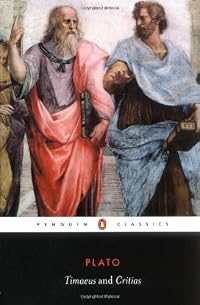
The most famous of Raphael’s frescoes in the Apostolic Palace at the Vatican, the one commonly referred to as "The School of Athens," shows Plato talking with Aristotle while carrying a copy of Timaeus and pointing to the sky. Did Raphael foresee the scientific revolution that was to come over the next century, and how much the new science would reflect ideas first expressed by Plato? show less
Timaeus takes show more the form of a long uninterrupted speech rather than a dialogue; it is described as part of a trilogy, along with the unfinished Critias and Hermocrates (of which there is no record). A character named Timaeus narrates ‘a likely account’ of how a craftsman god—the demiurge—imposed order on a pre-existing chaos. The craftsman god employed mathematics and geometry in the construction of the cosmos: stars, sun, moon and planets move with regular circular motions; the elements earth, water, air and fire are conceived of as having specific, ideal shapes, and the ultimate building blocks for the elements are two types of triangles.
A teleological theme running through the works of Plato links the natural world (including the human mind/body dichotomy) to ethics and politics. There is a Good, which exists independently of us, and we should aspire to that Good. In Timaeus, the heavens stand as an example of harmony, order and unity which we as individuals and as society should emulate. The Good is an end in itself; order is always better than chaos. This teleological approach distinguishes the cosmology of Timeaus from the mythological and magical traditions of ancient Greece, characterized by capricious gods and the multiplicity-of-accidents cosmologies of Empedocles, Leucippus and Democritus (ably reviewed by Gregory).
As Gregory notes in the Introduction, various streams in the philosophy of science can be traced back to Timaeus, including the many-worlds thesis, underdeterminism, cosmological fine-tuning and the role of chance, the macrocosm/microcosm analogy, etc. Plato’s cosmology sparked discussion in the Academy and influenced Stoics, early Christian theologians and Islamic philosophers (see the occasionalism of al-Ghazali). Renaissance neoplatonism, crucial in the rise of early modern philosophy and science, took Timaeus as its main text. Simplicius, in his commentary on Aristotle’s On the Heavens, reported on the medieval tradition suggesting that Plato set problems in astronomy (circular, regular, ordered motion) for later mathematicians to solve. The challenge was taken up by Galileo, Copernicus, Kepler, and others, and more than 1500 years after he wrote Timaeus, Plato’s insights bore fruit. The scientific revolution that undermined Scholasticism challenged the geocentric Aristotelian-Ptolemaic model that was the basis for Christian cosmology. Aquinas had been inspired by Aristotle’s emphasis on substance, properties and causes, but the work of Copernicus, Bruno, Kepler and Newton described the world in terms of mathematical formulae, mechanics and invariant laws of motion. Modern science has since confirmed the validity of the Platonic vision over the Aristotelian.
The most famous of Raphael’s frescoes in the Apostolic Palace at the Vatican, the one commonly referred to as "The School of Athens," shows Plato talking with Aristotle while carrying a copy of Timaeus and pointing to the sky. Did Raphael foresee the scientific revolution that was to come over the next century, and how much the new science would reflect ideas first expressed by Plato? show less
An excellent joint presentation of Timaeus and Critias which offers a dense, but readable account of Plato's cosmology and metaphysics. It also contains the famous account of Atlantis, but I find Plato's cosmological outlook far more interesting. It is, in some ways, a companion to Plato's Republic. The Timaeus is not a Platonic book to start with, but one that should - at some point - be read. One last additional thought is that I wouldn't allow Plato's geometric account of creation - involving triangles and the Platonic solids - to be off-putting and one can get the overall gist without delving in exacting detail into this unique aspect of the Timaeus.
Meh. Interesting bit about Atlantis. Views on women being "inferior" made me laugh. The rest was VERY deep, far to deep for my simple mind.
Thank goodness for Project Gutenberg. Had I not needed this for a challenge, I never would have even attempted to read this one. It's a slog - even though it's short, it's not an easy breezy read. It feels incomplete, rambles and is just not my kind of read.
Oh well. On to the next!
Oh well. On to the next!
*sigh* Yeah, I still don't like Plato. I didn't like him the first time I read him, I didn't like him in Greek, and I don't like him any better in translation. Blech.
Hard to criticise such an important text.
Members
- Recently Added By
Lists

Books Read in 2020
4,379 works; 123 members

In Our Time books
4,934 works; 2 members
Author Information

2,715+ Works 100,391 Members
Plato was born c. 427 B.C. in Athens, Greece, to an aristocratic family very much involved in political government. Pericles, famous ruler of Athens during its golden age, was Plato's stepfather. Plato was well educated and studied under Socrates, with whom he developed a close friendship. When Socrates was publically executed in 399 B.C., Plato show more finally distanced himself from a career in Athenian politics, instead becoming one of the greatest philosophers of Western civilization. Plato extended Socrates's inquiries to his students, one of the most famous being Aristotle. Plato's The Republic is an enduring work, discussing justice, the importance of education, and the qualities needed for rulers to succeed. Plato felt governors must be philosophers so they may govern wisely and effectively. Plato founded the Academy, an educational institution dedicated to pursuing philosophic truth. The Academy lasted well into the 6th century A.D., and is the model for all western universities. Its formation is along the lines Plato laid out in The Republic. Many of Plato's essays and writings survive to this day. Plato died in 347 B.C. at the age of 80. (Bowker Author Biography) show less
Some Editions
Series
Belongs to Publisher Series
Work Relationships
Common Knowledge
- Canonical title
- Timaeus and Critias
- Original publication date
- 2001 (Nederlandse ed.) (Nederlandse ed.)
- People/Characters
- Socrates; Timaeus; Critias; Hermocrates; Critias the Elder; Solon (show all 8); Poseidon; Atlas (King of Atlantis)
- Important places
- Atlantis; Greece; Athens, Greece; Egypt
- Original language
- Ancient Greek
Classifications
Statistics
- Members
- 1,123
- Popularity
- 22,443
- Reviews
- 11
- Rating
- (3.69)
- Languages
- 11 — Catalan, Czech, Dutch, English, Finnish, French, Greek (Ancient), Lithuanian, Polish, Portuguese, Spanish
- Media
- Paper, Ebook
- ISBNs
- 37
- ASINs
- 11