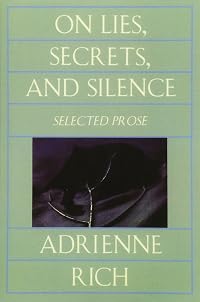
On Lies, Secrets, and Silence: Selected Prose 1966-1978
by Adrienne Rich
On This Page
Description
In this collection of prose writings, one of America's foremost poets and feminist theorists reflects upon themes that have shaped her life and work. At issue are the politics of language; the uses of scholarship; and the topics of racism, history, and motherhood among others called forth by Rich as "part of the effort to define a female consciousness which is political, aesthetic, and erotic, and which refuses to be included or contained in the culture of passivity."Tags
Recommendations























Member Reviews
I've been considering getting a gun since the Isla Vista shootings. My pacifist ideals are all very well, but it's my sister I'm concerned with, my sister who once desired to go to UC Santa Barbara, to commit to four years amongst that population currently sensationalized by the media eye for its tears, its terror, its #YesAllWomen and countercurrent #YesAllPeople. Going to college next year for her means a 20% chance of rape, a laughable chance of respectful retribution, and an opportunity to be killed by trigger-happy mysognistic extremists. Existing in general weighs her inherent value as a daughter (of men) or a sister (of men) or a potential mother (of men). I am a woman, she is my sister, and I would kill and die for her in a show more heartbeat. The popular treatment of the former as serious and the latter as expected is a consequence of a society exulting in its homicidal ignorance.
I've been called despicable for pushing my agenda in response to this latest patriarchal monstrosity, complete with gynephobic manifesto and religiously agenda’d showings of solidarity and "Yes but not ALL men..." paired with the requisite pointing at mental illness. Not all drunk drivers commit involuntary manslaughter. Not all smokers give cancer to nonsmoking bystanders. Not all speeders cause accidents. Women's bodies are a political agenda with every mention of abortion, every talk of slut shaming, every sexualization of the female form that places the blame on her, not him. Mental illness is an issue, not an argument, unless you have some statistics showing that both men and women participate equally in shooting massacres. Playing devil's advocate when you are an inherent holder of privilege and have never had to equate conversation with the opposite sex with welcoming physical assault makes you a psychopath, not a saint.
A father leers at his daughters whatever the clothing they wear, turns hysterical at mentions of other males' verbalized assault with cries of "shotguns" and "teach him a lesson." A mother pays her daughters' way forward through economical opportunities, kowtows before the stock market and the future son-in-law and doesn't even pretend to know the meaning of love. Everywhere, everyone is playing the game of civilization, where the only guarantee against complete and utter disconnection between humans in the throes of their monetary lust is motherhood. Thus, the world of the womb: keep it secret, keep it safe, keep it locked up for the needed counterbalance, vaunt it to the skies and fear it in the places of true solidarity and power. Never mind the infantileness that males never outgrow; that’s what the legalized amputation of every aspect of female is for.
There was an article recently about using trigger warnings in literature, giving forewarning to those who have those who have suffered from prejudice and assault in all their physical, mental, and emotional forms. Such a small, insightful, forward thinking proposition, but of course, the majority of responses to the concept of mixing empathy with pedagogy was ridicule. Thirty-four years it’s been since the publication of this book, one of many indicting the current state of the US for systematized oppression that begins from the cradle and forgoes the grave, and still we do not give a fuck for those who do not fit. We tolerate bigotry in our reading as if it were a silly old fossil of our modern day life, believe ourselves the supreme judge of which book when without the consideration of the prevalence of old white phallicies, and “boys will be boys”. Again, again, again, boys will rape, boys will kill, boys will annihilate, and all those boys will find themselves in positions of unhinged power and control. Can you imagine if all those massacres had been committed by women? You’d be able to tell who had balls by the shit stains trailing down their legs.
I read women because they have shared their world with me from the get go. Men will never have to overcome the fear of the outspoken stranger, the flirtatious heterosexual grin, the monthly reoccurrence of waking up in a pool of their own blood and feeling as if their insides were a pit sagging through its rotting fruit, the myriad political threats to their body and freedom, much as I will never be afraid of contests of masculinity and all its sordid baggage. In light of that, why should I bother?
I will read. I will write. I will go to school. I will become a professor. I will keep on the lookout for prejudice in the classics and the contemporary, no matter what the academics try to mewl about “literary objects” and “back then…” I will come back to texts of worth I’ve found and break out of my comfort zone of ideologies every chance I get, for if I can sympathize with so many White Male Others in literature, I can empathize with anyone. I will read the difficult white whales every so often for ethos’ sake and the opportunity to sharpen my feminist paradigm; many may have read and commented and critiqued already, but not I.
Casual objectifiers of my being in the classroom and on the street, I will see my anger at your inhuman contempt as justified, and I will come after you.
The work is hard and the companions are few and sometimes it takes all that I am to keep on thinking. As a result, the work is mine for the keeping, the companions are worth the world, and women like Adrienne Rich assure me that, for all the same old shit keeps repeating ad nauseam, I am not alone.
I am a woman. I will not stop. show less
One serious cultural obstacle encountered by any feminist writer is that each feminist work has tended to be received as if it emerged from nowhere; as if each of us had lived, thought, and worked without any historical past or contextual present. This is one of the ways in which women's work and thinking has been made to seem sporadic, errant, orphaned of any tradition of its own...as if her politics were simply an outburst of personal bitterness or rage.
I've been called despicable for pushing my agenda in response to this latest patriarchal monstrosity, complete with gynephobic manifesto and religiously agenda’d showings of solidarity and "Yes but not ALL men..." paired with the requisite pointing at mental illness. Not all drunk drivers commit involuntary manslaughter. Not all smokers give cancer to nonsmoking bystanders. Not all speeders cause accidents. Women's bodies are a political agenda with every mention of abortion, every talk of slut shaming, every sexualization of the female form that places the blame on her, not him. Mental illness is an issue, not an argument, unless you have some statistics showing that both men and women participate equally in shooting massacres. Playing devil's advocate when you are an inherent holder of privilege and have never had to equate conversation with the opposite sex with welcoming physical assault makes you a psychopath, not a saint.
A woman I know was recently raped; her first—and typical—instinct was to feel sorry for the rapist, who held her at knife-point. When we begin to feel compassion for ourselves and each other instead of for our rapists, we will begin to be immune to suicide.My thoughts on [The Royal Family], [The Second Sex], [The Bell Jar], any literature, any media, and any content I have engaged with on the critical level have been, are, and will always merge rhetoric with empathy, for it is an error of patriarchal culture that ethos and pathos and logos can be spat out and calibrated along an axis of increasingly qualified that ranges from objectivity at the top to sensitivity at the bottom. I feel for others who are not myself; the fact that the sentiment does not make for sustainable living is a sociocultural obscenity.
[Virginia Woolf’s] answer was that [the patriarchy] is leading to war, to elitism, to exploitation and the greed for power; in our time we can also add that it has clearly been leading to the ravagement of the nonhuman living world.
Yet the very concept of "professionalism," tainted as it is with the separation between personal life and work, with a win-or-lose mentality and the gauging of success by public honors and market prices, needs a thorough revaluation by women.
A father leers at his daughters whatever the clothing they wear, turns hysterical at mentions of other males' verbalized assault with cries of "shotguns" and "teach him a lesson." A mother pays her daughters' way forward through economical opportunities, kowtows before the stock market and the future son-in-law and doesn't even pretend to know the meaning of love. Everywhere, everyone is playing the game of civilization, where the only guarantee against complete and utter disconnection between humans in the throes of their monetary lust is motherhood. Thus, the world of the womb: keep it secret, keep it safe, keep it locked up for the needed counterbalance, vaunt it to the skies and fear it in the places of true solidarity and power. Never mind the infantileness that males never outgrow; that’s what the legalized amputation of every aspect of female is for.
It will be objected that this is merely “reverse chauvinism.” But given the intensive training all women go through in every society to place our own long-term and collective interests second or last and to value altruism as the expense of independence and wholeness-and given the degree to which the university reinforces that training in its every aspect—the most urgent need at present is for women to recognize, and act on, the priority of recreating ourselves and each other, after our centuries of intellectual and spiritual blockading.
Certainly a major change will be along the liens already seen in women’s studies: a breakdown of traditional departments and “disciplines,” of that fragmentation of knowledge that weakens thought and permits the secure ignorance of the specialist to protect him from responsibility for the application of his theories. It is difficult to imagine a woman-centered curriculum where quantitative method and technical reason would continue to be allowed to become means for the reduction of human lives, and where specialization would continue to be used as an escape from wholeness.
There was an article recently about using trigger warnings in literature, giving forewarning to those who have those who have suffered from prejudice and assault in all their physical, mental, and emotional forms. Such a small, insightful, forward thinking proposition, but of course, the majority of responses to the concept of mixing empathy with pedagogy was ridicule. Thirty-four years it’s been since the publication of this book, one of many indicting the current state of the US for systematized oppression that begins from the cradle and forgoes the grave, and still we do not give a fuck for those who do not fit. We tolerate bigotry in our reading as if it were a silly old fossil of our modern day life, believe ourselves the supreme judge of which book when without the consideration of the prevalence of old white phallicies, and “boys will be boys”. Again, again, again, boys will rape, boys will kill, boys will annihilate, and all those boys will find themselves in positions of unhinged power and control. Can you imagine if all those massacres had been committed by women? You’d be able to tell who had balls by the shit stains trailing down their legs.
…a man experiences the violation of some profound “right” when a woman leaves him: the “right” to her services, however lacking in mutuality the relationship. Through patriarchal socialization, men learn to think in terms of their “rights” where rights are not actually the issue: in areas like sexual behavior, maternal behavior, which are seen, not as springing from a woman’s choice and affections but as behavior to which the male is entitled to as a male.
We do not "save" men by bending to violence, nor do we "save" our children by letting them see, in their own homes, their first community, violence prevailing as the ultimate recourse in human relations, and victimization accepted in the name of "love."
I read women because they have shared their world with me from the get go. Men will never have to overcome the fear of the outspoken stranger, the flirtatious heterosexual grin, the monthly reoccurrence of waking up in a pool of their own blood and feeling as if their insides were a pit sagging through its rotting fruit, the myriad political threats to their body and freedom, much as I will never be afraid of contests of masculinity and all its sordid baggage. In light of that, why should I bother?
Re-vision—the act of looking back, of seeing with fresh eyes, of entering an old text form a new critical direction—is for women more than a chapter in cultural history: it is an act of survival.
For young adults trying to write seriously for the first time in their lives, the question “Whom can I trust?” must be an underlying boundary to be crossed before real writing can occur. We who are part of literary culture come up against such a question only when we find ourselves writing on some frontier of self-determination, as when writers from an oppressed group within literary culture, such as black intellectuals, or, most recently, women, begin to describe and analyze themselves as they cease to identify with the dominant culture. Those who fall into this category ought to be able to draw on it in entering into the experience of the young adult for whom writing itself—as reading—has been part of the not-me rather than one of the natural activities of the self.
I will read. I will write. I will go to school. I will become a professor. I will keep on the lookout for prejudice in the classics and the contemporary, no matter what the academics try to mewl about “literary objects” and “back then…” I will come back to texts of worth I’ve found and break out of my comfort zone of ideologies every chance I get, for if I can sympathize with so many White Male Others in literature, I can empathize with anyone. I will read the difficult white whales every so often for ethos’ sake and the opportunity to sharpen my feminist paradigm; many may have read and commented and critiqued already, but not I.
Casual objectifiers of my being in the classroom and on the street, I will see my anger at your inhuman contempt as justified, and I will come after you.
And beyond the exchange and criticism of work, we have to ask ourselves how we can make the conditions for work more possible, not just for ourselves but for each other. This is not a question of generosity. It is not generosity that makes women in community support and nourish each other. It is rather what Whitman called the “hunger for equals”—the desire for a context in which our own strivings will be amplified, quickened, lucidified, through those of our peers.
To do this work takes a capacity for constant active presence, a naturalist’s attention to minute phenomena, for reading between the lines, watching closely for symbolic arrangements, decoding difficult and complex messages left for us by women of the past. It is work, in short, that is opposed by, and stands in opposition to, the entire twentieth-century white male capitalist culture.
The work is hard and the companions are few and sometimes it takes all that I am to keep on thinking. As a result, the work is mine for the keeping, the companions are worth the world, and women like Adrienne Rich assure me that, for all the same old shit keeps repeating ad nauseam, I am not alone.
For us, to be “extraordinary” or “uncommon” is to fail. History has been embellished with “extraordinary,” “exemplary,” “uncommon,” and of course “token” women whose lives have left the rest unchanged. The “common woman” is in fact the embodiment of the extraordinary will-to-survival in millions of obscure women, a life-force which transcends childbearing: unquenchable, chromosomatic reality.
Our struggles can have meaning and our privileges—however precarious under patriarchy—can be justified only if they can help to change the lives of women whose gifts—and whose very being—continue to be thwarted and silenced.
I am a woman. I will not stop. show less
Originally posted on my blog, http://smallpressures.blogspot.com
This is one of those things that has been on my shelf forever and that I finally got around to reading cover to cover. Containing selected essays of Rich's from 1966-1978, this collection contains some of the seminal essays of the Second Wave feminist movement, especially in regards to women and writing or education, including "When We Dead Awaken" and "Toward a Woman-Centered University."
But one of the essays that really touched me personally was "Women and Honor: Some Notes on Lying," which explores, among other things, the issue of privacy. While there is no doubt that privacy is often a good thing, there have been way too many times in my life that I have seen privacy show more used to oppress, and lying used to perpetuate relationships that should be ended. Especially powerful are Rich's statements against the lies that women are asked to put forward every day to appease the people around them. Consider this: "The liar has many friends, and leads an existence of great loneliness."
This is great comfort to me as I am someone who has often chosen to share my thoughts and stand my ground and has sometimes suffered the consequences for it. Not that it is always right to spill your guts, and I can admit to many circumstances when it would have been better to keep my mouth shut, but it's comforting to know that one of the most prominent women writers of our time has something to say about it. show less
This is one of those things that has been on my shelf forever and that I finally got around to reading cover to cover. Containing selected essays of Rich's from 1966-1978, this collection contains some of the seminal essays of the Second Wave feminist movement, especially in regards to women and writing or education, including "When We Dead Awaken" and "Toward a Woman-Centered University."
But one of the essays that really touched me personally was "Women and Honor: Some Notes on Lying," which explores, among other things, the issue of privacy. While there is no doubt that privacy is often a good thing, there have been way too many times in my life that I have seen privacy show more used to oppress, and lying used to perpetuate relationships that should be ended. Especially powerful are Rich's statements against the lies that women are asked to put forward every day to appease the people around them. Consider this: "The liar has many friends, and leads an existence of great loneliness."
This is great comfort to me as I am someone who has often chosen to share my thoughts and stand my ground and has sometimes suffered the consequences for it. Not that it is always right to spill your guts, and I can admit to many circumstances when it would have been better to keep my mouth shut, but it's comforting to know that one of the most prominent women writers of our time has something to say about it. show less
Rich is a favorite poet of mine. But as with most poetry, it's about the reader. Poetry is rarely good or bad - it either hits your or it doesn't. Rich's work hits me.
Ratings
Members
- Recently Added By
Lists

Jewish Books
367 works; 24 members

The Mother of All Questions
10 works; 1 member

Club Read's Recommended Nonfiction Written by Women
618 works; 30 members
Author Information

105+ Works 9,926 Members
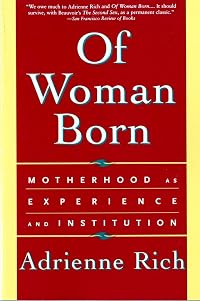
Adrienne Cecile Rich was born in Baltimore, Maryland on May 16, 1929. In 1951 she graduated from Radcliffe College and was selected for the Yale Series of Younger Poets prize by W.H. Auden. She began teaching for City College of New York in 1968, and was also a lecturer and adjunct professor at Swarthmore College and Columbia University School of show more the Arts. She taught in CUNY's basic writing program during the early 1970s. In the 1970s, she started to be active in the women's liberation movement. Her work has been characterized as confrontational, treating women's role in society, racism, and the Vietnam War. In addition to many collections of poetry, she has also written several books of nonfiction prose, such as Arts of the Possible: Essays and Conversations, What is Found There: Notebooks on Poetry and Politics, and Of Woman Born: Motherhood as Experience and Institution. Her last poetry collection was entitled Tonight No Poetry Will Serve: Poems 2007-2010. She has won numerous literary awards, including the 1986 Ruth Lilly Poetry Prize, the 1992 Poets' Prize, the 1997 Wallace Stevens Award of the Academy of American Poets, the 2004 National Book Critics Circle Award in Poetry, and the 2006 National Book Foundation Medal of Distinguished Contribution to American Letters. She has also received the Bollingen Prize, the Lannan Lifetime Achievement Award, the Academy of American Poets Fellowship, the Lenore Marshall Poetry Prize, and a MacArthur Fellowship. In 1974, she refused to receive as an individual the National Book Award for Poetry, instead accepting it on behalf of all silenced women. She also refused the National Medal of Arts in 1997, stating that "I could not accept such an award from President Clinton or this White House because the very meaning of art, as I understand it, is incompatible with the cynical politics of this administration." In 2012, she won the Lifetime Recognition Award from the Griffin Poetry Prize. She died from long-term rheumatoid arthritis on March 27, 2012. (Bowker Author Biography) show less
Common Knowledge
- Original publication date
- 1979
- First words
- In October 1902 Elizabeth Cady Stanton died at the age of eighty seven.
- Quotations
- We take so much of the universe on trust. You tell me: "In 1950 I lived on the north side of Beacon Street in Somerville." You tell me: "She and I were lovers, but for months now we have only been good friends." You tell me: ... (show all)"It is seventy degrees outside and the sun is shining." Because I love you, because there is not even a question of lying between us, I take these accounts of the universe on trust: your address twenty-five years ago, your relationship with someone I know only by sight, this morning's weather. I fling unconscious tendrils of belief, like slender green threads, across statements such as these, statements made so unequivocally, which have no tone or shadow of tentativeness. I build them into the mosaic of my world. I allow my universe to change in minute, significant ways, on the basis of things you have said to me, of my trust in you.
In lying to others we end up lying to ourselves. We deny the importance of an event, or a person, and thus deprive ourselves of a part of our lives. Or we use one piece of the past or present to screen out another. Thus we lo... (show all)se faith even with our own lives.
Lying is done with words, and also with silence.
To discover that one has been lied to in a personal relationship, however, leads one to feel a little crazy.
When we discover that someone we trusted can be trusted no longer, it forces us to reexamine the universe, to question the whole instinct and concept of trust. For a while, we are thrust back onto some bleak, jutting ledge, i... (show all)n a dark pierced by sheets of fire, swept by sheets of rain, in a world before kinship, or naming, or tenderness exist; we are brought close to formlessness. - Last words
- (Click to show. Warning: May contain spoilers.)We need to go beyond rhetoric or evasion into that place in ourselves, to feel the force of all we have been trying - without sucess - to skim across.
- Blurbers
- Moers, Ellen; Daly, Mary
Classifications
Statistics
- Members
- 800
- Popularity
- 34,850
- Reviews
- 3
- Rating
- (4.35)
- Languages
- English, Italian, Spanish
- Media
- Paper, Ebook
- ISBNs
- 9
- ASINs
- 5