
The Book Wars : What It Takes to Be Educated in America
by James Atlas
On This Page
Description
Discusses the merits of there being a general list of required reading books for United States college students in order to provide a common core of knowledge.Tags
Recommendations


















Member Reviews
The author is a literary journalist--an editor of NY Times Magazine, Atlantic, and Vanity Fair. He limns the substantive arguments put up by academics for and against The Great Books taught, or not, as the core of higher education.
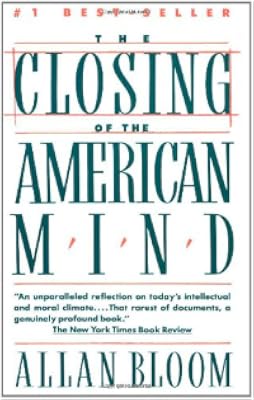
The outline of the war more or less begins with the introduction of Allan Bloom, a philosophy professor at the University of Chicago, and his publication of "The Closing of the American Mind" in 1987. Arthur Schlesinger Jr predicted this book would be another half-read best-seller that strikes a momentary nerve, is rarely read through, and "is soon forgotten". [We now see that his prediction, while true, has taken a ghastly turn, with a generation of "revisionist" ideologues only pretending to teach "Great" show more Books. ]
Atlas takes the trouble to sound out the sides in the war, and ventilates the positions, warts and all. However, it not a view with insight into the real challenge, which is not "teaching", but understanding. Bloom can quote from Socrates' "Apology" and explode Heidegger's "Rektoratsrede" but can he deliver their burdens to a single student? No, he fails utterly. And the barbarians at the gate were not the leftists or the deconstructionists he derides, pointlessly but repeatedly, but the fascists in love with the power of guns and tribal hatreds.
At the end, Atlas agrees with Bloom, and concludes: "Only a nation schooled in basic values--and we're no longer a nation schooled in anything at all--will grasp the negotiation between personal freedom and collective self-interest that is the essence of our American democracy. Those ideas are learned in books. The Great Books. The best that has been thought and said. The canon. Until a few years ago, this was our educational mandate. If it goes, a tradition that we cherished will go with it." show less
The outline of the war more or less begins with the introduction of Allan Bloom, a philosophy professor at the University of Chicago, and his publication of "The Closing of the American Mind" in 1987. Arthur Schlesinger Jr predicted this book would be another half-read best-seller that strikes a momentary nerve, is rarely read through, and "is soon forgotten". [We now see that his prediction, while true, has taken a ghastly turn, with a generation of "revisionist" ideologues only pretending to teach "Great" show more Books. ]
Atlas takes the trouble to sound out the sides in the war, and ventilates the positions, warts and all. However, it not a view with insight into the real challenge, which is not "teaching", but understanding. Bloom can quote from Socrates' "Apology" and explode Heidegger's "Rektoratsrede" but can he deliver their burdens to a single student? No, he fails utterly. And the barbarians at the gate were not the leftists or the deconstructionists he derides, pointlessly but repeatedly, but the fascists in love with the power of guns and tribal hatreds.
At the end, Atlas agrees with Bloom, and concludes: "Only a nation schooled in basic values--and we're no longer a nation schooled in anything at all--will grasp the negotiation between personal freedom and collective self-interest that is the essence of our American democracy. Those ideas are learned in books. The Great Books. The best that has been thought and said. The canon. Until a few years ago, this was our educational mandate. If it goes, a tradition that we cherished will go with it." show less
Ratings
Members
- Recently Added By
Author Information

12+ Works 672 Members
James Atlas is the founding editor of the Lipper/Viking Penguin Lives Series, a joint venture of Penguin and Lipper Books that he conceived around 1996 as he was struggling with his Bellow biography. His idea was to pair well-known writers and biographical subjects, with the books to be 150 pages or so, short for the genre. A longtime contributor show more to The New Yorker, he was an editor at The New York Times Magazine for many years. His work has appeared in The New York Times Book Review, The New York Review of Books, The London Review of Books, The Atlantic Monthly, Partisan Review, and many other journals. He is the author of Delmore Schwartz: The Life of an American Poet, which was nominated for a National Book Award. James Atalas passed away on September 4, 2019 at the age of 70. (Bowker Author Biography) show less
Common Knowledge
- Last words
- (Click to show. Warning: May contain spoilers.)Only a nation schooled in basic values--and we're no longer a nation schooled in anything at all--will grasp the negotiation between personal freedom and collective self-interest that is the essence of our American democracy. Those ideas are learned in books. The Great Books. The best that has been thought and said. The canon. Until a few years ago, this was our educational mandate. If it goes, a tradition that we cherished will go with it.
Classifications
- Genres
- Nonfiction, General Nonfiction
- DDC/MDS
- 028.5 — Computer science, information & general works Library & information sciences Reading and use of other information media Reading of young; Juveniles
- LCC
- Z1039 .C65 .A75 — Bibliography, Library Science and Information Resources General bibliography Books for special classes of persons, institutions, etc.
Statistics
- Members
- 54
- Popularity
- 566,796
- Reviews
- 1
- Rating
- (4.00)
- Languages
- English
- Media
- Paper
- ISBNs
- 1
- ASINs
- 1

