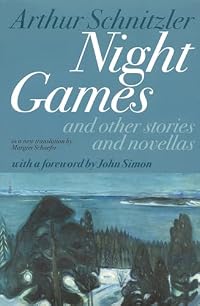
Night Games: And Other Stories and Novellas
by Arthur Schnitzler
On This Page
Description
These artful new translations of nine of Schnitzler's most important stories and novellas reinforce the Viennese author's remarkable achievement.Tags
Recommendations






Member Reviews
A fairy tale, a dream, a nightmare. The opening of Dream Story begins with the innocence of a young girl reading a fairy tale. However, the narrative almost immediately drifts into a not so innocent glance (look) between the girl's parents. Suddenly they are remembering a masquerade ball and the reader is drawn into the parents' world where reality is like a dream and "truth and lie flow into one another". Dream Story narrates the emotional life of a a couple, Fridolin and Albertine, who are living banal lives where the hours fly "by soberly in predetermined daily routines and work"; he as a doctor and
This story, psychological in nature, focuses on the inner desires and fantasies of a married couple. Themes of fidelity and infidelity, show more jealousy, and guilt are depicted while the couple copes with feelings of insecurity, betrayal, and resentment. More important in my estimation is the blurring of dream and reality. Fridolin's "real" adventure seems to become more unreal once he leaves and returns, while Albertine's dream has both connections with and an impact upon reality that transcends her irrational dream world. Schnitzler effectively blurs the line between reality and fantasy in the story; at the end, Fridolin and Albertina agree that no dream is ever entirely unreal, and that reality does not encompass the entirety of an individual life. It is not surprising that Arthur Schnitzler was considered one of the best portrayers of the Freudian point of view in literature.
Some critics also suggest that the novella underscores the tensions between duty and desire through both Fridolin and Albertine’s temptation to sacrifice family and marital stability in pursuit of sexual fantasies. One cannot escape the image of death as a theme of Dream Story, with the scene of the dead woman who may have sacrificed her life for Fridolin. Finally, I was impressed with the tautness of this novella as its themes were integrated within the story both symbolically and structurally. I should add that Schnitzler's novella was the source of Stanley Kubrick's 1999 film, "Eyes Wide Shut". show less
This story, psychological in nature, focuses on the inner desires and fantasies of a married couple. Themes of fidelity and infidelity, show more jealousy, and guilt are depicted while the couple copes with feelings of insecurity, betrayal, and resentment. More important in my estimation is the blurring of dream and reality. Fridolin's "real" adventure seems to become more unreal once he leaves and returns, while Albertine's dream has both connections with and an impact upon reality that transcends her irrational dream world. Schnitzler effectively blurs the line between reality and fantasy in the story; at the end, Fridolin and Albertina agree that no dream is ever entirely unreal, and that reality does not encompass the entirety of an individual life. It is not surprising that Arthur Schnitzler was considered one of the best portrayers of the Freudian point of view in literature.
Some critics also suggest that the novella underscores the tensions between duty and desire through both Fridolin and Albertine’s temptation to sacrifice family and marital stability in pursuit of sexual fantasies. One cannot escape the image of death as a theme of Dream Story, with the scene of the dead woman who may have sacrificed her life for Fridolin. Finally, I was impressed with the tautness of this novella as its themes were integrated within the story both symbolically and structurally. I should add that Schnitzler's novella was the source of Stanley Kubrick's 1999 film, "Eyes Wide Shut". show less
Flawless collection. I only knew Schnitzler from his play "Reigen" (a.k.a. "La Ronde"), and I never expected his short stories to be so great. They remind me of Chekhov, though the emphasis here is firmly on sex and death. Margaret Schaefer's translation is also great - you'd hardly guess these pieces were written at the turn of the century.
Ratings
Members
- Recently Added By
Author Information

449+ Works 7,580 Members
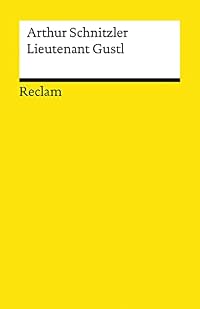
Arthur Schnitzler, Viennese playwright, novelist, short story writer, and physician, was a sophisticated writer much in vogue in his time. He chose themes of an erotic, romantic, or social nature, expressed with clarity, irony, and subtle wit. Reigen, a series of ten dialogues linking people of various social classes through their physical desire show more for one another, has been filmed many times as La Ronde. As a Jew, Schnitzler was sensitive to the problems of anti-Semitism, which he explored in the play Professor Bernhardi (1913), seen in New York in a performance by the Vienna Burgtheater in 1968. Henry Hatfield calls Schnitzler "second only to Hofmannsthal among the Austrian writers of his generation and one of the most underrated of German authors... . He combined the naturalist's devotion to fact with the impressionist's interest in nuance; in other words, he told the truth" (Modern German Literature). In his most famous story, Lieutenant Gustl (1901), Schnitzler employs the stream-of-consciousness technique in an exposition of the follies and gradual disintegration of society in fin de siecle Vienna. Schnitzler has also been linked with Freud (see Vols. 3 and 5) and is credited with consciously introducing elements of modern psychology into his works. (Bowker Author Biography) show less
Work Relationships
Common Knowledge
- Original language
- German
Classifications
Statistics
- Members
- 149
- Popularity
- 219,016
- Reviews
- 2
- Rating
- (4.05)
- Languages
- English
- Media
- Paper, Ebook
- ISBNs
- 3
- ASINs
- 1