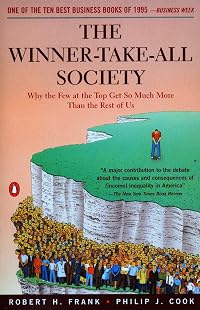
The Winner-Take-All Society: Why the Few at the Top Get So Much More Than the Rest of Us
by Robert H. Frank, Philip J. Cook
On This Page
Description
In this book, two distinguished economists draw attention to an important and disturbing new trend that has dramatically transformed our economy in the last two decades: the spread of "winner-take-all" markets, where more and more people compete for ever fewer and bigger prizes. Such markets, where tiny differences in performance translate into huge differences in reward, have long been the hallmark of the performing arts and professional sports, where increasingly sophisticated recording show more technologies and the global reach of television have enabled millions to listen to and watch only "star" artists and athletes, leaving nothing for the also-rans. In recent years, however, winner-take-all markets have reached into virtually every part of the nation's economic life, spreading into such businesses as fashion, investment banking, and media; into professions like law and medicine; into higher education; and, increasingly, into management itself. While not for a moment denying that consumers have sometimes benefited - nobody has to listen to a second-rate soprano when virtually everyone can afford recordings of first-rate singers - Frank and Cook argue persuasively that, on balance, the result has been disastrous. They show how winner-take-all markets have dramatically widened the gap between rich and poor by concentrating all rewards among just a small handful of winners, and how they have lured some of our most talented individuals into socially unproductive and sometimes even destructive pursuits. Finally, in their relentless stress on winners - the bestselling novel, the blockbuster film, and so on - winner-take-all markets have diluted our culture in ways that many people find deeply disturbing. show lessTags
Recommendations





















Member Recommendations
Member Reviews
A thought-provoking book that goes steadily downhill: The first half to 2/3 of this book makes some very good points that have escaped most of the popular discussions of economic issues. The authors point out, persuasively in my opinion, that certain industries and professions have "winner-take-all" characteristics that pervert the usual reward/punishment consequences of free-market economic policies.
The markets for which the authors have the strongest evidence of "winner take all" characteristics are presented earliest. As the book goes on, however, it falls into the same pattern of thousands of books before it: the authors have made one important and interesting observation, and they proceed to claim that virtually everything in the show more world that they disapprove of can be accounted for by this one observation. They assume, without plausible evidence, that the declines in education and popular culture are the direct consequence of winner-take-all markets. In a couple of cases they even admit that the evidence for winner-take-all characteristics in a particular industry or occupation is scanty or even nonexistent. But that doesn't prevent them from offering further arguments and policy recommendations based on the assumption that every one of these markets is dominated by winner-take-all distortions.
By the end of this book, where the authors make policy recommendations, they come close to leaving reality behind. They make these recommendations based on the assumptions that the **entire economy** is dominated by winner-take-all characteristics - a proposition for which they offer no evidence whatever. It is hard to escape the impression that their goal in writing this book was to justify a more socialistic economic policy on the part of the government, rather than to evenhandedly examine and explain an important issue.
In short: read the first of half of this book, because it makes a lot of worthwhile points and observations. Read most of the rest if you're retired or have a lot of free time. Skip the last chapter, with their policy recommendations. show less
The markets for which the authors have the strongest evidence of "winner take all" characteristics are presented earliest. As the book goes on, however, it falls into the same pattern of thousands of books before it: the authors have made one important and interesting observation, and they proceed to claim that virtually everything in the show more world that they disapprove of can be accounted for by this one observation. They assume, without plausible evidence, that the declines in education and popular culture are the direct consequence of winner-take-all markets. In a couple of cases they even admit that the evidence for winner-take-all characteristics in a particular industry or occupation is scanty or even nonexistent. But that doesn't prevent them from offering further arguments and policy recommendations based on the assumption that every one of these markets is dominated by winner-take-all distortions.
By the end of this book, where the authors make policy recommendations, they come close to leaving reality behind. They make these recommendations based on the assumptions that the **entire economy** is dominated by winner-take-all characteristics - a proposition for which they offer no evidence whatever. It is hard to escape the impression that their goal in writing this book was to justify a more socialistic economic policy on the part of the government, rather than to evenhandedly examine and explain an important issue.
In short: read the first of half of this book, because it makes a lot of worthwhile points and observations. Read most of the rest if you're retired or have a lot of free time. Skip the last chapter, with their policy recommendations. show less
Robert Frank and Philip J. Cook have written a most interesting book that explains why the salary of a typical American executive today is 120 times that of the average manufacturing worker when it was 35 times that in 1974; why "the incomes of the top 1 percent more than doubled in real terms between 1979 and 1989, a period during which the median income was roughly stable and in which the bottom 20 percent saw their income actually fall by 10 percent."
The authors reject the arguments that these horrifying statistics result from productivity increases, or the failure of tho se at the bottom to take advantage of opportunities, lack of education (Robert Reich), or genetic inferiority (Charles Murray). They blame what they call the "Star show more System," which has become common in many fields (OJ. Simpson's attorneys, corporation raiding of big name executives, etc.); a "reward structure common in entertainment and sports - where thousands compete for a handful of prizes at the top .... "
They argue this distorts society by diverting talented people into competitions almost all will lose. "Winner- Take-All markets attract too many contestants in part because of a common human frailty with respect to gambling - namely, our tendency to overestimate our chances of winning," i.e., the "Lake Wobegon Effect," where all the men are good-looking and all the children are above-average. show less
The authors reject the arguments that these horrifying statistics result from productivity increases, or the failure of tho se at the bottom to take advantage of opportunities, lack of education (Robert Reich), or genetic inferiority (Charles Murray). They blame what they call the "Star show more System," which has become common in many fields (OJ. Simpson's attorneys, corporation raiding of big name executives, etc.); a "reward structure common in entertainment and sports - where thousands compete for a handful of prizes at the top .... "
They argue this distorts society by diverting talented people into competitions almost all will lose. "Winner- Take-All markets attract too many contestants in part because of a common human frailty with respect to gambling - namely, our tendency to overestimate our chances of winning," i.e., the "Lake Wobegon Effect," where all the men are good-looking and all the children are above-average. show less
: A POWERFUL CRITIQUE OF ECONOMIC SYSTEMS THAT REWARD A FEW DISPROPORTIONATELY, THIS BOOK EXPLAINS HOW EXTREME INEQUALITY EMERGES IN TALENT-BASED MARKETS AND HOW IT AFFECTS SOCIETY
Magnificent thesis which has become even more relevent since it was written. This books helps you understand where you are getting sucked in by false promises.
Ratings
Members
- Recently Added By
Lists

Income Inequality
20 works; 4 members
Author Information

28+ Works 2,478 Members
Robert H. Frank is the H. J. Louis Professor of Management and Professor of Economics, emeritus, at Cornell University's Johnson Graduate School of Management. He has been an Economic View columnist for the New York Times since 2005. His many books include Success and Luck (Princeton). Twitter @econnaturalist

8+ Works 336 Members
Philip J. Cook is the ITT/Sanford Professor of Public Policy at Duke University and Research Associate of the National Bureau of Economic Research.
Classifications
- Genres
- Economics, Nonfiction, Sociology, General Nonfiction, Business
- DDC/MDS
- 306.4 — Society, government, & culture Social sciences, sociology & anthropology Social Behavior - Dating, Marriage, Divorce Specific aspects of culture
- LCC
- HB238 .F73 — Social sciences Economic theory. Demography Economic theory. Demography Competition. Production. Wealth
- BISAC
Statistics
- Members
- 230
- Popularity
- 141,677
- Reviews
- 4
- Rating
- (3.93)
- Languages
- English, Portuguese
- Media
- Paper
- ISBNs
- 4