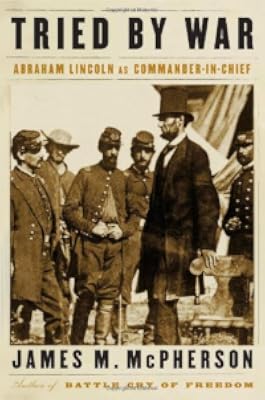
Tried by War: Abraham Lincoln as Commander in Chief
by James M. McPherson
On This Page
Description
Evaluates Lincoln's talents as a commander in chief in spite of limited military experience, tracing the ways in which he worked with, or against, his senior commanders to defeat the Confederacy and reshape the presidential role.Tags
Recommendations








Member Reviews
In “Tried By War” preeminent Civil War historian James McPherson brings his considerable talents to the subject of Abraham Lincoln’s actions as Commander-in-Chief during the Civil War. Utilizing a narrative that largely follows the rotating collection of Lincoln’s generals and how each came into and fell out of favor with the President. Throughout the war, Lincoln’s primary focus was the destruction of the rebel army, which he viewed as the key to defeating the Confederacy while his generals were too preoccupied with minimizing losses and capturing Richmond to sustain an effective assault on the Rebel forces.
McPherson makes clear that Lincoln developed his military strategy based on his political strategy. Above all, show more Lincoln’s greatest desire was to maintain the Union. In order to gain support early on, he accomplished this by taking a defensive strategy, goading the rebels into attacking Fort Sumter and first setting foot in neutral Kentucky. These two actions solidified support for the war in the North and ensured that the border states would not actively support the Confederacy. With that support in place, Lincoln began his search for a general who would carry out his plan for an all-out attack on the rebel army.
Brigadier General Irvin McDowell was placed in command of the Army of Northeastern Virginia but was quickly relieved following an embarrassing loss at Bull Run. The army’s failure was due to many factors, but none more important than McDowell being rushed into combat by Washington politics with a complicated strategy and an extremely green army.
Following the relief of Gen. McDowell, General George McClellan was the first man to lead Lincoln’s new Army of the Potomac. Billed as a “young Napolean, McClellan’s early command success actually hindered him during the Civil War. As McPherson eloquently but succinctly puts it, “never having experienced failure, he feared the unknown. To move against the enemy was to risk failure. So McClellan manufactured phantom enemies to justify his demands for more troops, to explain his inaction against the actual enemy, and to blame others for that inaction.” The general was “perpetually almost but not quite ready to move. No matter how many men or weapons he head, the enemy always had more. Even when faced with irrefutable evidence that he was overestimating his opponent’s strength, McClellan refused to move against the rebels. Lincoln was disgusted with his general’s “case of the slows” and even tried to replace him in August of 1862 only to be spurned by his choice of replacement, Ambrose Burnside. After three more months of having McClellan ignore his pleas for action, Lincoln finally relinquished the general of his command and convinced General Burnside to take command of the Army of the Potomac.
Burnside’s tenure as commander did not last long. His disastrous campaign against Fredericksburg after a mere two months as general and the subsequent aborted “Mud March” lost him the confidence of his subordinate generals. After first (unsuccessfully) attempting to relieve his subordinates of duty, Burnside offered Lincoln the choice of dismissing him or them. Lincoln accepted Burnside’s resignation and placed General Joseph Hooker in command.
Lincoln advised Hooker that, following the failures at Antietam and Fredericksburg, he expected the general to concentrate on Lee’s Army and to commit all of his forces in battle. Unfortunately, in his first real action at Chancellorsville, Hooker failed to carry out any of the President’s orders. He had been on the attack the previous week but, following a move by Stonewall Jackson, backed off and allowed the Confederates to gain the offensive, which they used to score a decisive victory in Chancellorsville; a battle in which two of the seven Union corps did not participate. The last straw came when Hooker requested Lincoln’s permission to attack the lightly defended Richmond as opposed to following Lee’s army. After more bickering with the President’s Secretary of War, Hooker submitted his resignation, which Lincoln accepted.
On his fourth day in command, General George Meade directed a successful defensive against Lee at Gettysburg, driving the Confederates out of Pennsylvania. Unfortunately for the general, he followed that victory with a missive proclaiming his desire to “drive from our soil every vestige of the presence of the invader.” To Lincoln, who was operating under the premise that “the whole country is our soil,” this statement reeked of McClellan. That statement, combined with Meade’s hesitation to follow, which allowed Lee’s army to escape, nearly caused the President to send the general a letter which would have provoked Meade’s resignation. Lincoln waited, though, mostly the Union army’s success in the west kept his mood cheerful.
Meade would remain in command of the Army of the Potomac for the remainder of the war, but his power was diminished in March of 1864 when Ulysses S. Grant was appointed Lieutenant General in command of all Union armies. Grant traveled with Meade for the rest of the war and most strategic decisions himself. With Grant, Lincoln finally found the general willing to make hard war he had been looking for. The general was far more willing to accept losses, knowing that the Union had men to replace those who died, while the Confederacy did not. Under Grant’s leadership, the Union was finally able to defeat and capture Lee’s army, effectively signaling the end of the Civil War.
For four years, Lincoln ordered his generals to take the offensive, to attack Lee’s army, and to stop overestimating the enemy’s numbers. For four years Lincoln’s generals failed him. Finally, under the leadership of Ulysses S. Grant, the Union army fought to win; and to defeat Lee’s army. show less
McPherson makes clear that Lincoln developed his military strategy based on his political strategy. Above all, show more Lincoln’s greatest desire was to maintain the Union. In order to gain support early on, he accomplished this by taking a defensive strategy, goading the rebels into attacking Fort Sumter and first setting foot in neutral Kentucky. These two actions solidified support for the war in the North and ensured that the border states would not actively support the Confederacy. With that support in place, Lincoln began his search for a general who would carry out his plan for an all-out attack on the rebel army.
Brigadier General Irvin McDowell was placed in command of the Army of Northeastern Virginia but was quickly relieved following an embarrassing loss at Bull Run. The army’s failure was due to many factors, but none more important than McDowell being rushed into combat by Washington politics with a complicated strategy and an extremely green army.
Following the relief of Gen. McDowell, General George McClellan was the first man to lead Lincoln’s new Army of the Potomac. Billed as a “young Napolean, McClellan’s early command success actually hindered him during the Civil War. As McPherson eloquently but succinctly puts it, “never having experienced failure, he feared the unknown. To move against the enemy was to risk failure. So McClellan manufactured phantom enemies to justify his demands for more troops, to explain his inaction against the actual enemy, and to blame others for that inaction.” The general was “perpetually almost but not quite ready to move. No matter how many men or weapons he head, the enemy always had more. Even when faced with irrefutable evidence that he was overestimating his opponent’s strength, McClellan refused to move against the rebels. Lincoln was disgusted with his general’s “case of the slows” and even tried to replace him in August of 1862 only to be spurned by his choice of replacement, Ambrose Burnside. After three more months of having McClellan ignore his pleas for action, Lincoln finally relinquished the general of his command and convinced General Burnside to take command of the Army of the Potomac.
Burnside’s tenure as commander did not last long. His disastrous campaign against Fredericksburg after a mere two months as general and the subsequent aborted “Mud March” lost him the confidence of his subordinate generals. After first (unsuccessfully) attempting to relieve his subordinates of duty, Burnside offered Lincoln the choice of dismissing him or them. Lincoln accepted Burnside’s resignation and placed General Joseph Hooker in command.
Lincoln advised Hooker that, following the failures at Antietam and Fredericksburg, he expected the general to concentrate on Lee’s Army and to commit all of his forces in battle. Unfortunately, in his first real action at Chancellorsville, Hooker failed to carry out any of the President’s orders. He had been on the attack the previous week but, following a move by Stonewall Jackson, backed off and allowed the Confederates to gain the offensive, which they used to score a decisive victory in Chancellorsville; a battle in which two of the seven Union corps did not participate. The last straw came when Hooker requested Lincoln’s permission to attack the lightly defended Richmond as opposed to following Lee’s army. After more bickering with the President’s Secretary of War, Hooker submitted his resignation, which Lincoln accepted.
On his fourth day in command, General George Meade directed a successful defensive against Lee at Gettysburg, driving the Confederates out of Pennsylvania. Unfortunately for the general, he followed that victory with a missive proclaiming his desire to “drive from our soil every vestige of the presence of the invader.” To Lincoln, who was operating under the premise that “the whole country is our soil,” this statement reeked of McClellan. That statement, combined with Meade’s hesitation to follow, which allowed Lee’s army to escape, nearly caused the President to send the general a letter which would have provoked Meade’s resignation. Lincoln waited, though, mostly the Union army’s success in the west kept his mood cheerful.
Meade would remain in command of the Army of the Potomac for the remainder of the war, but his power was diminished in March of 1864 when Ulysses S. Grant was appointed Lieutenant General in command of all Union armies. Grant traveled with Meade for the rest of the war and most strategic decisions himself. With Grant, Lincoln finally found the general willing to make hard war he had been looking for. The general was far more willing to accept losses, knowing that the Union had men to replace those who died, while the Confederacy did not. Under Grant’s leadership, the Union was finally able to defeat and capture Lee’s army, effectively signaling the end of the Civil War.
For four years, Lincoln ordered his generals to take the offensive, to attack Lee’s army, and to stop overestimating the enemy’s numbers. For four years Lincoln’s generals failed him. Finally, under the leadership of Ulysses S. Grant, the Union army fought to win; and to defeat Lee’s army. show less
If your own life does not offer frustrations to irritate you beyond reason, you can read this account of what Lincoln had to endure with his generals during the Civil War, most notably George McClellan.
McClellan didn’t seem too interested in engaging the army of which he had command, but he was so popular with his troops that Lincoln feared mutiny if he dismissed McClellan. McClellan also had overwhelming and enthusiastic support among Democrats. Therefore, Lincoln decided he had better put up with McClellan at least until after the elections in November of 1862.
But there is much more in this book than contemplating how many lives might have not been lost if McClellan (and subsequent balky generals) had just followed Lincoln’s show more orders.
McPherson organizes the book around five functions performed or overseen by Lincoln in his capacity as Commander-in-Chief: the formulation of policy, national strategy, military strategy, operations, and tactics. In all of these areas, McPherson shows how Lincoln based his decisions on one core concept, i.e., to preserve the nation by winning the war. Lincoln averred that “the right of a State to secede is not an open or debatable question” and that the President “cannot entertain any proposition for dissolution or dismemberment.”
[It should be noted that there is nothing in the Constitution about whether or not a state may leave the Union. The South argued that the Constitution was simply a compact among sovereign states and states could opt out if they no longer found conditions for this compact favorable to them. Lincoln, however, argued that the nation predated the Constitution, having been declared by the people, not the states, in the Declaration of Independence. Therefore no state can dissolve the Union. This is the idea upon which he elaborated in The Gettysburg Address.]
Later in his presidency, Lincoln added two other conditions for peace in addition to the insistence that the Union be restored. One was “abandonment of slavery.” Lincoln made a promise of freedom to black soldiers who fought for the Union, and, he maintained, he could not betray that promise. Nor would he agree to any ceasefire for the purpose of negotiations - he stipulated that there would be “no cessation of hostilities sort of an end of the war, and the disbanding of all forces hostile to the government.”
Much of McPherson’s analysis is made by reporting the content of the telegrams Lincoln sent his generals, and explaining the many excuses the generals made by way of reply for not obeying Lincoln’s directions. Lincoln's suggestions for military operations were remarkably astute, but they mostly were ignored.
Lincoln was incredibly frustrated over his generals’ inaction, excuses, and even insubordination, but he faced three main difficulties: (1) in the beginning, Lincoln was unsure of his own ability as a “commander in chief” and thought the West Point “professionals” perforce must know better than he, so he was apt to defer to their judgment; (2) many of the non-professionals were political appointments Lincoln had made to appease some faction or other, and while these men were very much out of their depth, Lincoln couldn’t take the political risk of cashiering them; (3) until near the end of the war, Lincoln just had no one else qualified to whom he could turn.
By 1864, however, Lincoln finally had a competent team in place, consisting of Grant, Sherman, Sheridan and Thomas, inter alia - men who not only were eager and willing to fight an offensive war, rather than strictly taking a defensive stance, but who understood that the goal of the war was to destroy Lee’s army, not just to capture Richmond (whether the Confederate army was still intact or not!)
McPherson tips his hat to Lincoln’s lucid and convincing explanations to the American people of the actions he took. As McPherson writes, Lincoln was “a master of metaphors” who utilized stories and homilies to make abstruse concepts seem totally clear and logical.
He also defends the measures Lincoln took to extend the wartime powers of the Executive, such as Lincoln's suspension of habeas corpus and his authorization of military tribunals to try civilians. As McPherson argues, at no time in American history was the survival of the country in greater danger than in the Civil War. Yet, he reminds us:
"…compared with the draconian enforcement of espionage and sedition laws in World War I, the internment of more than one hundred thousand Japanese Americans in the 1940s, McCarthyism in the 1950s, or the National Security State of our own time, the infringement of civil liberties from 1861 to 1865 seems mild indeed.”
Evaluation: This examination of how Lincoln fulfilled his role as a wartime Commander-in-Chief provides an excellent perspective on Lincoln, the military, and the many challenges facing a wartime president. In addition, you also get a brief history of the Civil War itself: one that summarizes, in a highly interesting format, most of its history. show less
McClellan didn’t seem too interested in engaging the army of which he had command, but he was so popular with his troops that Lincoln feared mutiny if he dismissed McClellan. McClellan also had overwhelming and enthusiastic support among Democrats. Therefore, Lincoln decided he had better put up with McClellan at least until after the elections in November of 1862.
But there is much more in this book than contemplating how many lives might have not been lost if McClellan (and subsequent balky generals) had just followed Lincoln’s show more orders.
McPherson organizes the book around five functions performed or overseen by Lincoln in his capacity as Commander-in-Chief: the formulation of policy, national strategy, military strategy, operations, and tactics. In all of these areas, McPherson shows how Lincoln based his decisions on one core concept, i.e., to preserve the nation by winning the war. Lincoln averred that “the right of a State to secede is not an open or debatable question” and that the President “cannot entertain any proposition for dissolution or dismemberment.”
[It should be noted that there is nothing in the Constitution about whether or not a state may leave the Union. The South argued that the Constitution was simply a compact among sovereign states and states could opt out if they no longer found conditions for this compact favorable to them. Lincoln, however, argued that the nation predated the Constitution, having been declared by the people, not the states, in the Declaration of Independence. Therefore no state can dissolve the Union. This is the idea upon which he elaborated in The Gettysburg Address.]
Later in his presidency, Lincoln added two other conditions for peace in addition to the insistence that the Union be restored. One was “abandonment of slavery.” Lincoln made a promise of freedom to black soldiers who fought for the Union, and, he maintained, he could not betray that promise. Nor would he agree to any ceasefire for the purpose of negotiations - he stipulated that there would be “no cessation of hostilities sort of an end of the war, and the disbanding of all forces hostile to the government.”
Much of McPherson’s analysis is made by reporting the content of the telegrams Lincoln sent his generals, and explaining the many excuses the generals made by way of reply for not obeying Lincoln’s directions. Lincoln's suggestions for military operations were remarkably astute, but they mostly were ignored.
Lincoln was incredibly frustrated over his generals’ inaction, excuses, and even insubordination, but he faced three main difficulties: (1) in the beginning, Lincoln was unsure of his own ability as a “commander in chief” and thought the West Point “professionals” perforce must know better than he, so he was apt to defer to their judgment; (2) many of the non-professionals were political appointments Lincoln had made to appease some faction or other, and while these men were very much out of their depth, Lincoln couldn’t take the political risk of cashiering them; (3) until near the end of the war, Lincoln just had no one else qualified to whom he could turn.
By 1864, however, Lincoln finally had a competent team in place, consisting of Grant, Sherman, Sheridan and Thomas, inter alia - men who not only were eager and willing to fight an offensive war, rather than strictly taking a defensive stance, but who understood that the goal of the war was to destroy Lee’s army, not just to capture Richmond (whether the Confederate army was still intact or not!)
McPherson tips his hat to Lincoln’s lucid and convincing explanations to the American people of the actions he took. As McPherson writes, Lincoln was “a master of metaphors” who utilized stories and homilies to make abstruse concepts seem totally clear and logical.
He also defends the measures Lincoln took to extend the wartime powers of the Executive, such as Lincoln's suspension of habeas corpus and his authorization of military tribunals to try civilians. As McPherson argues, at no time in American history was the survival of the country in greater danger than in the Civil War. Yet, he reminds us:
"…compared with the draconian enforcement of espionage and sedition laws in World War I, the internment of more than one hundred thousand Japanese Americans in the 1940s, McCarthyism in the 1950s, or the National Security State of our own time, the infringement of civil liberties from 1861 to 1865 seems mild indeed.”
Evaluation: This examination of how Lincoln fulfilled his role as a wartime Commander-in-Chief provides an excellent perspective on Lincoln, the military, and the many challenges facing a wartime president. In addition, you also get a brief history of the Civil War itself: one that summarizes, in a highly interesting format, most of its history. show less
After reading Stamped from the Beginning, I wanted to compare what others said about Abraham Lincoln and his approach to slavery. Since my husband already listened to Tried by War by James M. McPherson, I took the opportunity to do just that. Unfortunately, Mr. McPherson’s portrayal of Lincoln as the commander in chief is exactly what I expected.
Tried by War is not for anyone looking to learn more about Lincoln’s presidency. In essence, Mr. McPherson does nothing but look at Lincoln as the commander in chief. There is the requisite fawning over Lincoln’s ability to teach himself everything he needed to know, especially as his utter lack of military experience meant he had to learn the basics of combat strategy. More importantly, show more Mr. McPherson explores the limitations of being commander in chief while fighting a war from long-distance.
Mr. McPherson breaks down each of Lincoln’s Army commanders, their subsequent wins as well as their spectacular losses, and his frustrations with each of them. Moreover, he discusses the politics behind each assignment and the party machinations that were at the core of Lincoln’s decisions. In this case, we learn that everything Lincoln did had two end goals – to keep the Republicans in power and to reunite the country.
Since the slavery “issue” directly impacted Lincoln’s two goals, Mr. McPherson does spend some time discussing his evolving opinion about slavery. He even acknowledges that Lincoln’s shift from ignoring the “issue” to abolishing slavery was less ideological and more politically expedient. Still, Mr. McPherson continues to perpetuate the idea of Lincoln as slaves’ savior rather than someone making a calculated decision and even sometimes forced to take action before he was ready because his commanders backed him into a corner.
I can’t say I learned much from listening to Tried by War. There was a time in my late teens where I was obsessed with the Civil War and read everything I could about it. So, the detailed exploration of the various Army commanders Mr. McPherson includes did not provide new insight. If anything, it reiterates the incompetence of those commanders and the prolonging of the war their ineffectiveness ended up achieving. Still, those without extensive background knowledge of the Civil War may find Tried by War interesting. Mr. McPherson’s approach is welcoming while his explanations of each battle are clear enough for most people to understand. Given the severe political division separating the country right now, his descriptions of the politics of the war are particularly interesting. show less
Tried by War is not for anyone looking to learn more about Lincoln’s presidency. In essence, Mr. McPherson does nothing but look at Lincoln as the commander in chief. There is the requisite fawning over Lincoln’s ability to teach himself everything he needed to know, especially as his utter lack of military experience meant he had to learn the basics of combat strategy. More importantly, show more Mr. McPherson explores the limitations of being commander in chief while fighting a war from long-distance.
Mr. McPherson breaks down each of Lincoln’s Army commanders, their subsequent wins as well as their spectacular losses, and his frustrations with each of them. Moreover, he discusses the politics behind each assignment and the party machinations that were at the core of Lincoln’s decisions. In this case, we learn that everything Lincoln did had two end goals – to keep the Republicans in power and to reunite the country.
Since the slavery “issue” directly impacted Lincoln’s two goals, Mr. McPherson does spend some time discussing his evolving opinion about slavery. He even acknowledges that Lincoln’s shift from ignoring the “issue” to abolishing slavery was less ideological and more politically expedient. Still, Mr. McPherson continues to perpetuate the idea of Lincoln as slaves’ savior rather than someone making a calculated decision and even sometimes forced to take action before he was ready because his commanders backed him into a corner.
I can’t say I learned much from listening to Tried by War. There was a time in my late teens where I was obsessed with the Civil War and read everything I could about it. So, the detailed exploration of the various Army commanders Mr. McPherson includes did not provide new insight. If anything, it reiterates the incompetence of those commanders and the prolonging of the war their ineffectiveness ended up achieving. Still, those without extensive background knowledge of the Civil War may find Tried by War interesting. Mr. McPherson’s approach is welcoming while his explanations of each battle are clear enough for most people to understand. Given the severe political division separating the country right now, his descriptions of the politics of the war are particularly interesting. show less
"Abraham Lincoln was the only president in American history whose entire administration was bounded by war," writes noted Civil War historian James M. McPherson at the outset of "Tried by War: Abraham Lincoln as Commander in Chief." Given that the southern insurrection took shape before Lincoln's inauguration and ended a few weeks after his assassination with a surrender of the last rebel army, this observation is correct. More important, though, is McPherson's implication: too little attention has been paid to Lincoln's military policy and decision-making within the breadth of Lincoln scholarship.
It would be incorrect to state that no attention has been paid; indeed, several books have been written on the very issue, in addition to show more other articles and the like. However, it is clear that such analysis has had limited impact on, and inclusion in, most biographies of the 16th president. Aside from issues related to generals Winfield Scott, George McClellan, and Ulysses Grant – and such analyses usually revolve more around interpersonal relationships than military policy – Lincoln's involvement in military policy is largely overlooked.
McPherson addresses this omission in a thought-provoking and engaging way in this well-researched and well-written book. With his characteristic ability to explain substantial issues clearly, the Pulitzer Prize-winning author of the great single-volume history of the Civil War, "Battle Cry of Freedom," explores Lincoln's growth in military matters from a neophyte to a superb commander in chief whose approach to this presidential responsibility became a model that other chief executives followed. In fact, McPherson argues that the concept and application of "war powers" was developed by Lincoln, virtually from scratch.
In his analysis, McPherson identifies five key components to presidential leadership of the military; of these, tactics, which Lincoln famously studied through on-the-job reading, is least important, in his assessment, while policy is most important. (Other key functions are national strategy, military strategy, and military operations.) From the beginning, McPherson is clear that being an able commander in chief is foremost, and perhaps necessarily, a political thing. An analysis of Lincoln's dealings with general in chief Winfield Scott at the outset of the war, in which Scott repeatedly advocates political policy under the guise of military strategy, sets the tone for McPherson's study, implying that Lincoln was already an above-average commander-in-chief even at the outset of the war, because of his political skills and his refusal to cow-tow to the military establishment.
Throughout, McPherson describes Lincoln as a very active, and increasingly capable, commander-in-chief. Perhaps the most striking aspect of his analysis, though, is a subtle refutation of conventional wisdom of Lincoln as a military leader. Most historians attribute Lincoln's involvement in military matters to a paucity of able and competent top-level leadership until the emergence of Grant in 1864. Although McPherson recognizes that Lincoln grew to appreciate and admire Grant's approach, he carefully shows that Lincoln very much supervised, and occasionally overruled, Grant after he became general in chief.
It is difficult to name any significant problems or oversights in McPherson's book, though I suppose some might quibble with bits and pieces of the analysis. Instead, the book seems a marvel of excellence, blending learned research, a discerning eye, and felicitous prose into a study certain to inform readers of all backgrounds. The book's accessibility, its consistent focus on its intended subject, and the well-deserved reputation of its author should cause the book to be influential in Lincoln studies for the next generation or two, a status it richly deserves.
This review is also posted at http://lincolniana.blogspot.com/2011/07/book-review-tried-by-war.html show less
It would be incorrect to state that no attention has been paid; indeed, several books have been written on the very issue, in addition to show more other articles and the like. However, it is clear that such analysis has had limited impact on, and inclusion in, most biographies of the 16th president. Aside from issues related to generals Winfield Scott, George McClellan, and Ulysses Grant – and such analyses usually revolve more around interpersonal relationships than military policy – Lincoln's involvement in military policy is largely overlooked.
McPherson addresses this omission in a thought-provoking and engaging way in this well-researched and well-written book. With his characteristic ability to explain substantial issues clearly, the Pulitzer Prize-winning author of the great single-volume history of the Civil War, "Battle Cry of Freedom," explores Lincoln's growth in military matters from a neophyte to a superb commander in chief whose approach to this presidential responsibility became a model that other chief executives followed. In fact, McPherson argues that the concept and application of "war powers" was developed by Lincoln, virtually from scratch.
In his analysis, McPherson identifies five key components to presidential leadership of the military; of these, tactics, which Lincoln famously studied through on-the-job reading, is least important, in his assessment, while policy is most important. (Other key functions are national strategy, military strategy, and military operations.) From the beginning, McPherson is clear that being an able commander in chief is foremost, and perhaps necessarily, a political thing. An analysis of Lincoln's dealings with general in chief Winfield Scott at the outset of the war, in which Scott repeatedly advocates political policy under the guise of military strategy, sets the tone for McPherson's study, implying that Lincoln was already an above-average commander-in-chief even at the outset of the war, because of his political skills and his refusal to cow-tow to the military establishment.
Throughout, McPherson describes Lincoln as a very active, and increasingly capable, commander-in-chief. Perhaps the most striking aspect of his analysis, though, is a subtle refutation of conventional wisdom of Lincoln as a military leader. Most historians attribute Lincoln's involvement in military matters to a paucity of able and competent top-level leadership until the emergence of Grant in 1864. Although McPherson recognizes that Lincoln grew to appreciate and admire Grant's approach, he carefully shows that Lincoln very much supervised, and occasionally overruled, Grant after he became general in chief.
It is difficult to name any significant problems or oversights in McPherson's book, though I suppose some might quibble with bits and pieces of the analysis. Instead, the book seems a marvel of excellence, blending learned research, a discerning eye, and felicitous prose into a study certain to inform readers of all backgrounds. The book's accessibility, its consistent focus on its intended subject, and the well-deserved reputation of its author should cause the book to be influential in Lincoln studies for the next generation or two, a status it richly deserves.
This review is also posted at http://lincolniana.blogspot.com/2011/07/book-review-tried-by-war.html show less
This is a history of Lincoln as Commander-in-Chief of the Union Army and Navy. Though the writing was a little dry (and it could have used someone who knows how to use commas), it was a fascinating look at the Civil War from another point of view. Recommended.
Tried by War, Abraham Lincoln as Commander in Chief by James M. McPherson (pp. 272). McPherson fills what he perceives is a gap in the innumerable Lincoln biographies and histories by specifically addressing the President’s actions as Commander and Chief. Given the exhaustive Lincoln bibliography it is unrealistic to think his book brings new information to the table, so the value of this narrow look would be if the author provides any great insights not otherwise covered by others. To me he didn’t. That is not to say I did not learn a thing or two (or 100), but those were interesting by largely inconsequential details. Regardless, Tried by War was interesting and, frankly, I love reading about the trials Lincoln endured trying to show more find generals who would actually fight. It’s also nice to read about the political considerations that guided and sometimes shackled the President far more than most of us realize. All the familiar names crop up: Generals McClellan, Butler, McClernand, Meigs, Burnside, Sherman, Sheridan, Rosencrans, Meade, Grant, Hallet, and many more (including those prominent on the other side). For those not otherwise immersed in all things civil war, this fine volume provides an excellent overview of military operations as well as political considerations and actions directly related to them. McPherson is one of the better authors about this period and this book evidences his skill in writing. show less
The most amazing point of interest regarding this book about Abraham Lincoln is that it is the first book that basically analyzes Lincoln's position as the Commander-in-Chief. His entire administration was impacted by war starting with letters from Fort Sumter requesting aid on the day of his inauguration and ending with his assassination 6 days after General Lee surrendered at Appomattox. We have books about Lincoln's writings, his humor, his views on religion and slavery, and his ideas of how to reunite the nation, but nothing that had centered on his military role as Commander-in-Chief.
Lincoln spent more time during his Presidency with matters of war - communications with his Generals in the field, visiting the troops and show more battlefields, international relations, and military strategy then any other aspect of his policies. Never having been a soldier (he actually only served in the military for a short period and saw no action), Lincoln spent hours studying military strategy. He had to deal with incompetent Generals who were either filled with their own thoughts of supremacy or with Generals who were afraid to move their troops. Not until Ulysses Grant was placed in the position of the General in charge did Lincoln have a leader that would eventually end the Confederacy's drive toward separation from the Union.
I found this book fascinating in that the reader can see all the abilities that Lincoln had to put in place to prevent the Southern forces from completely demolishing the morale of the North and at the same using the knowledge that he had gathered from his military studies to instruct the officers in the Union Army to do what was need to win the war.
After reading this book, I am really glad as an American, that at this time, Lincoln was the President of our nation. He was the man that was needed at the time and he truly completed the task that was given to him. show less
Lincoln spent more time during his Presidency with matters of war - communications with his Generals in the field, visiting the troops and show more battlefields, international relations, and military strategy then any other aspect of his policies. Never having been a soldier (he actually only served in the military for a short period and saw no action), Lincoln spent hours studying military strategy. He had to deal with incompetent Generals who were either filled with their own thoughts of supremacy or with Generals who were afraid to move their troops. Not until Ulysses Grant was placed in the position of the General in charge did Lincoln have a leader that would eventually end the Confederacy's drive toward separation from the Union.
I found this book fascinating in that the reader can see all the abilities that Lincoln had to put in place to prevent the Southern forces from completely demolishing the morale of the North and at the same using the knowledge that he had gathered from his military studies to instruct the officers in the Union Army to do what was need to win the war.
After reading this book, I am really glad as an American, that at this time, Lincoln was the President of our nation. He was the man that was needed at the time and he truly completed the task that was given to him. show less
Members
- Recently Added By
Lists

THE WAR ROOM
813 works; 24 members

PSU Books
223 works; 1 member
Author Information

67+ Works 16,528 Members
James M. McPherson is the author of Battle Cry of Freedom: The Civil War Era, which won a Pulitzer Prize in history, and For Cause and Comrades: Why Men Fought in the Civil War, a Lincoln Prize winner. He is the George Henry Davis Professor of American History at Princeton University in New Jersey, where he also lives. His newest book, entitled show more Abraham Lincoln, celebrates the 200th anniversary of Lincoln's birth with a short, but detailed look at this president's life. (Bowker Author Biography) James M. McPherson, McPherson was born in 1936 and received a Ph.D. from Johns Hopkins University in 1963. He began teaching at Princeton University in the mid 1960's and is the author of several articles, reviews and essays on the Civil War, specifically focusing on the role of slaves in their own liberation and the activities of the abolitionists. His earliest work, "The Struggle for Equality," studied the activities of the Abolitionist movement following the Emancipation Proclamation. "Battle Cry of Freedom" won the Pulitzer Prize for History in 1989. "Drawn With the Sword" (1996) is a collection of essays, with one entitled "The War that Never Goes Away," that is introduced by a passage from Abraham Lincoln's second inaugural address on March 4, 1865 from which its title came: "Fondly do we hope - and fervently do we pray - that this mighty scourge of war may speedily pass away. Yet, if God wills that it continue, until all the wealth piled by the bond-man's two hundred and fifty years of unrequited toil shall be sunk, and until every drop of blood drawn with the lash, shall be paid by another drawn with the sword, as was said three thousand years ago, so still it must be said, 'the judgments of the Lord, are true and righteous altogether.'" "From Limited to Total War: 1861-1865" shows the depth of the political and social transformation brought about during the Civil War. It told how the human cost of the Civil War exceeded that of any country during World War I and explains the background to Lincoln's announcement of the Emancipation Proclamation, in 1862. The book also recounts the exploits of the Fifty-fourth Massachusetts Volunteer Infantry, one of the first black regiments organized in the Civil War, and their attack on Fort Wagner in July 1863. It pays tribute to Robert Gould Shaw, the white commanding officer of the regiment, who died in the attack and was buried in a mass grave with many of his men. Professor McPherson's writings are not just about the middle decades of the nineteenth century but are also about the last decades of the twentieth century. The political turmoil prior to the Civil War, the violence of the war, Lincoln's legacy and the impeachment of Andrew Johnson shed some light on contemporary events. (Bowker Author Biography) show less
Awards and Honors
Distinctions
Common Knowledge
- Canonical title
- Tried by War: Abraham Lincoln as Commander in Chief
- Original publication date
- 2008
- People/Characters
- Abraham Lincoln; Nathaniel P. Banks; Francis Preston Blair; Montgomery Blair; John Wilkes Booth; Braxton Bragg (show all 11); Don Carlos Buell; John Charles Frémont (1813-1890); Robert E. Lee; George B. McClellan (Major General); Winfield Scott (General)
- Important places
- USA
- Important events
- American Civil War (1861 | 1865)
- Epigraph
- "The insurgent leader ... does not attempt to deceive us. He affords us no excuse to deceive ourselves. He can not voluntarily reaccept the Union; we can not voluntarily yield it. Between him and us the issue is distinct, ... (show all)simple, and inflexible. It is an issue which can only be tried by war and decided by victory." -- Lincoln's annual message to Congress, December 6, 1864
- Dedication
- To Pat, for fifty years of marriage and history
- First words
- From the moment of his election as president on November 6, 1860, Lincoln confronted issues of policy and strategy even though he would not take office for almost four months -- Chapter 1
- Quotations
- Abraham Lincoln was the only president in American history whose entire administration was bounded by war.
Not only Lincoln’s success or failure as a president but also the very survival of the United States depended on how he performed his duty as commander in chief. - Last words
- (Click to show. Warning: May contain spoilers.)One of the listeners in the crowd turned to his companion. "That means nigger citizenship," snapped John Wilkes Booth. "Now, by God, I'll put him through. That is the last speech he will ever make." (Chapter 10)
(Click to show. Warning: May contain spoilers.)And the problem of Reconstruction after the Civil War was not that the federal government exercised too much power but that it did not exercise enough. (Epilogue) - Blurbers
- Goodwin, Doris Kearns ; Blight, David W. ; Holzer, Harold ; White, Ronald C., Jr.; Williams, Frank J. ; Glatthaar, Joseph
- Disambiguation notice
- Full title (2008): Tried by war : Abraham Lincoln as commander in chief / James M. McPherson.
Classifications
- Genres
- History, Nonfiction, General Nonfiction, Biography & Memoir
- DDC/MDS
- 973.7092 — History & geography History of North America United States Civil War Era (1857-1865) Civil War
- LCC
- E457.2 .M478 — History of the United States United States Civil War period, 1861-1865 Lincoln's administrations, 1861-April 15, 1865
- BISAC
Statistics
- Members
- 1,185
- Popularity
- 21,065
- Reviews
- 19
- Rating
- (3.93)
- Languages
- English
- Media
- Paper, Audiobook, Ebook
- ISBNs
- 14
- ASINs
- 11