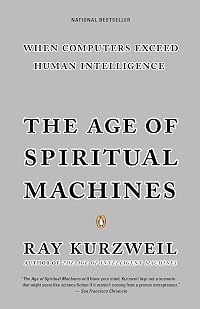
The Age of Spiritual Machines: When Computers Exceed Human Intelligence
by Ray Kurzweil
On This Page
Description
Ray Kurzweil is the inventor of the most innovative and compelling technology of our era, an international authority on artificial intelligence, and one of our greatest living visionaries. Now he offers a framework for envisioning the twenty-first century--an age in which the marriage of human sensitivity and artificial intelligence fundamentally alters and improves the way we live. Kurzweil's prophetic blueprint for the future takes us through the advances that inexorably result in show more computers exceeding the memory capacity and computational ability of the human brain by the year 2020 (with human-level capabilities not far behind); in relationships with automated personalities who will be our teachers, companions, and lovers; and in information fed straight into our brains along direct neural pathways. Optimistic and challenging, thought-provoking and engaging, The Age of Spiritual Machines is the ultimate guide on our road into the next century. show lessTags
Recommendations





Member Reviews
This one was a little flat for me, and not just because of the title. I can't fathom why he would equate "spiritual" and "intelligence" - of course, both are evolutionary products, but they are not synonymous in any way. Whenever humans build conscious machines, I really hope that those machines won't have the electronic equivalent of the human gene that makes them susceptible to superstition/belief. Still, the book was engaging enough until Kurzweil started talking about the "elegance of Buddhist notions of consciousness". After that, I just looked for the meat and not his forays into computer poetry.
I also was turned off by his dialogues at the end of each major section. I can only suppose he thought he was being cute or was trying to show more reach a different audience with that Socratic device, but it was just annoying to me. His predictions for 2009 were somewhat close, but are going to start failing big time come 2019 and beyond. His Law of Accelerating Returns might have some bearing on technological increases, but he's pipe-dreaming when it comes to socio-political matters.
And one last gripe...on quotes: When I see quotes in a book, I often like check on them to see if they are accurate, if there is anything interesting to go with the quote, or even if the quote is correctly attributed. Kurzweil peppers his books (all two of them I've read so far) with so many that pulling those threads would take too much time, and for the most part, they're fun. He blew it when he "quoted" Bill Gates...Gates never said "640,000 bytes of memory ought to be enough for anybody." Perhaps such a gaffe could be forgiven except that in one of his dialogues from the 2029 future prediction section, he said to his ... counterpoint? ... "at least there are fewer references to look up."
Should have looked up one more. show less
I also was turned off by his dialogues at the end of each major section. I can only suppose he thought he was being cute or was trying to show more reach a different audience with that Socratic device, but it was just annoying to me. His predictions for 2009 were somewhat close, but are going to start failing big time come 2019 and beyond. His Law of Accelerating Returns might have some bearing on technological increases, but he's pipe-dreaming when it comes to socio-political matters.
And one last gripe...on quotes: When I see quotes in a book, I often like check on them to see if they are accurate, if there is anything interesting to go with the quote, or even if the quote is correctly attributed. Kurzweil peppers his books (all two of them I've read so far) with so many that pulling those threads would take too much time, and for the most part, they're fun. He blew it when he "quoted" Bill Gates...Gates never said "640,000 bytes of memory ought to be enough for anybody." Perhaps such a gaffe could be forgiven except that in one of his dialogues from the 2029 future prediction section, he said to his ... counterpoint? ... "at least there are fewer references to look up."
Should have looked up one more. show less
In the first half of the book, Kurzweil constructs a sturdy foundation for the material and puts forth a number of ideas I can agree with (e.g., his defense of Eric Drexler's views on molecular technology). Ultimately, however, he fails to address (or even acknolwedge) any of the major attacks on strong AI (something he tries, and fails, to make up for at the end of The Singularity is Near) and his own scant discussion of consciousness and intentionality are laughable at best. The latter half of the book is a heavy dose of blind Extropian optimism, replete with free-market fantasies.
I gave this book 5 stars based on the beginning chapters, not the entire book. Towards the end, the book became repetitive and dragged on. It did not have to be so long.
The beginning, however, stimulates the mind to the point that you don't want to think about it. What makes us us? This philosophical question is not necessarily answered, but it puts a different spin on it. What is the line between human and machine, for both humans and machines? Really makes you think about what we are and what will come in the future.
The beginning, however, stimulates the mind to the point that you don't want to think about it. What makes us us? This philosophical question is not necessarily answered, but it puts a different spin on it. What is the line between human and machine, for both humans and machines? Really makes you think about what we are and what will come in the future.
This book is an enjoyable treatise on how the world might evolve over the next century as computing power increases at an accelerating rate. It is perhaps a more technical and constructed version of the writings of a Bill Joy or even the UnaBomber. Kurzweil lays out some theories or 'laws' as he calls them, which are based on historical data, and mixes that data with some relativity theory and Moore's laws of computing. They are graspable but not so solid that they have become widely believed. Extrapolating from the laws, the books lays out a plausible future where computers become much smarter than people; and people increasingly rely on computers for their brain power. There were some issues in the book. First, I really disliked show more Kurzweil deciding to write a lot of the book in a pseudo Socratic Method interview with himself. Very off-putting, and this leads to my lower rating. Second, the theories or laws are not explained that well. All that said, the fellow is on to something big, and it's so easy to be a visionary without putting specific predictions down, he has to be acknowledged for going out there and making specific predictions even 100 years out. If you now mix this older book with the newer writing of Aubrey de Grey on aging and the progression of biology/medicine, etc., you get quite a picture of life in 2030 or so. show less
The author Ray Kurzweil has a fairly interesting premise - what happens when machines are able to duplicate the complexities of the human brain? He spends a lot of time trying to convince his readers of that eventuality but it's also apparent that he has drunk his own kool-aid. And he spends hardly any time on the most interesting question of his book - what makes us human?
And since his book was written in 1999, already some of his predictions are off the mark.
I skimmed the last few chapters as interest waned.....
And since his book was written in 1999, already some of his predictions are off the mark.
I skimmed the last few chapters as interest waned.....
Some good material in this book, but eventually rather repetitive, and, in some later "dialogues," a tad silly. Interesting to be reading it in 2010 and seeing his 1999 predictions for 2009.
Ugh.
This book is like a techno-optimist's response to the Unabomber's manifesto. My problem is that the future espoused by Kurzweil is only slightly more appealing than the Unabomber's.
Specifically, I don't care for his timeline/predictions that humanity will be associating primarily with machines by 2019.
That seems like an inhuman future.
His idea of refinements and how much humanity will accept them also seems overly ambitious.
I would point to video games as an example of the refinements that a computer can "get closer to reality"... Every year, EA Sports's claim that "It's in the Game" gets a bit more appropriate.
But I think we're a long way away from people paying $35.00 to have tickets to see folks play a video game.
If that's a show more function of the time it takes humanity to accept computers or inherent limitations in computers, I'm not sure... Either way, his predictions seem off-base. show less
This book is like a techno-optimist's response to the Unabomber's manifesto. My problem is that the future espoused by Kurzweil is only slightly more appealing than the Unabomber's.
Specifically, I don't care for his timeline/predictions that humanity will be associating primarily with machines by 2019.
That seems like an inhuman future.
His idea of refinements and how much humanity will accept them also seems overly ambitious.
I would point to video games as an example of the refinements that a computer can "get closer to reality"... Every year, EA Sports's claim that "It's in the Game" gets a bit more appropriate.
But I think we're a long way away from people paying $35.00 to have tickets to see folks play a video game.
If that's a show more function of the time it takes humanity to accept computers or inherent limitations in computers, I'm not sure... Either way, his predictions seem off-base. show less
Members
- Recently Added By
Lists

Futurism Works
25 works; 6 members

Works referenced in The Turk by Tom Standage
37 works; 1 member
Author Information

18+ Works 7,013 Members
Ray Kurzweil was born on February 12, 1948. He was the principal developer of the first CCD flat-bed scanner, the first omni-font optical character recognition, the first print-to-speech reading machine for the blind, the first text-to-speech synthesizer, the first music synthesizer capable of recreating the grand piano and other orchestral show more instruments, and the first commercially marketed large-vocabulary speech recognition. He has received numerous awards including the MIT-Lemelson Prize and the National Medal of Technology. In 2002, he was inducted into the National Inventor's Hall of Fame. He has written several books including The Age of Spiritual Machines, The Age of Intelligent Machines, The Singularity Is Near, and How to Create a Mind: The Secret of Human Thought Revealed. (Bowker Author Biography) show less
Awards and Honors
Work Relationships
Common Knowledge
- Canonical title
- The Age of Spiritual Machines: When Computers Exceed Human Intelligence
- Original title
- The Age of Spiritual Machines: When Computers Exceed Human Intelligence
- Original publication date
- 1999
- Epigraph
- The universe is made of stories, not of atoms -Muriel Rukeyser
Is the universe a great mechanism, a great computation, a great symmetry, a great accident, or a great thought? -John D. Barrow
What if these theories are really true and we were magically shrunk and put into someone's brain while he was thinking. We would see all the pumps, pistons, gears and levers working away,and we would be able to describe their... (show all) workings completely, in mechanical terms,thereby describing the thought processes of the brain. But that description would nowhere contain any description of thought! It would contain nothing but descriptions of pumps, pistons, levers! -Gottfried Wilhelm Leibniz
Artificial Stupidity (AS) may be defined as the attempt by computer scientists to create computer programs capable of causing problems of a type normally associated with human thought. -Wallace Marshal
Artificial intelligence (AI) is the science of how to get machines to do the things they do in the movies. -Astro Trller
You can only make a certain amount with your hands, but with your mind, it's unlimited. -Kal Seinfeld's advice to his son, Jerry
The digitization of information in all its forms will probably be known as most fascinating development of the twentieth century. -An Wang
Economics, sociology, geopolitics, art, religion all provide powerful tools that have sufficed for centuries to explain the essential surfaces of life. To many observers there seems to be nothing truly new under the sun- no n... (show all)eed for a deep understanding of man's new tools- no requirement to descend into the microcosm of modern electronics in order to comprehend the world. The world is all too much with us. -George Gilder
Ever since I could remember, I'd wished that I'd be lucky enough to be alive at a great time-when something big was going on, like a crucifixion. And suddenly I realized I was. -Ben Shahn
As we say in the computer business, "shift happens." -Tim Romero
He who mounts a wild elephant goes where the wild elephant goes. -Randolph Bourne
It does not do you good to leave a dragon out of your calculations, if you live near him. -J.R.R. Tolkien
I'm as fond of my body as anyone else, but if I can be 200 with a body of silicon, I'll take it. -Danny Hills
When I look out my window what do you think I see?... so many different people to be. -Donovan
We know what we are, but we know not what we may become. -William Shakespeare - First words
- As we start at the beginning, we will notice an unusual attribute to the nature of time, one that is critical to our passage into the twenty-first century.
- Last words
- (Click to show. Warning: May contain spoilers.)Yes, that too.
- Blurbers
- Casti, John; Raymo, Chet; Minsky, Marvin; Gilder, George; Brown, Mike; Gates, Bill
Classifications
- Genres
- Technology, Nonfiction, General Nonfiction, Science & Nature
- DDC/MDS
- 006.3 — Computer science, information & general works Computer science, knowledge & systems Special computer methods (AI, barcoding, VR, web design, social media) Artificial Intelligence
- LCC
- Q335 .K88 — Science Science (General) Cybernetics
- BISAC
Statistics
- Members
- 1,949
- Popularity
- 10,890
- Reviews
- 21
- Rating
- (3.69)
- Languages
- 7 — Chinese, Danish, Dutch, English, German, Portuguese, Spanish
- Media
- Paper, Audiobook, Ebook
- ISBNs
- 24
- ASINs
- 10