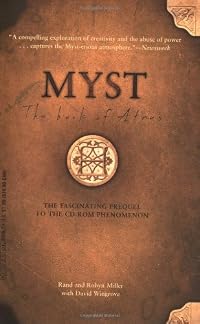
Myst: The Book of Atrus
by Rand Miller, Robyn Miller, David Wingrove
Myst: Publication Order (1), Myst (Band 1), Myst: Chronological Order (1)
On This Page
Description
Based on the best-selling CD-ROM game, a fantasy novel fills out the lives of the games characters, tracing the strange apprenticeship of Atrus to his father, Gehn, who wields the power to create worlds. Reprint.Tags
Recommendations






Member Reviews
During the Christmas of 1996, I sat down to my first Windows computer. I took it back to college with me that January, and I still remember sitting in my dorm room with the lights off, the speakers cranked up, clicking through the ages of Myst. Later on, I did the same with Riven, only pausing to trade out discs between CD-ROM drives.
Those feelings were evoked in bucketfuls when I read this book. The mystery and the enchantment were in full evidence, but along with it was a surprising depth, something that I don't expect from the usual video game tie-in book. In fact, it joins up seamlessly to both games, and makes me want to dig out those old discs and play through again. I will definitely be reading the next two volumes.
Those feelings were evoked in bucketfuls when I read this book. The mystery and the enchantment were in full evidence, but along with it was a surprising depth, something that I don't expect from the usual video game tie-in book. In fact, it joins up seamlessly to both games, and makes me want to dig out those old discs and play through again. I will definitely be reading the next two volumes.
I bought this book because I enjoyed the Myst computer game and thought it might be fun to read more about the world. Unfortunately, several years passed between playing the game and reading the book, so the connections are a bit fuzzy.
I enjoyed the book enough to want to play the game again, and to want to read the other books in the Myst series.
However, as a fantasy book on its own, there are too many unanswered questions and too many gaps in the story for it to really succeed.
I found Anna and Atrus to be interesting characters, although the reader gets to know Atrus more fully than Anna. Gehn is intriguing but, again, not fleshed out as completely as I would have liked. And Katran/Catherine is so mysterious... Like the story as a show more whole, the characters captured my interest but did not satisfy my curiosity (except Atrus). Too much missing information.
I love the concept of "writing" an Age (a world) into existence, and the authors do a credible job of describing both the intricacies and the pitfalls of the process.
This book is a quick read. I hope the other books in the series are better, but for now, I'd have to say that the Millers (Rand & Robyn) are better game developers than novelists. show less
I enjoyed the book enough to want to play the game again, and to want to read the other books in the Myst series.
However, as a fantasy book on its own, there are too many unanswered questions and too many gaps in the story for it to really succeed.
I found Anna and Atrus to be interesting characters, although the reader gets to know Atrus more fully than Anna. Gehn is intriguing but, again, not fleshed out as completely as I would have liked. And Katran/Catherine is so mysterious... Like the story as a show more whole, the characters captured my interest but did not satisfy my curiosity (except Atrus). Too much missing information.
I love the concept of "writing" an Age (a world) into existence, and the authors do a credible job of describing both the intricacies and the pitfalls of the process.
This book is a quick read. I hope the other books in the series are better, but for now, I'd have to say that the Millers (Rand & Robyn) are better game developers than novelists. show less
It really seems only fitting that a video game about books would have a series of books published in its name. For some reason when such books were first coming out I was sort of skeptical about their quality. I truly am glad I overcame this and decided to pick up the Myst books. I was an early enough adopter to be able to get all the hardcover texts and they are all beautifully designed. It's strange that a lot of books don't adopt this kind of method, because it really is eye catching and I'm glad the makers of Myst picked up on that. In terms of binding, it technically is rather cheaply done to support the mass market interest in this series. Rather than have a truly older styled binding, they have the typical style with embossed show more paper wrapped over the hard cover. The paper is of excellent quality and is embossed in sections, which adds a tinge of making it feel artificially handmade. I've had mine for many years now and there is barely any wear on it. However, when one inspects the design you can tell it is merely paper glued over the normal hardcover pressing and it is merely there for aesthetic appeal. The books in the game have a very old styled feel, which they should since they're all handmade books, but the makers wanted to keep that atmosphere alive with printing these books. Despite my inspection of the edition, I must say it was a great marketing idea and wish more publishers would do this rather than just adopt the typical dust jacket. That being said, the current editions more readily available to readers are the regular paperback and now the collected edition which was recently printed.
I wasn't sure what to really expect from this book when I first got it. I had beaten the game "Myst" and the game was pretty well written. However, the game had a lot of unknown elements in its story, and I'm sad to report that "The Book of Atrus" doesn't fill in all the gaps. It certainly fills in quite a bit, but not everything. This book acts as both a prequel to "Myst" and a bridge to "Riven". It's an interesting story in that regard because it tells about Atrus' childhood and goes into why the age of Riven is in dire need of our help!
At the end of Myst we find Atrus sitting at a desk in a deep cavern in place known as D'ni. We are transported there with him once we escape the island of Myst, but we are never told why he is there; just that he needs to make a decision concerning his sons. This is all well and good, but there are so many holes and questions, thus the novelization seeks to explain them. At one time Atrus lived with his grandmother, Ana, in a desert region. "The Book of Atrus" goes into detail about his life and learning there. It's almost an ideal childhood until one day his father, Gehn, returns and seeks to take him back to D'ni. See they are from a race of people who lived underground until they were all of a sudden destroyed. Ana, Gehn, and Atrus are the only decedents we are made aware of from this great society. So when Gehn was old enough he returned to the world of D'ni in search of its secrets, to see if he could find it and possibly rebuild it. Needless to say he sort of succeeded.
Gehn understands how to write in the books and knows the secret D'ni language to make different ages to create portal links between his world and others. However, he does not wield this power intelligently, but he doesn't want the knowledge to die with him, so he seeks out his son. He teaches Atrus everything, but Atrus has a keener mind for creating ages. Most of Gehn's worlds are unstable and if a world has inhabitants Gehn insists on be treated as a God. Needless to say Atrus' kindly nature has the better of him and he seeks to change this.
In this we get to see the bridge to Riven's story line. Riven had been an age linked to by Gehn, but the world was vastly unstable. So he and Atrus sought to fix it if they could. Gehn, being the overbearing man that he is, did not think most of Atrus' ideas were good ones. However, one thing would change Atrus' life forever when he got to Riven, he met Catherine there. Yes, the girl he references frequently in the first "Myst" game. Eventually she would bear his two sons Sirrus and Akenar, so as you can tell, I knew Atrus would succeed even during reading this, so I don't feel I am giving anything away. The book doesn't go into detail about the two sons growing up, so you never really know how everything started with them. Anyway, there is a solution to Atrus' problem, but I'll let the readers find that out for themselves. When we get to "Riven", the video game, there are further complications based around this story... I'll leave these mysteries to be discovered for yourself.
I don't feel I am spoiling very much of the book because it is riveting in itself. Most people who read this will undoubtedly have played the video games and already know the stories' outcomes before reading this. As any Myst player knows the interesting factor is in the details, I have left every part of these out. The book is a fascinating page turner and I really couldn't put it down at all. This book leaves a lot more mystery to the reader in the end and left us looking forward to the follow up text, "The Book of Ti'ana." I especially recommend this to any Myst fan who wants to delve deeper into the story line and world of Myst. I don't think many people would pick up Myst if they didn't already enjoy reading books to find out what new worlds they would be brought to. In that spirit these books are clearly written! show less
I wasn't sure what to really expect from this book when I first got it. I had beaten the game "Myst" and the game was pretty well written. However, the game had a lot of unknown elements in its story, and I'm sad to report that "The Book of Atrus" doesn't fill in all the gaps. It certainly fills in quite a bit, but not everything. This book acts as both a prequel to "Myst" and a bridge to "Riven". It's an interesting story in that regard because it tells about Atrus' childhood and goes into why the age of Riven is in dire need of our help!
At the end of Myst we find Atrus sitting at a desk in a deep cavern in place known as D'ni. We are transported there with him once we escape the island of Myst, but we are never told why he is there; just that he needs to make a decision concerning his sons. This is all well and good, but there are so many holes and questions, thus the novelization seeks to explain them. At one time Atrus lived with his grandmother, Ana, in a desert region. "The Book of Atrus" goes into detail about his life and learning there. It's almost an ideal childhood until one day his father, Gehn, returns and seeks to take him back to D'ni. See they are from a race of people who lived underground until they were all of a sudden destroyed. Ana, Gehn, and Atrus are the only decedents we are made aware of from this great society. So when Gehn was old enough he returned to the world of D'ni in search of its secrets, to see if he could find it and possibly rebuild it. Needless to say he sort of succeeded.
Gehn understands how to write in the books and knows the secret D'ni language to make different ages to create portal links between his world and others. However, he does not wield this power intelligently, but he doesn't want the knowledge to die with him, so he seeks out his son. He teaches Atrus everything, but Atrus has a keener mind for creating ages. Most of Gehn's worlds are unstable and if a world has inhabitants Gehn insists on be treated as a God. Needless to say Atrus' kindly nature has the better of him and he seeks to change this.
In this we get to see the bridge to Riven's story line. Riven had been an age linked to by Gehn, but the world was vastly unstable. So he and Atrus sought to fix it if they could. Gehn, being the overbearing man that he is, did not think most of Atrus' ideas were good ones. However, one thing would change Atrus' life forever when he got to Riven, he met Catherine there. Yes, the girl he references frequently in the first "Myst" game. Eventually she would bear his two sons Sirrus and Akenar, so as you can tell, I knew Atrus would succeed even during reading this, so I don't feel I am giving anything away. The book doesn't go into detail about the two sons growing up, so you never really know how everything started with them. Anyway, there is a solution to Atrus' problem, but I'll let the readers find that out for themselves. When we get to "Riven", the video game, there are further complications based around this story... I'll leave these mysteries to be discovered for yourself.
I don't feel I am spoiling very much of the book because it is riveting in itself. Most people who read this will undoubtedly have played the video games and already know the stories' outcomes before reading this. As any Myst player knows the interesting factor is in the details, I have left every part of these out. The book is a fascinating page turner and I really couldn't put it down at all. This book leaves a lot more mystery to the reader in the end and left us looking forward to the follow up text, "The Book of Ti'ana." I especially recommend this to any Myst fan who wants to delve deeper into the story line and world of Myst. I don't think many people would pick up Myst if they didn't already enjoy reading books to find out what new worlds they would be brought to. In that spirit these books are clearly written! show less
The first in a trilogy of books that fill in the lore of the Myst universe, The Book of Atrus is the story of Atrus and his tutelage in the D'ni art of world writing under his domineering father, Gehn. At it's core, it's a story of a father-son relationship that goes sour, and of the corrupting ideas of god-like power. I won't spoil it, but the story ends where the game Myst begins.
I read this book back when the Myst series of PC games were popular in the 1990s. I enjoyed it at the time, but rereading it after all these years, my opinion has naturally changed somewhat. Given that the games are so heavily based on the pre-rendered visuals and puzzle elements, the series is probably best suited to the realm of gaming. In the case of show more these books, there are a few illustrations scattered throughout, but most of the narrative relies on descriptions. Another change in my opinion has to do with age. That is to say, this book is more or less written as a young adult piece of fiction. Upon recently finishing the book, I didn't find the characters terribly penetrating or the personal conflicts very unique, but I've read many books over the years. For a story aimed at teens, I'd say it's decent, but as an adult, I don't find this to be a classic piece of literature.
Overall, I would say that the book serves as a good prequel to the first Myst game. show less
I read this book back when the Myst series of PC games were popular in the 1990s. I enjoyed it at the time, but rereading it after all these years, my opinion has naturally changed somewhat. Given that the games are so heavily based on the pre-rendered visuals and puzzle elements, the series is probably best suited to the realm of gaming. In the case of show more these books, there are a few illustrations scattered throughout, but most of the narrative relies on descriptions. Another change in my opinion has to do with age. That is to say, this book is more or less written as a young adult piece of fiction. Upon recently finishing the book, I didn't find the characters terribly penetrating or the personal conflicts very unique, but I've read many books over the years. For a story aimed at teens, I'd say it's decent, but as an adult, I don't find this to be a classic piece of literature.
Overall, I would say that the book serves as a good prequel to the first Myst game. show less
This is the book that really got me interested in Fantasy literature for the first time. It is the first time I had really seen depth in a Fantasy work, and The Book of Atrus has it to spare. The Millers have created a fully functional world here, which is really the whole appeal to the Myst games. But here we get more background as to how these linking books work and what really happened to the D'Ni world. It fills in the gaps left by the game, but it stands alone as a complete and endearing novel.
A very enjoyable story about the youth of Atrus, the main character from the MYST series of computer games. He's the kind of man than most men aspire to be: honest, courageous and adventurous, intelligent and inquisitive.
The greatest charms of the book lie in Atrus's approach to the problems he faces; his interactions with those around him; and the descriptions of the D'ni environment and culture.
The writing is a credit to David Wingrove, Mr. Miller's experienced co-author. The narrative is vivid, describing in detail the lighting, the textures of the stone and other materials, the lurching feel of being pulled through the books' pages into new worlds. You can practically feel the desert's hot dry air blistering your face, the coolness show more of the cave and the freshness of being outside when travelling to other worlds. Plus, the dialog DOESN'T leave you thinking, "people just don't talk like that," which is always a bonus.
Sprinkled throughout the book are also penciled illustrations of various items and landscapes, such as Atrus (an engineer and scientist) would have created in a journal. It enhances the feel of the narrative, and the authors in no way use it as a crutch to get out of describing things.
If you get the original hardback edition, the physical look and feel of the book is also well-crafted. The binding is excellent, the cover has an embossed logo, the pages have a comfortable texture and the page edges are non-uniformly jagged. show less
The greatest charms of the book lie in Atrus's approach to the problems he faces; his interactions with those around him; and the descriptions of the D'ni environment and culture.
The writing is a credit to David Wingrove, Mr. Miller's experienced co-author. The narrative is vivid, describing in detail the lighting, the textures of the stone and other materials, the lurching feel of being pulled through the books' pages into new worlds. You can practically feel the desert's hot dry air blistering your face, the coolness show more of the cave and the freshness of being outside when travelling to other worlds. Plus, the dialog DOESN'T leave you thinking, "people just don't talk like that," which is always a bonus.
Sprinkled throughout the book are also penciled illustrations of various items and landscapes, such as Atrus (an engineer and scientist) would have created in a journal. It enhances the feel of the narrative, and the authors in no way use it as a crutch to get out of describing things.
If you get the original hardback edition, the physical look and feel of the book is also well-crafted. The binding is excellent, the cover has an embossed logo, the pages have a comfortable texture and the page edges are non-uniformly jagged. show less
Very well written. The quality of the story explains why the games were such a success. Like Tolkien, every single background detail has been pre-figured. Loved all three.
Members
- Recently Added By
Lists

LIBROS DE CIENCIA FICCIÓN Y FANTASIA
60 works; 1 member

Frequently sought stories - Name that Book group
149 works; 11 members
Author Information

6+ Works 4,716 Members

4 Works 2,401 Members

56+ Works 7,953 Members
David Wingrove is the Hugo Award-winning co-author (with Brian Aldiss) of The Trillion Year Spree: The History of Science Fiction. He is also the co-author of the first three MYST books - novelisations of one of the world's bestselling computer games. He lives in north London with his wife and four daughters.
All Editions
Some Editions
Awards and Honors
Awards
Series


Work Relationships
Is contained in
Common Knowledge
- Canonical title
- Myst: The Book of Atrus
- Original publication date
- 1995
- People/Characters
- Atrus; Gehn; Ti'ana; Katran
- Important places
- D'ni; The Cleft; Riven; Myst
- Dedication
- To Mom and Dad
- First words
- Gehn's bootprints lay heavy around the tiny pool, the lush, well-tended green churned to mud.
- Last words
- (Click to show. Warning: May contain spoilers.)I know my apprehensions might never be allayed, and so I close, realizing that perhaps the ending has not yet been written.
Classifications
Statistics
- Members
- 2,024
- Popularity
- 10,273
- Reviews
- 26
- Rating
- (3.79)
- Languages
- 6 — Dutch, English, French, German, Polish, Spanish
- Media
- Paper, Audiobook
- ISBNs
- 21
- ASINs
- 6