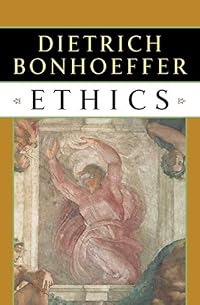
Ethics
by Dietrich Bonhoeffer
On This Page
Description
The crown jewel of Bonhoeffer's body of work, Ethicsis the culmination of his theological and personal odyssey. Based on careful reconstruction of the manuscripts, freshly and expertly translated and annotated, this new critical edition features an insightful Introduction by Clifford Green and an Afterword from the German edition's editors. Though caught up in the vortex of momentous forces in the Nazi period, Bonhoeffer systematically envisioned a radically Christocentric, incarnational show more ethic for a post-war world, purposefully recasting Christians' relation to history, politics, and public. show lessTags
Recommendations





















Member Reviews
"Sometimes I think I really have my life more or less behind me now and that all that would remain for me to do would be to finish my Ethics . . ." (14).
Unfortunately, he was unable to finish. Dietrich Bonhoeffer was hanged by the Nazi regime on April 9, 1945, a mere two weeks before the allies liberated the Flossenbürg concentration camp which held him. The essays and notes which comprise Ethics were gathered and published posthumously.
Despite the lack of unified structure or flow to the book, the work is rich. Bonhoeffer's penetrating mind reached deeply into a variety of ethical topics. Consider, for example, this meditation on obedience and freedom:
"Obedience restrains freedom; and freedom ennobles obedience. Obedience binds the show more creature to the Creator and freedom enables the creature to stand before the Creator as one who is made in His image" (248).
Bonhoeffer's Lutheran background is evident throughout this work. His discussion of the church and the world, the three uses of the law, and the role of the conscience in the life of a believer all reveal a Lutheran mind at work.
Ethics is a slow read. It's a book that forces you to slow down and consider the details of what it means to be an ethical Christian. show less
Unfortunately, he was unable to finish. Dietrich Bonhoeffer was hanged by the Nazi regime on April 9, 1945, a mere two weeks before the allies liberated the Flossenbürg concentration camp which held him. The essays and notes which comprise Ethics were gathered and published posthumously.
Despite the lack of unified structure or flow to the book, the work is rich. Bonhoeffer's penetrating mind reached deeply into a variety of ethical topics. Consider, for example, this meditation on obedience and freedom:
"Obedience restrains freedom; and freedom ennobles obedience. Obedience binds the show more creature to the Creator and freedom enables the creature to stand before the Creator as one who is made in His image" (248).
Bonhoeffer's Lutheran background is evident throughout this work. His discussion of the church and the world, the three uses of the law, and the role of the conscience in the life of a believer all reveal a Lutheran mind at work.
Ethics is a slow read. It's a book that forces you to slow down and consider the details of what it means to be an ethical Christian. show less
It is hard to review Bonhoeffer's Ethics since it is not completed. Many of its portions seem a bit disjointed, especially the somewhat arcane discussion of Lutheran primus usis legis and the like.
Nevertheless, the general theory of the book has merit-- the world is not dualist, but singular, under the authority of Jesus Christ who reconciled the world to God through His blood. Nothing can be properly understood as apart from Christ, since Christ is the source of creation and all things exist because of Him. On account of these things, and in an attempt to make sense of reality, Bonhoeffer identifies four mandates that God imposes upon the world-- labor, marriage (he adds family to this on occasion), government, and the church. show more Bonhoeffer sees each of these functioning in complementary ways and operating under their distinct mandates.
It would have been great to see how all the different pieces could contribute to this whole, but alas, such will not be the case. show less
Nevertheless, the general theory of the book has merit-- the world is not dualist, but singular, under the authority of Jesus Christ who reconciled the world to God through His blood. Nothing can be properly understood as apart from Christ, since Christ is the source of creation and all things exist because of Him. On account of these things, and in an attempt to make sense of reality, Bonhoeffer identifies four mandates that God imposes upon the world-- labor, marriage (he adds family to this on occasion), government, and the church. show more Bonhoeffer sees each of these functioning in complementary ways and operating under their distinct mandates.
It would have been great to see how all the different pieces could contribute to this whole, but alas, such will not be the case. show less
This is his last writing, and it is unfinished because he was executed in prison for living the ethics he preached. In this book, Bonhoeffer states, "Ethics as formation, then, means the bold endeavor to speak about the way in which the form of Jesus Christ takes form in our world, in a manner which is neither abstract nor casuistic, neither programmatic nor purely speculative."
This work is unfinished due to the death of Bonhoeffer by Nazi Germany. Bonhoeffer argues that the church should challenge the government to rule justly. In this way, he moves away from his more passive (less politically radical) message in his Cost of Discipleship.
Major work by famous German Lutheran theologian; covers both conceptual, theological issues and discussion of specific issues. Best to read in this version from the complete works as earlier versions are incomplete and in different order. Includes important discussion of conscience (276-83, 307-9).
A real martyr for Christianity
One of the best and most beautiful books I have ever read. I have saved a few books for myself to read at a later date. What an awesome gift this is to me!
Members
- Recently Added By
Lists

Christianity Books You've Read
179 works; 18 members

In Our Time books
4,934 works; 2 members
Author Information

283+ Works 33,545 Members
Born in 1906 in Breslau, Germany, now part of Poland, Dietrich Bonhoeffer became a radical theologian. He was raised in a home where the intellect was honored. His father was a physician and professor of psychiatry at the University of Berlin. Such scholars as the church historian Adolph von Harnack, the theologian and sociohistorian Ernst show more Troeltsch, and Max Weber, a founder of modern sociology, were frequent guests of the Bonhoeffers. A precocious student who evidenced a degree of independence of thought that was at odds with the reverence in which his fellow students held their professors, Bonhoeffer decided early on the church and theology as his life's work. He was a product of liberal studies that were greatly influenced by Karl Barth. Bonhoeffer's doctoral dissertation, Sanctorum Communio: A Dogmatic Investigation of the Sociology of the Church, was published in 1930, at the time he was teaching theology at the University of Berlin. A year's study in the United States followed and leadership of the World Alliance of Churches, where his flair for languages and his genial disposition won him many friends. His American and British friends tried unsuccessfully to dissuade him from returning to Germany after the rise of Hitler in 1932. But Bonhoeffer returned, and joining the so-called Confessing Church of those who resisted Germanizing the church, he conducted an illegal seminary in Finkenwalde. Out of this experience came his Life Together; out of his struggles to encourage Christians to resist the Nazis came The Cost of Discipleship, his study of the Sermon on the Mount. Although Bonhoeffer escaped military duty by joining the intelligence service, he was eventually arrested and imprisoned by the Gestapo and was linked to the attempt on Hitler's life. His Letters and Papers from Prison (translated in 1953), was his testimony of faith; the writing gave the American death of God movement the term religionless Christianity. Bonhoeffer was killed in 1945 while he was in prison in Flossenburg. (Bowker Author Biography) show less
Some Editions
Series
Belongs to Publisher Series
Common Knowledge
- Canonical title
- Ethics
- Original title
- Ethik
- Original publication date
- 1949
Classifications
Statistics
- Members
- 2,616
- Popularity
- 7,142
- Reviews
- 10
- Rating
- (3.92)
- Languages
- 8 — Chinese, Czech, English, French, German, Italian, Portuguese, Spanish
- Media
- Paper, Ebook
- ISBNs
- 32
- ASINs
- 34