On This Page
Description
When Lew Archer is hired to get the goods on the suspiciously suave Frenchman who's run off with his client's girlfriend, it looks like a simple case of alienated affections. Things look different when the mysterious foreigner turns out to be connected to a seven-year-old suicide and a mountain of gambling debts. Black Money is Ross Macdonald at his finest, baring the skull beneath the suntanned skin of Southern California's high society.Tags
Recommendations
















Member Reviews
Lew Archer’s latest case seems to be fairly straightforward. His client, Peter Jamieson, was engaged to Virginia Fablon until she ended the relationship and left him for a French political refugee, Francis Martel. Jamieson isn’t convinced that Martel is who he says he is; Archer’s job is to look into Martel’s background and perhaps prevent Virginia from having her heart broken. But as Archer investigates the case, many hearts are about to be broken — and lives ended.
It’s always a treat to come back to a Lew Archer novel. Macdonald’s writing is elegant and understated, and Archer as a character is a relatively moderate example of a private investigator. It may help that he’s 50 years old, not about to run around on an show more impulse. He takes his time and weighs his options before taking action.
This story kept me guessing, even as I thought I’d called parts of it. It’s also a story that I’m not sure would be as successful if the characters lived in the present day—they’d have additional challenges posed by 21st-century technology and the internet. But as an example of 1960s noir, it’s a very good one. show less
It’s always a treat to come back to a Lew Archer novel. Macdonald’s writing is elegant and understated, and Archer as a character is a relatively moderate example of a private investigator. It may help that he’s 50 years old, not about to run around on an show more impulse. He takes his time and weighs his options before taking action.
This story kept me guessing, even as I thought I’d called parts of it. It’s also a story that I’m not sure would be as successful if the characters lived in the present day—they’d have additional challenges posed by 21st-century technology and the internet. But as an example of 1960s noir, it’s a very good one. show less
Many critics consider this to be Ross Macdonald's finest book, and Macdonald himself professed to agree...perhaps because of the general consensus among critics. I love his work, and this is a good book, but it's not in my top three (The Wycherly Woman, The Chill and The Underground Man, in that order). The fact is that critics are partial to Black Money because it nods self-consciously to Fitzgerald's The Great Gatsby, and such allusions are considered the height of sophistication in the literary world. In a very real sense, Macdonald wrote this novel for the critics after a couple of them had disparaged certain elements of The Chill. Artists are sensitive, and I guess it's not surprising that Macdonald responded to criticism by trying show more to prove that he could produce a "serious" book, but he needn't have bothered. He was already a first-class writer, and didn't have to demonstrate that to a bunch of stuffy literary people whose readership was a tiny fraction of his own. Like I said, Black Money is good, but I think Macdonald may have overvalued it a little falsely. (Even as he proclaimed this his best novel, however, he had to concede that The Chill contained his finest plotting.) Also, there are a few instances of editorial sloppiness--a rare phenomenon in Macdonald's oeuvre--which deny this book a place among the top tier of his work, in my opinion.
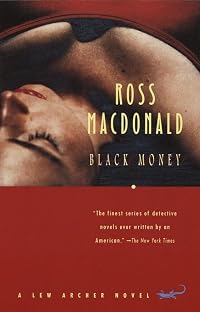
The back cover synopsis for Bantam's 1973 paperback edition tries hard to convey the impression that Macdonald had suddenly turned into Mickey Spillane, and it's downright hilarious: "Lew Archer made a deal with fat little Rich Boy at the posh Montevista Tennis Club. Seems Rich Boy had lost his beautiful fiancée to a stranger with a suspiciously phony French accent. So Rich Boy hired Archer to retrieve the runaway fiancée. Sounded like a fast, clean bundle for old, broke Archer..." You have to wonder who wrote that. (It certainly wasn't Macdonald.) Maybe the publisher was apprehensive about the book's literary pretensions and felt the need to compensate with an overtly hard-boiled teaser?
Black Money is a standard Archer novel in nearly every measurable sense. (And it happens to contain one of Macdonald's most painfully beautiful sentences: "His expression turned faraway, further and further away, as if his mind was climbing back over the curve of time to the source of his life.") The casual reader probably won't even notice the allusions to Gatsby, and those who have enjoyed Macdonald's other books will like this one, too. But it's emphatically not the best thing he ever wrote. show less
The back cover synopsis for Bantam's 1973 paperback edition tries hard to convey the impression that Macdonald had suddenly turned into Mickey Spillane, and it's downright hilarious: "Lew Archer made a deal with fat little Rich Boy at the posh Montevista Tennis Club. Seems Rich Boy had lost his beautiful fiancée to a stranger with a suspiciously phony French accent. So Rich Boy hired Archer to retrieve the runaway fiancée. Sounded like a fast, clean bundle for old, broke Archer..." You have to wonder who wrote that. (It certainly wasn't Macdonald.) Maybe the publisher was apprehensive about the book's literary pretensions and felt the need to compensate with an overtly hard-boiled teaser?
Black Money is a standard Archer novel in nearly every measurable sense. (And it happens to contain one of Macdonald's most painfully beautiful sentences: "His expression turned faraway, further and further away, as if his mind was climbing back over the curve of time to the source of his life.") The casual reader probably won't even notice the allusions to Gatsby, and those who have enjoyed Macdonald's other books will like this one, too. But it's emphatically not the best thing he ever wrote. show less
Like others, I assume, I picked this one up because I saw that the Coen's were writing a screenplay of it, and maybe direct it. If so, it's kind of an odd one for them, in that there's not a lot of action necessarily, and the story is somewhat convoluted (maybe not the right word), and as is often the case with Macdonald, reaches into the past quite a bit.
Fat rich college kid Peter hires Archer to prevent the girl he's in love with from marrying someone he doesn't trust, and who he thinks will not be good for her. This leads Archer into quite a tangled web, eventually involving the supposed suicide of the girl's father, seven years in the past, and the mysterious background of the man she wants to marry. Things play out much differently show more than you suppose they will as you follow it, as is Macdonald's way. He's really very good at portraying his characters, and though Archer seems like he would be cynical, he professes at one point in this book to "love people." But this is a hard crew to love, though Archer is attracted to one of the most broken characters in the novel, and also to one who is doing a good job of making her way in the world. A pretty engrossing novel, and I am looking forward to seeing what the Coens will do with it.
It's to Macdonald's credit that when he's describing his characters and Archer's attitude towards them, he doesn't get cynical. He portrays them the way they are, and though some are pretty despicable, Archer and Macdonald understand their motives and portray them well. show less
Fat rich college kid Peter hires Archer to prevent the girl he's in love with from marrying someone he doesn't trust, and who he thinks will not be good for her. This leads Archer into quite a tangled web, eventually involving the supposed suicide of the girl's father, seven years in the past, and the mysterious background of the man she wants to marry. Things play out much differently show more than you suppose they will as you follow it, as is Macdonald's way. He's really very good at portraying his characters, and though Archer seems like he would be cynical, he professes at one point in this book to "love people." But this is a hard crew to love, though Archer is attracted to one of the most broken characters in the novel, and also to one who is doing a good job of making her way in the world. A pretty engrossing novel, and I am looking forward to seeing what the Coens will do with it.
It's to Macdonald's credit that when he's describing his characters and Archer's attitude towards them, he doesn't get cynical. He portrays them the way they are, and though some are pretty despicable, Archer and Macdonald understand their motives and portray them well. show less
Great style, and read immediately after a dreadful fantasy novel. The comparison made MacDonald's prose register like cold mountain water a mouthful of dust.
But, but, the ending falls apart in an implausible way. So much so that it breaks the noir tone, becomes weird, unrealistic, theatrical. We were all doing fine until we left the post-stroke gambler and went back to the improbable professor.
But, but, the ending falls apart in an implausible way. So much so that it breaks the noir tone, becomes weird, unrealistic, theatrical. We were all doing fine until we left the post-stroke gambler and went back to the improbable professor.
The only bad thing about reading another Ross Macdonald, Lew Archer, novel is knowing that there is a finite number of them and now one less is left. He's not perfect but he is about as good as it gets.
Black Money is Macdonald at his best.
I notice one thing: Macdonald usually, but not always, begins and ends chapters with a unique description of the setting or a person. Sometimes they work, sometimes they don't.
While he knowingly is writing hard boiled fiction, Macdonald is sentimental enough that he includes observations about life that sometimes work, sometimes don't work. Most of the time, I wish he had left them out as they were already obvious from character action.
Still, just wonderful stuff.
Black Money is Macdonald at his best.
I notice one thing: Macdonald usually, but not always, begins and ends chapters with a unique description of the setting or a person. Sometimes they work, sometimes they don't.
While he knowingly is writing hard boiled fiction, Macdonald is sentimental enough that he includes observations about life that sometimes work, sometimes don't work. Most of the time, I wish he had left them out as they were already obvious from character action.
Still, just wonderful stuff.
“It’s dangerous to get what you want, you know. It sets you up for tragedy.”
Something I know all too well…
Who is Francis Martel? Archer is on the case to find out who, and what, he really is! It's a little slower than other Archer books that I have read, and maybe a bit less exciting. But, Macdonald is a wonderful writer, and I've listed a few quotes from this book that really appealed to me!
“: a dangerous sexual liaison, hypocrisy, guilt and imprisonment, the human soul trapped in a gland.”
"You married the wrong man at the wrong time for the wrong reasons, I told her silently.”
“There was something a little female about his movements, and more than a little ominous, as if his huge belly was pregnant with death.”
Something I know all too well…
Who is Francis Martel? Archer is on the case to find out who, and what, he really is! It's a little slower than other Archer books that I have read, and maybe a bit less exciting. But, Macdonald is a wonderful writer, and I've listed a few quotes from this book that really appealed to me!
“: a dangerous sexual liaison, hypocrisy, guilt and imprisonment, the human soul trapped in a gland.”
"You married the wrong man at the wrong time for the wrong reasons, I told her silently.”
“There was something a little female about his movements, and more than a little ominous, as if his huge belly was pregnant with death.”
I have no other works by this author nor have read any before, so it was a welcome new start for me. He was married (apparently) to Margaret Millar, who I have read and can recommend, but did not know that when I picked up this book, but was influenced by reason this edition was published as part of the Crime masterworks series, which I cannot resist in a second hand shop.
Set in the 1950s- 60s west coast USA, Lew Archer (the protagonist in some 13 books in the series) is a private detective, who is efficient, does not habitually carry a gun nor throw a punch, and who wants to help people. I don't say this as suggesting that these are meant to his defining features, in the way that Sherlock Holmes wears a dear stalker or that DCI Banks show more likes a scotch at the end of the day to unwind or that John Rebus likes a drink most times of the day, but rather to suggest that Archer is not your typical rough and ready PI. But he is efficient, thorough and worldly.
The read is very much a noir read and a very good one at that, save that the last 30 pages (of 300) fell away badly and (to my mind) left a very weak resolution of the many loose ends. I don't think the denouement was properly the subject of sufficient, valid clues. Sure it was open, logically, to have reached that conclusion, but not in a fair way.
But until then, it was a great read, which justifies its 4 star rating. I hope that this is a once off flaw, in which case I look forward to reading more of Macdonald/Archer. If it is emblematic of them however, it will suggest that Macdonald is the noir equivalent of Phillip Glass, a composer who I very much like, but who at least during part of his career, had no idea as to how to bring a piece to an end, other than to apply a guillotine and bring it to an absolute abrupt end.
As to the plot? PI Archer is engaged by mid 20s 2nd/3rd generation rich Peter to investigate blow in Francis Martel, supposedly rich and French and a political refugee on the run from the then French Government, who sweeps Peter's fiancee (actual or soon to be?) Virginia (Ginny) off her feet, and whom Peter wants to get back. Set in a small, coastal town which has not only an exclusive Tennis Club and lots of money, along with an underbelly (literally) across the rail tracks, but also (it is not giving anything away that is not on the back cover of the Crime Masterclass edition I was reading) there is gambling and gambling debts and ambition financially and socially aplenty.
Worth a read if mid 20th century US west coast noir is your thing, but I keen to know if Macdonald can go one better.
Big Ship
9 April 2022 show less
Set in the 1950s- 60s west coast USA, Lew Archer (the protagonist in some 13 books in the series) is a private detective, who is efficient, does not habitually carry a gun nor throw a punch, and who wants to help people. I don't say this as suggesting that these are meant to his defining features, in the way that Sherlock Holmes wears a dear stalker or that DCI Banks show more likes a scotch at the end of the day to unwind or that John Rebus likes a drink most times of the day, but rather to suggest that Archer is not your typical rough and ready PI. But he is efficient, thorough and worldly.
The read is very much a noir read and a very good one at that, save that the last 30 pages (of 300) fell away badly and (to my mind) left a very weak resolution of the many loose ends. I don't think the denouement was properly the subject of sufficient, valid clues. Sure it was open, logically, to have reached that conclusion, but not in a fair way.
But until then, it was a great read, which justifies its 4 star rating. I hope that this is a once off flaw, in which case I look forward to reading more of Macdonald/Archer. If it is emblematic of them however, it will suggest that Macdonald is the noir equivalent of Phillip Glass, a composer who I very much like, but who at least during part of his career, had no idea as to how to bring a piece to an end, other than to apply a guillotine and bring it to an absolute abrupt end.
As to the plot? PI Archer is engaged by mid 20s 2nd/3rd generation rich Peter to investigate blow in Francis Martel, supposedly rich and French and a political refugee on the run from the then French Government, who sweeps Peter's fiancee (actual or soon to be?) Virginia (Ginny) off her feet, and whom Peter wants to get back. Set in a small, coastal town which has not only an exclusive Tennis Club and lots of money, along with an underbelly (literally) across the rail tracks, but also (it is not giving anything away that is not on the back cover of the Crime Masterclass edition I was reading) there is gambling and gambling debts and ambition financially and socially aplenty.
Worth a read if mid 20th century US west coast noir is your thing, but I keen to know if Macdonald can go one better.
Big Ship
9 April 2022 show less
Members
- Recently Added By
Lists

Best Noir Fiction
160 works; 14 members

Anthony Boucher's Best Crime Fiction of the Year
115 works; 5 members

#MysteryBingo2022Silver(Revised)
36 works; 1 member
#MysteryBingo2022Silver(Original)
36 works; 1 member
#JustTheFacts2022Silver
48 works; 1 member

D.G. Meyers's List of Minor Classic Fiction of the 1960s
4 works; 1 member

A Rainbow of Books: Colors in the Title
570 works; 24 members

Books Read in 2021
5,361 works; 114 members

Lo mejor leído en 2025 - Leídos por primera vez: Magistrales (R. D.)
28 works; 1 member
Author Information

103+ Works 14,274 Members
Awards and Honors
Awards
Distinctions
Notable Lists
Series

Belongs to Publisher Series
Work Relationships
Is contained in
Common Knowledge
- Canonical title
- Black Money
- Original title
- Black Money
- Original publication date
- 1966
- People/Characters
- Lew Archer; Peter Jamieson; Virginia "Ginny" Fablon; Roy Fablon; Mariette Fablon; Francis Martel (show all 10); George Sylvester; Audrey Sylvester; Professor Tappinger; Bess Tappinger
- Important places
- Los Angeles, California, USA; Montevista, California, USA
- Dedication
- To Robert Easton
- First words
- I'd been hearing about the Tennis Club for years, but I'd never been inside it.
- Quotations
- You can question anything human.
- Last words
- (Click to show. Warning: May contain spoilers.)Then she got up and washed her face and composed herself.
- Blurbers
- Kellerman, Jonathan; Parker, Robert B.; Welty, Eudora; Boucher, Anthony; Berger, Thomas
- Original language*
- Inglés
*Some information comes from Common Knowledge in other languages. Click "Edit" for more information.
Classifications
Statistics
- Members
- 644
- Popularity
- 45,058
- Reviews
- 18
- Rating
- (3.95)
- Languages
- 11 — Czech, Danish, English, Finnish, French, German, Italian, Norwegian (Bokmål), Norwegian, Portuguese, Spanish
- Media
- Paper, Audiobook, Ebook
- ISBNs
- 49
- ASINs
- 24