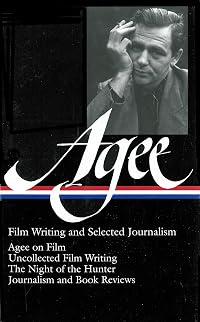
Film Writing and Selected Journalism
by James Agee
227 Members (4.57)
On This Page
Description
"This Library of America volume supplements the classic pieces from Agee on Film with previously uncollected writings on Ingrid Bergman, the Marx Brothers, Alfred Hitchcock's Lifeboat, Vittorio De Sica's Shoeshine, and a wealth of other cinematic subjects." "Agee's own work as a screenwriter is represented by his script for Charles Laughton's unique and haunting masterpiece of Southern gothic, The Night of the Hunter, adapted from the novel by Davis Grubb. This collection also includes show more examples of Agee's masterfully probing reporting for Fortune - on subjects as diverse as the Tennessee Valley Authority, commercial orchids, and cockfighting - and a sampling of literary reviews, among them appreciations of William Faulkner, Virginia Woolf, S.J. Perelman, and William Carlos Williams."--Jacket. show lessTags
Recommendations

Member Reviews
Members
- Recently Added By
Author Information

42+ Works 7,955 Members
Born in Knoxville, Tennessee, on November 27, 1909 and educated at Harvard, James Agee crowded versatile literary activity into his short and troubled life. In addition to two novels, he wrote short stories, essays, poetry, and screenplays; he worked professionally as a journalist and film critic. Appropriately, he is best remembered for a work show more that combines several genres and literary approaches. Let Us Now Praise Famous Men, a documentary report on sharecropper life accompanied by vividly realistic photographs by Walker Evans, has been called "a great Moby Dick of a book" (New York Times Book Review). It may be considered an important precursor of the so-called nonfiction novel that was to gain prominence during the 1960s. The Morning Watch (1954), a novel in the tradition of portraits of artists-to-be, and A Death in the Family, a moving account of domestic life based on the loss of Agee's father belong to more conventional types of fiction. The 1960 dramatization of All the Way Home by Tad Mosel, won a Pulitizer Prize and the New York Drama Critics Circle Award; it was also cited by Life as the "Best American Play of the Season." Agee's work for the screen included his scripts for The African Queen and The Night of the Hunter. Agee on Film (1958-60) consists of a gathering of reviews and comments as well as five scripts. Prior to Laurence Bergreen's well-received 1984 biography of Agee, the principal source of information about his life was Letters of James Agee to Father Flye, a collection of seventy letters written by Agee to his instructor at St. Andrew's School and trusted friend throughout his life. The letters show Agee most often in a reflective, self-condemning mood. The final letters, written from the hospital where he was battling daily heart attacks, are touching, as are his sad reflections on the work he yet wanted to do. Agee died in New York of a heart attack on May 16, 1955. He was posthumously awarded a Pulitzer Prize in 1957 for A Death in the Family. (Bowker Author Biography) show less
Series
Belongs to Publisher Series
Library of America (160)
Work Relationships
Common Knowledge
- Canonical title
- Film Writing and Selected Journalism
- Original publication date
- 2005-09-22
- Publisher's editor
- Sragow, Michael
- Disambiguation notice
- This is an omnibus unique to the Library of America; therefore, all CK facts apply to this publication only.
Classifications
- Genres
- Nonfiction, Literature Studies and Criticism
- DDC/MDS
- 791.43 — Arts & recreation Recreation, sports, and performing arts Public performances Motion pictures, radio, television, podcasting Motion pictures
- LCC
- PS3501 .G35 .A6 — Language and Literature American literature American literature Individual authors 1900-1960
- BISAC
Statistics
- Members
- 227
- Popularity
- 143,845
- Rating
- (4.57)
- Languages
- English
- Media
- Paper
- ISBNs
- 1
- ASINs
- 1