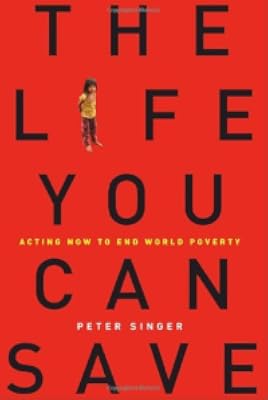
The Life You Can Save: How to Do Your Part to End World Poverty
by Peter Singer
On This Page
Description
Arguing that our current response to world poverty is not only insufficient but ethically indefensible, philosopher Peter Singer offers a seven-point plan that mixes personal philanthropy (figuring how much to give and how best to give it), local activism (spreading the word in your community), and political awareness (contacting your representatives to ensure that your nation's foreign aid is really directed to the world's poorest people).Tags
Recommendations





Member Reviews
I chose to read Singer's book because I've often wanted to do more for the world's poor, but I wanted to do so in an informed way and see to it that my money was going to be used in a meaningful way that did not have politically or religiously motivated strings attached. I've tried to research charities before, but quickly became frustrated with the lack of information out there and the lack of solid evidence as to their efficacy that even the most well-known charities couldn't provide. So I was already sold on the idea of giving to those in Third World countries, but didn't really know how to do so and I hoped Singer's book would offer me some practical advice as to which organizations to give to and some information regarding the show more difference these organizations are making.
The first part of the book is dedicated to making the philosophical case for our responsibility as a wealthy, industrialized nation to give to help end worldwide poverty. This part of the book I would give more of a 3 star rating, namely because this was a part of the book that I didn't really need. I was already convinced; I just wanted to know how. However, there are some interesting tidbits that explain our psychological and social aversion to giving which do help explain why so many of us can turn a blind eye to the world's poor. For example, if we're on our way to work and a small child is drowning in a nearby lake, almost all of us would rush out to save the child. We wouldn't worry about being late to work or about risking our own life; we would simply act because we know a child's life is in danger. And yet 1 in 5 children living in Third World countries die before the age of 5. We know that, but statistics don't move us to act in the same way witnessing one particular child whose face we can see and whose voice we can hear can.
An argument that I found compelling in this part of the book is his case against the "give close to home" idea. While Singer is not advocating do nothing for those in your community (indeed, he does argue that we need to be more involved in our communities and give more of our time and resources to volunteering), he does argue that there is a difference between what poor in America looks like and what poor in Ethiopia, Nepal, or the Congo looks like. Whereas 1 in 5 children die before the age of 5 in impoverished countries, 1 in 100 of children die of poverty in the U.S. (and, yes, that is definitely too much, but it does show where our money can do the most good). The American poor still have access to education, health care, and social services. 3/4 of their households have a car, air conditioning, and a VCR or DVD player. 97% of them own a color TV. There's American poverty has its own set of challenges and setbacks, but, as Singer points out, it's not necessarily the kind of poverty that kills as viciously and indiscriminately as it does in the Third World.
The last part of the book is the part that I found most effective for my purposes and, for those of you who are like me and just want some practical advice on how and to whom to give, you might want to skip ahead to this part of the book or you may just want to visit GiveWell.org, a website that reviews the effectiveness of various charities and advises as to which ones are efficiently making a true, quantifiable difference in the lives of the poor. I've already chosen two charities that I'll be giving to in 2011: The Fistula Foundation and The Small Enterprise Foundation.
What I found interesting about many of the negative reviews is that the number one reason cited for disliking the book was "it made me feel guilty about not doing more." Well, no shit, Sherlock. And, frankly, you should. I should. We all should. 1.4 billion people live on less than $1.25 a day--the Starbucks coffee I drank while reading this is approximately someone's salary for 4 days of work. If I have to skip the occasional Caramel Macchiato or bottled water or pair of shoes to help save a life, it's hardly a sacrifice on my part considering what's at stake. show less
The first part of the book is dedicated to making the philosophical case for our responsibility as a wealthy, industrialized nation to give to help end worldwide poverty. This part of the book I would give more of a 3 star rating, namely because this was a part of the book that I didn't really need. I was already convinced; I just wanted to know how. However, there are some interesting tidbits that explain our psychological and social aversion to giving which do help explain why so many of us can turn a blind eye to the world's poor. For example, if we're on our way to work and a small child is drowning in a nearby lake, almost all of us would rush out to save the child. We wouldn't worry about being late to work or about risking our own life; we would simply act because we know a child's life is in danger. And yet 1 in 5 children living in Third World countries die before the age of 5. We know that, but statistics don't move us to act in the same way witnessing one particular child whose face we can see and whose voice we can hear can.
An argument that I found compelling in this part of the book is his case against the "give close to home" idea. While Singer is not advocating do nothing for those in your community (indeed, he does argue that we need to be more involved in our communities and give more of our time and resources to volunteering), he does argue that there is a difference between what poor in America looks like and what poor in Ethiopia, Nepal, or the Congo looks like. Whereas 1 in 5 children die before the age of 5 in impoverished countries, 1 in 100 of children die of poverty in the U.S. (and, yes, that is definitely too much, but it does show where our money can do the most good). The American poor still have access to education, health care, and social services. 3/4 of their households have a car, air conditioning, and a VCR or DVD player. 97% of them own a color TV. There's American poverty has its own set of challenges and setbacks, but, as Singer points out, it's not necessarily the kind of poverty that kills as viciously and indiscriminately as it does in the Third World.
The last part of the book is the part that I found most effective for my purposes and, for those of you who are like me and just want some practical advice on how and to whom to give, you might want to skip ahead to this part of the book or you may just want to visit GiveWell.org, a website that reviews the effectiveness of various charities and advises as to which ones are efficiently making a true, quantifiable difference in the lives of the poor. I've already chosen two charities that I'll be giving to in 2011: The Fistula Foundation and The Small Enterprise Foundation.
What I found interesting about many of the negative reviews is that the number one reason cited for disliking the book was "it made me feel guilty about not doing more." Well, no shit, Sherlock. And, frankly, you should. I should. We all should. 1.4 billion people live on less than $1.25 a day--the Starbucks coffee I drank while reading this is approximately someone's salary for 4 days of work. If I have to skip the occasional Caramel Macchiato or bottled water or pair of shoes to help save a life, it's hardly a sacrifice on my part considering what's at stake. show less
Effective altruism works for me like veganism: by assuming a few rather uncontroversial ethical axioms, trusting science and reason, and following a handful of simple logical deductions, it seems to me that one cannot but arrive at effective altruism and veganism in the end.
The axioms are such as [my interpretations]: “if there is something that is ‘bad’ in the universe, it is suffering”; “ethics is by definition independent of the point of view of the observer”, “there are gradations of ‘evil’ or ‘bad behaviour’”, “there are gradations in the level of consciousness of creatures” or “more wealth or consumption does not significantly increase individual happiness, beyond a certain threshold”.
Unless one show more denies science altogether — or chooses to be decidedly incoherent or radically selfish — reflecting sufficiently upon the ideas posited in this book or in [b:Animal Liberation|29380|Animal Liberation|Peter Singer|https://i.gr-assets.com/images/S/compressed.photo.goodreads.com/books/1386924543l/29380._SY75_.jpg|1547077] necessarily leads to being at least very sympathetic to (negative?) utilitarianism, rationality, effective altruism, veganism, and other related ideas.
This has been my evolution in the last two or three years.
[b:The Life You Can Save: How to Do Your Part to End World Poverty|43624637|The Life You Can Save How to Do Your Part to End World Poverty|Peter Singer|https://i.gr-assets.com/images/S/compressed.photo.goodreads.com/books/1548004940l/43624637._SY75_.jpg|4787382] makes a good job at introducing these simple ideas to laymen. Peter Singer is a great promoter and an accessible source. And it is indeed very difficult to argue against the figures and the implications contained here, whimsical as they seem at first glance:
Perhaps the book focuses too much on giving. Giving, giving, giving. Yes, there are also chapters dedicated to criticising development aid and NGO's, to examining the psychological biases that prevent most of us from donating more, to showcasing success stories from several effective organisations — but the impression is that the main goal is to persuade regular people to give money away to charitable causes.
Even if I agree with the message, I fear that insisting so much on that particular point may be counterproductive. There are other strategies and strands of effective behaviour that, all together, may appeal to more readers: reducing consumption and consuming “better”; spreading the overall message; voting consciously and campaigning to further these goals; tackling the suffering of sentient beings other than humans (eg, becoming a vegan); having more children (or not having children at all, I just don't know what is the “right” thing to do vis-à-vis global issues); switching jobs or empowering outstanding individuals to further research and development, etc. show less
The axioms are such as [my interpretations]: “if there is something that is ‘bad’ in the universe, it is suffering”; “ethics is by definition independent of the point of view of the observer”, “there are gradations of ‘evil’ or ‘bad behaviour’”, “there are gradations in the level of consciousness of creatures” or “more wealth or consumption does not significantly increase individual happiness, beyond a certain threshold”.
Unless one show more denies science altogether — or chooses to be decidedly incoherent or radically selfish — reflecting sufficiently upon the ideas posited in this book or in [b:Animal Liberation|29380|Animal Liberation|Peter Singer|https://i.gr-assets.com/images/S/compressed.photo.goodreads.com/books/1386924543l/29380._SY75_.jpg|1547077] necessarily leads to being at least very sympathetic to (negative?) utilitarianism, rationality, effective altruism, veganism, and other related ideas.
This has been my evolution in the last two or three years.
[b:The Life You Can Save: How to Do Your Part to End World Poverty|43624637|The Life You Can Save How to Do Your Part to End World Poverty|Peter Singer|https://i.gr-assets.com/images/S/compressed.photo.goodreads.com/books/1548004940l/43624637._SY75_.jpg|4787382] makes a good job at introducing these simple ideas to laymen. Peter Singer is a great promoter and an accessible source. And it is indeed very difficult to argue against the figures and the implications contained here, whimsical as they seem at first glance:
“Do you have a bottle of water or a can of soda on the table beside you as you read this book? If you are paying for something to drink when safe drinking water comes out of the tap, you have money to spend on things you don’t really need. Around the world, over 700 million people struggle to live each day on less than you paid for that drink.”
“Today when people give large sums with a lot of fanfare, we may suspect that their real motive is to gain social status by their philanthropy, and to draw attention to how rich and generous they are. But does this really matter? Isn’t it more important that the money go to a good cause than that it be given with ‘pure’ motives? And if by doing the equivalent of sounding a trumpet when they give, they encourage others to give, isn’t that better still?”
“In 2016, the U.S. Environmental Protection Agency valued a generic American life at $ 10 million, while the Federal Department of Transportation in 2015 set a figure of $ 9.4 million. On all of these figures, the interventions described above [to save the lives of people living in extreme poverty] offer thousands of times better value.”
“In 2017, worldwide net official development assistance and aid was approximately $ 170 billion, while in the same year, consumers spent $ 532 billion on cosmetics. We say that we aspire to end extreme poverty in 11 years, yet we spend more than three times as much on beauty products as the governments we elect spend on ending extreme poverty.”
“Is the fact that other people are not doing their fair share a sufficient reason for allowing a child to die when you could easily rescue that child? I think the answer is clear: no.”
Perhaps the book focuses too much on giving. Giving, giving, giving. Yes, there are also chapters dedicated to criticising development aid and NGO's, to examining the psychological biases that prevent most of us from donating more, to showcasing success stories from several effective organisations — but the impression is that the main goal is to persuade regular people to give money away to charitable causes.
Even if I agree with the message, I fear that insisting so much on that particular point may be counterproductive. There are other strategies and strands of effective behaviour that, all together, may appeal to more readers: reducing consumption and consuming “better”; spreading the overall message; voting consciously and campaigning to further these goals; tackling the suffering of sentient beings other than humans (eg, becoming a vegan); having more children (or not having children at all, I just don't know what is the “right” thing to do vis-à-vis global issues); switching jobs or empowering outstanding individuals to further research and development, etc. show less
I confess that I have read very little of Peter Singer’s work before this book, persuaded by his many critics that his style of philosophical reasoning and utilitarian values are blunt instruments more likely to do harm than good. But here Singer wields these blunt instruments to very good effect against the wall of complacency and convenient pessimism that the affluent use to deny their responsibility for the problem of global poverty.
Singer’s argument is simple, premised on the obvious truth that if we are in a situation where we could save someone who is dying, we are morally obliged to do so unless in so doing we would be sacrificing something very nearly as valuable as the person's life. For example, failure to save the life show more of a drowning child because we do not want to risk ruining our shoes would be morally reprehensible. Singer then points out that globally 27,000 children per day die from causes related to extreme poverty (defined as living on less than $1.25 per day), and that these children could easily be saved by funding the expansion of existing health and development programs that are demonstrably effective. Doing so would not require affluent individuals to give up more than a trivial amount of the money that they spend on luxuries, nor would it significantly harm the economy of affluent societies. Singer thus concludes that failure to save these children is morally unacceptable, and challenges the reader to commit to supporting any of the charities that work effectively to eradicate global poverty.
To my mind, Singer effectively counters every conceivable objection to this argument. He is not naïve about the problems associated with global relief and development agencies. He is skeptical of government efforts, arguing that they are generally too entangled with the economic and political interests of wealthy nations to provide effective help. He argues that non-governmental organizations are much better, though he argues that they must be scrutinized carefully to make sure that they are working effectively.
So how much giving is enough? Singer argues that in principle, we are obliged to give to the point where we would be risking the loss of something nearly as valuable as the lives that are lost due to causes associated with extreme poverty. However, because the amount of money actually needed to ameliorate poverty is actually quite modest (the maximum estimate of additional funds needed to meet the millennial challenge goals for cutting global poverty in half by 2015 are only $189 billion), Singer argues that a much more modest level of giving would be sufficient to virtually eliminate extreme poverty. He calculates that if Americans of comfortable means donated roughly 5% of their income, and the rich and super-rich considerably more, America alone could raise $471 billion per year.
Singer persuasively argues that ending poverty is easily within our grasp. One of the most surprising facts in the book was how much progress has in fact already been made. In 1960, an estimated 20 million children died of poverty-related causes. The most recent estimates show that the number has fallen to 8.8 million — a remarkable achievement given that in the same time period the world’s population had risen from 2.5 to 6.5 billion.
Singer concludes not only that this level of giving would make little negative impact on the lives of the affluent, but that it might add significantly to their happiness and sense of fulfillment. The life you can save may be your own. show less
Singer’s argument is simple, premised on the obvious truth that if we are in a situation where we could save someone who is dying, we are morally obliged to do so unless in so doing we would be sacrificing something very nearly as valuable as the person's life. For example, failure to save the life show more of a drowning child because we do not want to risk ruining our shoes would be morally reprehensible. Singer then points out that globally 27,000 children per day die from causes related to extreme poverty (defined as living on less than $1.25 per day), and that these children could easily be saved by funding the expansion of existing health and development programs that are demonstrably effective. Doing so would not require affluent individuals to give up more than a trivial amount of the money that they spend on luxuries, nor would it significantly harm the economy of affluent societies. Singer thus concludes that failure to save these children is morally unacceptable, and challenges the reader to commit to supporting any of the charities that work effectively to eradicate global poverty.
To my mind, Singer effectively counters every conceivable objection to this argument. He is not naïve about the problems associated with global relief and development agencies. He is skeptical of government efforts, arguing that they are generally too entangled with the economic and political interests of wealthy nations to provide effective help. He argues that non-governmental organizations are much better, though he argues that they must be scrutinized carefully to make sure that they are working effectively.
So how much giving is enough? Singer argues that in principle, we are obliged to give to the point where we would be risking the loss of something nearly as valuable as the lives that are lost due to causes associated with extreme poverty. However, because the amount of money actually needed to ameliorate poverty is actually quite modest (the maximum estimate of additional funds needed to meet the millennial challenge goals for cutting global poverty in half by 2015 are only $189 billion), Singer argues that a much more modest level of giving would be sufficient to virtually eliminate extreme poverty. He calculates that if Americans of comfortable means donated roughly 5% of their income, and the rich and super-rich considerably more, America alone could raise $471 billion per year.
Singer persuasively argues that ending poverty is easily within our grasp. One of the most surprising facts in the book was how much progress has in fact already been made. In 1960, an estimated 20 million children died of poverty-related causes. The most recent estimates show that the number has fallen to 8.8 million — a remarkable achievement given that in the same time period the world’s population had risen from 2.5 to 6.5 billion.
Singer concludes not only that this level of giving would make little negative impact on the lives of the affluent, but that it might add significantly to their happiness and sense of fulfillment. The life you can save may be your own. show less
I really felt engaged and persuaded by this book until the last bit. That last bit really didn't sit well with me. You see, the book, up until that point, seems aimed at everyone in the first world, regardless of income level, and our obligations as members of these richer countries towards the world's poorest people, whose situation is so dire that every day is a question of life or death. I really did feel quite moved. But, at the very end, the plan that is proposed for giving is largely aimed at the top 10% income earners in the United States. It seemed like an unexpected about face. Up until then, I thought the moral argument had not only been aimed at everyone in the first world, but was also empowering because all of us could save show more lives. Then, in the end, it honed in on the rich and showed how, if the top 10% earners made significant contributions of their wealth towards world poverty, then the problem of life-threatening poverty could be entirely funded just by these folks. I found this last bit so ineffective that it really watered down the rest of the message which had been so powerful. show less
This is an oldish book (2009) I picked up; it's a bit dated, and I've heard all of Singer's arguments before, but I guess I just like hearing them.
Singer's out to get everyone to give more of their resources to the poorest of the poor. If you wouldn't pass by a child drowning in a pond, how can you not give a small sum of money to save a child's life across the world?
He attempts to refute all the common reasons we have for not giving more. He emphasizes the goal is not to guilt people, but to create a culture where more giving becomes the norm.
One thing that surprised me, until I remembered how old the book was - he says that of course we don't want to just give people money. That fosters dependence and doesn't change the institutions show more that keep them poor. I think he has since changed his tune, since his website, https://www.thelifeyoucansave.org/, now lists Give Directly as a recommended charity. Give Directly flat out gives money to people. That's all they do. That's why I love them. I am fully convinced that giving poor people money is the best way to go. They don't become dependent. They improve their circumstances. They often start or improve their businesses. And that is how they can begin to change their own institutions. show less
Singer's out to get everyone to give more of their resources to the poorest of the poor. If you wouldn't pass by a child drowning in a pond, how can you not give a small sum of money to save a child's life across the world?
He attempts to refute all the common reasons we have for not giving more. He emphasizes the goal is not to guilt people, but to create a culture where more giving becomes the norm.
One thing that surprised me, until I remembered how old the book was - he says that of course we don't want to just give people money. That fosters dependence and doesn't change the institutions show more that keep them poor. I think he has since changed his tune, since his website, https://www.thelifeyoucansave.org/, now lists Give Directly as a recommended charity. Give Directly flat out gives money to people. That's all they do. That's why I love them. I am fully convinced that giving poor people money is the best way to go. They don't become dependent. They improve their circumstances. They often start or improve their businesses. And that is how they can begin to change their own institutions. show less
You are immoral if you buy luxury and leisure items for yourself because that money could have saved lives and combated global, absolute poverty.
This is the logical extension of Peter Singer's recent book, The Life You Can Save (sub-titled, "Acting Now to End World Poverty"). Building on principles of moral philosophy, Singer begins by discussing a moral problem: If you are walking to an appointment and see a child drowning in a pool, are you morally obligated to help that child? The obvious answer is "yes," regardless of the time spent or the damage to our clothing that may result. Singer suggests that we are, then, morally obligated to aid other children around the world if we are able to.
To argue this more forcefully, he demonstrates show more a "logical argument from plausible premises."
First premise: Suffering and death from lack of food, shelter, and medical care are bad.
Second premise: If it is in your power to prevent something bad from happening, without sacrificing anything nearly as important, it is wrong not to do so.
Third premise: By donating to aid agencies, you can prevent suffering and death from lack of food, shelter, and medical care, without sacrificing anything nearly as important.
Conclusion: Therefore, if you do not donate to aid agencies, you are doing something wrong. (pgs. 15-16)
Singer seeks to establish that each of us is under a moral obligation to help others as much as we can without sacrificing anything nearly as important. This means, unless we are withholding food, shelter, or care from our family members, we ought to give. The logical extension of this is that most, if not all, luxury and leisure activities and things must be seen as immoral pursuits that cause us to overlook our moral obligation to others.
As an example, Singer writes, "To buy good stereo equipment in order to further my worthwhile goal, or life-enhancing experience, of listening to music is to place more value on these enhancements to my life than on whether others live or die" (p. 149).
The book is filled in by discussions of aid, types of aid that may be given, and how to arrive at an appropriate amount to give. While advocating much more, Singer recognizes it is not realistic to expect people to give as much as he desires them to. Even he himself does not achieve that much giving.
He draws from the principle of fairness to suggest a modest goal. We can all chip in, and if we do our fair share, we will not become disgusted by those who are not doing their fair share. The alternative is to push people to give a lot, only to become frustrated when they see others not doing their part. He suggests that most of us can start at 5% of our annual income. (He does think the rich can and should give much more than 5%.)
I found this to be a fascinating book that caused me to really think through my giving and my lifestyle. In fact, I'm still thinking about it. I enjoyed the argument from moral philosophy and found him to go much deeper with his thinking than many Christian writers do. I recommend the book for anyone interested in the problems of poverty, service, and giving. show less
This is the logical extension of Peter Singer's recent book, The Life You Can Save (sub-titled, "Acting Now to End World Poverty"). Building on principles of moral philosophy, Singer begins by discussing a moral problem: If you are walking to an appointment and see a child drowning in a pool, are you morally obligated to help that child? The obvious answer is "yes," regardless of the time spent or the damage to our clothing that may result. Singer suggests that we are, then, morally obligated to aid other children around the world if we are able to.
To argue this more forcefully, he demonstrates show more a "logical argument from plausible premises."
First premise: Suffering and death from lack of food, shelter, and medical care are bad.
Second premise: If it is in your power to prevent something bad from happening, without sacrificing anything nearly as important, it is wrong not to do so.
Third premise: By donating to aid agencies, you can prevent suffering and death from lack of food, shelter, and medical care, without sacrificing anything nearly as important.
Conclusion: Therefore, if you do not donate to aid agencies, you are doing something wrong. (pgs. 15-16)
Singer seeks to establish that each of us is under a moral obligation to help others as much as we can without sacrificing anything nearly as important. This means, unless we are withholding food, shelter, or care from our family members, we ought to give. The logical extension of this is that most, if not all, luxury and leisure activities and things must be seen as immoral pursuits that cause us to overlook our moral obligation to others.
As an example, Singer writes, "To buy good stereo equipment in order to further my worthwhile goal, or life-enhancing experience, of listening to music is to place more value on these enhancements to my life than on whether others live or die" (p. 149).
The book is filled in by discussions of aid, types of aid that may be given, and how to arrive at an appropriate amount to give. While advocating much more, Singer recognizes it is not realistic to expect people to give as much as he desires them to. Even he himself does not achieve that much giving.
He draws from the principle of fairness to suggest a modest goal. We can all chip in, and if we do our fair share, we will not become disgusted by those who are not doing their fair share. The alternative is to push people to give a lot, only to become frustrated when they see others not doing their part. He suggests that most of us can start at 5% of our annual income. (He does think the rich can and should give much more than 5%.)
I found this to be a fascinating book that caused me to really think through my giving and my lifestyle. In fact, I'm still thinking about it. I enjoyed the argument from moral philosophy and found him to go much deeper with his thinking than many Christian writers do. I recommend the book for anyone interested in the problems of poverty, service, and giving. show less
Nice and short appeal to why you should probably be giving more of your income to saving lives. I found many of the propositions to be difficult to reject (which is a good thing). However, in cases where I did disagree, I noticed that Singer's tone regarding those disagreeing with him is far too dismissive. To me, the value in the book lies in its ability to force you to think about at what price you actually value a life that is close to you (friend/family) vs. one far away (stranger in foreign country), and a milder tone might make such introspection easier.
I would recommend reading the book because it's such an efficient read: for how short it is, the book caused me to stop and think about where I personally stand on the ideas show more expressed a disproportionate amount of times. show less
I would recommend reading the book because it's such an efficient read: for how short it is, the book caused me to stop and think about where I personally stand on the ideas show more expressed a disproportionate amount of times. show less
Members
- Recently Added By
Lists

Filosofía - Clásicos
217 works; 1 member

Books Read in 2014
2,343 works; 86 members

Read in 2014
334 works; 11 members

Books Read in 2011
684 works; 19 members

Read in 2011
81 works; 1 member
Author Information

45+ Works 10,667 Members
Awards and Honors
Notable Lists
Common Knowledge
- Canonical title
- The Life You Can Save: How to Do Your Part to End World Poverty
- Original publication date
- 2009
- Dedication
- To Renata, without whom...
- First words
- When he saw the man fall onto the subway tracks, Wesley Autry didn't hesitate.
- Last words
- (Click to show. Warning: May contain spoilers.)What greater motivation can there be than doing whatever one possibly can to reduce pain and suffering?
- Blurbers
- Karnofsky, Holden; Offenheiser, Raymond C.
Classifications
- Genres
- Philosophy, General Nonfiction, Nonfiction
- DDC/MDS
- 362.5 — Society, government, & culture Social problems and social services Social Welfare Poor (from social service perspectives)
- LCC
- HV48 .S56 — Social sciences Social pathology. Social and public welfare. Criminology Social pathology. Social and public welfare. Social service. Social work. Charity
- BISAC
Statistics
- Members
- 751
- Popularity
- 37,409
- Reviews
- 21
- Rating
- (4.06)
- Languages
- 10 — Danish, Dutch, English, French, German, Italian, Polish, Portuguese, Spanish, Swedish
- Media
- Paper, Audiobook, Ebook
- ISBNs
- 26
- ASINs
- 6