On This Page
Description
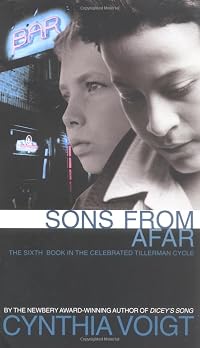
Six years after coming to live with their grandmother, James and Sammy Tillerman go in search of their long-lost father.Tags
Recommendations














Member Reviews
Growing up in a traditional nuclear family I seldom tried to imagine any other reality. Voigt's Tillerman Cycle was published after my middle- and high-school tenure, when exposure to different family structures would have stretched me, to say the least, in positive ways.
With attention to the details of each character's speech, mannerisms, and interior dialog, Voigt breathes vibrant life into these memorable protagonists. The development of adolescent identity without a parent, or without both, unspools with confident pacing that kept me turning the pages.
I will miss the Tillermans.
With attention to the details of each character's speech, mannerisms, and interior dialog, Voigt breathes vibrant life into these memorable protagonists. The development of adolescent identity without a parent, or without both, unspools with confident pacing that kept me turning the pages.
I will miss the Tillermans.
James and Sammy Tillerman couldn’t be more different: brainy James struggles to make friends and tends to overthink things, while athletic Sammy enjoys wide popularity but can be kind of thoughtless. One thing they do have in common is Francis Verriker, the father who abandoned their family before Sammy was even born. Sammy says the only reason he’d want to meet Francis would be to punch him in the face, but James has questions about why he is the way he is, and he wonders if meeting his father would give him some answers. He pulls unwilling Sammy into the quest, and when James’ interest flags, Sammy keeps the search on track. But can two teenagers with limited resources find a man who obviously doesn’t want to be found?
While show more this isn’t going to take a place among my favorites, it’s a solid entry in the series, recommended if you’ve gotten this far. The character development is top notch. show less
While show more this isn’t going to take a place among my favorites, it’s a solid entry in the series, recommended if you’ve gotten this far. The character development is top notch. show less
So hard to believe this is the same author who wrote the masterpiece that is A Solitary Blue. James is a whiny emo inconsistent uncommunicative teenager, which sounds accurate but Voigt's other teenage characters seemed authentic without being irritating to the max.
There's a literal page about James walking through the mud in rain too emo to use an umbrella or avoid puddles (the narrative SPECIFIES this) letting the rain plaster his hair to his head and fall down his cheeks like tears which he liked because then he could pretend he's crying to himself while not really because real men don't cry. Page 102, check it out if you hate yourself.
I could see what Voigt was trying to do with James wanting to find his father and complete the show more story of their family history, what not growing up with a father figure could do, but the whole scenario rang false because the family isn't lacking in love or direction or support or parenting in any way. The entire premise of this book felt shoehorned into being a problem just so the author could write another book.
Also the scene of the family thinking it might not be a bad idea to set up 14-year-old Maybeth with her 28-year-old piano teacher "for her protection" was a whole new level of effed up.
I forced myself to sit through Bullet's racism in The Runner because at least Voigt attempted to deal with that issue, but I'm not doing it again with James' unchallenged fatphobia and misogyny. show less
There's a literal page about James walking through the mud in rain too emo to use an umbrella or avoid puddles (the narrative SPECIFIES this) letting the rain plaster his hair to his head and fall down his cheeks like tears which he liked because then he could pretend he's crying to himself while not really because real men don't cry. Page 102, check it out if you hate yourself.
I could see what Voigt was trying to do with James wanting to find his father and complete the show more story of their family history, what not growing up with a father figure could do, but the whole scenario rang false because the family isn't lacking in love or direction or support or parenting in any way. The entire premise of this book felt shoehorned into being a problem just so the author could write another book.
Also the scene of the family thinking it might not be a bad idea to set up 14-year-old Maybeth with her 28-year-old piano teacher "for her protection" was a whole new level of effed up.
I forced myself to sit through Bullet's racism in The Runner because at least Voigt attempted to deal with that issue, but I'm not doing it again with James' unchallenged fatphobia and misogyny. show less
Book six in the Tillerman series, is told from the dual perspectives of Sammy and James. James is now 16, Sammy 12.
James begins to wonder about their father, and convinces Sammy to go along with him on a quest of sorts to see what he can find out about the man they never knew. Sammy doesn't care, but is willing to humor James. They find out a little... but not much. About the time James decides their father isn't much worth finding out about, Sammy begins to wonder, and the two take off in a different direction, leading to an alarming encounter (and I think the least plausible encounter in the entire series so far) when the two boys attempt to question a burly, half-drunken sailor about their father. The best moments in the book are show more when the two wildly different brothers are inwardly comparing themselves to each other.
Much better than "The Runner," which was a distinctly unpleasant book in the series, but not up to par with "Homecoming," "Dicey's Song," or "Come a Stranger" either. show less
James begins to wonder about their father, and convinces Sammy to go along with him on a quest of sorts to see what he can find out about the man they never knew. Sammy doesn't care, but is willing to humor James. They find out a little... but not much. About the time James decides their father isn't much worth finding out about, Sammy begins to wonder, and the two take off in a different direction, leading to an alarming encounter (and I think the least plausible encounter in the entire series so far) when the two boys attempt to question a burly, half-drunken sailor about their father. The best moments in the book are show more when the two wildly different brothers are inwardly comparing themselves to each other.
Much better than "The Runner," which was a distinctly unpleasant book in the series, but not up to par with "Homecoming," "Dicey's Song," or "Come a Stranger" either. show less
Beautifully written, as always. When I read this one initially, I was thrilled to peer inside Sammy and James' lives- finally! We've learned all about Jeff, Mina, Dicey, and Bullet. It's Sammy and James' turn to work out their own demons, and James becomes more human and much more sympathetic. Very satisfying.
Rich, thoughtful, and nuanced.
It would be a five-star read if not for a strange weight-loss minor theme that I could have done without.
It would be a five-star read if not for a strange weight-loss minor theme that I could have done without.
We get to know Dicey's brothers better, as they take a journey (in more ways than one) to find their deadbeat father. Still good, but probably my least favorite of the set.
Members
- Recently Added By
Lists

Books Read in 2017
4,249 works; 129 members

Maybe This Year? Books to Look Forward To
412 works; 9 members

Books Read in 2006
424 works; 7 members

Read in 2006
140 works; 1 member
Author Information

73+ Works 18,841 Members
Cynthia Voigt was born on February 25, 1942 in Boston, Massachusetts. She received a bachelor's degree from Smith College, did graduate work at St. Michael's College, and later received a teacher's certification from Christian Brothers College. After college, she worked for an advertising agency. Before becoming a full-time author, she was a show more secretary and a high school English teacher. Her first book, Homecoming, was published in 1981. Her children's books address such issues at child abuse and racism, topics that are not often talked about in books designed for children. She is the author of numerous books including the Bad Girls series, the Tillerman Cycle series, and the Kingdom series. She won the Notable Children's Trade Book in the field of social studies for Homecoming, the Newbery Medal, ALA in 1983 for Dicey's Song, and the Edgar Allan Poe Award in 1984 for The Callender Papers. In 1995, she received the MAE Award. (Bowker Author Biography) show less
Some Editions
Awards and Honors
Awards
Distinctions
Notable Lists
Series


Work Relationships
Is contained in
Common Knowledge
- Canonical title
- Sons from Afar
- Original title
- Sons from Afar
- Original publication date
- 1991
- People/Characters
- James Tillerman; Sammy Tillerman; Dicey Tillerman; Maybeth Tillerman; Abigail Tillerman
- Original language*
- Engels
*Some information comes from Common Knowledge in other languages. Click "Edit" for more information.
Classifications
- Genres
- Fiction and Literature, Teen, Children's Books, Young Adult
- DDC/MDS
- 813.54 — Literature & rhetoric American literature in English American fiction in English 1900-1999 1945-1999
- LCC
- PZ7 .V874 .S — Language and Literature Fiction and juvenile belles lettres Fiction and juvenile belles lettres Juvenile belles lettres
- BISAC
Statistics
- Members
- 653
- Popularity
- 44,391
- Reviews
- 9
- Rating
- (3.61)
- Languages
- 6 — Dutch, English, Finnish, French, German, Swedish
- Media
- Paper, Ebook
- ISBNs
- 26
- ASINs
- 5