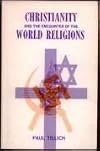
Christianity and the Encounter of the World Religions
by Paul Tillich
On This Page
Description
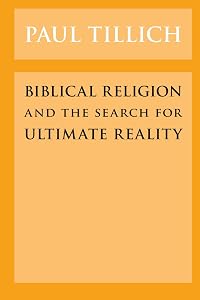
A collection of four Bampton Lectures given in the fall of 1961in the Low Memorial Library of Columbia University on decisive Christian points of views on other religions. The topics discussed include the emphasis on and the characterization of quasi-religions, the elaboration of the universalist element in Christianity, the suggestion of a dynamic typology of the religions, the dialogical character of the encounter of high religions, and the judgment of Christianity against itself as a show more religion and its ensuing openness for criticism. show lessTags
Recommendations

























Member Reviews
One of the world's most renowned theologians and philosophers of religion, Dr Paul Tillich discusses in this book certain points of view considered by him to be decisive as an approach to Christianity and its encounter with world religions: the emphasis on and the characterization of quasi-religions; the elaboration of the universalist element in Christianity; the suggestion of a dynamic typology; the dialogical character of the encounter of high religions; and the judgment of Christianity against itself and its openness for criticism from other religions and from quasi-religious.
Favorite quotes:
The religious principle cannot come to an end. For the question of the ultimate meaning of life cannot be silenced as long as men are men. Religion cannot come to an end, and a particular religion will be lasting to the degree in which it negates itself as a religion. Thus Christianity will be a bearer of the religious answer as long as it breaks through its own particularity.
The way to achieve this is not to relinquish one's religious tradition for the sake of a universal concept which would be nothing but a concept. The way is to penetrate into the depth of one's own religion, in devotion, thought and action. In the depth of every living religion there is a point at which the religion itself loses its importance, and show more that to which it points breaks through its particularity, elevating it to spiritual freedom and with it to a vision of the spiritual presence in other expressions of the ultimate meaning of man's existence. show less
The religious principle cannot come to an end. For the question of the ultimate meaning of life cannot be silenced as long as men are men. Religion cannot come to an end, and a particular religion will be lasting to the degree in which it negates itself as a religion. Thus Christianity will be a bearer of the religious answer as long as it breaks through its own particularity.
The way to achieve this is not to relinquish one's religious tradition for the sake of a universal concept which would be nothing but a concept. The way is to penetrate into the depth of one's own religion, in devotion, thought and action. In the depth of every living religion there is a point at which the religion itself loses its importance, and show more that to which it points breaks through its particularity, elevating it to spiritual freedom and with it to a vision of the spiritual presence in other expressions of the ultimate meaning of man's existence. show less
Ratings
Members
- Recently Added By
Author Information

136+ Works 12,671 Members
Paul Johannes Tillich was born into a German Lutheran pastor's family in that part of Germany that is now Poland. He attended several universities, earning the doctorate in philosophy in 1910, then taught at several more from 1919 to 1933. Removed from his professorate at Frankfurt by the Nazi government, he emigrated to the United States, with show more the encouragement of Reinhold Niebuhr, and taught at Union Theological Seminary in New York (1933--55), Harvard University (1955--62), and the University of Chicago (1962--65). The fullest biography, including some fairly lurid material of a psychosexual nature, can be found in the appreciative work by Wilhelm and Marion Pauck. The student who wants to encounter Tillich at his most succinct might turn to The Courage To Be (1952) or The Theology of Paul Tillich (1982). He is sometimes classified as Neo-orthodox, but that label does not fit him as well as it does Karl Barth, who had small regard for Tillich's "theology of correlation," where responding to the world's questions is seen as the proper way of practicing theology. (Bowker Author Biography) show less
Series
Belongs to Publisher Series
Common Knowledge
- Canonical title
- Christianity and the Encounter of the World Religions
- Original publication date
- 1963
Classifications
Statistics
- Members
- 140
- Popularity
- 233,538
- Reviews
- 2
- Rating
- (3.50)
- Languages
- English, French
- Media
- Paper
- ISBNs
- 5
- ASINs
- 4