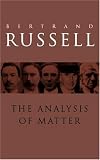
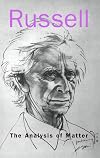
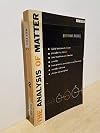
The Analysis of Matter
by Bertrand Russell
On This Page
Description
The Analysis of Matter is the product of thirty years of thinking by one of the twentieth century's best-known philosophers. An inquiry into the philosophical foundations of physics, it was written against the background of stunning new developments in physics earlier in the century, above all relativity, as well as the excitement around quantum theory, which was just being developed. Concerned to place physics on a stable footing at a time of great theoretical change, Russell argues that show more the concept of matter itself can be replaced by a logical construction whose basic foundations are events. He is careful to point out that this does not prove that matter does not exist, but it does show that physicists can get on with their work without assuming that matter does exist. Russell argues that fundamental bits of ''matter'', such as electrons and protons, are simply groups of events connected in a certain way and their properties are all that are required for physics. This Routledge Classics edition includes the 1992 Introduction by John G. Slater. show lessTags
Recommendations




















Member Reviews
Philip Goff (in _Galileo's Error_, 2019) identifies this work as the beginning (further developed by Arthur Eddington in a 1928 book) of some thinkers' progression towards the modern-day kind of panpsychism sometimes ascribed to the Integrated Information Theory of consciousness. It combines the philosophy of perception with the science of physics to arrive at a denial of any great distinction between mind and matter -- what philosophers call neutral monism. For a professional philosopher, clearly, Russell was very well versed in physics, including the then-young relativity theory and the then-newborn Heisenberg/Schrödinger quantum theory. His writing exhibited quite a bit of male centeredness and a great deal of show more restrictive-relative-clause "whichiness" (as opposed to "thattiness"), but I'd say these stylistic negatives are excusable because of the time of the book's writing, as of course is the failure to mention not-yet-discovered neutrons when talking about atomic nuclei. show less
Librería 6. Estante 6.
Dec 20, 2019Spanish
Ratings
Members
- Recently Added By
Lists

The Works of Bertrand Russell
62 works; 1 member
Author Information

433+ Works 39,618 Members
Bertrand Arthur William Russell (1872-1970) was a British philosopher, logician, essayist and social critic. He was best known for his work in mathematical logic and analytic philosophy. Together with G.E. Moore, Russell is generally recognized as one of the main founders of modern analytic philosophy. Together with Kurt Gödel, he is regularly show more credited with being one of the most important logicians of the twentieth century. Over the course of a long career, Russell also made contributions to a broad range of subjects, including the history of ideas, ethics, political and educational theory, and religious studies. General readers have benefited from his many popular writings on a wide variety of topics. After a life marked by controversy--including dismissals from both Trinity College, Cambridge, and City College, New York--Russell was awarded the Order of Merit in 1949 and the Nobel Prize for Literature in 1950. Noted also for his many spirited anti-nuclear protests and for his campaign against western involvement in the Vietnam War, Russell remained a prominent public figure until his death at the age of 97. (Bowker Author Biography) show less
Classifications
- Genres
- Science & Nature, Philosophy, Nonfiction
- DDC/MDS
- 530.1 — Natural sciences & mathematics Physics Physics Theoretical Physics
- LCC
- QC6 .R83 — Science Physics Physics General
- BISAC
Statistics
- Members
- 121
- Popularity
- 270,530
- Reviews
- 3
- Rating
- (3.00)
- Languages
- English, Portuguese, Spanish
- Media
- Paper, Ebook
- ISBNs
- 9
- ASINs
- 7