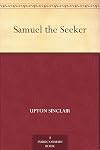
Samuel the Seeker
by Upton Sinclair
On This Page
Description
Set in upstate New York, the story follows Samuel Prescott's eventful life. A robbery leaves Samuel penniless and forces him to encounter many bigger than life characters, from greedy capitalists to the sainted socialists, with the righteous religious and the purchased politicians.Tags
Recommendations










Member Reviews
Samuel the Seeker is, to put it bluntly, a pro-socialist (dare I say Communist?) morality play against the evils of Capitalism with a capital C. If this brief description already has you gritting your teeth in ideological rage, then it’s safe to say you aren’t going to enjoy this – or indeed, possibly any – Upton Sinclair novel.
Sinclair’s novel follows the journey of Samuel Prescott, an idealistic young farm boy who strikes out on his own to strike it rich when his father dies shortly after losing all of his savings in a bad stock market investment. What would typically be a rags-to-riches story becomes a rags-to-rags exercise in futility, as Samuel is confronted with every form of social injustice and societal ill that you show more can imagine. Upton introduces Samuel to the reader as a virtual blank slate with little more than farming and bible verses to inform his world view. Through the novel, Samuel eagerly adopts every world philosophy introduced to him, only to watch every ideology he accepts under the weight of his experiences when taken to their logical conclusion.
In just one example of Samuel’s numerous encounters, a professor who rescues Samuel from being jailed for vagrancy - a situation in itself a source of confusion for the young man – explains to him that the reason that some people are starving the streets while others have more than they could ever need is because of an economic Darwinism in which all people struggle to earn money to support themselves, but that only those who are worthy surviving actually succeed. Samuel easily buys into the logic of the professor’s argument, and being penniless and unable to find work himself, readily consigns himself to his deserved fate of starving to death, and flusters the professor when he asks him to help inform the local poor of their duty to die in order to make room for those more worthy than them.
Samuel is Sinclair’s satirical device in the flesh, much like Voltaire’s Candide, exposing the hypocrisies and fallacies of the world by actually believing in them… Until he stumbles upon a group of local socialists, whom he immediately distrusts until the truths the deliver to him actually play out as promised (although perhaps not as well as Samuel would have liked). This is where those who are natural inclined to disagree with anything of an anti-capitalist nature are apt to cry foul, since ideologies that Sinclair is in favor of are not portrayed as illogical and corrupt as the ones with which he aligns, and perhaps they have a point. Perhaps you can’t separate literature from philosophy when the former is specifically designed to be a vehicle of the later. However, if you are so inclined to look beyond Sinclair’s ultimate message – unless you agree with it, of course, of course – what you’ll find is a thought-provoking and well-executed social/political satire that, like all of the best ones, is still relevant today. show less
Sinclair’s novel follows the journey of Samuel Prescott, an idealistic young farm boy who strikes out on his own to strike it rich when his father dies shortly after losing all of his savings in a bad stock market investment. What would typically be a rags-to-riches story becomes a rags-to-rags exercise in futility, as Samuel is confronted with every form of social injustice and societal ill that you show more can imagine. Upton introduces Samuel to the reader as a virtual blank slate with little more than farming and bible verses to inform his world view. Through the novel, Samuel eagerly adopts every world philosophy introduced to him, only to watch every ideology he accepts under the weight of his experiences when taken to their logical conclusion.
In just one example of Samuel’s numerous encounters, a professor who rescues Samuel from being jailed for vagrancy - a situation in itself a source of confusion for the young man – explains to him that the reason that some people are starving the streets while others have more than they could ever need is because of an economic Darwinism in which all people struggle to earn money to support themselves, but that only those who are worthy surviving actually succeed. Samuel easily buys into the logic of the professor’s argument, and being penniless and unable to find work himself, readily consigns himself to his deserved fate of starving to death, and flusters the professor when he asks him to help inform the local poor of their duty to die in order to make room for those more worthy than them.
Samuel is Sinclair’s satirical device in the flesh, much like Voltaire’s Candide, exposing the hypocrisies and fallacies of the world by actually believing in them… Until he stumbles upon a group of local socialists, whom he immediately distrusts until the truths the deliver to him actually play out as promised (although perhaps not as well as Samuel would have liked). This is where those who are natural inclined to disagree with anything of an anti-capitalist nature are apt to cry foul, since ideologies that Sinclair is in favor of are not portrayed as illogical and corrupt as the ones with which he aligns, and perhaps they have a point. Perhaps you can’t separate literature from philosophy when the former is specifically designed to be a vehicle of the later. However, if you are so inclined to look beyond Sinclair’s ultimate message – unless you agree with it, of course, of course – what you’ll find is a thought-provoking and well-executed social/political satire that, like all of the best ones, is still relevant today. show less
Ratings
Members
- Recently Added By
Author Information

246+ Works 22,084 Members
Upton Sinclair, a lifelong vigorous socialist, first became well known with a powerful muckraking novel, The Jungle, in 1906. Refused by five publishers and finally published by Sinclair himself, it became an immediate bestseller, and inspired a government investigation of the Chicago stockyards, which led to much reform. In 1967 he was invited by show more President Lyndon Johnson to "witness the signing of the Wholesome Meat Act, which will gradually plug loopholes left by the first Federal meat inspection law" (N.Y. Times), a law Sinclair had helped to bring about. Newspapers, colleges, schools, churches, and industries have all been the subject of a Sinclair attack, analyzing and exposing their evils. Sinclair was not really a novelist, but a fearless and indefatigable journalist-crusader. All his early books are propaganda for his social reforms. When regular publishers boycotted his work, he published himself, usually at a financial loss. His 80 or so books have been translated into 47 languages, and his sales abroad, especially in the former Soviet Union, have been enormous. (Bowker Author Biography) show less
Series
Belongs to Publisher Series
Common Knowledge
- First words
- "Samuel," said old Ephraim, "Seek, and ye shall find."
- Last words
- (Click to show. Warning: May contain spoilers.)But ours is the hope of human hearts and the strength of the soul's desire!
Classifications
Statistics
- Members
- 22
- Popularity
- 1,193,308
- Reviews
- 1
- Rating
- (3.50)
- Languages
- English, German, Italian, Swedish
- Media
- Paper, Ebook
- ISBNs
- 33
- ASINs
- 5