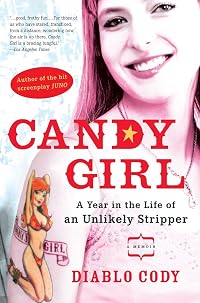
Candy Girl
by Diablo Cody
On This Page
Description
Diablo Cody was 24 when she decided there had to be more to life than typing ad copy. On a whim, she signed up for amateur night at Minneapolis's seedy Skyway Lounge. She didn't win a prize, but she discovered that stripping delivered a rush she had never experienced before. While she didn't fit the ordinary profile of a stripper--she had a supportive boyfriend, was equal parts brainpower and beauty, was from a good family, and was out to do a little soul searching--she soon immersed herself show more in this enticing life full-time. Here she tells the fish-out-of-water story of her yearlong walk on the wild side, giving readers a behind-the-scenes look at this industry through a writer's keen eye, from quiet gentlemen's clubs to multi-level sex palaces, with wry observations along the way.--From publisher description. show lessTags
Recommendations









Member Reviews
From the “interesting women” reading list, this one is often rather sad. On a whim, Diablo Cody started stripping just to see what it was like; soon the extra money ceased to be “extra” and became essential. The economics of strip clubs – at least the ones she worked at – are interesting; the dancers were heavily pressured to solicit drinks, lap dances, “bed dances” (like a lap dance, but horizontal), and other “special” services; in many cases, the dancers have to pay to work and get money back for each “special”. As a result, it was entirely possible to work a grueling shift and end up owing the club money for the night. Cody comments on the resulting strange inversion of the normal gender relations – show more attractive young women in scanty to nonexistent clothing begging old fat bald guys for the favor of their company. OTOH, when things went well, they could go very well indeed – Cody describes an evening when she literally got more money than she could carry from a customer who kept buying $90 bed dances.
Club managers, who Cody calls “The Mustaches”, do not display fatherly regard for their dancers; not surprising under the circumstances. Cody mostly writes about herself and her supportive boyfriend, without a lot of comments on other dancers (except their physical attributes); one painful exception is where she narrates a young single mom’s comment “You think you’ll always love your baby’s daddy, because he’s your baby’s daddy; but you don’t”. Not Shakespeare, but still profound.
Her day job was as a copywriter for a Minneapolis ad agency; strangely, her “real” employer didn’t seem to notice when she repeatedly showed up for work exhausted after a dance shift that lasted till 04:30 and when she dyed her hair bubble-gum pink; in fact, she got a promotion to a managerial position. She must have been a decent copywriter; some of her writing in Candy Girl is LOL funny – too bad I can’t repeat any of it here. With “****” censorship, all you’d see is definite articles and conjunctions.
Cody went on to become a successful screenwriter; she must have got lots of interesting material from her short stint as a stripper (in addition to permanently distorted feet from dancing in 6” heels, black and blue thighs from pole work, but, on the plus side, “abs of adamantium”).
Quick read, sometimes very funny, hide from the kids. show less
Club managers, who Cody calls “The Mustaches”, do not display fatherly regard for their dancers; not surprising under the circumstances. Cody mostly writes about herself and her supportive boyfriend, without a lot of comments on other dancers (except their physical attributes); one painful exception is where she narrates a young single mom’s comment “You think you’ll always love your baby’s daddy, because he’s your baby’s daddy; but you don’t”. Not Shakespeare, but still profound.
Her day job was as a copywriter for a Minneapolis ad agency; strangely, her “real” employer didn’t seem to notice when she repeatedly showed up for work exhausted after a dance shift that lasted till 04:30 and when she dyed her hair bubble-gum pink; in fact, she got a promotion to a managerial position. She must have been a decent copywriter; some of her writing in Candy Girl is LOL funny – too bad I can’t repeat any of it here. With “****” censorship, all you’d see is definite articles and conjunctions.
Cody went on to become a successful screenwriter; she must have got lots of interesting material from her short stint as a stripper (in addition to permanently distorted feet from dancing in 6” heels, black and blue thighs from pole work, but, on the plus side, “abs of adamantium”).
Quick read, sometimes very funny, hide from the kids. show less
Diablo's memoir is subtitled "A year in the life of an unlikely stripper". She had a relatively regular upbringing and at 24 meets her future husband Jonny on the interset. She moves to Minneapolis and gets a job in an office but feels something is missing from her life. Walking home one day she decides to enter into an ameateur night at a strip club. She doesn't win but decides to pursue stripping part time outside of her more acceptable job.
She finds it unbelivably easy to walk in off the street looking very inlike your traditional idea of a stripper and gain work. She works in a variety of strip clubs in the area doing a reasonable, but not outstanding, trade. She has paritcular problems with the pole at first. She discovers in time show more that her full time job is causing her stress and is very unfulfilling and decides to strip full time. She works in a peep show where she is seperated by the customer by a plate of clear plastic. She she masturbates for the customer with a variety of toys while the customer gets off. After she leaves that job she spends some time as a phone sex girl but is depressed by the number of callers wanting "Stephenie", her barely legal persona. She gets a great lap dance with her husband and decides to go back to stripping in clubs. Her time away has given her a fresh perspective and she is able to make a lot more money the second time around before eventually retiring and presumably becoming a screen writer.
Not for those who dislike bad language or explicit sexual scenes, but I have to say I loved it! I did a pole dancing course to try and get in shape (which I loved and I still need to figure out where to put a pole in our flat) and I did go to a couple of strip clubs to see it done professionally rather than to get fit. It is funny the differences between the different types and I even paid for my own private fully nude lap dance (very cool). I have considered trying out as a stripper but my husband isn't comfortable with it and I respect that, plus I am not sure if I could actually do it.
The tale is told with her witty humour and a lot of laugh out loud places. She makes no excuses, gives no explanations or justifications which I found very refreshing. To get a feel of her writing style this is one of my favourite quotes about the first time she started at a new club:
"The main stage was ringed by a tip rail that could accommodate at least twenty. Above the stage was a glass-floored second stage, which allowed customers to look up watch another girl dancing overhead. This multidimensional display of poontang reminded me of the 3-D chessboard on StarTrek, which is turn reminded me that I was a huge nerd." show less
She finds it unbelivably easy to walk in off the street looking very inlike your traditional idea of a stripper and gain work. She works in a variety of strip clubs in the area doing a reasonable, but not outstanding, trade. She has paritcular problems with the pole at first. She discovers in time show more that her full time job is causing her stress and is very unfulfilling and decides to strip full time. She works in a peep show where she is seperated by the customer by a plate of clear plastic. She she masturbates for the customer with a variety of toys while the customer gets off. After she leaves that job she spends some time as a phone sex girl but is depressed by the number of callers wanting "Stephenie", her barely legal persona. She gets a great lap dance with her husband and decides to go back to stripping in clubs. Her time away has given her a fresh perspective and she is able to make a lot more money the second time around before eventually retiring and presumably becoming a screen writer.
Not for those who dislike bad language or explicit sexual scenes, but I have to say I loved it! I did a pole dancing course to try and get in shape (which I loved and I still need to figure out where to put a pole in our flat) and I did go to a couple of strip clubs to see it done professionally rather than to get fit. It is funny the differences between the different types and I even paid for my own private fully nude lap dance (very cool). I have considered trying out as a stripper but my husband isn't comfortable with it and I respect that, plus I am not sure if I could actually do it.
The tale is told with her witty humour and a lot of laugh out loud places. She makes no excuses, gives no explanations or justifications which I found very refreshing. To get a feel of her writing style this is one of my favourite quotes about the first time she started at a new club:
"The main stage was ringed by a tip rail that could accommodate at least twenty. Above the stage was a glass-floored second stage, which allowed customers to look up watch another girl dancing overhead. This multidimensional display of poontang reminded me of the 3-D chessboard on StarTrek, which is turn reminded me that I was a huge nerd." show less
Why did I ever wait so long to read this!? This book was laugh out loud funny, intriguing and eye opening beyond compare. Diablo's quick wit and hilarious insights on the sex industry and her year in it is not to be missed! Diablo moved to Minneapolis and decided to reinvent herself and walk on the wild side with the permission and understanding of her boyfriend she decided to try her hand at stripping. She went from novice to pro in no time at all and bounced around to several different clubs. After that got tiring she decided to be a "doll" one of the girls that stood in a box at a sex store tempting men to spend some alone time with her, with only a window separating them. Ranging from hilarious to disgusting her year on the wild show more side is a must read for anyone even remotely interested in the sex trade. Diablo worked at gentlemen's clubs, a sex store, and a sex hotline and her views on the trade are eye opening.
For fans of erotica, dirty books, or memoirs. show less
For fans of erotica, dirty books, or memoirs. show less
This book is a weird trip. It does not unfold as do others of its ilk, a fact acknowledged by the author in a little afterword (which redeemed the whole thing for me). Cody fooled me. So, let me explain.
This is a nice, white, middle class girl's trip into the dark side, only she doesn't quite know why she does it and neither do we (at least, until that final 6-8 pages). We get, in equal portions, funny, raw, wry, cruel, sickening, too-hip, trying-too-hard, and painfully-honest. She's not trying to make a political point. She's not on a feminist soap box. She's not handing out excuses or explanations, or accusations or blame. She's just telling us "Hey, I did this. This is what I saw. This is what I did. Boo-ya."
And it works. At times I show more didn't think it was going to work. Really, I almost stopped reading a time or two because (read my status notes!), trained as I am by other memoirs in which a Nice Girl/Guy does Something Transgressive and Has A Crisis, I was waiting for the big boom, the disaster, the Horrible Thing. Didn't happen. What I thought was a build up toward a climax wasn't anything but time going by. My bad. Cody maybe didn't know where she was going until she got there, but it was...cool. Once we both got there, I was good with it.
You could, if you wanted, take this book apart and use it in a number of ways, but you'd be pushing. Cody isn't going there. You'd have to pause at some points and put some words in her mouth or translate her unambiguous text through some version of Babelfish. There are no big lessons here, no realizations about culture, no sociopolitical conclusions. It is, to borrow a hackneyed phrase, what it is. And I like it a lot more because of that. show less
This is a nice, white, middle class girl's trip into the dark side, only she doesn't quite know why she does it and neither do we (at least, until that final 6-8 pages). We get, in equal portions, funny, raw, wry, cruel, sickening, too-hip, trying-too-hard, and painfully-honest. She's not trying to make a political point. She's not on a feminist soap box. She's not handing out excuses or explanations, or accusations or blame. She's just telling us "Hey, I did this. This is what I saw. This is what I did. Boo-ya."
And it works. At times I show more didn't think it was going to work. Really, I almost stopped reading a time or two because (read my status notes!), trained as I am by other memoirs in which a Nice Girl/Guy does Something Transgressive and Has A Crisis, I was waiting for the big boom, the disaster, the Horrible Thing. Didn't happen. What I thought was a build up toward a climax wasn't anything but time going by. My bad. Cody maybe didn't know where she was going until she got there, but it was...cool. Once we both got there, I was good with it.
You could, if you wanted, take this book apart and use it in a number of ways, but you'd be pushing. Cody isn't going there. You'd have to pause at some points and put some words in her mouth or translate her unambiguous text through some version of Babelfish. There are no big lessons here, no realizations about culture, no sociopolitical conclusions. It is, to borrow a hackneyed phrase, what it is. And I like it a lot more because of that. show less
So, okay, the other autobiography I read this year (so far) is Candy Girl, by Hollywood "It Girl" du jour, Diablo Cody. Why? Well, I liked Juno (yes, I will still admit, and the soundtrack, too, goddammit) and I was intrigued by her rags to riches, er, I mean, stripper to screenwriter tale. (NB: All of this, presumably, was told on her blog [called, I kid you not, The Pussy Ranch], so the story of blogger-cum-novelist naturally interests me, too.)
I found her book to be an eye-opener. Thematically, it's not for the faint of heart. Grandmothers and little kids might want to avert their eyes. She goes from bored secretarial lackluster to total immersion in Minneapolis' sex industry within a few chapters. Dancing and stripping on amateur show more night lead to more of the same as a full time profession, toning her abs and refining her "look." But she doesn't stop there. She morphs into a phone sex operator when the late night pressures amass and then into one of those girls "performing" behind the glass in the back rooms of a sex shop.
Is there a moral to this story? No, not really. It's just an interesting segment of her life and a story worth telling. (Actually, she says, "any story involving a panty auction is required to be told.") Apparently this excursion was her attempt to scoff at the boring middle class lifestyle she grew up in. No, it was more than that. Allow me to quote her from one of the final pages:
Most girls get into stripping because they’ve discovered a fast crowd, are mired in financial woe or have lived with dysfunction for so long that they're naturally drawn to the fucked-up family dynamic in strip clubs. For me, it was the polar opposite. I had spent my entire life choking on normalcy, decency and Jif sandwiches with the crusts amputated. For me, stripping was an unusual kind of escape. I had nothing to escape from but privilege, but I claimed asylum anyway. At twenty-four, it was my last chance to reject something and become nothing. I wanted to terrify myself. Mission accomplished.
Reading about a typical male fantasy from the clinical female point of view was quite interesting. From that perspective, there is nothing erotic at all about all of that forced eroticism. Bruised knees and sore feet become the focal point, not the exposed flesh or various gyrations. Stripping becomes a business, a lifestyle, a routine. Men become pigs – something I suspect women have known for some time.
The highlight of this book, which is also the lowlight, is the writing, which is every bit as crafty and clever (at first) and then tiring (after a while) and border-line pretentious as it was in her virgin screenplay attempt. It starts out impressive and eventually wears on you. Young Diablo doesn't know when to tone it down, nor when to use it for effect, which sort of requires that it doesn't overstay its welcome.
But I want to add to that last sentence the word: "yet." I think she has more in her, and a few years of maturity will go a long way towards stabilizing her voice. If nothing else, it brought her down off the pole and bawling like a baby up on stage at the Academy Awards. Clearly this girl embraces change. I just hope the literary world hasn't lost her for good for the money and fame that Hollywood has to offer. I think it would be a shame. show less
I found her book to be an eye-opener. Thematically, it's not for the faint of heart. Grandmothers and little kids might want to avert their eyes. She goes from bored secretarial lackluster to total immersion in Minneapolis' sex industry within a few chapters. Dancing and stripping on amateur show more night lead to more of the same as a full time profession, toning her abs and refining her "look." But she doesn't stop there. She morphs into a phone sex operator when the late night pressures amass and then into one of those girls "performing" behind the glass in the back rooms of a sex shop.
Is there a moral to this story? No, not really. It's just an interesting segment of her life and a story worth telling. (Actually, she says, "any story involving a panty auction is required to be told.") Apparently this excursion was her attempt to scoff at the boring middle class lifestyle she grew up in. No, it was more than that. Allow me to quote her from one of the final pages:
Most girls get into stripping because they’ve discovered a fast crowd, are mired in financial woe or have lived with dysfunction for so long that they're naturally drawn to the fucked-up family dynamic in strip clubs. For me, it was the polar opposite. I had spent my entire life choking on normalcy, decency and Jif sandwiches with the crusts amputated. For me, stripping was an unusual kind of escape. I had nothing to escape from but privilege, but I claimed asylum anyway. At twenty-four, it was my last chance to reject something and become nothing. I wanted to terrify myself. Mission accomplished.
Reading about a typical male fantasy from the clinical female point of view was quite interesting. From that perspective, there is nothing erotic at all about all of that forced eroticism. Bruised knees and sore feet become the focal point, not the exposed flesh or various gyrations. Stripping becomes a business, a lifestyle, a routine. Men become pigs – something I suspect women have known for some time.
The highlight of this book, which is also the lowlight, is the writing, which is every bit as crafty and clever (at first) and then tiring (after a while) and border-line pretentious as it was in her virgin screenplay attempt. It starts out impressive and eventually wears on you. Young Diablo doesn't know when to tone it down, nor when to use it for effect, which sort of requires that it doesn't overstay its welcome.
But I want to add to that last sentence the word: "yet." I think she has more in her, and a few years of maturity will go a long way towards stabilizing her voice. If nothing else, it brought her down off the pole and bawling like a baby up on stage at the Academy Awards. Clearly this girl embraces change. I just hope the literary world hasn't lost her for good for the money and fame that Hollywood has to offer. I think it would be a shame. show less
Juno was my favorite movie last year. Yes, go ahead and call me twee or insufferably hip if you like. I thought it combined sweetness with cleverness. I am a sucker for both of those qualities.
The woman who wrote Juno, as you may have heard, is an ex-stripper. Candy Girl (which was published before the film appeared) is the story of Diablo Cody's walk on the nude side.
Less than a paragraph is all is takes to learn that Ms. Cody's voice is very similar to that of a certain fictional pregnant teenager. If the dialogue in Juno got on your nerves, avoid this book. I enjoy a playful way with language, even if it does occasionally veer into eye-rolling punnery. (Honest to blog!)
Anyway, Cody was a straight-arrow sort who got into stripping show more because she needed to prove to herself that she wasn't too chicken to have a wild streak. She describes her titty-bar times with what feels like complete candor. Strippers are jaded for good reason; she clients use them as fuckdolls, and the club owners use them as chattel, taking the vast majority of the money the women make. (She calls a typical strip club a "pink gulag.") Then again, Cody conveys that stripping made her feel shockingly alive and in control of herself for the first time. At her office job, she is efficient and feels like a fraud; peeling away her garments, though it's rarely glamorous, gives her a real high. Until eventually it doesn't.
What with sex workers taking down governors this week, Candy Girl felt very a propos to me as I read it. Not for the sexually squeamish or the terminally scornful. show less
The woman who wrote Juno, as you may have heard, is an ex-stripper. Candy Girl (which was published before the film appeared) is the story of Diablo Cody's walk on the nude side.
Less than a paragraph is all is takes to learn that Ms. Cody's voice is very similar to that of a certain fictional pregnant teenager. If the dialogue in Juno got on your nerves, avoid this book. I enjoy a playful way with language, even if it does occasionally veer into eye-rolling punnery. (Honest to blog!)
Anyway, Cody was a straight-arrow sort who got into stripping show more because she needed to prove to herself that she wasn't too chicken to have a wild streak. She describes her titty-bar times with what feels like complete candor. Strippers are jaded for good reason; she clients use them as fuckdolls, and the club owners use them as chattel, taking the vast majority of the money the women make. (She calls a typical strip club a "pink gulag.") Then again, Cody conveys that stripping made her feel shockingly alive and in control of herself for the first time. At her office job, she is efficient and feels like a fraud; peeling away her garments, though it's rarely glamorous, gives her a real high. Until eventually it doesn't.
What with sex workers taking down governors this week, Candy Girl felt very a propos to me as I read it. Not for the sexually squeamish or the terminally scornful. show less
Diablo Cody (the person who wrote "Juno" and fine-tuned "The Evil Dead" remake) displays her humble beginnings with a memoir of her experience as an outsider in the live-action sex industry. I've read books from people inside, but they've grown bitter and resentful of the field. I was afraid this one would be too perky and positive, but this book is neither, it's somewhere in-between.
She writes with the same style in "Juno", meaning quirky, creative metaphors that take sixty words to illustrate. (I've never had to use my eReader's dictionary function so much.) Half the content is similes about her situation. Don't get me wrong, I enjoy them, but at a certain point, it's ridiculous. But damned if it doesn't get the point across in an show more entertaining way.
Some people criticized her for being too filthy or see the book as validation for her career choice. I don't. I found it page-turning, and more informative than the other stripper books I've read (there seems to be an astonishing lack of good books about the sex industry). I know she didn't become a stripper so she could write a book, but her motivations seem a little ambiguous. Still, she proves that she's more together than lots of the other working girls.
I liked how she was able to examine differences at each kind of strip club, from high end to low end to sex store peep shows. And she talks about the girls she met, the boredom and thrills, and how her personal life affected her stripper life. It's not strictly anthropological. It's a little more like a LiveJournal made into a book. It's sharp and witty, and even without the Minnesota ties I recognized, I would have enjoyed it. It reminds me of pre-Lena Dunham. show less
She writes with the same style in "Juno", meaning quirky, creative metaphors that take sixty words to illustrate. (I've never had to use my eReader's dictionary function so much.) Half the content is similes about her situation. Don't get me wrong, I enjoy them, but at a certain point, it's ridiculous. But damned if it doesn't get the point across in an show more entertaining way.
Some people criticized her for being too filthy or see the book as validation for her career choice. I don't. I found it page-turning, and more informative than the other stripper books I've read (there seems to be an astonishing lack of good books about the sex industry). I know she didn't become a stripper so she could write a book, but her motivations seem a little ambiguous. Still, she proves that she's more together than lots of the other working girls.
I liked how she was able to examine differences at each kind of strip club, from high end to low end to sex store peep shows. And she talks about the girls she met, the boredom and thrills, and how her personal life affected her stripper life. It's not strictly anthropological. It's a little more like a LiveJournal made into a book. It's sharp and witty, and even without the Minnesota ties I recognized, I would have enjoyed it. It reminds me of pre-Lena Dunham. show less
Members
- Recently Added By
Lists

Books featured on I Don't Even Own a Television
167 works; 3 members
Author Information

13 Works 2,079 Members
Some Editions
Common Knowledge
- Canonical title
- Candy Girl
- Original publication date
- 2005-12-29
- People/Characters
- Diablo Cody; Jonny
- Epigraph
- A year in the life of an unlikely stripper
- Dedication
- For Jonny and the three ugly ones
- First words
- Nobody comes to Minnesota to take their clothes off, at least as far as I know.
- Quotations
- Girls turning tricks presented a criminal threat, but the manager was far more paranoid about drug use.
- Last words
- (Click to show. Warning: May contain spoilers.)I righted myself and slid to my feet, bruised but otherwise smashing.
Classifications
- Genres
- Biography & Memoir, Nonfiction, General Nonfiction
- DDC/MDS
- 792.7028092 — Arts & recreation Recreation, sports, and performing arts Theater: Plays, Ballet, Opera Variety shows and theatrical dancing; burlesque, cabaret, vaudeville, music hall, nightclubs modified standard subdivisions Techniques, procedures, apparatus, equipment, materials, miscellany Acting and performance standard subdivisions History, geographic treatment, biography Biography
- LCC
- PN1949 .S7 .C63 — Language and Literature Literature (General) Literature (General) Drama Special types
- BISAC
Statistics
- Members
- 1,075
- Popularity
- 23,784
- Reviews
- 70
- Rating
- (3.51)
- Languages
- 7 — English, German, Italian, Portuguese, Croatian, Spanish, Swedish
- Media
- Paper, Audiobook, Ebook
- ISBNs
- 18
- ASINs
- 3