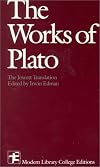
The Works of Plato
by Plato
On This Page
Description
Presents a selection of ten dialogues of Plato that represent the range and diversity of his human and intellectual interests.Tags
Recommendations



















Member Reviews
Selections needed to complete my St. John's list: In Phaedrus, the discussion of Platonic love is completed with further discussion regarding the sensible vs the bodily love. Socrates is made out as a lover of wisdom, not as wise himself. His mastery of discussion are also shown in the way he wraps up his first argument so quickly, only to have Phaedrus force him to stay, at which time he works into his real thoughts. In essence, he shows that arguments are of higher worth if they can stand up to continuing tests of their truth. Also, man cannot handle arguments about his ideas if he has not explored them and himself completely. In Parmenides, we are introduced to the full metaphysical concept of the idea. It's separation fron the show more actual object and the resulting paradoxical implications are troubling to Plato, although it could be easily dismissed due to the metaphysical nature. In Thaetetus, Socrates is portrayed as the midwife of ideas. Most of the discussion compares lawyers and philosophers, the former being slaves to time and objective, while the latter can fully explore any topic to find the real truth. In Sophist, Plato gives an oveview of the various philosophical camps and casts an inferior light on most of them. The sophists are actually somewhat simple in that their arguments do not hold up under further scrutiny. Finally, in Timaeus, the recurring theme of balance between body and soul is discussed. In addition, we are introduced to Solons' tales about Atlantis which are more fully conveyed in Critias. Critias is actually one of the more interesting works to me, bringing out so many parallels to Biblical tales, origins of government, ancient history, and cultural ideas prevalent across the world. show less
Ratings
Members
- Recently Added By
Lists

1001 Books You Must Read Before You Die
1,448 works; 1,134 members
Author Information

2,731+ Works 100,710 Members
Plato was born c. 427 B.C. in Athens, Greece, to an aristocratic family very much involved in political government. Pericles, famous ruler of Athens during its golden age, was Plato's stepfather. Plato was well educated and studied under Socrates, with whom he developed a close friendship. When Socrates was publically executed in 399 B.C., Plato show more finally distanced himself from a career in Athenian politics, instead becoming one of the greatest philosophers of Western civilization. Plato extended Socrates's inquiries to his students, one of the most famous being Aristotle. Plato's The Republic is an enduring work, discussing justice, the importance of education, and the qualities needed for rulers to succeed. Plato felt governors must be philosophers so they may govern wisely and effectively. Plato founded the Academy, an educational institution dedicated to pursuing philosophic truth. The Academy lasted well into the 6th century A.D., and is the model for all western universities. Its formation is along the lines Plato laid out in The Republic. Many of Plato's essays and writings survive to this day. Plato died in 347 B.C. at the age of 80. (Bowker Author Biography) show less
Some Editions
Series
Belongs to Publisher Series
Work Relationships
Contains
Common Knowledge
- Original language
- Ancient Greek
- Disambiguation notice
- Modern Library selections. This collection contains: Lysis, Euthyrphro, Apology, Crito, Phaedo, Protagoras, Phaedrus, Symposium, Republic, Theaetetus. Do not combine with other collections.
Classifications
Statistics
- Members
- 556
- Popularity
- 53,211
- Reviews
- 1
- Rating
- (3.79)
- Languages
- English
- Media
- Paper, Ebook
- ISBNs
- 6
- UPCs
- 1
- ASINs
- 24