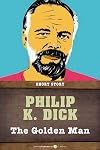
The Golden Man
by Philip K. Dick (Story Notes)
On This Page
Description
The Golden Man by Philip K. Dick - The powers of earth had finally exterminated the last of the horrible tribes of mutant freaks spawned by atomic war. Menace to homo sapien supremacy was about ended-but not quite. For out of the countryside came a great golden, godlike youth whose extraordinary mutant powers, combining the world's oldest and newest methods of survival, promised a new and superior type of "Is it always hot like this?" the salesman demanded. He addressed everybody at the show more lunch counter and in the shabby booths against the wall. A middle-aged fat man with a good-natured smile, rumpled gray suit, sweat-stained white shirt, a drooping bowtie, and a Panama hat. "Only in the summer," the waitress answered. None of the others stirred. The teen-age boy and girl in one of the booths, eyes fixed intently on each other. Two workmen, sleeves rolled up, arms dark and hairy, eating bean soup and rolls. A lean, weathered farmer. An elderly businessman in a blue-serge suit, vest and pocket watch. A dark rat-faced cab driver drinking coffee. A tired woman who had come in to get off her feet and put down her bundles. The salesman got out a package of cigarettes. He glanced curiously around the dingy cafe, lit up, leaned his arms on the counter, and said to the man next to him: "What's the name of this town?". show lessTags
Recommendations


















Member Recommendations
Vulco1 Future seeing
Member Reviews
'The Golden Man' (1954) is about this future society where mutants are hiding and are being hunted by a government agency either to neuter them or outright kill them. This government agency one day finds a mutant that is very different from all the others they've caught.
3/5 stars. Great pacing, opening scene, action scenes, but descriptions of women are kind of skeevy. Reads like an episode of the TV series 'Legion.'
3/5 stars. Great pacing, opening scene, action scenes, but descriptions of women are kind of skeevy. Reads like an episode of the TV series 'Legion.'
My reactions upon reading this book in 1989 -- some possible spoilers ahead.
"Introduction" -- We hear of Dick's anger towards and love of sf and his friends in it (particularly Norman Spinrad and Thomas E. Disch but also Roger Zelazny and Robert Heinlein -- who loaned Dick money and who, though Dick was almost completeley opposite politically to him, Dick loved). Other topics include the adoration of Dick in France and his love of women and music.
"The Golden Man" -- , This story is structured to make one sympathetic towards the Golden Man and, as Dick points out in his story notes, this was the Golden Age of the sympathetic mutant in a lá Van Vogt's Slan. At the end though, we are faced, like the androids in Dick's Do Androids Dream show more of Electric Sheep?, with beings that seem outwardly human but are not. The pre-vision talent of the Golden Man was interesting , and Dick tried to go into some of its implications. The idea of a mutant's sexual attractiveness was original and valid.
"Return Match" -- Bizarre story of mechanical menace via a lethal and quite addictive machine. The idea of a self-modifying pinball machine is unique; though Dick doesn't use the vocabulary an author would today to describe his device, it is quite modern. I liked the world being turned into a giant pinball machine for Office Tinbane hunted by an unknown menaces pinball becoming like a war game.
"The King of the Elves" -- A minor story whose real charm is the lonely protagonist finding a life of company, adventure, and usefulness with the Elves and leaving his gas station. Having his friend be King of the Trolls was a nice touch, and Dick is, as usual, conveys the menace in his story well.
"The Mold of Yancy" -- I can only dimly imagine the satiric jolt this story had on its publication. Now its tale of a banal, non-coercive totalitarian -- with Dick making a thoughtful distinction between dictatorship and totalitarianism -- state seems original, funny and a bit scary since it seems plausible. I liked a society of non-coercion where everyone willingly conforms and becomes thoughtless but retains the illusion of thought. Yancy the construct (as in the novel this story became, The Penultimate Truth) was a fascinating concept. Though Dick's jargon of gestalt is dated (today he would couch the story in terms of digital constructs and computerese) the concept of fake images is compelling. Yancy was also convincingly vapid. Dick shows his paranoia at having Yancy a tool in a capitalist conspiracy.
"Not By Its Cover" -- A fun, humorous story about an alien creature possessing of a certain type of immortality. I like the central idea of the sentient wub altering the books it bound with hilarious results (and sometimes serious ones) and the appropriate style.
"The Little Black Box" -- This story of Wilbur Mercer and his religion of empathy boxes was used in Dick's excellent Do Androids Dream of Electric Sheep? with a changed milleau. I agree with Dick that the idea is much better realized here. Mercer is an enigmatic figure and, as in the novel, we never do get a conclusive answer as to the orgin of Mercerism or if it's a precursor to alien physical (or, at least, political) invasion. That question and the threat of Mercerism (and all religion to the political status quo since, as Dick states in the notes, a religion is a type of political order) is much more emphasized here. Mercerism was only under attack by androids in the novel. Dick addresses the mystery as to why someone would seek pain in the course of a religious quest. Mercer offers no salvation. Dick's characters propose guilt and a longing for mystical communion as possible answers. On two side matters, I liked Dick's apparently original (and slightly humorous) explanation of what happens when two telepaths meet (they know the other is trying to read their mind), and I think I see a possible explanation for Dick's many unflattering portrayals of female characters. Joan Hrashi starts out as unflattering portrayal. She hypocritically preaches taking responsibility for ones actions but seems totally unconcerned that Ray Meritan's wife killed herself because of Joan's adulterous affair with him. She even keeps the suicide weapon as a morbid trophy. She also seems neurotic. Yet, in the course of the story, she is frightened, intimidated, lonely, longing, and bullied. Perhaps Dick's female characters are not so much mean portrayals of a whole sex and indicative of Dick's personal view (though there is ample evidence to support that stance and also that Dick had both a wary and loving view of women) as much as full portrayals of flawed humans: neurotic, partly evil, and frightened and intimidated by life.
"The Unreconstructed M" -- Another story whose idea became incorporated into Dick's The Penultimate Truth. I liked the idea, as in the novel, of faking forensic evidence. Here, as with Rick Deckard in Dick's Do Androids Dream of Electric Sheep?, the policeman Edward Ackers is faced with the prospective of using an increasingly fallible set of criteria for determining criminal cupability. However, unlike Deckard, Ackers is too proud to admit that justice can be fooled. Here, Ackers is also fooled by agent Garth who he takes as a madman. Here, as with the Roman style demesnes in The Penultimate Truth, Dick uses (along with the idea of the death rattle) the ancient ideal of exile for criminals. The story's only real detraction from enjoyment was the last two pages which did not really seem to serve any purpose. Having a character named David Lantano (who appears as a very long lived Indian in The Penultimate Truth) poses the puzzling question as to why Dick cannibalized his stories with so little modification. Was he just very rushed in composition?
"The War with the Fnools" -- A fun story. The central and end joke -- that aliens become more like us by picking up the vices of smoking, drinking, and sex -- was not very funny. What was funny was the Fnools utter incomprehension that their two foot high size made them immediately recognizable despite the accuracy of their impersonations.
"The Last of the Masters" -- One of Dick's morally ambiguous tales whose conflict is concisely stated in the story notes -- the choice between theoretically desiring anarchy and personal freedom versus the practical benefits of government. I had little sympathy for the anarchist and found a sad grandeur in the decaying robot trying to preserve the world he had known.
"Meddler" -- As Dick himself admits, this is a rather simple-minded story. It's easily guessed that the time traveler will bring back the seeds (here literally) of man's destruction. More emphasis on the politics of the story would have been interesting. The idea of politicians checking, illegally, the outcome of their decisions is quite plausible as is a resulting coverup. Still, as Dick points out, it is his first exploration of the latent reality underneath the obvious appearance; such exploration was to become one of Dick's primary preoccupations.
"A Game of Unchance" A story which simultaneously had the menace, glitter, and sleaziness of the carnival coupled with a Mars that had some of the desolate, rural flavor of Ray Bradbury's Mars. The pompous, callous UN officials were menacing in their contempt and closed-lipedness and also a bit humorous at the same time. Given the story notes, I assume the rather ambiguous ending is indicative of the colony being set up for trouble again. The story is scary because the colonists who we sympathize with are caught in a mysterious conflict they do not understand. The microbots were sufficiently menacing.
"Sales Pitch" -- This is a pre-eminently fifties piece of sf: a tale of everyday life (complete with tiring rocket commuting from the suburbs of Earth to work on Ganymede) with a satiric barb directed at that fifties' target of advertising. Here ads react directly on the brain and drive our hero over the edge. I disagree with Dick in finding this story a real downer. True, our hero's last moments are not spent in peaceful contemplation but in listening to the prattle of the robot; however, I found the fasrad, a robot product that sells itself and absolutely will not take no for an answer and uses humourously coercive measures, blackly funny.
"Precious Artifact" -- A story with a typically Dickian paranoid premise: that the victors in an instellar war have taken to impersonating the defeated humans to enlist the survivors help in restoring Earth. I don't always find Dick's paranoid premises moving, but I did find this one creepy in its plot of a created reality masking desolation. Dick's love of life, here, as often, symbolized by a cat, is very evident. Humanity may be dead, killed by aliens, but the human terraformers are willing to help as long as some small part of life has survived on Earth. Its presence will catalyze them into forgiveness and aid. Ironically, the life they psychically cling to and invest with their emotions is fake (like Richard Deckard's frog at the end of Dick's Do Androids Dream of Electric Sheep?).
"Small Town" -- On its most basic level, this is one of those vengeance tales where a put-upon man takes vengeance on those around him and his town (and rightly so given his adulterous wife). As Dick points out, Verne Haskel is into destruction of hated objects not their subjugation. That element and Dick's skill makes this an entertaining if not great story. The symbol of the model train is well realized. From a historical/sociological perspective, it's interesting to note how, in this story (and many other Dick works I've read that were written in the fifties) everyone has Freudian concepts and jargon on their lips.
"The Pre-Persons" -- A very angry and vitrolic story. I've read about reaction to this story and Dick's defense. I agree in principle with Dick's attack on abortion and the slippery, purely arbitrary and legalistic definition of when life begins -- and its possibly horrifying consequences of "post-partum" abortion. The arbitrary line of snuffing 12 year olds because they don't meet the definition of human -- the ability to do higher math -- seems as valid as the criteria now, and Dick works out the logical implications (including killing stupid adults). But Dick muddles his story and, in part, dulls his satiric blade when he introduces (especially given his life and earlier writings) what I take to be personal issues. His love of life and the defenseless comes through with the quite effective partial use of children as viewpoint characters, but it also leads him to make the connection between killing defenseless animals and children, a "hatred of the helpless ... of everything that grows". That seems an invalid connection. Simple desire to destroy doesn't seem to be as much a motive of abortion as narcissism and carelessness. Furthermore, this view of abortion's causes links with Dick's distrust of authority figures to make Oscar Ferris a truly detestable figure, definitely not one of Dick's sympathetic policemen. He loves rounding kids up, regards them as obscene little creatures. But the most noticeable theme beside the anti-abortion stance is that of the "castrating female". I don't think Dick hated women. He seemed quite attracted to them but always, for whatever reaason, dissatisfied with what he found as witnessed by five marriages. Ian Best does remark that in Canada women are different than remarks that only some are, that the devouring woman has existed throughout time and space. Cynthia Best is typical of Dick's evil women: selfishness, nagging, and concerned with social status (There is one grisly scene when Cynthia discusses having an abortion for the novelty value and trying to decide what color the preserving fluid should be). I don't think Dick was a misogynist though. I find it ironic that Joanna Russ (according to Dick in the story notes but I believe him) wrote a very nasty letter to Dick saying she usually offered to beat people up who said the things this story did. This is the same woman who wrote the seemingly man-hating "When It Changed". I found the ending of this story rather irritating. Dick seems to have trouble ending stories; sometimes they just trail off into irrational behavior by the characters and ambiguous outcomes between good and evil. I regard Dick as very good at characterization and dialogue; yet, I find his characters puzzling, contradictory, inconsistent, and irrational at times. I suspect that's why they seem so human since most of us have some degree of those traits.
"Afterword", Philip K. Dick, The Golden Man, ed. Philip K. Dick, 1980. Basic, short statement by Dick on his basic themes of fakery, reality's nature, trust, and love. show less
"Introduction" -- We hear of Dick's anger towards and love of sf and his friends in it (particularly Norman Spinrad and Thomas E. Disch but also Roger Zelazny and Robert Heinlein -- who loaned Dick money and who, though Dick was almost completeley opposite politically to him, Dick loved). Other topics include the adoration of Dick in France and his love of women and music.
"The Golden Man" -- , This story is structured to make one sympathetic towards the Golden Man and, as Dick points out in his story notes, this was the Golden Age of the sympathetic mutant in a lá Van Vogt's Slan. At the end though, we are faced, like the androids in Dick's Do Androids Dream show more of Electric Sheep?, with beings that seem outwardly human but are not. The pre-vision talent of the Golden Man was interesting , and Dick tried to go into some of its implications. The idea of a mutant's sexual attractiveness was original and valid.
"Return Match" -- Bizarre story of mechanical menace via a lethal and quite addictive machine. The idea of a self-modifying pinball machine is unique; though Dick doesn't use the vocabulary an author would today to describe his device, it is quite modern. I liked the world being turned into a giant pinball machine for Office Tinbane hunted by an unknown menaces pinball becoming like a war game.
"The King of the Elves" -- A minor story whose real charm is the lonely protagonist finding a life of company, adventure, and usefulness with the Elves and leaving his gas station. Having his friend be King of the Trolls was a nice touch, and Dick is, as usual, conveys the menace in his story well.
"The Mold of Yancy" -- I can only dimly imagine the satiric jolt this story had on its publication. Now its tale of a banal, non-coercive totalitarian -- with Dick making a thoughtful distinction between dictatorship and totalitarianism -- state seems original, funny and a bit scary since it seems plausible. I liked a society of non-coercion where everyone willingly conforms and becomes thoughtless but retains the illusion of thought. Yancy the construct (as in the novel this story became, The Penultimate Truth) was a fascinating concept. Though Dick's jargon of gestalt is dated (today he would couch the story in terms of digital constructs and computerese) the concept of fake images is compelling. Yancy was also convincingly vapid. Dick shows his paranoia at having Yancy a tool in a capitalist conspiracy.
"Not By Its Cover" -- A fun, humorous story about an alien creature possessing of a certain type of immortality. I like the central idea of the sentient wub altering the books it bound with hilarious results (and sometimes serious ones) and the appropriate style.
"The Little Black Box" -- This story of Wilbur Mercer and his religion of empathy boxes was used in Dick's excellent Do Androids Dream of Electric Sheep? with a changed milleau. I agree with Dick that the idea is much better realized here. Mercer is an enigmatic figure and, as in the novel, we never do get a conclusive answer as to the orgin of Mercerism or if it's a precursor to alien physical (or, at least, political) invasion. That question and the threat of Mercerism (and all religion to the political status quo since, as Dick states in the notes, a religion is a type of political order) is much more emphasized here. Mercerism was only under attack by androids in the novel. Dick addresses the mystery as to why someone would seek pain in the course of a religious quest. Mercer offers no salvation. Dick's characters propose guilt and a longing for mystical communion as possible answers. On two side matters, I liked Dick's apparently original (and slightly humorous) explanation of what happens when two telepaths meet (they know the other is trying to read their mind), and I think I see a possible explanation for Dick's many unflattering portrayals of female characters. Joan Hrashi starts out as unflattering portrayal. She hypocritically preaches taking responsibility for ones actions but seems totally unconcerned that Ray Meritan's wife killed herself because of Joan's adulterous affair with him. She even keeps the suicide weapon as a morbid trophy. She also seems neurotic. Yet, in the course of the story, she is frightened, intimidated, lonely, longing, and bullied. Perhaps Dick's female characters are not so much mean portrayals of a whole sex and indicative of Dick's personal view (though there is ample evidence to support that stance and also that Dick had both a wary and loving view of women) as much as full portrayals of flawed humans: neurotic, partly evil, and frightened and intimidated by life.
"The Unreconstructed M" -- Another story whose idea became incorporated into Dick's The Penultimate Truth. I liked the idea, as in the novel, of faking forensic evidence. Here, as with Rick Deckard in Dick's Do Androids Dream of Electric Sheep?, the policeman Edward Ackers is faced with the prospective of using an increasingly fallible set of criteria for determining criminal cupability. However, unlike Deckard, Ackers is too proud to admit that justice can be fooled. Here, Ackers is also fooled by agent Garth who he takes as a madman. Here, as with the Roman style demesnes in The Penultimate Truth, Dick uses (along with the idea of the death rattle) the ancient ideal of exile for criminals. The story's only real detraction from enjoyment was the last two pages which did not really seem to serve any purpose. Having a character named David Lantano (who appears as a very long lived Indian in The Penultimate Truth) poses the puzzling question as to why Dick cannibalized his stories with so little modification. Was he just very rushed in composition?
"The War with the Fnools" -- A fun story. The central and end joke -- that aliens become more like us by picking up the vices of smoking, drinking, and sex -- was not very funny. What was funny was the Fnools utter incomprehension that their two foot high size made them immediately recognizable despite the accuracy of their impersonations.
"The Last of the Masters" -- One of Dick's morally ambiguous tales whose conflict is concisely stated in the story notes -- the choice between theoretically desiring anarchy and personal freedom versus the practical benefits of government. I had little sympathy for the anarchist and found a sad grandeur in the decaying robot trying to preserve the world he had known.
"Meddler" -- As Dick himself admits, this is a rather simple-minded story. It's easily guessed that the time traveler will bring back the seeds (here literally) of man's destruction. More emphasis on the politics of the story would have been interesting. The idea of politicians checking, illegally, the outcome of their decisions is quite plausible as is a resulting coverup. Still, as Dick points out, it is his first exploration of the latent reality underneath the obvious appearance; such exploration was to become one of Dick's primary preoccupations.
"A Game of Unchance" A story which simultaneously had the menace, glitter, and sleaziness of the carnival coupled with a Mars that had some of the desolate, rural flavor of Ray Bradbury's Mars. The pompous, callous UN officials were menacing in their contempt and closed-lipedness and also a bit humorous at the same time. Given the story notes, I assume the rather ambiguous ending is indicative of the colony being set up for trouble again. The story is scary because the colonists who we sympathize with are caught in a mysterious conflict they do not understand. The microbots were sufficiently menacing.
"Sales Pitch" -- This is a pre-eminently fifties piece of sf: a tale of everyday life (complete with tiring rocket commuting from the suburbs of Earth to work on Ganymede) with a satiric barb directed at that fifties' target of advertising. Here ads react directly on the brain and drive our hero over the edge. I disagree with Dick in finding this story a real downer. True, our hero's last moments are not spent in peaceful contemplation but in listening to the prattle of the robot; however, I found the fasrad, a robot product that sells itself and absolutely will not take no for an answer and uses humourously coercive measures, blackly funny.
"Precious Artifact" -- A story with a typically Dickian paranoid premise: that the victors in an instellar war have taken to impersonating the defeated humans to enlist the survivors help in restoring Earth. I don't always find Dick's paranoid premises moving, but I did find this one creepy in its plot of a created reality masking desolation. Dick's love of life, here, as often, symbolized by a cat, is very evident. Humanity may be dead, killed by aliens, but the human terraformers are willing to help as long as some small part of life has survived on Earth. Its presence will catalyze them into forgiveness and aid. Ironically, the life they psychically cling to and invest with their emotions is fake (like Richard Deckard's frog at the end of Dick's Do Androids Dream of Electric Sheep?).
"Small Town" -- On its most basic level, this is one of those vengeance tales where a put-upon man takes vengeance on those around him and his town (and rightly so given his adulterous wife). As Dick points out, Verne Haskel is into destruction of hated objects not their subjugation. That element and Dick's skill makes this an entertaining if not great story. The symbol of the model train is well realized. From a historical/sociological perspective, it's interesting to note how, in this story (and many other Dick works I've read that were written in the fifties) everyone has Freudian concepts and jargon on their lips.
"The Pre-Persons" -- A very angry and vitrolic story. I've read about reaction to this story and Dick's defense. I agree in principle with Dick's attack on abortion and the slippery, purely arbitrary and legalistic definition of when life begins -- and its possibly horrifying consequences of "post-partum" abortion. The arbitrary line of snuffing 12 year olds because they don't meet the definition of human -- the ability to do higher math -- seems as valid as the criteria now, and Dick works out the logical implications (including killing stupid adults). But Dick muddles his story and, in part, dulls his satiric blade when he introduces (especially given his life and earlier writings) what I take to be personal issues. His love of life and the defenseless comes through with the quite effective partial use of children as viewpoint characters, but it also leads him to make the connection between killing defenseless animals and children, a "hatred of the helpless ... of everything that grows". That seems an invalid connection. Simple desire to destroy doesn't seem to be as much a motive of abortion as narcissism and carelessness. Furthermore, this view of abortion's causes links with Dick's distrust of authority figures to make Oscar Ferris a truly detestable figure, definitely not one of Dick's sympathetic policemen. He loves rounding kids up, regards them as obscene little creatures. But the most noticeable theme beside the anti-abortion stance is that of the "castrating female". I don't think Dick hated women. He seemed quite attracted to them but always, for whatever reaason, dissatisfied with what he found as witnessed by five marriages. Ian Best does remark that in Canada women are different than remarks that only some are, that the devouring woman has existed throughout time and space. Cynthia Best is typical of Dick's evil women: selfishness, nagging, and concerned with social status (There is one grisly scene when Cynthia discusses having an abortion for the novelty value and trying to decide what color the preserving fluid should be). I don't think Dick was a misogynist though. I find it ironic that Joanna Russ (according to Dick in the story notes but I believe him) wrote a very nasty letter to Dick saying she usually offered to beat people up who said the things this story did. This is the same woman who wrote the seemingly man-hating "When It Changed". I found the ending of this story rather irritating. Dick seems to have trouble ending stories; sometimes they just trail off into irrational behavior by the characters and ambiguous outcomes between good and evil. I regard Dick as very good at characterization and dialogue; yet, I find his characters puzzling, contradictory, inconsistent, and irrational at times. I suspect that's why they seem so human since most of us have some degree of those traits.
"Afterword", Philip K. Dick, The Golden Man, ed. Philip K. Dick, 1980. Basic, short statement by Dick on his basic themes of fakery, reality's nature, trust, and love. show less
I just read the titular story from this collection on a lark because it had the underlying core of Next with Nick Cage. I honestly didn't expect too much and wasn't all that surprised that it read like a standard hokey pulp.
You know, with tin foil outfits and utter shock and amazement that some blonde dude is really a lion among men. *rolls eyes*
OKAY, so, the core idea in the core idea of this story is still very cool and still pretty neat for something coming out of the mid-1950's. Multi-worlds theory involving soothsaying in a rather cool mind-blowing seeing EVERYTHING kind of way the way we tend to give Jedi's credit in the very short time-span. :)
Other than that, however? The story wasn't all that much. lol
You know, with tin foil outfits and utter shock and amazement that some blonde dude is really a lion among men. *rolls eyes*
OKAY, so, the core idea in the core idea of this story is still very cool and still pretty neat for something coming out of the mid-1950's. Multi-worlds theory involving soothsaying in a rather cool mind-blowing seeing EVERYTHING kind of way the way we tend to give Jedi's credit in the very short time-span. :)
Other than that, however? The story wasn't all that much. lol
Interesting collection of old stories. For fans only I think.
The Golden Man is the Short Story which lies behind the Nicholas Cage Film, Next.
Indeholder "Mark Hurst: Foreword", "Philip K. Dick: Introduction", "The Golden Man", "Return Match", "The King of the Elves", "The Mold of Yancy", "Not By Its Cover", "The Little Black Box", "The Unreconstructed M", "The War with the Fnools", "The Last of the Masters", "Meddler", "A Game of Unchance", "Sales Pitch", "Precious Artifact", "Small Town", "The Pre-Persons", "Philip K. Dick: Afterword".
"Mark Hurst: Foreword" handler om ???
"Philip K. Dick: Introduction" handler om ???
"The Golden Man" handler om mutanten Cris Johnson der har undgået regeringens kontrol og medlidenhedsdrab i 18 år. Han er helt gylden og ligner en gud og når at flytte sig hvis man forsøger at skyde ham. Også hvis man lader en robot styre af tilfældigheder show more skyde, så evnen er ikke telepati, men forudseenhed. Desuden er han en flot mand, så han besnærer en af de kvindelige topfolk og undslipper. De andre forudser at almindelige mennesker hurtigt vil blive udkonkurreret af denne slags mutanter.
"Return Match" handler om ???
"The King of the Elves" handler om tankpasseren Shadrach Jones bliver opsøgt af elvere og bliver deres nye konge efter et drabeligt slag med troldene og deres konge.
"The Mold of Yancy" handler om ???
"Not By Its Cover" handler om at bøger indbundet i wubskind ændrer indhold.
"The Little Black Box" handler om en Empathy Box som sætter en i forbindelse med en Jesus figur undervejs mod den sikre død.
"The Unreconstructed M" handler om ???
"The War with the Fnools" handler om krig mod nogle væsener der ville være svære at skelne hvis de ikke kom i helt ens bundter ca 80 cm høje.
"The Last of the Masters" handler om ???
"Meddler" handler om at Berkowsky får ret i en forudsigelse om at det er dumt at lave om på fremtiden, da Hasten får nogle dræbersommerfugle med tilbage fra fremtiden.
"A Game of Unchance" handler om en omrejsende udenjordisk forlystelsespark der med vilje taber nogle små robotter til en lille ussel koloni.
"Sales Pitch" handler om at Ed Morris på 37 år bliver bombarderet med reklamer hele vejen fra Ganymedes til Jorden, dvs reklamer på motorvejen bare endnu mere irriterende. En sælgerrobot dukker op hjemme ved ham og vil sælge en fasrad, der viser sig at være den selv. Fasrad = Fully Automatic Self-Regulating Android (Domestic). Den er altid tændt og altid koblet op på nettet. Selv om han forsøger at slippe væk fra både familien, robotten og sit liv lykkes det ikke helt.
"Precious Artifact" handler om en rekonstruktionsingeniør fra Mars der efter krigen mellem Proxima og Jorden ikke er sikker på hvem der vandt men en lille robotkat hjælper.
"Small Town" handler om ???
"The Pre-Persons" handler om ???
"Philip K. Dick: Afterword" handler om ???
Glimrende noveller. Jeg er en stor wub-fan, så "Not By Its Cover" er min favorit i denne samling. show less
"Mark Hurst: Foreword" handler om ???
"Philip K. Dick: Introduction" handler om ???
"The Golden Man" handler om mutanten Cris Johnson der har undgået regeringens kontrol og medlidenhedsdrab i 18 år. Han er helt gylden og ligner en gud og når at flytte sig hvis man forsøger at skyde ham. Også hvis man lader en robot styre af tilfældigheder show more skyde, så evnen er ikke telepati, men forudseenhed. Desuden er han en flot mand, så han besnærer en af de kvindelige topfolk og undslipper. De andre forudser at almindelige mennesker hurtigt vil blive udkonkurreret af denne slags mutanter.
"Return Match" handler om ???
"The King of the Elves" handler om tankpasseren Shadrach Jones bliver opsøgt af elvere og bliver deres nye konge efter et drabeligt slag med troldene og deres konge.
"The Mold of Yancy" handler om ???
"Not By Its Cover" handler om at bøger indbundet i wubskind ændrer indhold.
"The Little Black Box" handler om en Empathy Box som sætter en i forbindelse med en Jesus figur undervejs mod den sikre død.
"The Unreconstructed M" handler om ???
"The War with the Fnools" handler om krig mod nogle væsener der ville være svære at skelne hvis de ikke kom i helt ens bundter ca 80 cm høje.
"The Last of the Masters" handler om ???
"Meddler" handler om at Berkowsky får ret i en forudsigelse om at det er dumt at lave om på fremtiden, da Hasten får nogle dræbersommerfugle med tilbage fra fremtiden.
"A Game of Unchance" handler om en omrejsende udenjordisk forlystelsespark der med vilje taber nogle små robotter til en lille ussel koloni.
"Sales Pitch" handler om at Ed Morris på 37 år bliver bombarderet med reklamer hele vejen fra Ganymedes til Jorden, dvs reklamer på motorvejen bare endnu mere irriterende. En sælgerrobot dukker op hjemme ved ham og vil sælge en fasrad, der viser sig at være den selv. Fasrad = Fully Automatic Self-Regulating Android (Domestic). Den er altid tændt og altid koblet op på nettet. Selv om han forsøger at slippe væk fra både familien, robotten og sit liv lykkes det ikke helt.
"Precious Artifact" handler om en rekonstruktionsingeniør fra Mars der efter krigen mellem Proxima og Jorden ikke er sikker på hvem der vandt men en lille robotkat hjælper.
"Small Town" handler om ???
"The Pre-Persons" handler om ???
"Philip K. Dick: Afterword" handler om ???
Glimrende noveller. Jeg er en stor wub-fan, så "Not By Its Cover" er min favorit i denne samling. show less
Apr 14, 2009 (Edited)Danish
Ratings
Members
- Recently Added By
Author Information

Phillip Kindred Dick was an American science fiction writer best known for his psychological portrayals of characters trapped in illusory environments. Born in Chicago, Illinois, on December 16, 1928, Dick worked in radio and studied briefly at the University of California at Berkeley before embarking on his writing career. His first novel, Solar show more Lottery, was published in 1955. In 1963, Dick won the Hugo Award for his novel, The Man in the High Castle. He also wrote a series of futuristic tales about artificial creatures on the loose; notable of these was Do Androids Dream of Electric Sheep?, which was later adapted into film as Blade Runner. Dick also published several collections of short stories. He died of a stroke in Santa Ana, California, in 1982. (Bowker Author Biography) show less
Some Editions
Series
Belongs to Publisher Series
Work Relationships
Is contained in
Contains
Common Knowledge
- Canonical title
- The Golden Man
- Original title
- The Golden Man
- Original publication date
- 1980-02
- Dedication*
- Für Mark und Diana
in Liebe.
Und für Russel Galen, der mir
wieder Selbstvertrauen gab. - First words*
- Wenn ich diese Geschichten von mir sehe, die im Verlauf von drei Jahrzehnten entstanden sind, dann komme ich mir vor wie Hans im Glück. (Einführung)
- Last words*
- (Click to show. Warning: May contain spoilers.)Wenn ich das könnte, dann würden meine Wut, meine Angst und mein hoher Blutdruck vielleicht verschwinden. (Einführung)
- Publisher's editor*
- Alpers, Hans Joachim
- Original language*
- Englisch
- Disambiguation notice*
- Collection; The German edition drops 'The Pre-Persons' & the Afterword by Philip K. Dick as well as the Foreword by Mark Hurst.
*Some information comes from Common Knowledge in other languages. Click "Edit" for more information.
Classifications
Statistics
- Members
- 400
- Popularity
- 77,823
- Reviews
- 6
- Rating
- (3.56)
- Languages
- 6 — Czech, English, French, German, Japanese, Polish
- Media
- Paper, Ebook
- ISBNs
- 18
- ASINs
- 6