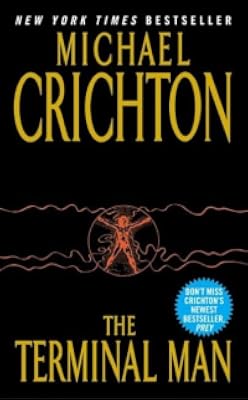
The Terminal Man
by Michael Crichton
On This Page
Description
Fiction. Science Fiction. Suspense. Thriller. HTML:From the bestselling author of Jurassic Park, Timeline, and Sphere comes a neurological thriller about the dangers of cutting-edge medical experimentation.Harry Benson suffers from violent seizures. So violent that he often blackouts when they take hold. Shortly after severely beating two men during an episode, the police escort Benson to a Los Angeles hospital for treatment. There, Dr. Roger McPherson, head of the prestigious show more Neuropsychiatric Research Unit, is convinced he can cure Benson with an experimental procedure that would place electrodes deep in his brain’s pleasure centers, effectively short-circuiting Harry's seizures with pulses of bliss. The surgery is successful, but while Benson is in recovery, he discovers how to trigger the pulses himself. To make matters worse his violent impulses have only grown, and he soon escapes the hospital with a deadly agenda. . . show less
Tags
Recommendations




Member Reviews
There are reviews divided between saying that it is dated, and conversely, that it is ever presently meaningful. However, what I think most reviewers have missed is the storyline of how Harry Benson's fear of the loss of self is misunderstood by everyone around him, including Janet Ross who believes herself to be on his side and against his surgery. This is referenced in a final recollection of hers, of an earlier patient who had eventually committed suicide. The strongest theme in this novel for me was the debate of loss of self. The concerns of the other players in the book is how to reconstruct a good life for Benson, which in his mind is no life at all.
Well, I will give Michael Crichton his due...this is much better than The Andromeda Strain. While that book's plot can be summarized as "Everyone thought there was a deadly emergency but it turns out there wasn't", this book is much more of a straightforward thriller. It spends much less time on philosophy and technical digressions, and he tries really hard to develop his characters. Unfortunately, that's where his novels continue to not work for me. As hard as he tries to give them personalities, they still all feel very flat to me. There are three primary male doctor characters in this novel, and I would challenge anyone, if their dialogue was taken out of context, to be able to identify who said it. There's just nothing particularly show more memorable about any of it. That's his greatest weakness as a writer, and it's what holds his novels back from being great. show less
Wow, the underlying science and technology is really dated, almost 40 years later. That's to be expected, but that facet will be at the forefront of the reader's consciousness.
The book displays the origins of Crichton's technique of extrapolating current science to craft a thriller novel, but it's not as polished as his later work.
The book displays the origins of Crichton's technique of extrapolating current science to craft a thriller novel, but it's not as polished as his later work.
The Terminal Man is a by-the-numbers Crichton novel. Reckless doctors rush a new procedure into use that has scary implications (and for extra scariness, it is powered by a plutonium implant). A wise Cassandra-like protagonist warns against the new procedure, but is ignored. The procedure is performed, and disaster ensues. People die or get horribly injured. The heroic protagonist, with the help of a love interest quality police captain, tracks down the villain and ends the threat.
The story would have been helped if the Cassandra-protagonist's warnings hadn't been so tepid, or if she had stopped whining about how the male doctors wouldn't listen to her because she was a woman (the male doctors probably didn't listen to her because her show more warnings were couched in such listless ways). The plot itself is extremely linear - the book is literally procedure, screw up, resolution. And things go wrong in the book because the nurses in the hospital ward where medical experiments are conducted are portrayed as being extraordinarily dense: they don't recognize the signature of the head of the ward on the experimental patient's chart, and just ignore this critical notation on the chart rather than ask anyone about it. It seems as if Crichton thinks women are simpering fools with heads full of cotton.
This book was one of Crichton's earlier efforts, and it shows. As said before, the Crichton anti-technology playbook is in evidence, probably in its most basic form in this book. The characters are wooden, the female characters are also almost universally stupid or timid, or both. Elements are introduced that have no payoff, like the plutonium powered nature of the implant, the growing memory capabilities of computers, and the unexplained breakdown of a couple simulated computer personalities (which vaguely tie into the plot, but only just barely). Crichton's anti-technology paranoia is front and center through the whole story. The book was made into a movie that flopped, and it is easy to figure out why. This is a book not worth wasting one's time upon. show less
The story would have been helped if the Cassandra-protagonist's warnings hadn't been so tepid, or if she had stopped whining about how the male doctors wouldn't listen to her because she was a woman (the male doctors probably didn't listen to her because her show more warnings were couched in such listless ways). The plot itself is extremely linear - the book is literally procedure, screw up, resolution. And things go wrong in the book because the nurses in the hospital ward where medical experiments are conducted are portrayed as being extraordinarily dense: they don't recognize the signature of the head of the ward on the experimental patient's chart, and just ignore this critical notation on the chart rather than ask anyone about it. It seems as if Crichton thinks women are simpering fools with heads full of cotton.
This book was one of Crichton's earlier efforts, and it shows. As said before, the Crichton anti-technology playbook is in evidence, probably in its most basic form in this book. The characters are wooden, the female characters are also almost universally stupid or timid, or both. Elements are introduced that have no payoff, like the plutonium powered nature of the implant, the growing memory capabilities of computers, and the unexplained breakdown of a couple simulated computer personalities (which vaguely tie into the plot, but only just barely). Crichton's anti-technology paranoia is front and center through the whole story. The book was made into a movie that flopped, and it is easy to figure out why. This is a book not worth wasting one's time upon. show less
More of a novella than a novel, Crichton’s work runs at a mere 261 pages. An author known for science-fiction related horror laden with advanced technology in scientific fields, Crichton’s Terminal Man doesn’t delve into the ocean and alien life as in Sphere, or in the wild pits of the jungle as in Congo, but instead deep into the tangled mess of the human mind. Harry Benson has a form of seizure that induces black-outs, ones accompanied by uncontrollable rage and violence. Thinking they have found their poster boy for a new experimental treatment, a team of specialists work with the police to have the offender receive a new type of operation. Electrodes are planted into his brain, where when the seizure is coming on, the show more electrodes (ran by a main computer system), are activated, instead sending pleasure responses to his tissues. The operation works, until Benson discovers how he can turn on the pleasure nodes with more frequency, resulting in a frantic rampage that turns this tale into one a modern Frankenstein.
Loaded throughout with social commentary, this book gives one food for thought. Beginning with a 2 ½ page introduction from the author, Crichton cites a brief history of man using technology to modify brain behavior through psychosurgery. In the book he uses a psychologist, and touches a little on psychotherapy and non-physical brainwashing, but the real scope of his work explores, points out the good, and then warns against the dangers of man becoming overly arrogant with technology. The plot premise is nothing new (nothing is anymore, though), being done long ago with such works as Frankenstein, Jekyl & Hyde, and so forth. The updated version here uses more modern-day tools, but the story is the same.
Crichton writes with a serious, impersonal style, keeping scenes short and sweet. Real action in terms of violence doesn’t gear up until the end, but it’s not needed until then either. Of course, as with his other books, tons of medical and technological jargon is used, with a few pages illustrated on what the imaginary computer print-outs would show. If you’re a person who doesn’t crave serious pieces, this ones not for you. It’s not boring though, far from it, and while the characters are not delved into deeply it’s told from multiple points of view from a observing manner they seem realistic enough to make things worse. Suspense is high at the end, but this thriller isn’t devoted solely to this response. Instead, it enjoys making people think, much like his others books did.
The Terminal Man is interesting, absorbing, and worth reading. It’s not worthy of five stars simply because it’s not exciting enough after it’s done, but it’s still a good read, especially with those who enjoy shorter works. show less
Loaded throughout with social commentary, this book gives one food for thought. Beginning with a 2 ½ page introduction from the author, Crichton cites a brief history of man using technology to modify brain behavior through psychosurgery. In the book he uses a psychologist, and touches a little on psychotherapy and non-physical brainwashing, but the real scope of his work explores, points out the good, and then warns against the dangers of man becoming overly arrogant with technology. The plot premise is nothing new (nothing is anymore, though), being done long ago with such works as Frankenstein, Jekyl & Hyde, and so forth. The updated version here uses more modern-day tools, but the story is the same.
Crichton writes with a serious, impersonal style, keeping scenes short and sweet. Real action in terms of violence doesn’t gear up until the end, but it’s not needed until then either. Of course, as with his other books, tons of medical and technological jargon is used, with a few pages illustrated on what the imaginary computer print-outs would show. If you’re a person who doesn’t crave serious pieces, this ones not for you. It’s not boring though, far from it, and while the characters are not delved into deeply it’s told from multiple points of view from a observing manner they seem realistic enough to make things worse. Suspense is high at the end, but this thriller isn’t devoted solely to this response. Instead, it enjoys making people think, much like his others books did.
The Terminal Man is interesting, absorbing, and worth reading. It’s not worthy of five stars simply because it’s not exciting enough after it’s done, but it’s still a good read, especially with those who enjoy shorter works. show less
Started this book last night and also finished it after it sat around half read for years. Finally decided to start over on it and finish it this time. Its a good read,ypical of Crichtin. It is full of medical procedures and terminology that leaves to a mini psychological thriller and a search for a criminal. It isn't Crichton's greatest work, but it is definitely good and very thought provoking. I enjoyed it very much and am very happy to be able to check it off on my list of books I've read that are written by Michael Crichton.
A fantastic story about a delusional man who thinks that machines will one day take over the man, and their their intelligence will exceed the combined human intelligence on Earth. Driven mad by this thought, he is sent for treatment where things don't turn out according to plan.
While the concept might seem trivial at first, you are bound to have chills by the end of the book; especially as you look around yourself to find the immense network of intelligent machines ... continuously evolving.
While the concept might seem trivial at first, you are bound to have chills by the end of the book; especially as you look around yourself to find the immense network of intelligent machines ... continuously evolving.
Members
- Recently Added By
Lists

Carole's List
445 works; 13 members

Reading List of Christopher McCandless
12 works; 1 member
Author Information

145+ Works 172,876 Members
John Michael Crichton, known as Michael Crichton, was born on October 28, 1942 in Chicago, Illinois. He wrote novels while attending Harvard University and Harvard Medical School to help pay the tuition. One of these, The Andromeda Strain, which was published in 1969, became a bestseller. After graduating summa cum laude, he was a postdoctoral show more fellow at the Salk Institute in California before becoming a full-time writer and film director. His carefully researched novels included Eaters of the Dead, The Terminal Man, The Great Train Robbery, Congo, Sphere, Jurassic Park, Rising Sun, Disclosure, The Lost World, Airframe, and Micro. He also wrote non-fiction works including Five Patients: The Hospital Explained, Jasper Johns, and Travels. In the late 1960s, he also wrote under the pen names Jeffrey Hudson and John Lange. He has received several awards including Writer of the Year in 1970 from the Association of American Medical Writers and two Edgar Awards in 1968 and in 1979. Many of his novels have been made into highly successful films, six of which he directed. He was also the creator and executive producer of the Emmy Award-winning television series ER. In addition to his writing and directorial success, his expertise in information science enabled him to run a software company and develop a computer game. He died of cancer on November 4, 2008 at the age of 66. (Bowker Author Biography) show less
Some Editions
Awards and Honors
Distinctions
Series
Belongs to Publisher Series
Work Relationships
Is contained in
Has the adaptation
Is abridged in
Common Knowledge
- Canonical title
- The Terminal Man
- Original title
- The Terminal Man
- Original publication date
- 1972
- People/Characters
- Harry Benson; Dr. Roger McPherson; Dr. John Ellis; Dr. Janet Ross; Dr. Morris; Gerhard (show all 7); Richards
- Important places
- Santa Monica, California, USA; Los Angeles, California, USA
- Related movies
- The Terminal Man (1974 | IMDb)
- Epigraph*
- Eerste man gekoppeld aan een computer....en die man is een krankzinnige moordenaar
- Dedication
- To Kurt Villadsen
- First words
- Readers who find the subject matter of this book shocking or frightening should not delude themselves by also thinking it is something quite new.
- Last words
- (Click to show. Warning: May contain spoilers.)She began to cry.
- Original language*
- Inglés
*Some information comes from Common Knowledge in other languages. Click "Edit" for more information.
Classifications
Statistics
- Members
- 4,002
- Popularity
- 3,936
- Reviews
- 45
- Rating
- (3.25)
- Languages
- 15 — Chinese, Czech, Danish, Dutch, English, Finnish, French, German, Hungarian, Italian, Polish, Portuguese, Spanish, Swedish, Turkish
- Media
- Paper, Audiobook, Ebook
- ISBNs
- 70
- ASINs
- 29