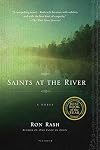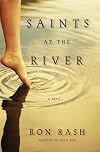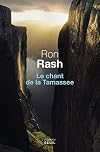
Saints at the River
by Ron Rash
On This Page
Description
When a twelve-year-old girl drowns in the Tamassee River and her body is trapped in a deep eddy, the people of the small South Carolina town that bears the river's name are thrown into the national spotlight. The girl's parents want to attempt a rescue of the body; environmentalists are convinced the rescue operation will cause permanent damage to the river and set a dangerous precedent. Torn between the two sides is Maggie Glenn, a twenty-eight-year-old newspaper photographer who grew up in show more the town and has been sent to document the incident. Since leaving home almost ten years ago, Maggie has done her best to avoid her father, but now, as the town's conflict opens old wounds, she finds herself revisiting the past she's fought so hard to leave behind. Meanwhile, the reporter who's accompanied her to cover the story turns out to have a painful past of his own, and one that might stand in the way of their romance. Drawing on the same lyrical prose and strong sense of place that distinguished his award-winning first novel, One Foot in Eden, Ron Rash has written a book about the deepest human themes: the love of the land, the hold of the dead on the living, and the need to dive beneath the surface to arrive at a deeper truth. Saints at the River confirms the arrival of one of today's most gifted storytellers. show lessTags
Recommendations
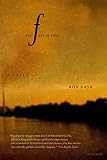



















Member Recommendations
Member Reviews
A twelve year old girl vacationing with her family wades out into the Tamassee River and is swept over the falls downstream. Now her parents want to recover her body and local environmentalists, fisher and kayakers are worried that the method suggested will damage the area around the river and set a precedent allowing for developers to move in. Maggie Glenn is a photographer with a Colombia-based paper, sent to cover the story with a reporter because she is from Oconee county, where the accident occurred.
The story circles around the motivations of both groups, with neither being identified as good or bad. Well, the developer was pretty close to a stock villain, with his habit of simply paying any nominal fines for pollution rather than show more taking the more expensive and time-consuming measures to fix things. Even Rash's notable writing talents did not stretch that far. There's a secondary story about Maggie's broken relationship to her father and her conflicted feelings about being back in her hometown. This was as early novel by Rash, and so it lacks some of the complexity and nuance of his later works, like Serena, but it was a well-written and highly readable book beautifully set in the mountains of South Carolina. show less
The story circles around the motivations of both groups, with neither being identified as good or bad. Well, the developer was pretty close to a stock villain, with his habit of simply paying any nominal fines for pollution rather than show more taking the more expensive and time-consuming measures to fix things. Even Rash's notable writing talents did not stretch that far. There's a secondary story about Maggie's broken relationship to her father and her conflicted feelings about being back in her hometown. This was as early novel by Rash, and so it lacks some of the complexity and nuance of his later works, like Serena, but it was a well-written and highly readable book beautifully set in the mountains of South Carolina. show less
Maggie is a child of the mountains, but she has been away from the mountains for a time, going to college and then working in Columbia, embracing the big city as a newspaper photographer. When a young girl drowns in the Tamassee River and is trapped there, her parents want to bring the body up at any cost, environmentalists fear the cost will be the destruction of the river itself. The stage is set for a battle, and Maggie finds herself in the middle, with a lot of personal baggage on both sides of the issue.
The story is a tad predictable in spots and over before you wish it to be. There is a cliche romance, but it does not dominate the story. These elements keep it from being great, but there are moments when it comes mighty close. show more Even though the environmental side cited Wendell Berry, which ought to have landed me solidly in their camp, I could see this through the eyes of the parents as well, you would want your daughter’s body. It would seem inconceivable that you would just go home and leave her there. In fact, what I admire most about Rash’s treatment here was that it was not preachy but realistic, right down to including all the players who come on the scene just to gain a political edge, money or recognition.
The river itself becomes almost a character, with a voice and a will that cannot be manipulated by a mere human.
Wolf Cliff is a place where nature has gone out of its way to make humans feel insignificant. The cliff itself is two hundred feet of granite that looms over the gorge. A fissure jags down its gray face like a piece of black embedded lightning. The river tightens and deepens. Even water that looks calm moves quick and dangerous. Mid-river fifty yards above the falls a beech tree thick as a telephone pole balances like a footbridge on two haystack-tall boulders. A spring flood set it there twelve years ago.
The characters make poignant arguments:
It's nice to know there is something in the world that’s uncorrupted. Something that can’t be bought and cut up into pieces so somebody can make money off it.
I particularly loved this example from a character who wished to leave the body where it lay:
…the girl’s body is the Tamassee’s now…the moment she stepped in the shallows she accepted the river on its own terms. That’s what the wilderness is – nature on its own terms, not ours, and there’s no middle ground. It either is or it isn’t.
The Appalachians are still a distinct and different region, with some of the best of what is old-fashioned intact, like community and loyalty. There is also a wisdom there that comes from the harder life and knowing nature in a way city-folk simply find it hard to comprehend. Perhaps because most people raised in a city don’t even realize that they cannot see the stars at night the way God meant them to be seen.
This is an early work for Ron Rash, and if you have read any of his later books, you will recognize the immaturity here, but there is also that hint of great things to come. After a rocky start with [b:Serena|2815590|Serena|Ron Rash|https://i.gr-assets.com/images/S/compressed.photo.goodreads.com/books/1347430224l/2815590._SX50_.jpg|2841515], which I simply could not bring myself to love, I have read enough of Ron Rash to become a dyed-in-the-wool fan. As my Daddy would have said, “he is a t.c. huzzy”. It’s a compliment...means a very special one of a kind.
show less
The story is a tad predictable in spots and over before you wish it to be. There is a cliche romance, but it does not dominate the story. These elements keep it from being great, but there are moments when it comes mighty close. show more Even though the environmental side cited Wendell Berry, which ought to have landed me solidly in their camp, I could see this through the eyes of the parents as well, you would want your daughter’s body. It would seem inconceivable that you would just go home and leave her there. In fact, what I admire most about Rash’s treatment here was that it was not preachy but realistic, right down to including all the players who come on the scene just to gain a political edge, money or recognition.
The river itself becomes almost a character, with a voice and a will that cannot be manipulated by a mere human.
Wolf Cliff is a place where nature has gone out of its way to make humans feel insignificant. The cliff itself is two hundred feet of granite that looms over the gorge. A fissure jags down its gray face like a piece of black embedded lightning. The river tightens and deepens. Even water that looks calm moves quick and dangerous. Mid-river fifty yards above the falls a beech tree thick as a telephone pole balances like a footbridge on two haystack-tall boulders. A spring flood set it there twelve years ago.
The characters make poignant arguments:
It's nice to know there is something in the world that’s uncorrupted. Something that can’t be bought and cut up into pieces so somebody can make money off it.
I particularly loved this example from a character who wished to leave the body where it lay:
…the girl’s body is the Tamassee’s now…the moment she stepped in the shallows she accepted the river on its own terms. That’s what the wilderness is – nature on its own terms, not ours, and there’s no middle ground. It either is or it isn’t.
The Appalachians are still a distinct and different region, with some of the best of what is old-fashioned intact, like community and loyalty. There is also a wisdom there that comes from the harder life and knowing nature in a way city-folk simply find it hard to comprehend. Perhaps because most people raised in a city don’t even realize that they cannot see the stars at night the way God meant them to be seen.
This is an early work for Ron Rash, and if you have read any of his later books, you will recognize the immaturity here, but there is also that hint of great things to come. After a rocky start with [b:Serena|2815590|Serena|Ron Rash|https://i.gr-assets.com/images/S/compressed.photo.goodreads.com/books/1347430224l/2815590._SX50_.jpg|2841515], which I simply could not bring myself to love, I have read enough of Ron Rash to become a dyed-in-the-wool fan. As my Daddy would have said, “he is a t.c. huzzy”. It’s a compliment...means a very special one of a kind.
show less
SAINTS AT THE RIVER begins with its main issue, the issue at the center of the story. I think of it as prologue, although that’s not what Ron Rash calls it. As always, he writes it beautifully and it was promising, the way all prologues should be. It made me anxious to read more.
A girl drowns in the Tamassee River in a rural town in South Carolina. This becomes a big controversy, not only in that town but in the country because divers cannot get to her body without first damaging the riverbed. Doing so would violate conservation laws, and, say environmentalists, set a president for others to cause more damage when it is in their business interests.
But the girl's parents want to give their daughter a proper burial. So they need to get show more her body out of that river, and they find someone who claims to be able to do that.
But the townspeople know the river better than these “outsiders.” They know that trying to alter that river is flirting with danger.
One large newspaper covering this story sends its star reporter to that town, along with a photographer who coincidentally grew up there. They try not to take sides. But the reporter, Allen, recently lost his wife and daughter in a car accident so tends to sympathize with the girl’s parents. On the other hand, a few years ago the photographer, Maggie, was an environmentalist working alongside the protesters. But even she tends to sympathize with the girl’s parents. Maggie at least understands both sides of the issue.
Although townspeople warn of the danger of tampering with this fast–moving river and although doing so is against the law, a man is permitted to erect a temporary dam in hopes that divers will be better able to get to the girl’s body.
Then all hell breaks loose. And Maggie, who has been understanding both sides of the issue, has now earned the wrath of most of her old friends and neighbors and, especially, of her old lover.
SAINTS AT THE RIVER is Rash's second book. I am so glad I finally found it. show less
A girl drowns in the Tamassee River in a rural town in South Carolina. This becomes a big controversy, not only in that town but in the country because divers cannot get to her body without first damaging the riverbed. Doing so would violate conservation laws, and, say environmentalists, set a president for others to cause more damage when it is in their business interests.
But the girl's parents want to give their daughter a proper burial. So they need to get show more her body out of that river, and they find someone who claims to be able to do that.
But the townspeople know the river better than these “outsiders.” They know that trying to alter that river is flirting with danger.
One large newspaper covering this story sends its star reporter to that town, along with a photographer who coincidentally grew up there. They try not to take sides. But the reporter, Allen, recently lost his wife and daughter in a car accident so tends to sympathize with the girl’s parents. On the other hand, a few years ago the photographer, Maggie, was an environmentalist working alongside the protesters. But even she tends to sympathize with the girl’s parents. Maggie at least understands both sides of the issue.
Although townspeople warn of the danger of tampering with this fast–moving river and although doing so is against the law, a man is permitted to erect a temporary dam in hopes that divers will be better able to get to the girl’s body.
Then all hell breaks loose. And Maggie, who has been understanding both sides of the issue, has now earned the wrath of most of her old friends and neighbors and, especially, of her old lover.
SAINTS AT THE RIVER is Rash's second book. I am so glad I finally found it. show less
I loved this book for the richness of language and story. The characters are memorable, the struggle is one that focuses on the emotional tensions that run high during a tragedy. There are layers to the narrative that I enjoy, from the point of view of the family of the victim, the rescuers, and the reporters sent to cover the story. For me, Ron's books always provide a window into the very best and worst parts of human nature, and this is no exception.
Rash is a better poet than a novelist. He has a beautiful command of the language, but his characters lack depth. The female protagonist is merely a caricature of a young woman--obsessed with men, sex, and looks.
I loved this book for the richness of language and story. The characters are memorable, the struggle is one that focuses on the emotional tensions that run high during a tragedy. There are layers to the narrative that I enjoy, from the point of view of the family of the victim, the rescuers, and the reporters sent to cover the story. For me, Ron's books always provide a window into the very best and worst parts of human nature, and this is no exception.
A 12-year-old girl drowns and her body is trapped in a river in the Appalachians in South Carolina. Thus begins the push and pull between her parents and the sentimental vote who want her body to be removed in order to give her a proper burial and the environmentalists who believe that that operation will damage a river that is supposed to be federally protected. The narrator is Maggie Glenn, who grew up in the area and is now a big-city newspaper photographer. She comes back to town to document the drama and also puts to rest some of the demons from her own past. Will leave you thinking about loyalty, forgiveness, and the gray areas of life. Highly recommended.
Members
- Recently Added By
Lists

Top Five Books of 2014
1,064 works; 398 members
Author Information

28+ Works 6,826 Members
Some Editions
Awards and Honors
Awards
Notable Lists
Series
Belongs to Publisher Series
Seuil, Points (P4509)
Common Knowledge
- Canonical title
- Saints at the River
- Original title
- Saints at the River
- Original publication date
- 2004
- People/Characters*
- Maggie Glenn (La narratrice et protagoniste, Journaliste photographe); Allen Hemphill (Protagoniste, Journaliste, Ami/compagnon de Maggie); Luke Miller (Militant écologiste intransigeant, Ex compagnon de Maggie); Billy Watson (= William Watson III, Ami d'enfance de Maggie, Commerçant); Mr Glenn (Le père de Maggie, Frère de Margaret); Herb Kowalski (Le père de Ruth) (show all 23); Ellen Kowalski (La mère de Ruth); Ben Glenn (Le frère de Maggie); Ruth Kowalski (L'enfant noyée dans la Tamassee); Peter Brennon (Le fabricant et installateur de barrage amovible); Margaret Lusk (Tante de Maggie); Joel Lusk (Fils de Margaret, Cousin de Maggie); Earl Wilkinson (l'exploitant d'une société de rafting touristique, Ami d'enfance de Maggie); Tony Brian (Le promoteur immobilier); Billy Watson (= William Watson III, Ami d'enfance de Maggie, Commerçant); Randy Moseley (Ami d'enfance de Maggie, Sauveteur plongeur); Ronny Moseley (Ami d'enfance de Maggie, Sauveteur plongeur); Walter Phillips (Le garde firextier régional de Tamassee et de la forêt nationale d'Oconee); Le shérif Cantrell (Shériff de Tamassee); Hubert McClure (L'adjoint du Shériff Cantrell); Mama Tilson (Tenancière du Restaurant); Harley Winchester (Bûcheron âgé, Ami du père de Maggie); Lee Gervais (Le rédacteur en chef de Maggie et Allen)
- Important places*
- Tamassee, Caroline du Sud, Etats-Unis; Columbia,Caroline du Sud, Etats-Unis
- Epigraph*
- Elle n’a pas à blâmer le dévot ; mais peut être en mesure de n’en faire l’éloge que sous condition, comme un être qui agit loyalement selon ses droits.
William James, « The Value of Saintliness »... (show all)> - Dedication*
- Pour Ann
- First words*
- Première partie
Elle descend le chemin qui longe la rivière, laissant derrière elle ses parents et son petit frère toujours autour du pique-nique. [...]
UN
Des fantômes.
[...] - Last words*
- (Click to show. Warning: May contain spoilers.)[...].
Dans l'obscurité du rocher en forme de dôme, sous les chutes, nul courant ne ralentit ni ne s'incurve en souvenir de la présence, autrefois, de Ruth Kowalski et de Randy Moseley, car ils ont maintenant et pour toujours sombré dans le vaste et généreux oubli de la rivière. - Original language*
- Anglais (Etats-Unis) (Etats-Unis)
*Some information comes from Common Knowledge in other languages. Click "Edit" for more information.
Classifications
Statistics
- Members
- 416
- Popularity
- 74,116
- Reviews
- 17
- Rating
- (3.63)
- Languages
- English, French
- Media
- Paper, Ebook
- ISBNs
- 7
- ASINs
- 5