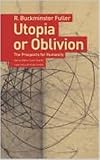
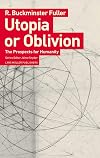
Utopia or Oblivion: The Prospects for Humanity
by R. Buckminster Fuller
On This Page
Description
Buckminster Fuller (1895–1983) was an architect, engineer, geometrician, cartographer, philosopher, futurist, inventor of the famous geodesic dome, and one of the most brilliant thinkers of his time. For more than five decades, he set forth his comprehensive perspective on the world's problems in numerous essays, which offer an illuminating insight into the intellectual universe of this renaissance man. These texts remain surprisingly topical even today, decades after their initial show more publication.While Fuller wrote the works in the 1960's and 1970's, they could not be more timely: like desperately needed time-capsules of wisdom for the critical moment he foresaw, and in which we find ourselves. Long out of print, they are now being published again, together with commentary by Jaime Snyder, the grandson of Buckminster Fuller. Designed for a new generation of readers, Snyder prepared these editions with supplementary material providing background on the texts, factual updates, and interpretation of his visionary ideas.Initially published in 1969, and one of Fuller's most popular works, Operating Manual for Spaceship Earth is a brilliant synthesis of his world view. In this very accessible volume, Fuller investigates the great challenges facing humanity, and the principles for avoiding extinction and “exercising our option to make it”. How will humanity survive? How does automation influence individualization? How can we utilize our resources more effectively to realize our potential to end poverty in this generation? He questions the concept of specialization, calls for a design revolution of innovation, and offers advice on how to guide “spaceship earth” toward a sustainable future.And it Came to Pass – Not to Stay brings together Buckminster Fuller's lyrical and philosophical best, including seven “essays” in a form he called his “ventilated prose”, and as always addressing the current global crisis and his predictions for the future. These essays, including “How Little I Know”, “What I am Trying to Do“, “Soft Revolution”, and “Ethics”, put the task of ushering in a new era of humanity in the context of “always starting with the universe”. In rare form, Fuller elegantly weaves the personal, the playful, the simple, and the profound.Utopia or Oblivion is a provocative blueprint for the future. This comprehensive volume is composed of essays derived from the lectures he gave all over the world during the 1960's. Fuller's thesis is that humanity – for the first time in its history – has the opportunity to create a world where the needs of 100% of humanity are met. This is Fuller in his prime, relaying his urgent message for earthians critical moment and presenting pioneering solutions which reflect his commitment to the potential of innovative design to create technology that does “more with less” and thereby improves human lives . . . “This is what man tends to call utopia. It's a fairly small word, but inadequate to describe the extraordinary new freedom of man in a new relationship to universe - the alternative of which is oblivion.” Buckminster Fuller. show lessTags
Recommendations



































Member Reviews
This text presents Fuller's speculative philosophy of history, in a somewhat piecemeal fashion of various talks. fuller has an unusual background of both social and technical expertise. His perspective is menat to be stimulating
Rated: F
Ratings
Members
- Recently Added By
Author Information

74+ Works 4,437 Members
Richard Buckminster "Bucky" Fuller, the innovative thinker, engineer, and inventor, was born July 12, 1895 in Milton, Massachusetts. Despite early failures and tragedies, including his being expelled from Harvard University twice and the death of his four-year-old daughter, Fuller went on to achieve many successes. He is best known for inventing show more the geodesic dome; his design has been used in structures all over the world. Besides Harvard, Fuller also attended the U.S. Naval Academy, and was a professor at Southern Illinois University. He is the author of Synergetics: Explanations in the Geometry of Thinking, a book that discusses the utopic role technology will play in the future. Critical Path is the book Fuller felt was his most important. It outlined his plan to rejuvenate earth through the use of technology. His last book, Grunch of Giants, summarizes his most important ideas. Fuller was awarded 28 United States patents and many honorary doctorates. In 1968 he was elected into the National Academy of Design as an Associate member. In 1970 he received the Gold Medal award from the American Institute of Architects. He also received the Presidential Medal of Freedom presented to him on February 23, 1983 by President Ronald Reagan. (Bowker Author Biography) show less
Series
Belongs to Publisher Series
Pelican Books (A1567)
Common Knowledge
- Original publication date
- 1969
Classifications
Statistics
- Members
- 316
- Popularity
- 101,404
- Reviews
- 2
- Rating
- (3.48)
- Languages
- English
- Media
- Paper, Ebook
- ISBNs
- 9
- ASINs
- 10