On This Page
Description
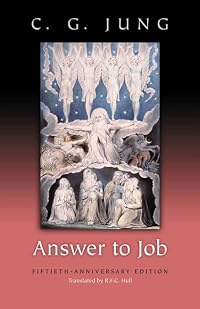
Considered one of Jung's most controversial works, Answer to Job also stands as Jung's most extensive commentary on a biblical text. Here, he confronts the story of the man who challenged God, the man who experienced hell on earth and still did not reject his faith. Job's journey parallels Jung's own experience--as reported in The Red Book: Liber Novus--of descending into the depths of his own unconscious, confronting and reconciling the rejected aspects of his soul. This paperback edition show more of Jung's classic work includes a new foreword by Sonu Shamdasani, Philemon Professor of Jung History at University College London. Described by Shamdasani as "the theology behind The Red Book," Answer to Job examines the symbolic role that theological concepts play in an individual's psychic life. show lessTags
Recommendations













Member Reviews
Just as Freud wrote Moses and Monotheism at the end of his career, in which he analyzed the Hebrew religious tradition; Jung wrote Answer to Job late in life as an attempt to integrate the Christian God. It is sometimes hilariously chatty, as when he remarks that "the family life of our first parents was not all beer and skittles." (p. 31) The central thesis is that the motive for the Christian Incarnation was to redeem God, whose moral inferiority had been disclosed by the events of Job. Jung's text culminates in a discussion of the Apocalypse.
Although Jung at first claims to be limiting his treatment to the psycho-symbolic dimensions of the Apocalyptic narrative, without discussing their parallels in historical events, he eventually show more succumbs to the latter temptation. Specifically, he points out the Roman Catholic church's doctrinal acceptance of the Assumption of the Virgin as a socio-historical realization of the Patmos vision of the Woman Clothed with the Sun.
In my reading, it occurred to me that the Catholic church can function like a great mythic barometer of Western society, because of its vast population, tightly integrated through an organismic hierarchy. And I wondered what "archetypal" conditions might be augured by that church's current focus of attention: priestly child abuse. The paternal figure of the priest, denoted as benevolent and an agent of divine forgiveness, is now shown to have a terrible hidden aspect more fearsome than that of the God of Job. While that God was merely unjust in authorizing the torment of a righteous man, the God of the abusive priest is cruel in having his ministers victimize the innocent.
Of course, this cruelty is not entirely without biblical precedent. The plague on the firstborn of Egypt was, at least, visited on the offspring of tyrannous, non-Yahweh-respecting, unregenerate pagans who were thus understood as estranged from God. But the molestation of Roman Catholic children who have been brought to church for blessing and instruction is more reminiscent of Herod's massacre of the innocents, which usually portends an array of dark and worldly forces opposing God's attempt at sacrificial incarnation. In this case, though, it is God who sends the sacerdotal predators, like He sends the locusts from the bottomless pit in Revelation IX:
"For their power is in their mouth, and in their tails: for their tails [were] like unto serpents, and had heads, and with them they do hurt." (v. 19) show less
Although Jung at first claims to be limiting his treatment to the psycho-symbolic dimensions of the Apocalyptic narrative, without discussing their parallels in historical events, he eventually show more succumbs to the latter temptation. Specifically, he points out the Roman Catholic church's doctrinal acceptance of the Assumption of the Virgin as a socio-historical realization of the Patmos vision of the Woman Clothed with the Sun.
In my reading, it occurred to me that the Catholic church can function like a great mythic barometer of Western society, because of its vast population, tightly integrated through an organismic hierarchy. And I wondered what "archetypal" conditions might be augured by that church's current focus of attention: priestly child abuse. The paternal figure of the priest, denoted as benevolent and an agent of divine forgiveness, is now shown to have a terrible hidden aspect more fearsome than that of the God of Job. While that God was merely unjust in authorizing the torment of a righteous man, the God of the abusive priest is cruel in having his ministers victimize the innocent.
Of course, this cruelty is not entirely without biblical precedent. The plague on the firstborn of Egypt was, at least, visited on the offspring of tyrannous, non-Yahweh-respecting, unregenerate pagans who were thus understood as estranged from God. But the molestation of Roman Catholic children who have been brought to church for blessing and instruction is more reminiscent of Herod's massacre of the innocents, which usually portends an array of dark and worldly forces opposing God's attempt at sacrificial incarnation. In this case, though, it is God who sends the sacerdotal predators, like He sends the locusts from the bottomless pit in Revelation IX:
"For their power is in their mouth, and in their tails: for their tails [were] like unto serpents, and had heads, and with them they do hurt." (v. 19) show less
This is not a theological or a religious book. This will probably go over any biblical literalist's head. It is a psychological address of the Christian culture's general propensity to divide their conscious attitude into light (good) and dark (evil) while repressing the dark attributes (metaphorically banishing the shadow to the underworld) into the unconscious. Jung recognized that this habit created a lot of unconscious neurotic and psychotic behavior in Christian culture at large and wanted to heal this rift. Jung uses his discussion of The Book of Job as a folkloric aid in unifying these pairs of opposites. It should be noted that Jung also presents this exact point with the gnostic notion of Abraxas in "Seven Sermons to the Dead."
Four stars because it greatly expanded my view of the interpersonal dynamics of important Biblical events.
It's sometimes difficult to tell where Jung stands, vis-à-vis historical/biblical scholarship (even though, admittedly, that's not his focus at all).
"Jung. . . .points out that the psychology of religion has two aspects, the psychology of religious persons and the psychology of religious 'contents.' He has himself, in this book, made a rare and original contribution to the latter."--A.M. Silver, British Journal of Psychology
REPONSE A JOB
Le Livre de Job est comme un point de repère au sein
des péripéties d'un drame divin. Lorsqu'il prit naissance,
de nombreux témoignages antérieurs évoquaient déjà une
image pleine de contradictions de Yahvé: celle d'un dieu
qui, dans ses émotions, dépasse toute mesure et souffre
précisément de cette démesure.
Ce dieu doit s'avouer luimême que la colère et la jalousie le consument et qu'il lui est douloureux de le constater. La réflexion et la connaissance résident en lui à côté de l'irréflexion et de l'ignorance de soi-même, comme résident aussi la bonté à côté de la cruauté, et la force créatrice à côté de la volonté de détruire. Tous ces éléments sont présents et aucun ne gêne l'autre. Un show more tel état mental n'est pensable à nos yeux qu'en l'absence de toute conscience réfléchie, ou bien, si cette conscience existe, cela signifie que la réflexion y est alors occasionnelle, passive, impuissante. Un état semblable, avec des caractéristiques de cette sorte, ne peut se qualifie autrement que d'amoral.
Le témoignage des Ecritures nous apprend comment les
hommes de l'Ancien Testament ont éprouvé leur Dieu.... show less
Le Livre de Job est comme un point de repère au sein
des péripéties d'un drame divin. Lorsqu'il prit naissance,
de nombreux témoignages antérieurs évoquaient déjà une
image pleine de contradictions de Yahvé: celle d'un dieu
qui, dans ses émotions, dépasse toute mesure et souffre
précisément de cette démesure.
Ce dieu doit s'avouer luimême que la colère et la jalousie le consument et qu'il lui est douloureux de le constater. La réflexion et la connaissance résident en lui à côté de l'irréflexion et de l'ignorance de soi-même, comme résident aussi la bonté à côté de la cruauté, et la force créatrice à côté de la volonté de détruire. Tous ces éléments sont présents et aucun ne gêne l'autre. Un show more tel état mental n'est pensable à nos yeux qu'en l'absence de toute conscience réfléchie, ou bien, si cette conscience existe, cela signifie que la réflexion y est alors occasionnelle, passive, impuissante. Un état semblable, avec des caractéristiques de cette sorte, ne peut se qualifie autrement que d'amoral.
Le témoignage des Ecritures nous apprend comment les
hommes de l'Ancien Testament ont éprouvé leur Dieu.... show less
Mar 26, 2018 (Edited)Spanish
Members
- Recently Added By
Lists

Jordan B. Peterson's Recommended Books
104 works; 5 members

Mo's Reading List
218 works; 1 member

Mo's Reading List (Abridged)
75 works; 1 member
Author Information

Carl Gustav Jung was born in Switzerland on July 26, 1875. He originally set out to study archaeology, but switched to medicine and began practicing psychiatry in Basel after receiving his degree from the University of Basel in 1902. He became one of the most famous of modern psychologists and psychiatrists. Jung first met Sigmund Freud in 1907 show more when he became his foremost associate and disciple. The break came with the publication of Jung's Psychology of the Unconscious (1912), which did not follow Freud's theories of the libido and the unconscious. Jung eventually rejected Freud's system of psychoanalysis for his own "analytic psychology." This emphasizes present conflicts rather than those from childhood; it also takes into account the conflict arising from what Jung called the "collective unconscious"---evolutionary and cultural factors determining individual development. Jung invented the association word test and contributed the word complex to psychology, and first described the "introvert" and "extrovert" types. His interest in the human psyche, past and present, led him to study mythology, alchemy, oriental religions and philosophies, and traditional peoples. Later he became interested in parapsychology and the occult. He thought that unidentified flying objects (UFOs) might be a psychological projection of modern people's anxieties. He wrote several books including Studies in Word Association, Flying Saucers: A Modern Myth of Things Seen in the Skies, and Psychology and Alchemy. He died on June 6, 1961 after a short illness. (Bowker Author Biography) show less
Some Editions
Series

Belongs to Publisher Series
Bollingen Series ((20))
Collected Works of C. G. Jung (Excerpts from CW Vol. 11)
Work Relationships
Is contained in
Has as a student's study guide
Common Knowledge
- Original title
- Antwort auf Hiob
- Original publication date
- 1952 (German) (German); 1954 (English: Hull) (English: Hull)
- Original language
- German
Classifications
- Genres
- Nonfiction, Religion & Spirituality, General Nonfiction, Philosophy
- DDC/MDS
- 223.106 — Religion The Bible Poetic books of Old Testament Job
- LCC
- BL51 .J853 — Philosophy, Psychology and Religion Religions. Mythology. Rationalism Religions. Mythology. Rationalism Philosophy of religion. Psychology of religion. Religion
- BISAC
Statistics
- Members
- 891
- Popularity
- 30,099
- Reviews
- 8
- Rating
- (3.95)
- Languages
- 13 — Dutch, English, Estonian, Finnish, French, German, Greek, Hungarian, Italian, Norwegian (Bokmål), Portuguese, Spanish, Swedish
- Media
- Paper, Audiobook, Ebook
- ISBNs
- 37
- ASINs
- 24