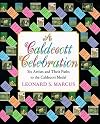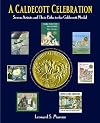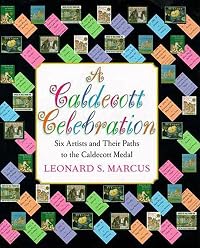
A Caldecott Celebration: Six Artists Share Their Paths to the Caldecott Medal
by Leonard S. Marcus, Chris Van Allsburg (Illustrator), Marcia Joan Brown (Illustrator), Robert McCloskey (Illustrator), Maurice Sendak (Illustrator), William Steig (Illustrator), David Wiesner (Illustrator)
On This Page
Description
Profiles six Caldecott award winning books and their authors, including Robert McCloskey's "Make Way for Ducklings," Marcia Brown's "Cinderella," Maurice Sendak's "Where the Wild Things Are," William Steig's "Sylvester and the Magic Pebble," Chris Van Allsburg's "Jumanji," and David Wiesner's "Tuesday."Tags
Recommendations








Member Reviews
I did not realize that it's a kids' book, so it was nice to learn so much in an easier and more concise read than I anticipated.
Of course, some of my favorite artists are missing. But this book is a wonderful way to learn what artists go through when creating a book that they really care about, and that the Caldecott judges agree is valuable.
Of course, some of my favorite artists are missing. But this book is a wonderful way to learn what artists go through when creating a book that they really care about, and that the Caldecott judges agree is valuable.
In A Caldecott Celebration: Six Artists and Their Paths to the Caldecott Medal, Leonard Marcus illustrates the long road six Caldecott illustrators followed to produce to an award-winning book. This book is a combination of biography and art history as it looks at how six artists approached children’s book illustration over the last six decades.
I love the children’s books Marcus highlights, and it was truly fascinating to learn the stories behind them. The books he highlights are these (one for each decade).
* Make Way for Ducklings by Robert McCloskey (1942 Caldecott Medal winner)
* Cinderella by Marcia Brown (1955 winner)
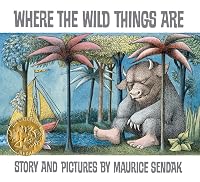
* Where the Wild Things Are by Maurice Sendak (1964 winner)
* Sylvester and the Magic Pebble by William Steig show more (1970 winner)
* Jumanji by Chris Van Allsburg (1982 winner)
* Tuesday by David Weisner (1992 winner)
If you are interested in the Caldecott winners or children’s picture book illustration in general, I’d highly recommend A Caldecott Celebration. It’s short (less than 50 pages), and I can only wish this covered many more of the Caldecott winners: One a decade didn’t satisfy my curiosity!
More detailed review on my blog show less
I love the children’s books Marcus highlights, and it was truly fascinating to learn the stories behind them. The books he highlights are these (one for each decade).
* Make Way for Ducklings by Robert McCloskey (1942 Caldecott Medal winner)
* Cinderella by Marcia Brown (1955 winner)
* Where the Wild Things Are by Maurice Sendak (1964 winner)
* Sylvester and the Magic Pebble by William Steig show more (1970 winner)
* Jumanji by Chris Van Allsburg (1982 winner)
* Tuesday by David Weisner (1992 winner)
If you are interested in the Caldecott winners or children’s picture book illustration in general, I’d highly recommend A Caldecott Celebration. It’s short (less than 50 pages), and I can only wish this covered many more of the Caldecott winners: One a decade didn’t satisfy my curiosity!
More detailed review on my blog show less
Named for the nineteenth--century English illustrator Randolph Caldecott, since 1938, this award is given to excellent illustrated children's books. Those awarded, can be assured their book will be read by many, and their book will be held as the finest available in the year awarded.
Awarded each year by the American Library Association, the winner of the Caldecott Medal must be a U.S. citizen or resident. Each year a different group of 15 people meet secretly to make the decision.
http://www.ala.org/alsc/awardsgrants/bookmedia/caldecottmedal/caldecotthonors/ca...
The author of [A Caldecott Celebration] chose seven Caldecott Medal books spanning seven decades of the medal's history. Each book and author is outlined with wonderful show more information.
Those examined are:
[Make Way for Duckling] by [[Robert McCloskey]] the 1942 winner
[Cinderella; or, The Little Glass Slipper] by [[Marcia Brown]] the 1955 winner
[Where the Wild Things are] by [[Maurice Sendak]] the 1964 winner
[Sylvester and the Magic Pebble] by [[William Steig]] the 1970 winner
[Jumanji] by [[Chris Van Allsburg]] the 1982 winner
[Tuesday] by [[David Wiesner]] the 1992 winner
[The Man Who Walked Between the Towers] by [[Mordicai Gerstein]] show less
Awarded each year by the American Library Association, the winner of the Caldecott Medal must be a U.S. citizen or resident. Each year a different group of 15 people meet secretly to make the decision.
http://www.ala.org/alsc/awardsgrants/bookmedia/caldecottmedal/caldecotthonors/ca...
The author of [A Caldecott Celebration] chose seven Caldecott Medal books spanning seven decades of the medal's history. Each book and author is outlined with wonderful show more information.
Those examined are:
[Make Way for Duckling] by [[Robert McCloskey]] the 1942 winner
[Cinderella; or, The Little Glass Slipper] by [[Marcia Brown]] the 1955 winner
[Where the Wild Things are] by [[Maurice Sendak]] the 1964 winner
[Sylvester and the Magic Pebble] by [[William Steig]] the 1970 winner
[Jumanji] by [[Chris Van Allsburg]] the 1982 winner
[Tuesday] by [[David Wiesner]] the 1992 winner
[The Man Who Walked Between the Towers] by [[Mordicai Gerstein]] show less
a look at Caldecott winners and how they began their careers, as well as how they have been influenced to creat the art they do.
a look at Caldecott winners and how they began their careers, as well as how they have been influenced to create the art they do.
Mini biographies of seven Caldecott winners spanning seven decades.
Ratings
Members
- Recently Added By
Lists

Books Read in 2022
5,166 works; 112 members

Books about Books
149 works; 24 members
Author Information

43+ Works 2,853 Members
Leonard S. Marcus is one of the world's most respected writers about children's literature. His essays, interviews, and reviews appear in the New York Times Book Review and numerous other publications, and he has a regular column in Parenting magazine. His books include Minders of Make-Believe: Idealists, Entrepreneurs, and the Shaping of American show more Children's Literature; Golden Legacy: How Golden Books Won Children's Hearts, Changed Publishing Forever, and Became an American Icon Along the Way; A Caldecott Celebration: Seven Artists and Their Paths to the Caldecott Medal; Dear Genius: The Letters of Ursula Nordstrom; and The Wand in the Word: Conversations with Writers of Fantasy. Leonard S. Marcus lives in Brooklyn, New York, with his wife and son. show less

Considered to be one of the foremost authors and illustrators of surrealistic fantasy for children, Chris Van Allsburg was born in Grand Rapids, Michigan, in 1949. He received his B. F. A. at the University of Michigan and his M. F. A. at the Rhode Island School of Design. He married Lisa Morrison and currently teaches at the Rhode Island School show more of Design. Van Allsburg's work is highly praised for the excellent artisanship of his illustrations, which often have a surreal element. His first book, The Garden of Abdul Gasazi (1979), concerning a lost dog found by a magician, and his second book, Jumanji (1981), about a strange board game that comes to life, brought him quick praise. Jumanji won the Caldecott Medal in 1982. The Polar Express (1985), Van Allsburg's most popular book, deals with the idea that the ability to believe in things beyond one's experiences helps to keep a person young. It also won a Caldecott Medal in 1986. Other books by Van Allsburg include The Z was Zapped, and Just a Dream, a story about a boy who learns to be ecological. Van Allsburg's sculptures have also been exhibited at many New York galleries. (Bowker Author Biography) show less


Robert McCloskey was born in Hamilton, Ohio on September 14, 1914. In 1932, he won a scholarship to the Vesper George Art School in Boston. Two years later he was commissioned to execute bas-reliefs for the municipal building in his hometown. Then he moved to New York to study at the National Academy of Design. He painted for two summers on Cape show more Cod, but only sold a few water colors during that time. After meeting with a children's book editor, he moved back Ohio and began to draw and paint the things around him in everyday life. The result was Lentil, the story of a boy and his harmonica in a typical Midwestern town. He returned to New York, where Viking Press acquired the book. He then got a job in Boston, assisting Francis Scott Bradford in making an enormous mural of famous people of Beacon Hill. It was there that he got the idea for Make Way for Ducklings, which won the Caldecott Medal in 1942. During World War II, he was a sergeant in the Army. Stationed in Alabama, he was assigned to draw training pictures. After the war, he continued to write and illustrate children's books including Blueberries for Sal, One Morning in Maine, Time of Wonder, and Burt Dow, Deep-Water Man. Time of Wonder was awarded the Caldecott Medal in 1958, making McCloskey the first artist to receive this honor twice. In 1974, he was awarded the Regina Medal by the Catholic Library Association for continued distinguished contribution to children's literature. He died on June 30, 2003 at the age of 88. (Bowker Author Biography) show less

Maurice Sendak was born on June 10, 1928 in Brooklyn, New York. While in high school, he worked part time as an illustrator for All-American Comics adapting the Mutt and Jeff newspaper comic strip to a comic book format. His first professional illustrations were for a physics textbook, Atomics for the Millions, published in 1947. He later worked show more as a window-display director for F.A.O. Schwartz while attending night school at the Art Students League. In 1950, he illustrated his first children's book The Wonderful Farm by Marcel Aymé. He wrote his first children's book Kenny's Window in 1956 and went on to become a prolific author-illustrator. His works include Chicken Soup with Rice; In the Night Kitchen; Outside Over There; Higglety Pigglety Pop; The Sign on Rosie's Door; We Are All in the Dumps with Jack and Guy; Brundibar; Bumble Ardy; and My Brother's Book. He received numerous awards including the Caldecott medal for Where The Wild Things Are in 1964, the Hans Christian Andersen International Medal in 1970, the Laura Ingalls Wilder Award, and the National Medal of Arts in 1996. Characters from two of his books were the basis of an animated television special, Really Rosie, which first aired in 1975. He was also the set designer and lyricist for a subsequent off-Broadway musical of the same title. He was the lyricist, as well as the set and costume designer, for the original production of an opera based on Where The Wild Things Are in 1980. In addition, he has designed sets and costumes for performances of operas by Mozart, Prokofiev, and other classical composers. He died due to complications from a recent stroke on May 8, 2012 at the age of 83. (Bowker Author Biography) show less

William Steig was born in Brooklyn, New York, on November 14, 1907, and spent his childhood in the Bronx. Steig found an outlet for his talent by creating cartoons for the high school newspaper. After high school graduation, Steig spent two years at City College, three years at the National Academy, and five days at the Yale School of Fine Arts show more before dropping out. During his early days as a free-lance artist, he supplemented his income with work in advertising, although he intensely disliked it. He illustrated for the The New Yorker, beginning in 1930. During the 1940s, Steig's creativity found a more agreeable outlet when he began carving figurines in wood; his sculptures are on display as part of the collection in the historic home of Franklin D. Roosevelt in Hyde Park, New York, and in several museums in New England. In 1967, Bob Kraus, a fellow cartoonist at The New Yorker, was in the process of organizing Windmill Books, an imprint for Harper & Row. Kraus suggested that Steig try writing and illustrating a book for a young audience. The result was Steig's letter-puzzle book entitled C D B!, published in 1968. Roland the Minstrel Pig, was published the same year. With his very next title, Sylvester and the Magic Pebble, he won the Caldecott Medal. The Amazing Bone was also a Caldecott Honor Book.In 1972, Steig published his first children's novel, Dominic, which won the Christopher Award. Abel's Island followed and was a Newberry Honor Book. William Steig died in October 3, 2003 in Boston Massachusettes. (Bowker Author Biography) show less

American children's book author and illustrator David Wiesner was born in Bridgewater, New Jersey on February 5, 1956. He graduated with a BFA in Illustration from Rhode Island School of Design. Known for his imaginative work, Wiesner is particularly celebrated for using wordless storytelling in his picture books. His latest picture book is about show more two artists; it is entitled, Art & Max. "Sector 7" and "Free Fall" are Caldecott Honor Books, while Wiesner won the prestigious Caldecott Medal for "Tuesday" (1992), "The Three Pigs" (2002), and "Flotsam" (2007). Wiesner is only the second person to have won this award three times. (Bowker Author Biography) show less
Awards and Honors
Awards
Distinctions
Common Knowledge
- Original publication date
- 1998
- People/Characters
- Robert McCloskey; Marcia Brown; Maurice Sendak; William Steig; Chris Van Allsburg; David Wiesner
- Epigraph
- It is deeply satisfying to win a prize in front of a lot of people.
--E.B. White, Charlotte's Web - Dedication
- For Amy and Jacob with love - L.S.M.
- First words
- Introduction: Artists, like everyone, enjoy being praised for a job well done.
- Last words
- (Click to show. Warning: May contain spoilers.)When I saw my book and name at the end of the list, I though, 'Wow!' - and realized that from now on I would always be a part of that tradition.
Classifications
Statistics
- Members
- 150
- Popularity
- 218,221
- Reviews
- 6
- Rating
- (3.89)
- Languages
- English
- Media
- Paper
- ISBNs
- 4