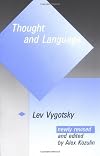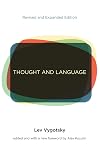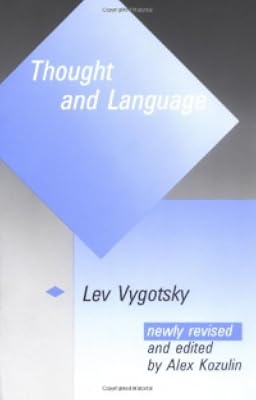
Thought and Language
by Lev S. Vygotsky
On This Page
Description
Lev Vygotsky's Thought and Language has become recognized as a classic foundational work of cognitive science. Its 1962 English translation must certainly be considered one of the most important and influential books ever published by the MIT Press. In this highly original exploration of human mental development, Vygotsky analyzes the relationship between words and consciousness, arguing that speech is social in its origins and that only as children develop does it become internalized verbal show more thought. In 1986, the MIT Press published a new edition of the original translation by Eugenia Hanfmann and Gertrude Vakar, edited by Vygotsky scholar Alex Kozulin, that restored the work's complete text and added materials to help readers better understand Vygotsky's thought. Kozulin also contributed an introductory essay that offered new insight into Vygotsky's life, intellectual milieu, and research methods. from https://books.google.com (March 4, 2016). show lessTags
Recommendations

















Member Reviews
While a bit dated, Vygotsky's work is still heavily cited by current pedagogical theorists like Marcia Baxter-Magolda and her collaborators. It was through reading Baxter-Magolda's work that I was first led to Vygotsky, and having seen his name just about everywhere I've since dug into the study of teaching and learning, I thought it high time I got back to the source.
This translation is a readable, and as indicated in the book's preface, it's more than a translation, but also a rearrangement: as Vygotksy's organization suffered during his tubercular convalescence, the original Russian manuscript of his work was often redundant and difficult to read. Hanfmann and Vakar have eliminated much of the redundancy and have streamlined show more Vygotsky's arguments, making the resulting test more readable.
Seeking to better understand the organic and functional relationships between language and thought, Vygotsky begins by critiquing theories of language and thought development that were in vogue at the time of writing (early 1930s). Specifically, he points to Jean Piaget and to William Stern, indicating difficulties in their theories. Piaget's development from egocentric thought and speech to society-driven thought and speech is criticized for assuming the existence of bonds between speech and thought that do not necessarily exist. His chief problem with Stern's theory of language development has to do with its insistence on "intentionality" as a root cause of vocalization, and rather than an aspect of it. (It should be noted to Piaget's later work, though suffering from a number of weaknesses that would be pointed out by others [for instance, Carol Gilligan], would later respond to some of Vygotsky's criticisms.)
Vygotsky then moves to better understand the genetic roots of thought and speech in his fourth chapter, indicating how data support no clear-cut linear relationships between the development of thought and speech. This chapter is devoted to a deeper analysis of what he calls the "pre-intellectual elements of speech" and the "prelinguistic elements of thought."
This is as far as I've read to date.
So far the text is dense but accessible, and I'm finding many of the philosophical discussions fascinating. I'm particularly interested to continue reading the next chapters, which promise to discuss "concept formation" in children, and the roots of scientific learning. Ultimately my hope is to better understand the way that social forces (and in particular society-driven communication through speech and writing) purport to serve the development of scientific (and therefore mathematical) thinking. show less
This translation is a readable, and as indicated in the book's preface, it's more than a translation, but also a rearrangement: as Vygotksy's organization suffered during his tubercular convalescence, the original Russian manuscript of his work was often redundant and difficult to read. Hanfmann and Vakar have eliminated much of the redundancy and have streamlined show more Vygotsky's arguments, making the resulting test more readable.
Seeking to better understand the organic and functional relationships between language and thought, Vygotsky begins by critiquing theories of language and thought development that were in vogue at the time of writing (early 1930s). Specifically, he points to Jean Piaget and to William Stern, indicating difficulties in their theories. Piaget's development from egocentric thought and speech to society-driven thought and speech is criticized for assuming the existence of bonds between speech and thought that do not necessarily exist. His chief problem with Stern's theory of language development has to do with its insistence on "intentionality" as a root cause of vocalization, and rather than an aspect of it. (It should be noted to Piaget's later work, though suffering from a number of weaknesses that would be pointed out by others [for instance, Carol Gilligan], would later respond to some of Vygotsky's criticisms.)
Vygotsky then moves to better understand the genetic roots of thought and speech in his fourth chapter, indicating how data support no clear-cut linear relationships between the development of thought and speech. This chapter is devoted to a deeper analysis of what he calls the "pre-intellectual elements of speech" and the "prelinguistic elements of thought."
This is as far as I've read to date.
So far the text is dense but accessible, and I'm finding many of the philosophical discussions fascinating. I'm particularly interested to continue reading the next chapters, which promise to discuss "concept formation" in children, and the roots of scientific learning. Ultimately my hope is to better understand the way that social forces (and in particular society-driven communication through speech and writing) purport to serve the development of scientific (and therefore mathematical) thinking. show less
Good book about children concept creation.
Original title of the Russian edition, Thinking and Speech
Ratings
Members
- Recently Added By
Lists

Alan Kay's Reading List
103 works; 3 members

Nonfreudian/Nonjungian/Nonlacanian/NonD&G Psychological Analysis
36 works; 2 members
Author Information

65 Works 1,627 Members
Series
Belongs to Publisher Series
MIT paperback series (29)
Common Knowledge
- Canonical title
- Thought and Language
- Original publication date
- 1962
Classifications
Statistics
- Members
- 779
- Popularity
- 35,971
- Reviews
- 3
- Rating
- (4.34)
- Languages
- 15 — Czech, Danish, English, Finnish, French, German, Greek, Italian, Polish, Portuguese, Russian, Serbian, Spanish, Swedish, Turkish
- Media
- Paper, Ebook
- ISBNs
- 55
- ASINs
- 18